
I have recently been testing crypto payment cards, mainly because I want to spend stablecoins without losing too much to fees. RedotPay and Bybit Card are both popular options. One is a Hong Kong-based Visa card, while the other is a Mastercard/Visa card closely integrated with a crypto exchange. Their positioning is similar, but the real-world differences are significant. Below is a look at the latest information I found, based on mid-2026 data, with a focus on fees, availability, KYC, and payment compatibility.
Sources and Limits of the Conclusions
Primary-source verification: RedotPay Card Limitations & Fees; Bybit Card; Fees and Limits (Bybit Card).
For verifiable facts concerning RedotPay and Bybit Card fees, regional eligibility, card networks, and digital-wallet compatibility, this article relies on the listed official or regulatory sources. Actual service status, pricing, eligibility, and regional coverage should be confirmed on the issuer’s or platform’s current application pages.
Results may vary depending on issuer, jurisdiction, account tier, and merchant rules. User experiences, success rates, fee comparisons, or broader trend assessments not directly disclosed by the primary sources above should be understood as analysis or inference and have not been officially confirmed for individual cases.
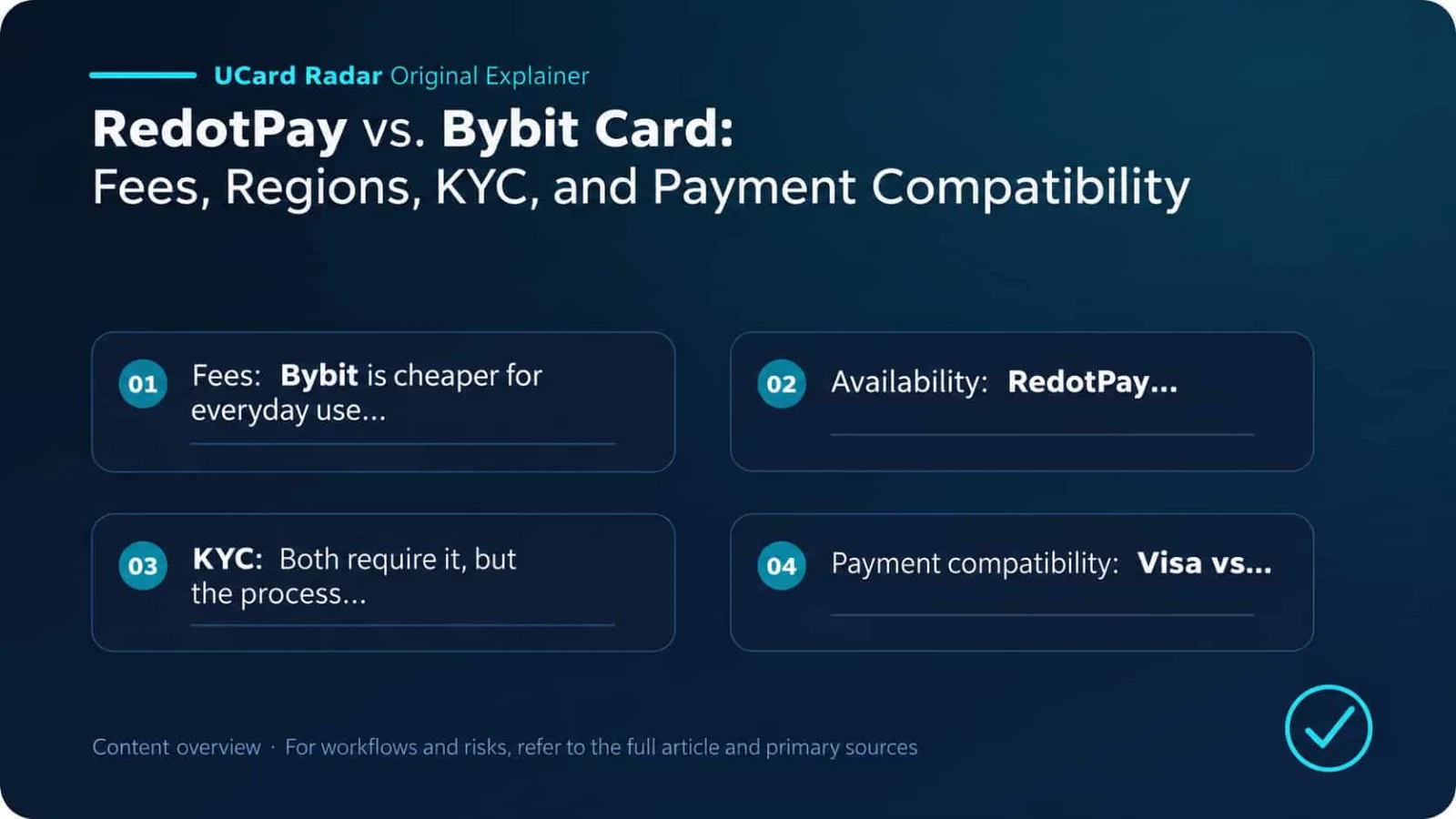
Fees: Bybit Is Generally Cheaper for Everyday Use, While RedotPay Has a Higher Entry Cost
RedotPay (Visa):
Card issuance fee: around 10 USD for a virtual card and around 100 USD for a physical card, including shipping.
Monthly/annual fee: 0.
Transaction/conversion fee: generally around 1%, plus an additional 1.2% FX fee for non-USD transactions, bringing total non-USD spending costs to roughly 2.2%.
ATM: from around 2%, plus ATM operator fees.
Funding/card top-up: around 1% depending on the funding route, with lower-cost chains such as Tron generally being cheaper.
Cashback: generally none, although some Solana versions offer limited cashback.
Bybit Card (mostly Mastercard, Visa in some regions):
Card issuance fee: virtual cards are usually free; physical cards generally cost around 5–30 USD depending on the region.
Monthly/annual fee: 0.
Conversion fee: around 0.9%, with FX fees of roughly 0.5%–2% depending on the region, generally lower in areas such as the EEA.
ATM: some regions, including parts of Europe, provide a monthly free allowance of around 100 EUR, with approximately 2% charged above that threshold.
Funding: transfers directly from a Bybit account are generally free.
Cashback: one of the main attractions. Base cashback is around 2%, with VIP levels reaching up to 10%. Higher levels generally require significant trading volume, so ordinary users are more likely to receive around 2%, subject to limits.
For small everyday purchases, particularly in the euro area or at USD-denominated merchants, Bybit is often more economical because cashback can offset part of the cost. RedotPay is better suited to larger individual transactions or users who do not care about cashback. Its high spending limits are one of its strongest features, with daily limits potentially reaching the million-dollar range. Neither card is particularly cheap for ATM withdrawals.
Regional Availability: RedotPay Has Broader Coverage
RedotPay is operated by a Hong Kong-based company and covers 100+ countries, with a strong presence across Asia-Pacific, Latin America, Europe, the Middle East, and Africa. Many users in Southeast Asia and Latin America report that it works well, although mainland United States, mainland China, Singapore, and certain other markets are explicitly unsupported.
Bybit Card primarily targets the EEA (European Economic Area), the United Kingdom, and selected markets such as Australia, Argentina, Brazil, Mexico, and certain other Latin American and Asia-Pacific jurisdictions. Applicants generally need to prove residency in an eligible jurisdiction. Global card spending is broadly supported, but account-opening eligibility is more restrictive.
If you are based in a less mainstream market in Asia or Latin America, RedotPay is generally the stronger option. If you live in the EU or are already a heavy Bybit user, Bybit Card is often more convenient.
KYC: Both Require It, but the Processes Differ
Both products require full KYC, typically involving an ID card or passport plus a selfie. Third-party providers such as Sumsub may be used, and approval can take anywhere from a few minutes to 1–3 days. RedotPay tends to feel somewhat lighter, while Bybit is more tightly linked to the exchange account and generally has clearer address-verification requirements.
Neither product offers a minimal no-KYC option. Once approved, RedotPay virtual cards can usually be issued quickly, and Bybit virtual cards are also typically available soon after approval.
From a security perspective, both operate on a custodial model, meaning funds are held within the platform ecosystem. Large balances should therefore not be left on the card account for extended periods.
Payment Compatibility: Visa vs Mastercard Makes Little Difference in Practice
RedotPay: Uses the Visa network, with acceptance at more than 130 million merchants worldwide. It works well with Apple Pay and Google Pay and is suitable for subscriptions, online shopping, travel, and ATM use with the physical card.
Bybit Card: Primarily uses Mastercard, with Visa in some regions. It is also widely accepted and supports Apple Pay and Google Pay where available. Its deeper integration with the Bybit ecosystem allows users to spend directly from their exchange account and may include additional benefits such as cashback on subscriptions.
Both cards generally perform well at POS terminals, online merchants, and overseas merchants. Some merchants may reject crypto-linked cards, particularly in higher-risk industries, but this is a broader industry issue. Based on user feedback, RedotPay tends to perform slightly better across Asia-Pacific merchants, while Bybit is generally more stable in Europe.
Which One Is Better for You?
Choose RedotPay if you want fast onboarding, live outside the EU, need higher limits, or primarily use the card in Asia-Pacific markets. Its virtual card is relatively inexpensive, coverage is broad, and it works well as an entry-level or backup card. The main disadvantages are weaker cashback and somewhat higher fees.
Choose Bybit Card if you already use Bybit, live in a supported market, and value cashback and lower everyday costs. Free virtual issuance plus potential cashback makes it attractive, although geographic restrictions are a major limitation.
Use both if you are a heavy user. Some users keep RedotPay for higher-value or backup payments and use Bybit Card for everyday spending and cashback.