
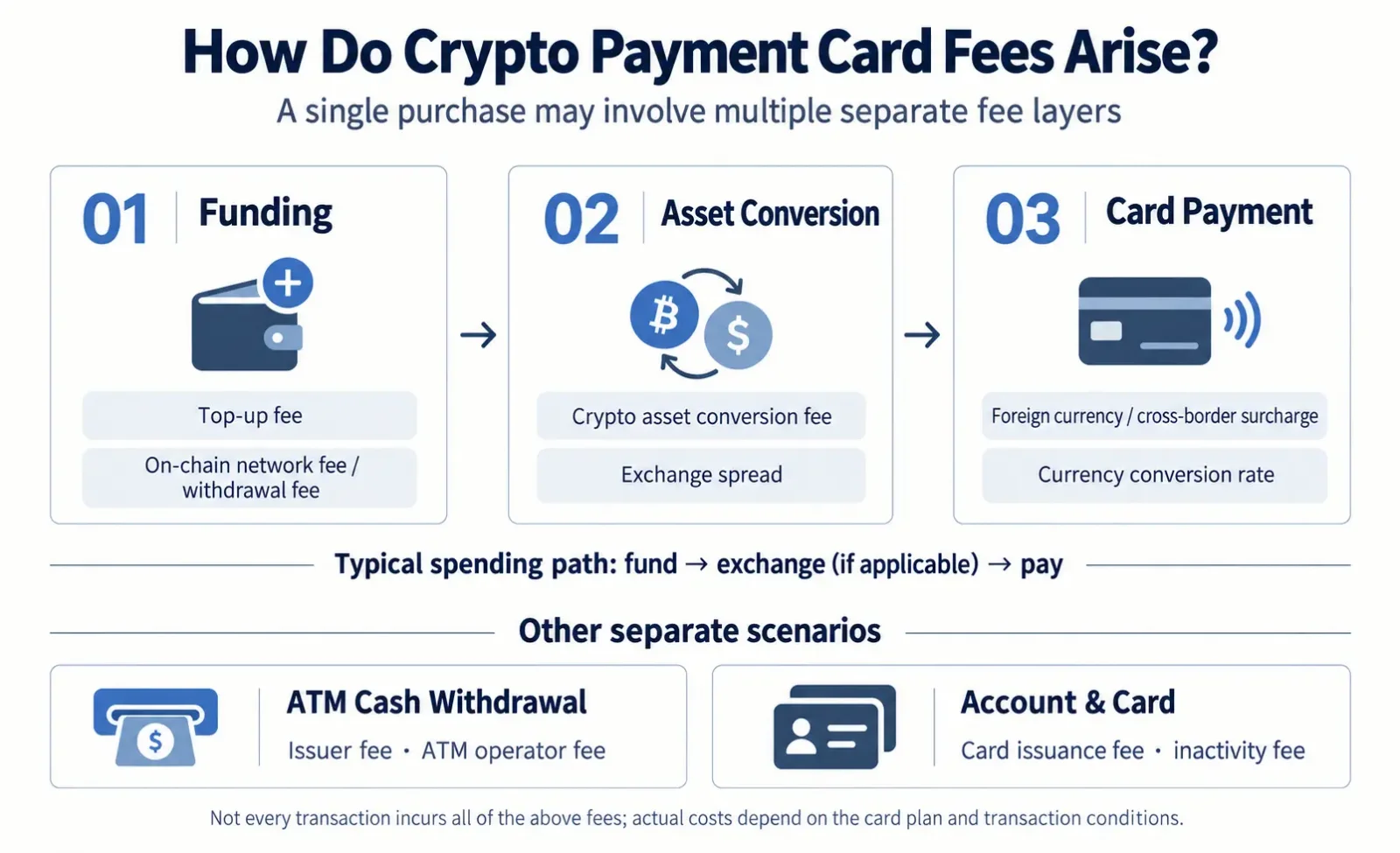
Crypto card costs do not arise only when a card is used for a purchase. Crypto conversion fees, exchange rate spreads, foreign transaction fees, top-up charges, and ATM withdrawal fees may all apply separately.
UCard Radar examined ten card plan–region combinations across Coinbase Card, Crypto.com Card, Bybit Card, Nexo Card, and RedotPay. Among the nine combinations with identifiable foreign-currency or cross-border transaction surcharges, published rates under specified conditions range from 0.2% to 7%. The differences largely reflect the issuing region, card tier, and timing of the transaction.
1. Scope of Comparison and Fee Categories
Provider | Card plans included |
|---|---|
Coinbase Card | U.S. debit card program |
Crypto.com Card | Midnight cards in the U.S., Europe, and the UK |
Bybit Card | Card programs in Australia, Brazil, Argentina, and Mexico |
Nexo Card | Card programs available in Europe and the UK |
RedotPay | USD card program |
A single brand may serve customers in different markets through different card issuers. Billing currencies, eligibility requirements, and fee schedules can therefore vary. This comparison uses specific card plans as its unit of analysis and divides costs into five categories: funding costs (top-ups, transfers, and crypto withdrawals); asset conversion costs (conversion fees and exchange rate spreads); spending and FX costs (transaction fees and foreign-currency or cross-border surcharges); ATM withdrawal costs (issuer and ATM operator fees); and account and cardholder costs (card issuance, replacement, and inactivity fees).
The funding model also determines when fees arise. A prepaid card may involve selling crypto when funds are loaded, while some debit cards convert assets at the time of purchase. Nexo Card offers both Debit Mode and Credit Mode. The former uses available asset balances for spending; the latter allows users to borrow against digital assets. Interest in the borrowing model depends on the actual loan terms and how long the borrowing remains outstanding. It cannot be represented by an ordinary card spending fee.
2. Foreign Transaction Fees: Differences by Region, Tier, and Timing
The table below shows the published foreign-currency or cross-border transaction surcharges for each card plan under specified conditions. Foreign transaction fees often depend on whether the transaction currency matches the card's billing currency. Some plans also distinguish between transaction locations. Whether a purchase abroad incurs a fee depends on the currency and geographic conditions stated in the applicable fee schedule.
Product and region | Published FX / cross-border surcharge | Main conditions |
|---|---|---|
Coinbase Card · U.S. | No separately published rate suitable for direct comparison | No separate Coinbase purchase transaction fee; selling crypto may involve a spread |
Crypto.com Midnight · U.S. | 3% | Non-USD purchases and ATM withdrawals |
Crypto.com Midnight · Europe | 0.2% / 2% | Non-EUR transactions: 0.2% within the EU and UK; 2% outside those regions |
Crypto.com Midnight · UK | 0.2% / 2% | Non-GBP transactions: 0.2% within the UK and EU; 2% outside those regions |
Bybit Card · Australia | 2% | Transaction currency differs from the card's billing currency |
Bybit Card · Brazil | 1.5% | Eligible foreign-currency transactions |
Bybit Card · Argentina | 7% | Eligible foreign-currency transactions |
Bybit Card · Mexico | 2% | Transaction currency differs from the card's billing currency |
Nexo Card · Europe / UK | 0.2%–2.5% | Varies by transaction region and weekday/weekend |
RedotPay · USD card | 1.2% | Transactions in currencies other than the card's default currency |
Sources: Official fee schedules published by each provider. Crypto.com's tiered fees for Europe and the UK took effect on October 1, 2026. Bybit's official fee schedule was updated on September 10, 2026.
Crypto.com's foreign transaction fees vary by card tier. In the U.S., Midnight, Ruby, Jade, and Indigo cards incur a 3% charge on applicable non-USD transactions. Icy, Rose, and Obsidian cards are exempt from this charge. In Europe and the UK, the following tiered rates have applied to non-local-currency transactions since October 1, 2026:
Card tier | Within the EU and UK | Outside the EU and UK |
|---|---|---|
Midnight | 0.2% | 2% |
Ruby | 0.2% | Free up to the monthly allowance; 2% above it |
Jade / Indigo | 0.2% | Free up to the monthly allowance; 2% above it |
Icy / Rose / Obsidian | 0% | 0% |
Ruby's monthly fee-free allowance for transactions outside the region is €400 in Europe and £400 in the UK. For Jade / Indigo, the corresponding allowances are €800 and £800. These allowances reset each calendar month and apply only to specified non-local-currency transactions outside the EU and UK. Non-local-currency transactions within the region remain subject to the 0.2% rate shown in the table. Transactions that cross an allowance threshold are charged according to the relevant local terms. These European and UK allowances do not apply to U.S. cards. European fee schedule | UK fee schedule
Nexo charges different rates depending on transaction location and timing. Eligible transactions within the European Economic Area, the UK, and Switzerland incur 0.2% on weekdays and 0.7% on weekends. In other regions, the corresponding rates are 2% and 2.5%. Nexo's official card information
3. Purchase Fees and Crypto Conversion Costs
When Coinbase Card is used to spend USD, USDC, or other supported assets, Coinbase does not charge a separate purchase transaction fee. However, quotes for selling crypto may include an exchange rate spread. Spending an existing USD balance and selling BTC to fund a purchase have different cost structures. For USDC, the conditions under which conversion at par is available must also be checked against the product rules. Selling assets may have tax implications as well. The absence of a transaction fee does not establish that payments funded from every asset type are cost-free. Coinbase's official fee information
A conversion fee is an explicitly stated percentage or fixed charge imposed by the platform. An exchange rate spread is the difference between the execution quote and a reference price; it may not appear as a separate fee. Both can apply to the same transaction. To calculate the cost of a crypto-funded purchase, users should examine not only the recorded fees but also how much crypto was actually sold and the fiat amount received at the time. If the spread cannot be quantified, it should be labeled "not quantified" rather than recorded as zero.
Bybit lists crypto conversion fees for purchases funded with non-fiat assets: 0.9% in Australia, Brazil, and Mexico, and 0.5% in Argentina. The calculation is based on the platform's One-Click Sell Exchange Rate. RedotPay charges a 1% crypto conversion fee and a separate 1.2% fee for transactions outside the card's default currency. Both charges may apply when a transaction meets the conditions for asset conversion and foreign-currency fees. Where sufficient fiat funds are already available on the card, the same crypto conversion process is generally unnecessary. Bybit fee schedule | RedotPay fee information
4. Top-Up Methods and Funding Costs
Top-up fees for Crypto.com's U.S. prepaid cards vary by funding method:
Top-up method | Published rate | Nominal fees on cumulative top-ups of $500 |
|---|---|---|
Debit card | 1% | $5 |
Credit card | 2.99% | $14.95 |
PayPal | 2.1% | $10.50 |
The combined daily debit and credit card top-up limit for the U.S. Midnight card is $250. The $500 figure in the table is used solely to illustrate cumulative fees. The amount would need to be loaded through multiple transactions on separate days, subject to the daily limit. PayPal top-up limits are calculated separately. The figures represent only the platform's stated charges and exclude any additional fees imposed by banks or third-party payment providers. In Europe and the UK, the debit and credit card top-up rate for prepaid cards is 1%. U.S. fee schedule | Europe and UK top-up information
Funding an account with assets such as USDT or USDC may incur network fees for on-chain wallet transfers. Withdrawals from an exchange may also carry withdrawal fees. These charges are distinct from an issuer's top-up fee. Converting crypto to fiat before funding the card may introduce an additional conversion fee or spread. Funding costs often arise before a purchase is made and cannot be assessed from the card's purchase statement alone. If one transfer funds multiple purchases, the on-chain fee is a shared cost of that pool of funds; the full network fee should not be counted again for each purchase.
5. FX Padding: Authorization Holds Versus Final Charges
Bybit's FX Padding rates are 5% in Argentina, 1% in Brazil, 0% in Australia, and 0% in Mexico. FX padding is a temporary amount reserved during authorization of a foreign-currency transaction to account for possible exchange rate movements before final settlement. It is not a final fee. Bybit's official fee information
The authorized amount may exceed the final settlement amount. Once the transaction has been processed, any reserved funds above the actual charge are released back into the available balance. This temporary hold can leave insufficient funds for a subsequent payment, but the held amount must not be added to foreign transaction or crypto conversion fees when calculating actual costs. If a merchant delays settlement, reverses a transaction, or issues a refund, the final transaction record should determine whether a charge was actually incurred.
6. ATM Withdrawals: Fee-Free Allowances and Excess Charges
Card plan | Issuer ATM withdrawal fee |
|---|---|
Coinbase Card · U.S. | Coinbase does not charge a withdrawal fee |
Crypto.com Midnight · U.S. | First $200 per month free; 2% on the excess |
Crypto.com Midnight · Europe | First €200 per month free; 2% on the excess |
Crypto.com Midnight · UK | First £180 per month free; 2% on the excess |
Bybit Card · Australia | First $100 per month free; 2% on the excess |
Nexo Card · Base | First €200 / £180 per month free; 2% on the excess, subject to a minimum of €1.99 / £1.99 per withdrawal |
RedotPay · USD card | 2% on the first $10,000 in cumulative monthly withdrawals; 3% on the amount above that threshold |
"Free" in this table refers only to the issuer's specified ATM withdrawal fee, not to the total cost of withdrawing cash. Nexo's monthly fee-free allowances for Silver, Gold, and Platinum are €400, €1,000, and €2,000, respectively; the corresponding UK allowances are £360, £900, and £1,800. Crypto.com also sets different limits according to card tier. RedotPay's HKD card has different rules from the USD card shown here. For the USD card, the 2% charge applies even below the threshold, so this is not a fee-free allowance followed by an excess charge.
ATM operator surcharges are separate from issuer withdrawal fees and may be disclosed at the terminal. Currency conversion can introduce foreign transaction fees or DCC-related costs as well. Sources: Coinbase, Nexo, and RedotPay.
7. Card Issuance, Inactivity, and Eligibility Requirements
Card plan | Issuance fee or eligibility requirements |
|---|---|
RedotPay virtual / physical card | $10 / $100 |
Crypto.com Midnight · U.S. | Physical card: $4.99 |
Crypto.com Midnight · Europe | Physical card: €4.99 |
Bybit · Australia | Virtual card issuance fee temporarily waived; standard physical card: $29.99, with waivers for eligible VIP users |
Bybit · Brazil | No issuance fee for virtual or physical cards |
Nexo Card | Virtual card free; activation requires an account balance of at least $50. Physical card and delivery free; applicants must reach Gold tier and hold a digital asset portfolio balance exceeding $5,000 |
Nexo's asset requirements are eligibility thresholds, not card issuance fees. The $50 account balance remains available for use, and the higher portfolio balance required for a physical card does not mean the issuer charges $5,000. The card has no monthly, annual, or inactivity fees. RedotPay's issuance fee, by contrast, is actually deducted when the card is issued, creating a separate one-time cost for infrequent users. Sources: RedotPay, Bybit, Nexo, and Crypto.com's regional fee schedules.
The Crypto.com Midnight inactivity fee is charged monthly under the applicable terms after 12 consecutive months without qualifying cardholder-initiated financial activity. In the U.S., it has been $5.95 per month since September 1, 2026. In Europe and the UK, monthly charges of €6 and £6, respectively, took effect on October 1, 2026. Qualifying financial activity initiated by the cardholder resets the inactivity period. Declined or refunded transactions do not count as qualifying activity. The fee applies only in months after the triggering conditions are met; it should not be treated as an unavoidable annual fee before those conditions arise. U.S. | Europe | UK
8. Card Network Exchange Rates and DCC
Cross-currency spending may involve three distinct prices: the quote for selling crypto, the currency conversion rate applied by the card network or settlement provider, and the issuer's foreign transaction surcharge. The network exchange rate and issuer surcharge arise at separate stages. A published foreign transaction fee alone therefore cannot establish the actual exchange rate received. Mastercard's Currency Converter provides reference rates, but issuers may apply different rates or additional fees. The actual conversion outcome also depends on authorization timing.
Dynamic currency conversion (DCC) is an alternative payment option offered by a merchant or ATM. Cardholders can pay in the local currency and have the conversion handled through the card's normal settlement process. Alternatively, they can accept a quote in their home or card currency, with the merchant's service provider performing the conversion. Under Visa's DCC guidance, the terminal should display both currency amounts, the exchange rate, and any markup or additional fee, and allow the cardholder to choose. Accepting DCC may change both the conversion process and the final cost. Declining DCC generally leaves the conversion to the card's normal settlement process, although issuer surcharges may still apply. When accepting DCC, cardholders should examine the actual rate quoted by the merchant or ATM provider. Even if the card issuer waives foreign transaction fees, DCC is not necessarily cheaper.
Sources
Information verified through October 30, 2026.