
KAST and RedotPay both let users spend crypto assets on everyday purchases through virtual cards, physical cards, and mobile wallets. Their approaches to managing funds, charging fees, and positioning their products, however, differ considerably.
KAST focuses on connecting stablecoin accounts with everyday payments. Users can deposit supported stablecoins such as USDT and USDC, receive a USD-denominated spending balance, and pay with a Visa card. Its free Standard membership offers cashback on eligible purchases, while the platform also provides services such as receiving and transferring funds.
RedotPay operates more like a multi-asset crypto spending account. Users can hold different cryptocurrencies, which the platform converts when a card transaction occurs according to the user's payment settings and the applicable conversion rules. Regular cards have no monthly or annual fee, but card issuance, crypto conversion, and certain transactions carry charges.
For users who primarily hold USDT or USDC, KAST's fee structure for stablecoin deposits and USD purchases offers some advantages. RedotPay is an alternative for those who want to spend a wider range of assets, including BTC and ETH, directly.
Fees are only part of the decision. Eligibility by country, physical card delivery, issuing programs, asset custody arrangements, and payment restrictions also affect how these products work in practice.
This article compares the providers' personal card products using their official materials. KAST Standard and the regular RedotPay card serve as the baseline; paid memberships and specific issuing programs are addressed separately where relevant.
Key Differences Between KAST and RedotPay
Comparison | KAST | RedotPay |
|---|---|---|
Product positioning | Stablecoin-based global account and card payment service | Multi-asset crypto account and payment card service |
Main funding sources | Stablecoins such as USDT and USDC, plus other crypto assets and eligible bank transfers | Multiple crypto assets, including USDT, USDC, BTC, and ETH |
How spending is funded | Supported stablecoin deposits create a USD-denominated balance; some card programs use separate collateral arrangements | Converts the relevant crypto asset at the time of a transaction, according to payment settings |
Virtual card | Available | Available |
Physical card | Available | Available |
Basic membership annual fee | Standard is free | No annual fee for regular cards |
Account inactivity fee | General terms provide for a $1-equivalent monthly fee after 12 consecutive months without transaction activity | No regular monthly or annual card fee |
Virtual card cost | Standard includes a card allowance; an issuance fee may still apply in some regions | Standard issuance fee of $10; a one-time waiver is available with monthly Pro membership |
Physical card cost | The Standard physical card itself is free; delivery costs $40 | Standard issuance fee of $100; a one-time waiver is available with annual Pro membership |
USD card purchases | Published transaction fee: 0% | Ordinary purchases generally incur a transaction charge of approximately 1% |
Foreign-currency purchases | FX fee of 0.5%–1.75% on non-USD purchases | Transactions in a currency other than the card's denomination incur a 1.2% currency conversion fee |
Card denomination | USD | All new cards have been issued in USD since January 21, 2026; previously issued HKD cards have separate rules |
Cashback for regular users | Standard offers 1.5% cashback on eligible spending, subject to a monthly cap | No universal ongoing cashback commitment for regular cards; Pro has a separate rewards program |
Apple Pay / Google Wallet | Supported for regionally eligible cards | Supported for eligible cards |
ATM withdrawals | Available with physical cards, subject to fees and withdrawal limits | Available with physical cards, with fees varying by card type |
KYC | Identity verification required | Identity verification required |
The table uses the providers' published standard fees. It excludes temporary promotions, special regional arrangements, and charges imposed by third-party merchants.
KAST's card issuance fees can vary by region, and certain cardholder agreements disclose charges that differ from Standard membership pricing. RedotPay now denominates all newly issued cards in USD; the rules for earlier HKD cards are relevant mainly to existing cardholders. Actual costs depend on the applicable issuing program and transaction terms.
How Funds Are Managed: KAST Creates a Spending Balance First; RedotPay Converts Assets at Checkout
The central distinction is how each product turns crypto assets into funds that can be spent through a payment card.
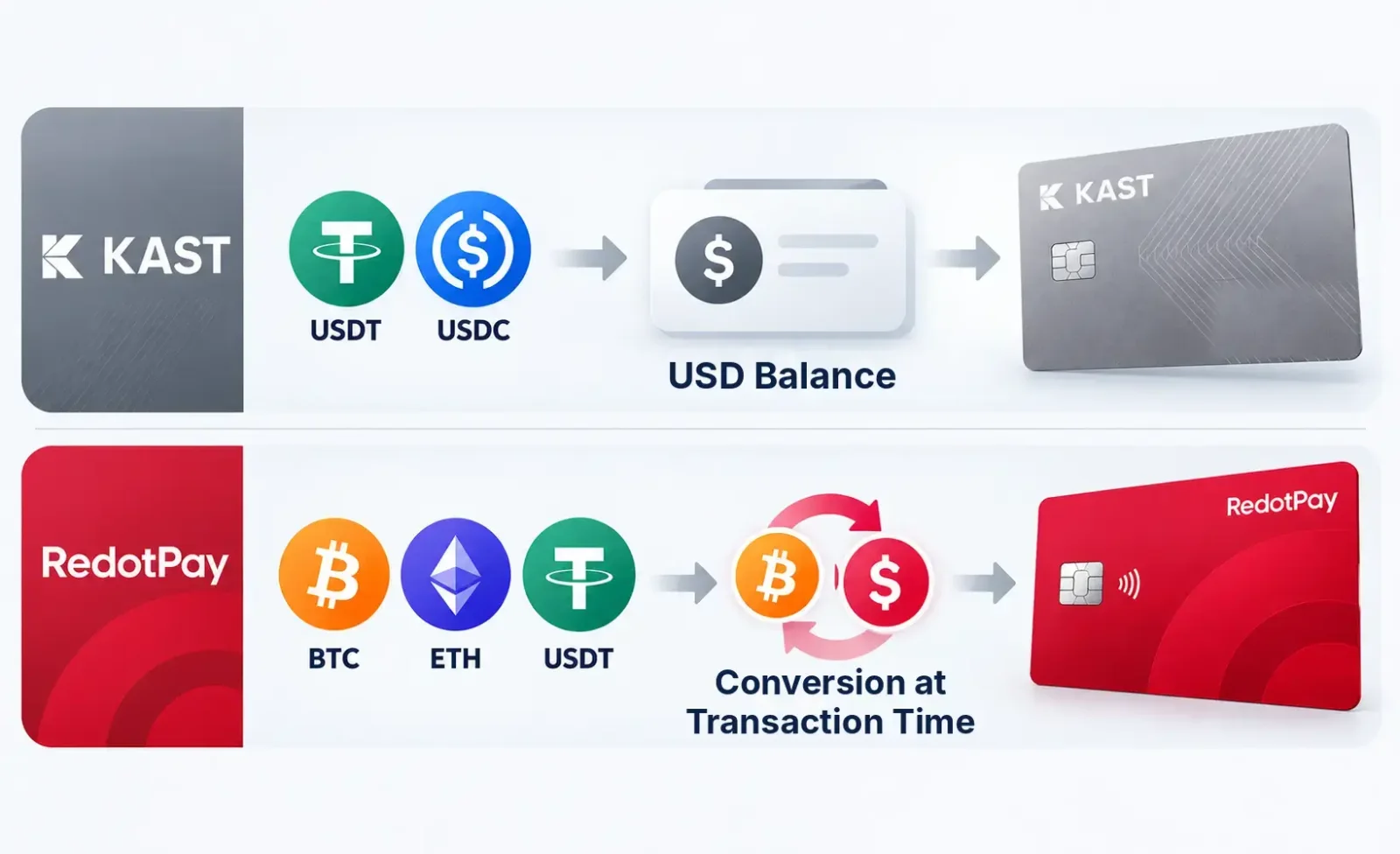
KAST: Stablecoin Deposits Become a USD-Denominated Balance
KAST allows users to deposit stablecoins such as USDT and USDC over designated blockchain networks.
According to KAST's official fees and conditions, updated October 22, 2026, the platform charges a 0% deposit fee on supported stablecoins and converts them into a USD-denominated balance at a 1:1 ratio, with no spread on that conversion. Users remain responsible for fees charged by the sending wallet or blockchain network.
For example, if a user transfers 1,000 USDC to KAST and the token, deposit network, and account all meet the product's requirements, the published standard arrangement credits the balance at a 1:1 USD ratio.
When the user subsequently pays for a USD-denominated purchase with a KAST card, the official fee schedule lists both USD card spending and ordinary transaction fees at 0%.
This is a relatively straightforward arrangement for people who mainly hold USD stablecoins and regularly make purchases settled in dollars.
A USD balance displayed by KAST is not, however, a conventional bank deposit. Different card programs can also operate under different legal arrangements for the underlying assets.
Under the platform's general Terms and Conditions of Service, effective July 7, 2026, transferring virtual assets to KAST constitutes a sale of those assets to KAST under the contractual structure. Once ownership transfers, KAST owes the user a USD-denominated payment obligation. The account records represent a contractual claim against KAST—not a bank deposit or fiat money held in the user's own name. The user retains contractual rights to request redemption or withdrawal of the unused amount.
KAST's US-specific Cardholder Agreement, however, separately establishes a digital-asset collateral mechanism.
Under that agreement, cardholders covered by the program may use digital assets as collateral for card spending. The agreement states that ownership of the pledged assets remains with the cardholder and that the assets are held through smart contracts on supported blockchains. If a contractually defined liquidation event occurs, KAST may liquidate the corresponding collateral to satisfy card payment obligations. Triggers include specified transaction settlement arrangements, failure to make a payment when due, and insufficient market value of the collateral.
The US agreement page gives July 13, 2026, as the effective date of the product terms. The contractual parties include the cardholder and the relevant issuing institution, with the arrangement also governed by KAST service terms accepted separately by the user.
The asset-sale mechanism in the general service terms therefore should not be treated as the sole funding structure for every KAST card program. Equally, the US-specific agreement does not establish that all US users operate under a digital-asset collateral model.
These documents describe arrangements at different contractual levels. Determining which applies requires examining the card program actually approved for the user, the relevant service entities, and the agreements signed.
Under either structure, a USD amount shown by KAST should not be equated with the protections of a traditional bank deposit. The general terms state that KAST is not a bank and that its accounts do not benefit from conventional deposit insurance protections. Collateral-based arrangements additionally expose users to asset price movements, liquidation conditions, and smart contract execution risks.
RedotPay: Spending Directly From Multiple Crypto Assets
RedotPay's official product information lists support for multiple crypto assets, including BTC, ETH, BNB, SOL, USDT, and USDC.
Users can hold these assets in their accounts and select which currency to spend through their payment settings.
According to RedotPay's services and features documentation, the platform converts the relevant crypto assets into the currency needed for payment when a card transaction occurs. Cardholders do not have to sell their holdings manually in advance.
Users can also prioritize payment assets and disable currencies they do not want to use for card purchases. Someone holding BTC, ETH, and USDT, for example, can adjust which asset is spent first, within the supported asset list and applicable payment rules.
This removes some manual conversion and transfer steps, making it particularly useful for people who want to pay everyday expenses directly from several types of crypto assets.
The trade-off is that cardholders remain exposed to market price movements in their assets until payment takes place.
When paying with BTC, the amount of BTC deducted depends on the exchange rate at the time of the transaction. Even with USDT or USDC, the stablecoin conversion price, transaction charges, and liquidity conditions still matter.
In its explanation of cryptocurrency exchange rates, RedotPay says its crypto-to-USD prices for card transactions are based on a weighted average of prices from five major global cryptocurrency exchanges.
For users primarily funding purchases with stablecoins, the key difference in cost and risk is that KAST establishes a USD-denominated balance beforehand, while RedotPay converts the asset at the time of purchase.
Card Issuance Costs: A Lower Entry Cost With KAST, One-Time Fees With RedotPay
Both providers offer virtual and physical cards, but the cost of obtaining them differs.
KAST Standard: Free Membership With an Included Card Allowance
KAST currently offers three membership tiers: Standard, Premium, and Private.
Standard has no annual fee and includes an allowance of two Standard cards. The official fee document also states that in some regions, an issuance charge of $2 per virtual card may apply even when the card falls within the free allowance.
The Standard physical card itself costs $0, with a $40 delivery fee.
In other words, free Standard membership does not mean every type of card can be obtained without charge in every region.
KAST's paid memberships are substantially more expensive:
Premium: $1,000 per year.
Private: $10,000 per year.
Paid tiers offer higher cashback limits, additional points, and other services, but higher reward rates do not necessarily offset the membership cost.
For typical consumers, Standard is the more appropriate basis for comparison.
Importantly, a $0 Standard membership fee does not mean an account can remain inactive indefinitely without charge.
KAST's general service terms, effective July 7, 2026, provide that an account with no transaction activity for 12 consecutive months is treated as dormant and charged an inactivity fee of $1 per month, deducted from the available balance in the platform's primary virtual asset. If there is no available balance, this fee does not create a negative balance.
This is a dormant-account charge, not a Standard membership fee or a card management charge during ordinary use. It remains relevant to users who may leave a card unused for an extended period.
RedotPay: $10 for a Virtual Card, $100 for a Physical Card
RedotPay's card issuance fee guidance, updated July 27, 2026, lists the following charges:
Card type | Standard issuance fee |
|---|---|
Virtual card | $10 |
Physical card | $100 |
Regular RedotPay cards carry no routine card management, monthly, or annual fee. Users primarily pay a one-time issuance fee and transaction-related costs incurred later.
RedotPay Pro members can, however, receive a one-time waiver of certain issuance fees.
According to the official Pro membership guide, published September 4, 2026:
**Monthly Pro membership ($12.90/month):** Includes a one-time virtual card application fee waiver worth $10.
**Annual Pro membership ($129/year):** Includes a one-time physical card application fee waiver worth $100.
The physical card waiver applies only to annual members; monthly members cannot use this benefit to obtain a physical card for free. RedotPay also states that the physical card waiver voucher granted to annual members does not expire.
These are paid membership benefits, not a universal issuance policy for regular cards, and they are distinct from temporary promotions.
If someone only wants a virtual card, paying the $10 issuance fee directly costs less than buying a $12.90 monthly Pro subscription solely to waive that fee. Likewise, the value of annual Pro membership depends on cashback, ATM fee waivers, and other benefits. A $100 physical card fee waiver alone does not make upgrading the better deal.
RedotPay also runs promotions from time to time, some of which waive card issuance fees subject to deadlines, redemption rules, and usage conditions.
On published standard costs for obtaining a regular card for the first time, KAST Standard has the advantage for eligible users who can use its included card allowance. RedotPay has more explicit standalone issuance fees, while Pro membership provides another route to obtaining a card.
Everyday Spending Fees: The Difference Is More Noticeable on USD Transactions
Card issuance is a one-time expense. For long-term cardholders, transaction fees, crypto conversion costs, and foreign-currency charges usually matter more.
KAST: No Transaction Fee on USD Purchases, but FX Charges on Other Currencies
KAST's official fee schedule lists:
Transaction type | KAST standard fee |
|---|---|
Deposits of supported stablecoins | 0% |
USD card purchases | 0% |
General card transaction fee | 0% |
FX fee on non-USD card purchases | 0.5%–1.75% |
Non-USD purchases below $25 | Additional $0.10 |
Declined transaction due to insufficient funds | $0.50 |
The specific FX rate on non-USD transactions depends on factors including the user's country of residence, the location of the transaction, and the card program.
For example, a $100 purchase settled in USD incurs no standard transaction fee under KAST's published schedule, assuming no other special charges are triggered.
If a purchase of equivalent value is settled in euros, pounds sterling, or another currency, the applicable FX fee must be considered. For transactions below $25, an additional small-transaction fee may also apply.
For users who frequently pay for SaaS subscriptions, software services, or USD-denominated products, KAST's published USD spending fees are attractive.
A distinction is still needed between card transaction fees and exchange rates offered by merchants.
If an overseas merchant uses dynamic currency conversion (DCC) to convert a local-currency price into USD, its exchange rate may include an additional cost. Even when KAST charges no FX fee on USD purchases, choosing USD at checkout may not produce the lowest total cost.
These are KAST's published standard fees. Specific cardholder agreements may disclose different charges. For example, the US-specific agreement lists a card annual fee of up to $20 and separate terms for foreign-currency transactions. Those charges should not automatically be treated as Standard membership fees, but neither should their effect on the cost of the relevant card program be ignored.
RedotPay: Crypto Conversion and Card Transaction Charges Drive Costs
Spending with a regular RedotPay card involves costs associated with crypto conversion and card transactions. Unlike withdrawing cash from an ATM, an ordinary retail purchase does not incur an ATM withdrawal fee, although conversion costs may still apply.
RedotPay's official explanation of refund amounts, published July 27, 2026, states that paying with a RedotPay card generally involves a transaction fee of approximately 1% in addition to the merchant's purchase price.
Its ATM and related transaction fee guidance also lists the following:
Fee category | Published rate or rule |
|---|---|
Regular card purchase transaction charge | Approximately 1% according to the official explanation; the actual amount depends on the applicable transaction conditions |
Crypto asset conversion | 1%, as described in the official ATM and related fees guidance |
Transaction in a currency different from the card's denomination | 1.2% |
Transaction in the card's denomination | No charge under this particular currency conversion category |
Crypto conversion or transaction costs must be distinguished from the foreign-exchange charge associated with a transaction currency that differs from the card's denomination.
For example, a user holding USDT who pays for a USD-denominated product with a USD card may still incur an ordinary card transaction charge, even though no conversion between different card-denomination currencies is required.
A USD card used for a euro-denominated purchase may also incur the 1.2% card currency conversion fee. Crypto conversion and card currency conversion occur at different stages and may both affect the same payment. But it would be incorrect to mechanically add every published percentage without first confirming which charges actually apply.
Since January 21, 2026, RedotPay has issued all new cards in USD. New applicants therefore mainly need to assess the costs of cross-currency transactions on USD-denominated cards. Previously issued HKD cards remain subject to conversion rules based on their own denomination.
RedotPay also applies separate charges to certain merchants.
According to its special merchant fee guidance, updated September 3, 2026, transactions with certain designated merchants incur an additional 1.5% fee, with a minimum of $0.50 per transaction. However, the first three qualifying transactions per card in each calendar month are exempt from this charge.
The published list includes certain merchants associated with gaming, digital services, and advertising. Both the list and the dates when charges apply may change.
Users who frequently pay for digital services or advertising should check whether their regular merchants appear on the fee list. Even when the transaction currency matches the card denomination, the final amount deducted may vary by merchant.
How Different Could the Cost Be for the Same Purchase?
Assume a user already holds sufficient USDC, has both cards active, and makes a $100 purchase charged by the merchant in USD.
For this example, we exclude issuance fees, promotions, wallet and network charges, market price changes, and additional special-merchant fees. The comparison covers standard spending costs only.
KAST Standard
Under the published rules, deposits of supported stablecoins carry a 0% platform fee, and USD card purchases also incur a 0% transaction fee.
If the $100 purchase qualifies for cashback, Standard may return $1.50 at a 1.5% rate. This remains subject to the monthly eligible spending cap and other rewards conditions.
Regular RedotPay card
RedotPay explicitly states that card purchases generally incur a transaction charge of about 1% in addition to the merchant's price.
Using that published statement as an estimate, if a $100 purchase funded with USDC is subject to an approximately 1% transaction charge, the fee would be about $1. Because a USD card is paying for a USD-denominated item, the 1.2% foreign-currency conversion fee for transactions in a different card denomination does not apply.
This is an illustrative estimate based on published rates, not a guarantee that every USDC purchase incurs a fixed $1 charge. The actual amount of USDC spent also depends on the applicable fee rules, conversion price, and final settlement amount.
The example does not include extra fees for designated merchants, and it does not assume that the user subscribes to RedotPay Pro.
Under these assumptions, KAST Standard has the lower cost for USD purchases funded with stablecoins. The result may differ if a transaction involves other crypto assets, currency conversion, or special merchant charges.
KAST's 1.5% cashback should also not be treated as an automatic discount on every transaction. It applies only to purchases that meet the rewards criteria.
Foreign-Currency Purchases Need a Separate Comparison
When someone uses a USD-denominated card to pay in a local currency in Europe, Asia, or Latin America, either card may incur currency conversion costs.
KAST lists an FX fee of 0.5%–1.75% for non-USD spending. RedotPay specifies a 1.2% currency conversion fee for transactions in a currency different from the card's denomination, and ordinary card transaction charges may apply separately.
Because RedotPay now issues all new cards in USD, new users should not treat HKD cards as another freely available new-card option. Existing HKD cardholders must calculate fees using their card's original denomination.
For users who mainly hold stablecoins and frequently make non-USD purchases, comparing FX percentages alone can significantly understate the true cost.
A more useful calculation brings together the purchase amount, the merchant's settlement currency, the card denomination, the crypto conversion price, FX fees, and any special merchant charges. The result should then be checked against the actual quantity of assets deducted or their USD equivalent.
That is the appropriate basis for comparing the cards in a specific spending scenario.
Cashback: KAST's Basic Membership and RedotPay Pro Use Different Reward Models
KAST includes spending cashback among its basic membership benefits.
According to KAST's official membership and fee information, the standard USD cashback rates by tier are:
KAST tier | Standard USD cashback | Monthly eligible spending cap | Annual fee |
|---|---|---|---|
Standard | 1.5% | $2,000 | $0 |
Premium | 2% | $10,000 | $1,000 |
Private | 3% | $40,000 | $10,000 |
With Standard, up to $2,000 in eligible spending each month can earn the basic 1.5% cashback rate. If all of that spending qualifies, the maximum is $30 per month.
Premium and Private members may also earn KAST Points. These points are not equivalent to USD cash: they have separate redemption terms, and their monetary value cannot be inferred directly from the number awarded.
Whether a paid upgrade is worthwhile largely depends on spending volume and whether the additional cashback covers the membership fee.
Assume a user makes $6,000 in eligible purchases every month throughout the year:
Standard earns at most $30 per month, or $360 for the year.
Premium earns $120 per month at 2%, or $1,440 for the year.
Premium produces $1,080 more in basic cashback than Standard, but costs $1,000 annually.
In this idealized scenario, Premium's additional basic cashback exceeds its annual fee by just $80, before considering other membership benefits, points, or differences in transaction costs.
If eligible spending declines, upgrading becomes less economically attractive.
RedotPay's membership rewards work differently.
Its official Pro program guide specifies:
Monthly membership: $12.90.
Annual membership: $129.
Eligible purchases through Apple Pay and Google Pay earn 3% cashback.
Monthly cashback is capped at 18 USDs.
USDs are RedotPay's spending reward units. They can only be used for subsequent eligible card purchases, cannot be withdrawn or transferred directly, and expire 30 days after being issued.
They are therefore not fully equivalent to KAST's USD cashback.
For example, a RedotPay Pro member who spends $600 in a month through qualifying mobile wallet transactions can earn 18 USDs at a 3% rate.
After deducting the $12.90 monthly membership fee, and assuming the rewards can all be used before they expire, the theoretical difference between the reward's face value and the subscription cost is $5.10 in equivalent value.
That calculation does not deduct crypto conversion costs on the underlying purchases or include any other fees.
If the user cannot fully redeem the rewards, or most everyday purchases are made outside Apple Pay or Google Pay, Pro's practical value falls.
KAST Standard provides basic cashback on qualifying purchases without requiring a paid membership. RedotPay Pro requires a subscription and spending through specified payment channels to benefit from its rewards program.
Comparing the headline rates of 1.5% and 3% is not enough. The meaningful figure is what the user can actually retain after membership fees and transaction costs.
Application Eligibility: International Card Acceptance Does Not Mean Local Residents Can Apply
Before choosing a crypto payment card, international users need to establish whether they are eligible to obtain one.
KAST's website advertises that its cards can be used at Visa-accepting merchants in more than 170 countries and regions.
Those 170-plus markets describe where cards may be accepted for payment, not where every resident is eligible to apply for a card.
KAST's service terms make account eligibility dependent on country of residence, identity verification, sanctions requirements, and local law. Users must select their country of residence during KYC and confirm which products are available under the permissions shown in their account.
Card issuance, bank account services, and mobile wallet availability may also differ across countries.
RedotPay publishes a more explicit list of issuance restrictions.
According to its card issuance restrictions, updated August 28, 2026, residents of the United States, mainland China, Singapore, India, Indonesia, and certain other jurisdictions are currently ineligible for its virtual and physical cards.
The list also covers certain European and other jurisdictions affected by sanctions, issuing rules, or service restrictions.
Residents of the United States
KAST has a US-specific cardholder agreement and identity verification and product arrangements related to the US market.
However, eligibility to open a platform account, eligibility for a Standard card, and admission to a specific US issuing program are separate matters.
KAST's US Cardholder Agreement sets out distinct provisions for card accounts, digital-asset collateral, and fees. Its card account opening disclosures include an annual fee of up to $20. This is a contractual disclosure for a specific card program and should not be conflated with free KAST Standard membership.
The fact that a US resident can complete platform identity verification, or that a US-specific cardholder agreement exists, does not mean every verified US resident can obtain the current Standard card. Nor does it guarantee access to particular bank account, transfer, or mobile wallet functions.
Card eligibility depends on the issuing programs actually available, the applicant's residence and identity qualifications, and the issuing institution's approval.
RedotPay's position is more definite: as of this article's verification date, the United States remains on its card issuance restriction list. US residents are therefore ineligible for ordinary virtual and physical card issuance.
The providers' published application policies differ for US residents, but this does not establish that KAST Standard is open to all US residents.
Residents of Singapore and Indonesia
RedotPay's current issuance restriction list includes both Singapore and Indonesia.
Acceptance of international payment cards by local merchants does not make residents of those countries eligible for a RedotPay card.
For KAST, applicants must verify during registration and identity checks whether their place of residence is accepted and whether the relevant card program is open for applications.
Residents of the United Kingdom and Europe
Europe should not be treated as a single, uniform application market for crypto payment cards.
RedotPay's issuance restriction list includes Croatia, Slovenia, Serbia, and other countries, but does not prohibit applications across the entire European Economic Area as a single category.
KAST may likewise apply different conditions based on country, issuing institution, or payment feature.
Users in the United Kingdom, Germany, France, the Netherlands, and elsewhere should check the current rules for their specific country rather than assuming that a general statement such as "available in Europe" establishes eligibility.
For international users who intend to rely on a crypto payment card long term, residence, issuing-program availability, and acceptable identity documents should be checked before comparing fees.
A low fee or attractive cashback rate has no practical value if the person cannot obtain the card.
Physical Card Shipping and Card Issuance Eligibility Are Separate Rules
There is another distinction in RedotPay's country restrictions that users may overlook.
Its physical card delivery restrictions are not the same as its list of jurisdictions where card issuance is restricted.
For example, Egypt appears on RedotPay's current list of destinations where physical card delivery is prohibited, but not on the card issuance prohibition list mentioned above.
Therefore, RedotPay's inability to ship physical cards to Egypt does not necessarily mean residents of Egypt cannot apply for virtual cards.
Conversely, the absence of a country from the physical card delivery restriction list does not guarantee that its residents will receive approval for card issuance.
Obtaining a physical card requires meeting identity eligibility rules, issuing requirements, and shipping conditions.
KAST also distinguishes applying for a card from shipping a physical card. Its official materials describe virtual card creation and physical card ordering, while delivery eligibility must be confirmed based on the account region, card type, and order page.
For software subscriptions, international e-commerce, or mobile wallet payments, a virtual card may be sufficient. For frequent ATM withdrawals, chip-card transactions, or other situations requiring a physical card, shipping coverage and activation conditions become essential.
KYC Requirements: Both Require Identity Verification, With Different Review Structures
Both KAST and RedotPay require users to verify their identities.
KAST's identity verification guidance divides verification into different levels.
Basic registration allows users to access the app and view some features. Core financial services, however, including card use and sending or receiving payments, generally require Level 2 identity verification. This includes an identity document, residential address, and facial verification.
Applying for certain USD or EUR account services, or using features such as global transfers, may require a higher level of review, including proof of address or source-of-funds documentation.
Under RedotPay's identity verification requirements, applicants must provide personal information, valid identity documents, and facial verification. Additional evidence, such as source-of-funds documentation, may be required.
RedotPay requires applicants to be at least 18 years old and permits only one verified account per person.
Both platforms may request supplementary materials during review. An estimated processing time displayed in an automated KYC workflow is not a guaranteed approval time.
KAST's tiered verification system places greater emphasis on differentiating access to account features. RedotPay conducts identity checks centered on use of the crypto account and payment card. Neither is a crypto payment card intended for long-term anonymous use.
Apple Pay, Google Wallet, and Online Subscriptions: Both Cards Support Them, Subject to Regional and Merchant Restrictions
Both KAST and RedotPay offer mobile wallet functionality.
KAST's official usage guidance lists Apple Pay, Google Pay, online shopping, subscription services, in-store POS purchases, and ATMs as major use cases. Actual availability still depends on the region and card program.
For example, KAST's Apple Pay availability guidance, updated September 2026, states that the ability to add a card to Apple Wallet depends on the country of residence verified with KAST, not merely the user's current physical location or the region selected for their Apple account.
RedotPay also provides instructions for Apple Pay and Google Pay. Eligible virtual cards can be linked to supported third-party payment platforms.
Even after a card has been successfully added to a mobile wallet, payment acceptance is not guaranteed at every merchant. Merchants may decline a transaction based on the country of issuance, card type, transaction category, or fraud and risk controls.
What This Means for AI, SaaS, and International Subscription Users
For users paying for ChatGPT, Claude, GitHub, cloud services, or other digital subscriptions, the question extends beyond whether the card can be added to Apple Pay or Google Wallet.
It is also necessary to check whether the card supports online card-not-present (CNP) transactions, can complete the authentication required by the merchant, and will have sufficient available funds or spending capacity when a subscription renews.
KAST supports eligible subscription transactions, and Standard's fees for USD purchases are clearly specified.
RedotPay likewise supports online payments and subscriptions, but users should account for crypto conversion charges, payment currency settings, special merchant fees, and possible declines.
RedotPay allows users to manage permissions for online payments, in-store transactions, and ATM withdrawals within its app, and to set per-transaction and daily spending limits.
If a particular payment currency or transaction type is disabled, a purchase may fail even when the account holds sufficient crypto assets.
For subscribers, reliable recurring payments depend on available assets, card status, merchant acceptance policies, and the issuer's handling of recurring charges—not merely the card's payment network.
ATM Withdrawals: KAST Charges Fixed and Percentage-Based Fees; RedotPay Fees Depend on Card Type
Physical cards can be used at participating ATMs to obtain cash, in addition to making in-person purchases.
Both platforms support ATM withdrawals, but their fees and limits differ.
KAST's official fee guidance, updated October 22, 2026, states:
USD ATM withdrawals: $3 fixed fee per transaction, plus 2% of the withdrawal amount.
Non-USD ATM withdrawals: The above charges apply, and additional FX fees may also be incurred.
For example, withdrawing $100 would incur $5 in KAST-side fees, excluding any amount charged by the ATM operator.
RedotPay's official ATM fee guidance distinguishes card types:
USD cards: 2% on the portion of monthly cumulative withdrawals up to $10,000, and 3% on the portion above that threshold.
HKD cards: 2% ATM withdrawal fee.
Additional charges may apply when crypto assets must be converted or the transaction involves a different currency denomination.
The HKD card rate is mainly relevant to cards issued previously and still in circulation.
Under RedotPay's card denomination guidance, updated July 21, 2026, all newly applied-for cards have been issued in USD since January 21, 2026. RedotPay previously issued USD or HKD cards according to region and eligibility, but that choice no longer applies to current new-card applications.
Annual RedotPay Pro membership also provides an ATM fee waiver benefit.
According to the official Pro membership rules, annual members can have RedotPay's ATM withdrawal fees waived for a cumulative withdrawal amount of up to $1,000 within each membership billing cycle. The allowance resets each billing cycle, and the portion above it is charged at standard rates.
This benefit covers only the applicable ATM fees charged by RedotPay, not independent charges from ATM operators or local banks. RedotPay states that it is available at ATMs worldwide that accept the relevant card network.
Charges imposed independently by ATM operators must be considered whether or not the cardholder subscribes to Pro.
KAST's public materials also contain a discrepancy in withdrawal limits. Its consolidated fee schedule updated October 22, 2026, lists a maximum of $500 per ATM withdrawal and no more than three withdrawals or $1,500 in total within 24 hours. Another publicly available card overview, however, still shows lower limits.
Where published versions differ, users should rely on the limits actually applicable to their card as shown in the current KAST app.
Frequent cash users need to compare more than percentage rates: withdrawal size, card type, local currency, ATM operator charges, and daily limits all matter. Annual RedotPay Pro members should also assess whether their ATM fee waiver benefits are sufficient to justify the membership fee.
Fund Security and Refunds: Lower Fees Do Not Mean Stronger Protection
The two platforms differ in their contractual treatment of funds and allocation of risk.
Under KAST's general service terms, users who transfer virtual assets to the platform may be selling those assets to KAST under the contractual arrangement, leaving KAST with a USD-denominated payment obligation. In that case, the user's position is a contractual claim rather than a bank deposit.
KAST's US-specific Cardholder Agreement contains different provisions for collateral. In the digital-asset collateral arrangement covered by that agreement, ownership remains with the cardholder, assets are held through smart contracts, and collateral may be liquidated upon specified events to satisfy card payment obligations.
Assessing the risks of holding funds with KAST therefore requires distinguishing the asset sale and payment obligation under the general terms from the collateral and liquidation provisions that may apply to a particular card program.
The former involves the platform's ability to perform its obligations and the risks of holding a contractual claim. The latter additionally involves collateral value, liquidation triggers, and smart contract execution. Actual rights and obligations depend on the user's product program and contractual documents.
RedotPay users can hold multiple crypto assets in their platform accounts and spend them according to the card's payment rules.
That means users face market risks associated with the crypto assets they hold, as well as risks arising from the custody, conversion, and risk-management arrangements of RedotPay and its service partners.
Both products involve multiple business entities. A card's use of Visa or another payment network does not mean the balance in the associated platform account has the same legal protections as funds held elsewhere in the payment system.
Refunds introduce another cost that is easy to overlook.
RedotPay's official refund explanation notes that ordinary card purchases generally incur an approximately 1% transaction charge on top of the purchase price, while the merchant receives the purchase amount.
When a merchant issues a refund, it generally returns only the amount it received. The amount credited back to the user may therefore be less than the original total deduction, and platform fees from the initial transaction may not be refunded.
KAST's refund and dispute procedures are governed by its service agreements, partner institutions, and card network rules.
For transactions involving crypto conversion, it is also important to distinguish the product amount refunded by the merchant, fees already charged by the card platform, and the effects of movements in conversion prices.
If a refund is credited in a different asset or balance format from the original purchase, further conversion costs may arise.
These costs and risks seldom appear in headline marketing figures such as card issuance fees or cashback percentages, yet they can materially affect long-term costs.
Which Users Are Better Suited to KAST or RedotPay?
The relative strengths of the two cards depend mainly on which assets users hold and how they spend them.
Mainly Hold USDT or USDC and Pay for USD Purchases: Compare KAST Standard First
For people who mainly hold USD stablecoins and regularly pay for SaaS services or USD-denominated international orders, KAST Standard offers a competitive fee structure.
Supported stablecoin deposits carry no platform deposit fee, USD card purchases incur a 0% transaction charge, and eligible spending can earn basic cashback.
If Standard is available in the user's country of residence and frequent ATM withdrawals are not needed, KAST Standard deserves early consideration.
Users who usually pay in non-USD currencies, however, must account for FX fees and potential small-transaction charges.
They should also understand the contractual structure of the specific card program and be aware of the dormant-account fee in the general service terms. Free Standard membership does not imply that every specialized issuing program or long-inactive account is free of charges.
Want to Spend BTC, ETH, and Other Crypto Assets Directly: Consider RedotPay
RedotPay lets users manage several crypto assets in one account and spend them according to a configurable payment priority.
This can be convenient for users who want to pay everyday expenses from different crypto holdings without repeatedly converting them manually.
Conversion at the time of payment, however, means price movements directly affect the quantity of assets used. If an account is mainly funded with non-stablecoin assets such as BTC and ETH, the same purchase can consume different amounts of crypto at different times.
For users who spend infrequently and do not need additional cashback benefits, a regular RedotPay card has no monthly or annual fee, making ongoing cardholding costs comparatively simple.
The initial issuance charge and conversion costs at the time of payment still need to be included.
Use Mobile Wallets Frequently and Want Cashback: Compare Net Value
KAST Standard provides basic cashback on qualifying purchases.
RedotPay Pro ties membership rewards to specified payment methods such as Apple Pay and Google Pay, and provides different card issuance fee waivers according to membership tier.
KAST has a monthly eligible spending cap; RedotPay requires a paid subscription and is subject to payment-channel requirements, a monthly reward cap, and rules governing the use of USDs.
At low monthly spending levels, RedotPay Pro's membership fee may offset most of the rewards. Even higher spending cannot necessarily exceed the monthly cap of 18 USDs.
Users should calculate value based on their actual payment methods, subscription fees, rewards they can redeem, and card issuance needs—not merely compare the two cashback percentages.
Need a Physical Card and Frequent ATM Withdrawals: Calculate Both Separately
KAST Standard charges $40 to deliver a physical card, while a regular RedotPay physical card has a $100 issuance fee.
On the published standard cost of obtaining a regular physical card for the first time, KAST has the advantage.
However, annual RedotPay Pro members can receive a one-time waiver of the $100 physical card application fee and a waiver of platform ATM fees on up to $1,000 in cumulative withdrawals during each membership billing cycle.
That can change the calculation for some frequent cash users. But annual membership itself costs $129, and fees imposed by third-party ATM operators are not waived.
Long-term costs should be assessed using withdrawal frequency, amounts per withdrawal, foreign-currency charges, local ATM fees, and applicable withdrawal limits.
Final Comparison: Check Three Things Before Applying
For users spending mainly in USD and funding purchases with stablecoins, KAST Standard is competitive under its published fee and cashback rules.
RedotPay is better suited to users who want to hold and spend a range of crypto assets directly, although conversion fees and changes in asset prices at the time of a transaction affect the actual cost.
Whichever card is under consideration, three checks should come before an application.
First, is card issuance permitted in your country or region? International acceptance of a payment card does not establish that local residents can apply for one. Physical card orders also require a separate check of delivery coverage and activation conditions.
Second, which assets will you spend, and in which currency will the transaction settle? Paying for a USD-denominated product with USDC, buying a euro-priced product using BTC, and withdrawing cash with cards denominated in different currencies can produce very different charges.
Third, do you need a virtual card, a physical card, or a payment account for long-term use? Someone making only a few small subscription payments each month generally has little reason to start with an expensive membership tier. Cross-border receipts, bank transfers, and managing funds in multiple currencies require a broader comparison of account services beyond the cards themselves.
The main distinctions between KAST and RedotPay extend beyond issuance fees and cashback rates. They include the legal relationship created when funds enter the platform, when crypto assets are converted, and which payment and account functions users in different regions can actually access.
References
This article is based on official public materials from KAST and RedotPay, verified as of October 26, 2026.
Official KAST Sources
KAST — Crypto Cards: Card types, cashback rules, spending features, and basic membership information.
KAST — Fees and Conditions for Cards and Accounts: Card issuance, transaction, FX, ATM, stablecoin deposit, and withdrawal fees, updated October 22, 2026.
KAST — Terms and Conditions of Service: General terms effective July 7, 2026, including virtual asset sales, contractual payment obligations, account inactivity charges, and funding risks.
KAST — Cardholder Agreement (US): US-specific card fees, digital-asset collateral, ownership, and liquidation events; the page lists a product terms effective date of July 13, 2026.
KAST — Cardholder Agreement (Non-US): Cardholder agreement for non-US programs, including associated card fees and eligibility conditions.
KAST — Identity Verification: Verification levels, documentation, and access to account features.
KAST — Apple Pay Availability: The relationship between verified country of residence and Apple Pay availability for KAST users.
Official RedotPay Sources
RedotPay — Card Issuance Fees: Standard virtual and physical card issuance fees.
RedotPay — Card Limitations & Fees: Official overview of card charges and restrictions.
RedotPay — ATM Withdrawal Fees: ATM withdrawal charges, card denominations, and crypto conversion fees, dated July 27, 2026.
RedotPay — Why Is My Refund Amount Less Than What I Paid?: Ordinary card transaction charges and refund deductions, dated July 27, 2026.
RedotPay — How Do I Know if I Have a USD or HKD Card?: New USD card issuance policy effective January 21, 2026, and the denomination rules for existing HKD cards.
RedotPay — Special Merchant Transaction Fees: Charges for specified merchants, minimum fees, and exemptions.
RedotPay — Card Issuance Restrictions: Jurisdictions restricted from virtual and physical card issuance, as published August 28, 2026.
RedotPay — Card Delivery Restrictions: Restrictions on physical card shipping destinations.
RedotPay — Services and Features: Supported assets and the conversion process at the time of payment.
RedotPay — Getting Started with RedotPay Pro: Membership fees, one-time issuance fee waivers, reward structure, cashback caps, and ATM benefits, published September 4, 2026.
RedotPay — Identity Verification Requirements: KYC eligibility, required information, and identity review procedures.