
Crypto payment cards can easily create a false sense of security: as long as the card still works and the app still allows you to log in, the product may appear safe.
That is not necessarily true.
A functioning crypto payment card usually depends on multiple parties: the card brand, wallet platform, KYC provider, fiat-account institution, card issuer, payment processor, Visa or Mastercard network, and liquidity partners responsible for crypto conversion and settlement. What the user sees is a single card, but behind it lies a long chain of funds movement and compliance dependencies.
A failure at any critical point may first appear as occasional payment declines, delayed refunds, or additional verification requests. It may later develop into an account freeze, an inability to withdraw funds, or even the complete shutdown of the card program.
For that reason, whether a card should continue to be used cannot be judged only by whether a payment works today. The key question is whether the risk has spread from an individual transaction to the account and funding system as a whole.
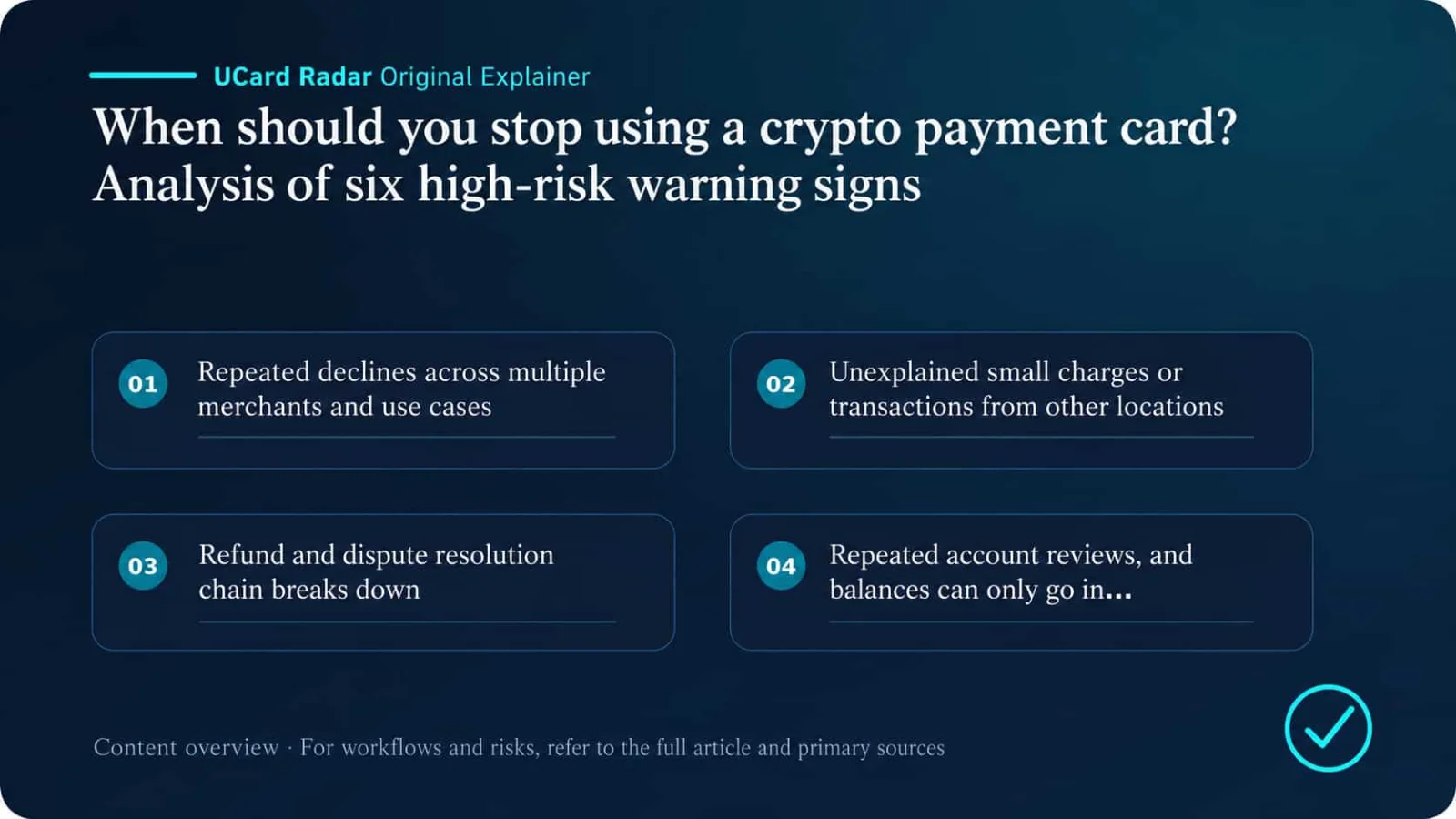
Once any of the following six types of events occurs, users should no longer treat them as ordinary operational glitches. They should consider stopping deposits immediately, pausing spending, and moving any available balance.
Sources and Limits of the Conclusions
Primary-source verification: Visa Core Rules and Visa Product and Service Rules; Mastercard Transaction Processing Rules; What should I do if my prepaid card or PIN is lost or stolen, or I see unauthorized charges?.
For verifiable facts concerning payment declines, freezes, unauthorized transactions, and disputes involving crypto payment cards, this article relies on the listed official or regulatory documents. Actual service status, pricing, eligibility, and regional availability should be confirmed on the issuer’s or platform’s current application pages.
Different issuers, jurisdictions, account tiers, and merchant rules may produce different outcomes. Any discussion of user experience, success rates, fee comparisons, or broader trends not directly disclosed in the primary sources above should be understood as analysis or inference and has not been officially confirmed for individual cases by the relevant institutions.
1. Repeated Declines Across Multiple Merchants and Payment Scenarios
A single failed payment is not unusual.
Insufficient balance, merchants that do not accept prepaid cards, failed 3D Secure authentication, offline-terminal restrictions, or MCC category restrictions can all cause an individual transaction to be declined. Visa also states that the specific reason for a decline generally needs to be investigated and explained by the issuer.
The real warning sign is when declines become systematic:
Payments fail repeatedly at different merchants;
Both online and in-store payments stop working;
The card token in Apple Pay or Google Pay suddenly becomes invalid;
Small test payments and normal purchases are both declined;
The app still shows the card as “active,” but support cannot provide a decline code;
Large numbers of users report the same problem at roughly the same time.
Visa’s current rules also include mechanisms under which transactions may be systematically declined under high-risk or fraud conditions. This means persistent declines may not simply be a terminal problem; they may originate from the issuer, risk-control systems, or the card program itself. (Visa)
When to Stop Using the Card
If the card repeatedly fails at two or more legitimate merchants and across two or more payment scenarios, and the platform cannot explain the reason within 24 hours, users should stop depositing more funds to test it.
Some users respond to declines by adding more money, switching currencies, or increasing their balance in an attempt to determine whether the problem is insufficient funds. This is the wrong approach. If the issue is caused by a card-program restriction or compliance control, adding more funds only increases the amount potentially exposed to a freeze.
Actions to Take
Pause deposits and withdraw any available balance; keep records of the decline time, amount, merchant name, and error code; use another card for essential payments; and wait for the platform to confirm whether the issue is merchant-specific, account-specific, or a broader card-program problem.
2. Unexplained Small Charges or Transactions from Other Locations
Many cases of card fraud do not begin with a large purchase.
After obtaining a card number, expiration date, and security code, an attacker may first attempt a very small transaction to test whether the card is valid. If the test succeeds, they may proceed with subscription charges, digital-goods purchases, or larger transactions.
The following situations should not be left until the statement is settled:
An unfamiliar authorization for USD 1 or less appears;
A charge from a foreign merchant appears late at night;
The same merchant attempts several failed transactions in succession;
Online purchases appear even though the card has never been used;
New authorizations or subscription charges continue after the card has been frozen;
A verification code is received even though the cardholder did not initiate a transaction.
For prepaid cards and similar accounts, regulators recommend contacting the issuer immediately after discovering a lost card, compromised PIN, or unauthorized transaction. Delayed reporting may increase the losses for which the user is responsible. (Consumer Financial Protection Bureau)
When to Stop Using the Card
As soon as a transaction is confirmed to have been initiated by someone else, the original card should be taken out of use immediately, regardless of the amount. Do not wait several days to see what happens.
A reversed unexplained small charge also does not prove that the card is safe. It may simply be the release of a preauthorization, or it may indicate that an attacker successfully tested whether the card was valid.
Actions to Take
Freeze the card immediately; disable online payments, international payments, ATM withdrawals, and contactless payments; remove the card token from Apple Pay, Google Pay, and other wallets; change the account password and reset two-factor authentication; submit a dispute to the issuer and obtain a case or ticket number.
It is also important to note that simply replacing the card may not fully terminate old subscriptions. Some card-updater services automatically provide new card credentials to merchants where the card is stored, so users should also cancel the relevant merchant authorizations and subscriptions directly. (Visa Developer)
3. Failure of the Refund and Dispute Process
The reliability of a crypto payment card cannot be judged only by its payment success rate. Refunds must also be able to return properly.
In a normal card-payment system, merchant refunds should be credited to the cardholder’s account through the payment network. In cases involving unauthorized transactions, undelivered goods, or duplicate charges, the user should also be able to contact the issuer and raise a transaction dispute. Mastercard defines a refund as a return transaction initiated by a merchant to the cardholder’s account, and both Visa and Mastercard require issuers to handle specific transaction disputes. (Mastercard)
The real danger is not a refund arriving two days late. It is when the entire resolution process begins to fail:
The merchant provides refund evidence, but the card account remains uncredited for an extended period;
The platform cannot look up the refund reference number or ARN;
Support refuses to open a dispute ticket;
Submitted dispute records disappear from the app;
The same documents must be resubmitted every time support is contacted;
The platform suddenly claims that “crypto cards do not support refunds or chargebacks,” despite never disclosing this before;
Refunds can only be returned as platform points or internal tokens rather than withdrawable funds.
When to Stop Using the Card
If a transaction with clear merchant refund evidence exceeds the platform’s stated processing period and the platform cannot provide a traceable processing reference, the card should no longer be used for large purchases.
If two or more refunds disappear, or if the platform refuses to accept disputes involving unauthorized transactions, use of the card should stop entirely.
Why the Risk Is High
A successful payment only proves that money can move from the user to the merchant. A successful refund proves that funds can also move in the opposite direction back to the user.
If a card can debit funds but cannot return them, the payment loop is no longer complete. Continuing to use it means that future airline cancellations, hotel-deposit releases, product returns, or subscription disputes may leave the user unable to recover funds.
4. Repeated Account Reviews While Funds Can Enter but Not Leave
KYC review by itself is not a danger signal.
Crypto payment cards involve fiat payments, cross-border transactions, and conversion of digital assets. A platform may therefore reasonably ask users to reverify identity, address, or source of funds. The real issue is whether the review process has a clear reason, a defined document list, a processing deadline, and a route for appeal.
High-risk situations often look like this:
Deposits still work, but withdrawals and transfers are disabled;
Card spending is suspended while the account can still receive funds;
Each document submission leads to another request for repetitive documentation;
No estimated completion time is provided;
Support can only say “please wait for the compliance team”;
The platform refuses to identify the legal entity holding the customer balance;
Even when the user asks to close the account, funds still cannot be withdrawn.
This creates a classic “one-way funding gateway”: money can go in but cannot come out normally.
When to Stop Using the Card
If withdrawals, transfers, and spending are restricted at the same time, users should stop depositing immediately.
If, after all identity documents have been submitted, the platform still cannot provide a case number, a reason for the review, or a clear resolution path, the account should no longer be treated as an everyday funding account.
Actions to Take
Save screenshots of the account balance, deposit records, blockchain transaction hashes, bank-transfer records, KYC submission pages, and all support correspondence. Request written confirmation from the platform explaining the restriction, identifying the legal entity holding the funds, and describing the refund process if the account is closed.
It is important to note that some non-bank payment institutions use client-fund segregation or “safeguarding” rather than conventional bank deposit insurance. The UK FCA states that when a non-bank payment institution fails, client funds are generally not directly protected by the FSCS; failure of the institution may still lead to losses or lengthy delays in returning funds. (FCA)
5. Changes to the Issuer, Banking Partner, or Regulatory Status
In the crypto payment card market, the consumer-facing brand is not necessarily the actual card issuer.
A user may apply for a card through Brand A, while the underlying money account is provided by E-money Institution B, the card is issued by Bank C, and transactions are processed by Processor D. The front-end brand may remain online even after an underlying partnership is no longer intact.
The following changes should be treated as major risk events:
The website removes the name of the original issuer or legal entity;
The card BIN, account terms, or service entity changes suddenly;
The platform announces a new banking partner without explaining how balances will be migrated;
A regulator imposes business restrictions on a relevant entity;
New card applications are suspended while existing users are still encouraged to deposit;
The platform disables withdrawals, conversion, or payments;
A partner publicly announces termination of the card program;
Users are required to migrate balances within an unusually short period.
In 2025, the UK FCA disclosed that Ziglu stopped payment and crypto-asset activities after regulatory restrictions and entered special administration. The case shows that payment and crypto businesses can move from restricted operations to formal resolution within a relatively short period. (FCA)
When to Stop Using the Card
If there is a major change involving the issuer, custody institution, or regulatory authorization and the platform has not published a complete plan for handling balances and migrating services, users should stop adding new funds.
If a regulator has already announced formal business restrictions, users should not wait for the consumer brand to publish a marketing-style explanation before acting.
Actions to Take
Withdraw available balances as a priority, cancel important subscriptions and automatic renewals, download full statements, record the card issuer and applicable terms, and check whether the company named in regulatory notices matches the legal entity identified in the user agreement.
6. Sudden Rule Changes Combined with Loss of Customer Support and Operational Response
Many high-risk card programs do not immediately shut down their websites before operations fail.
A more common pattern is that fees rise first and limits are reduced later; settlement times lengthen, then withdrawals are paused; support channels are reduced, and only afterward does the platform publish a vague “system upgrade” notice.
When several of the following signals appear together, the risk is no longer an ordinary operational issue:
Card issuance fees, deposit fees, conversion fees, or withdrawal fees rise sharply;
Daily spending or withdrawal limits are significantly reduced;
User agreements change repeatedly without version history;
The website removes the company address, license information, or support email;
Social-media accounts stop updating;
Support tickets receive no human reply for several days;
The app remains outdated for an extended period and key pages repeatedly fail;
The company handles funding issues only through Telegram or private messages;
The platform encourages further deposits but does not explain withdrawal failures;
Support demands an additional payment to “unfreeze the account” or “pay a security deposit.”
Any one of these may reflect poor operations. Several appearing at the same time usually indicate pressure on the platform’s funding, compliance, or partner relationships.
When to Stop Using the Card
If two of the following three conditions appear at the same time—withdrawal problems, sudden rule changes, and unresponsive support—the card should no longer be used.
If support asks the user to transfer additional crypto assets in order to unlock an existing balance, the situation should be treated as a potential fraud or Ponzi-style funding risk, and no further payment should be made.
Stop-Use Decision Table for Six High-Risk Events
High-Risk Event | Situation That May Be Observed Temporarily | Threshold for Stopping Use | First Action |
|---|---|---|---|
Repeated declines | Failure at one merchant or with one payment method | Repeated failures across multiple merchants and scenarios with no clear explanation | Stop deposits and withdraw balance |
Unauthorized transaction | Merchant name looks unfamiliar but transaction can be confirmed | Any charge not initiated by the user | Freeze card and file a dispute |
Refund failure | Still within the merchant’s or issuer’s promised processing period | Refund evidence exists but cannot be traced, or multiple refunds disappear | Request ARN and ticket number |
Account review | One-time request for additional identity or address documents | Deposits work but withdrawals and spending remain restricted for an extended period | Stop funding and preserve evidence |
Partner or regulatory change | A clear migration plan has been published | Business is restricted but balance arrangements are unclear | Withdraw funds as soon as possible |
Sudden rule changes and loss of support | Short-term maintenance with a clear restoration time | Withdrawal failure, sudden fee increases, and unresponsive support appear together | Stop using the service and prepare a complaint |
Stopping Use Does Not Mean Merely Freezing the Card
Many users interpret “stop using” as simply not making purchases for a while. For a high-risk crypto payment card, that is not enough.
A complete loss-control process should involve three levels.
First, stop all new funding, including on-chain deposits, bank transfers, and internal platform conversions. Do not add more funds merely to test whether withdrawals work.
Second, reduce account exposure. Freeze the card, disable all transaction permissions, remove mobile-wallet tokens, cancel subscriptions, and change any password that is also used on other platforms.
Third, preserve evidence that may be needed for recovery or dispute resolution, including the legal-entity name, user-agreement version, balance screenshots, statements, refund receipts, blockchain hashes, support tickets, and email records. If a dispute occurs, contact the actual card issuer as soon as possible rather than relying only on the card brand. Both Visa and Mastercard state that specific transaction and account issues are generally handled by the issuer. (Visa)
Conclusion: The Real Danger Is Not That the Card Stops Working, but That the Money Cannot Come Back
An occasional payment decline does not necessarily mean that a crypto payment card is about to fail. Conversely, a card that still works does not prove that the funds in the associated account are safe.
The decision to stop using a card should focus on three questions:
Can funds still be withdrawn freely? Can abnormal transactions still be disputed? Is there still a clear, verifiable legal entity responsible for the platform?
If two of these fail at the same time, the product should no longer be treated as a normal payment card, and large balances should not remain on the platform.
The safest way to use a crypto payment card remains the same: fund it only when needed, spend in small amounts, avoid holding large balances for long periods, and keep at least one fully independent backup card. Mature risk control is not about becoming one of the first people to seek redress after a platform shuts down. It is about moving funds out while the first links in the risk chain are beginning to break.