
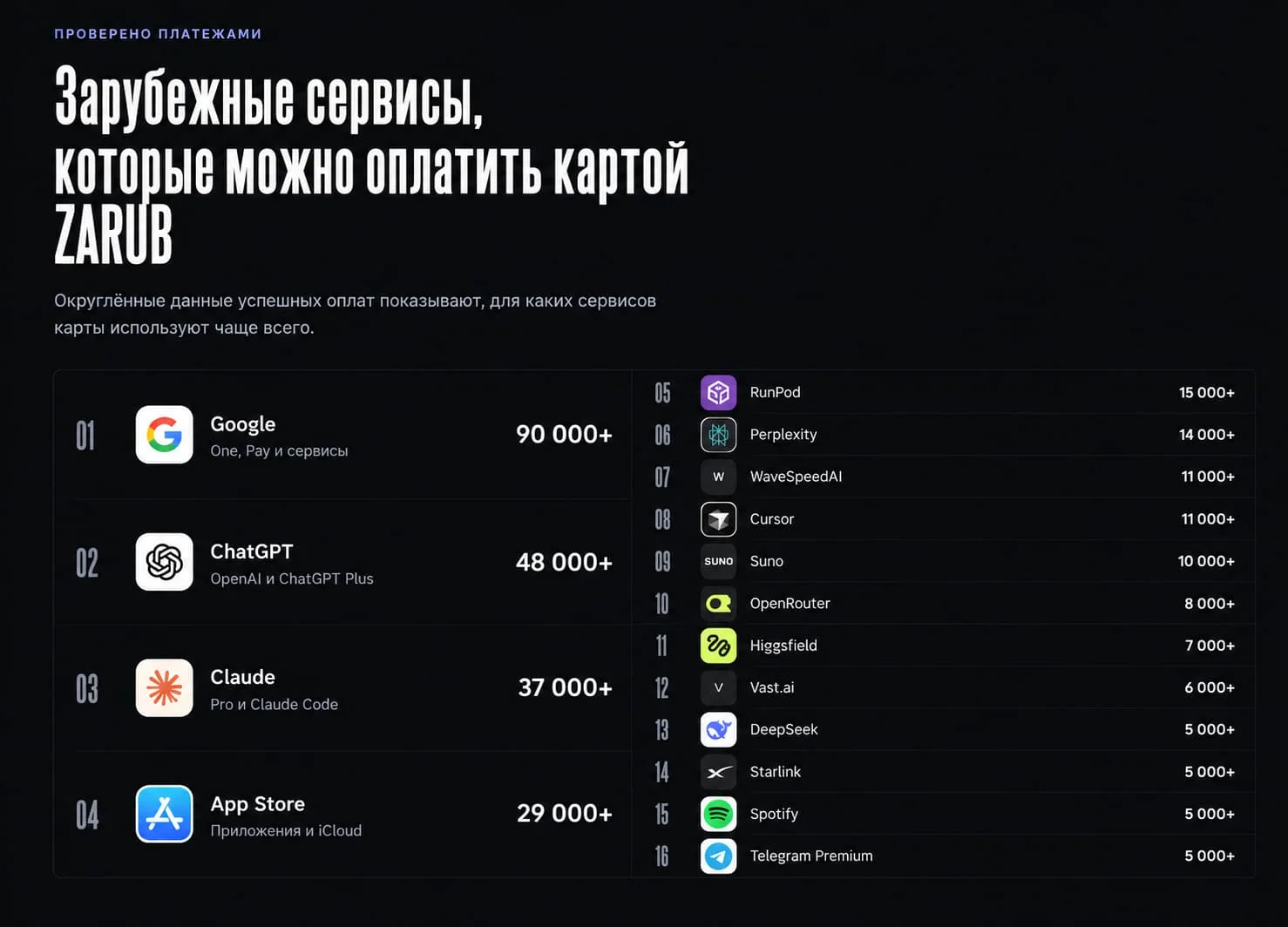
U-card companies openly promote cards for paying for AI service subscriptions. Hong Kong-based DogPay presents support for AI subscriptions as one use case for a USDT-funded card, while another provider markets to Russian customers by claiming its cards have already been used for 48,000 ChatGPT payments and 37,000 Claude subscriptions. As shown below (Payment methods promoted for ChatGPT and Claude Code. Source: zarub.io, accessed October 13, 2026.), all of these figures are Zarub's own statistics.
OpenAI and Claude are not available in China or Russia. For U-card providers and the BIN sponsors behind them, this creates a U-card compliance issue. The European Union has imposed sanctions on Russia that prohibit its citizens from using certain crypto-asset wallets, accounts and custody services. China’s central bank has also issued administrative policies declaring cryptocurrency trading in China illegal. On September 29, 2026, The Economist published an article titled “New Crypto Scams in the AI Boom,” citing an April report on crypto cards by Crystal Intelligence. The report found that nearly 70% of U-card providers had weak KYC controls, while some carried out no meaningful checks at all.
How U-Cards Circumvent AI Companies’ Access Restrictions
U-cards issued in other countries can allow users in Russia or China to pay foreign AI companies, but the card alone cannot create an account for them. There are two main obstacles.
The first is the account itself. Service providers block unsupported regions and conduct identity verification. Anthropic has said that if identity verification fails, it will ban accounts originating from unsupported regions, including China and Russia.
The second is payment, which is another obstacle for the card. In March 2022, the major international card networks suspended operations in Russia. Since then, cards issued by Russian banks have generally been unusable abroad. Cards issued in China, meanwhile, identify themselves to the issuer and payment ecosystem as Chinese-issued cards.
Cards issued in other countries or regions can bypass these two restrictions. Some services use cryptocurrencies such as USDT and USDC. Others accept local currency, but do not explain exactly how the currency conversion is handled.
Merchants typically use the BIN, issuing bank and billing address to infer a customer’s location. With these cards, however, all three may point to the country of issuance rather than the user’s actual location.
Which AI Products U-Card Providers Are Promoting for Subscription Payments
DogPay: A Hong Kong USDT-Funded Card
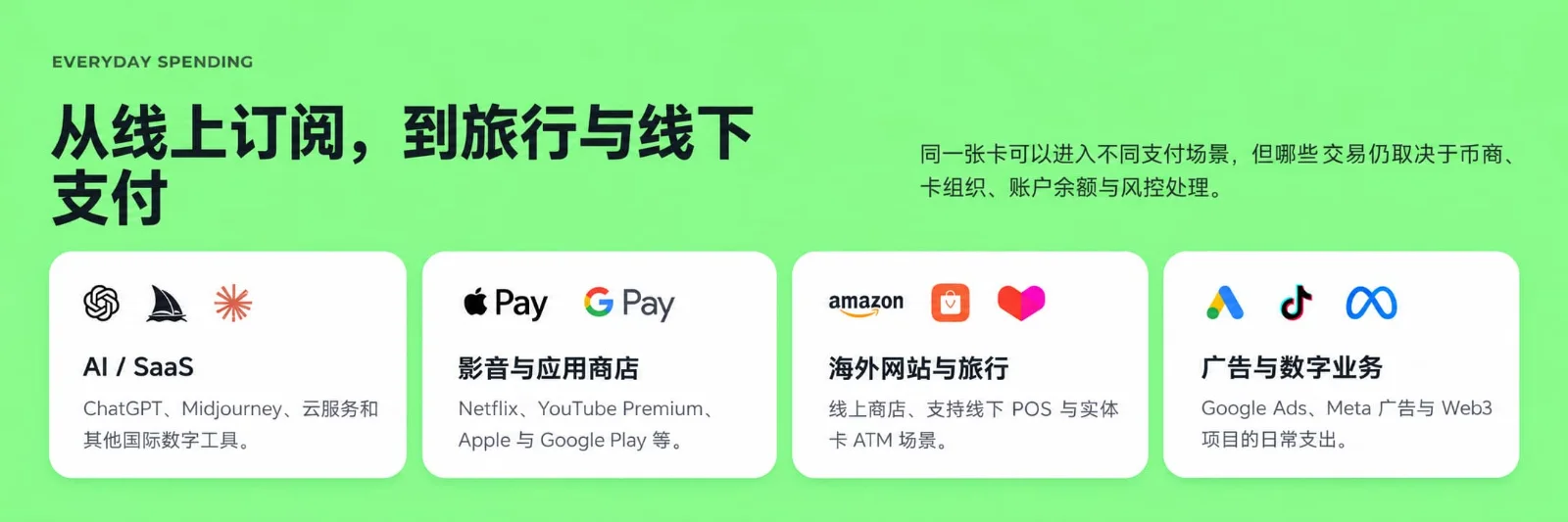
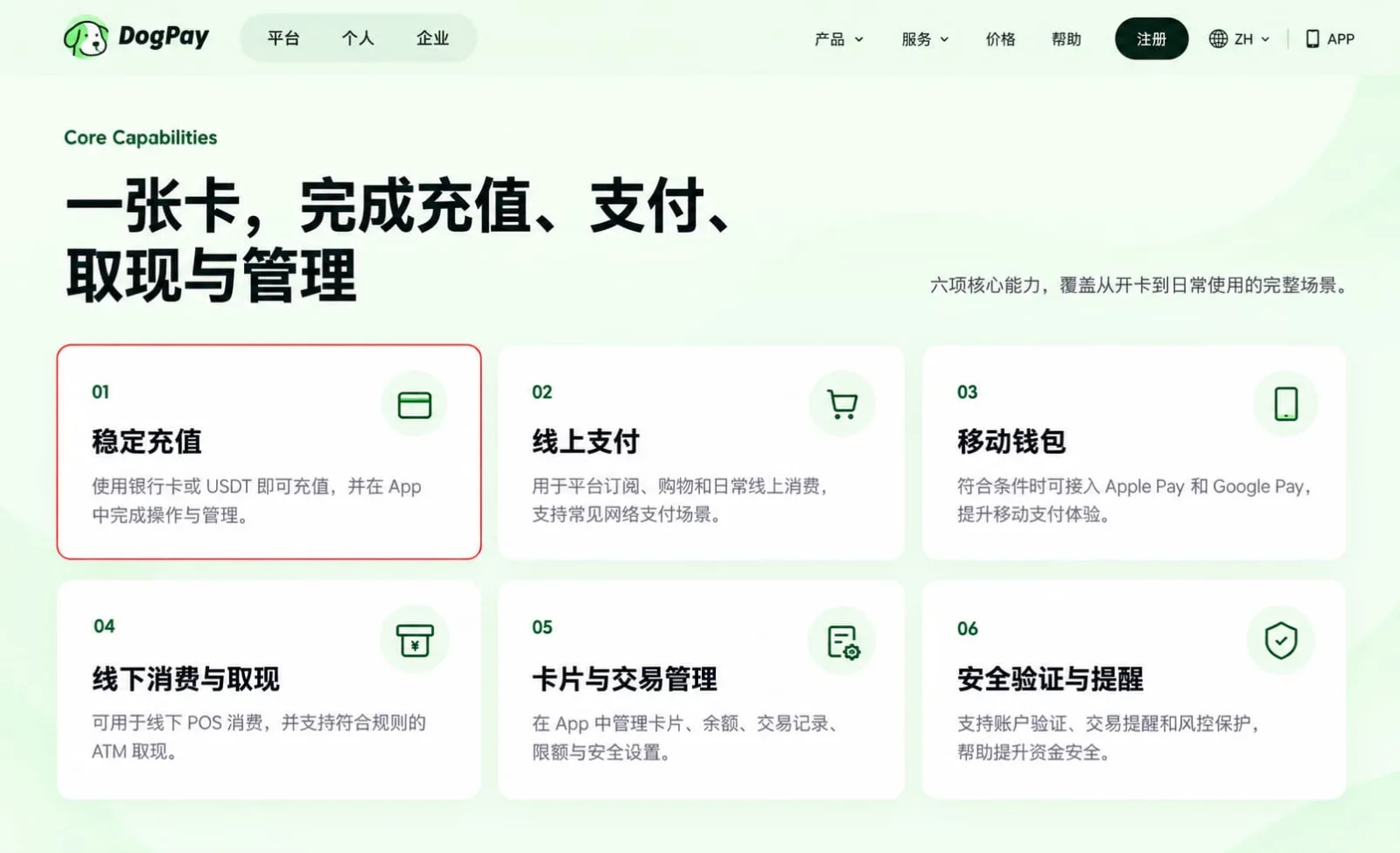
DogPay lists “AI subscription payments,” mentioning ChatGPT and Midjourney, as one of its use cases alongside cross-border e-commerce and multi-currency accounts. Its official page states that the card is funded through a USDT network deposit, after which the funds are converted and loaded onto the card within the app. The page also states that customers must complete KYC verification, as shown below.
Zarub: Ruble Funding for Russian Users
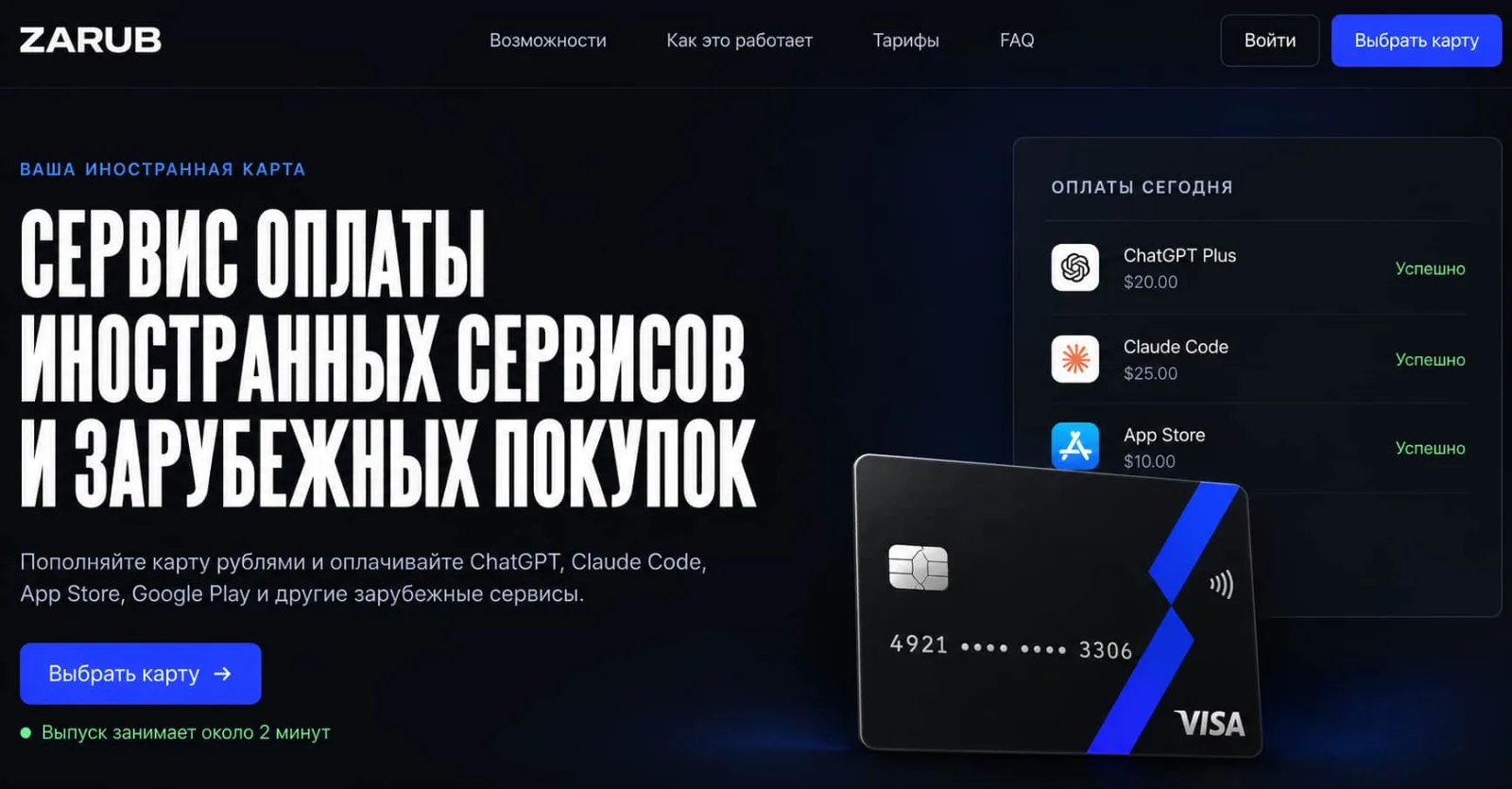
zarub.io is Zarub’s official website. The Russian-language site describes the product as a “payment service for foreign services and overseas purchases.” Its homepage invites users to “top up your card with rubles” and use it to pay for ChatGPT, Claude, the App Store, Google Play and other international services. The page also displays examples marked as successful payments. (Accessed October 13, 2026.)
On the Zarub platform, Google-related payments exceed 90,000 transactions, ranking first and surpassing both ChatGPT and Claude. The ranking also includes GPU rental platforms RunPod, with more than 15,000 payments, and Vast.ai, with more than 6,000. This suggests that some users are buying computing capacity, not merely chatbot subscriptions.
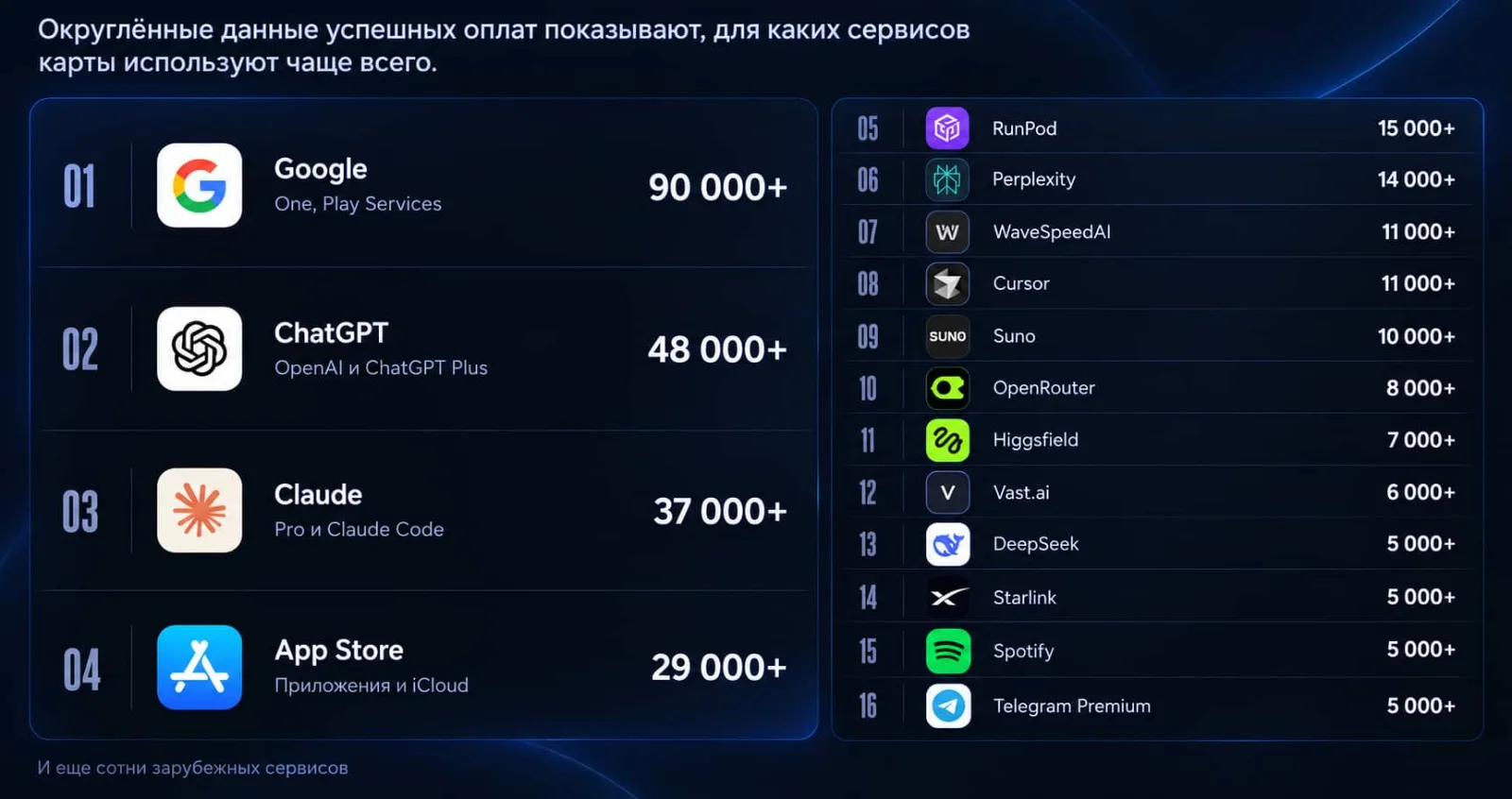
Zarub’s website does not mention cryptocurrency. Users fund their accounts in rubles through Russia’s Faster Payments System (SBP), which is operated through Russian banks, and then make foreign-currency payments using cards issued abroad. As long as the account balance is sufficient, subscriptions renew automatically, making these customers ongoing rather than one-off users.
Why This Is a Compliance Issue for Card Issuers and Virtual Asset Service Providers
The risk lies in the program itself rather than the industry being purchased: its market positioning, target customers and source of funds. Russia and China present different policy environments.
China: Domestic Law
China is not subject to U.S. sanctions. The primary issue is its own domestic law. In September 2021, the People’s Bank of China declared cryptocurrency transactions illegal in mainland China, including online services provided by overseas platforms to mainland Chinese residents. A crypto card program funded with USDT and marketed to mainland Chinese residents therefore conflicts with Chinese law, regardless of how the program is licensed in its home jurisdiction.
Any party issuing, sponsoring or reviewing such a card program needs to address the following questions:
Is the program marketed on the basis that it gives users access to services unavailable in their home country?
Does it allow residents of mainland China or Russia to register? Does the KYC process capture the customer’s place of residence or identity information?
In addition to source-of-funds checks, are cardholders screened against sanctions lists?
How does the cardholder’s actual location compare with the country where the card is issued?
What funds these cards: which assets are involved, and which wallets, exchanges or banks send the funds?
Are large numbers of cards being opened by the same individual or organization?
The answers matter because the person funding the wallet, the cardholder and the person using the AI account may not be the same person.
Russia: The Direct Issue Facing EU Virtual Asset Service Providers
The clearest rules come from Europe. Since October 2022, EU sanctions have prohibited certain crypto-asset wallet, account and custody services from being provided to Russian citizens and residents, regardless of the amount involved. Any EU U-card program serving sanctioned populations must comply with these restrictions.
For issuers and BIN sponsors in other jurisdictions, the key issue is the source of funds. Russia’s national payment infrastructure is domestic, meaning ruble funding ultimately passes through Russian banks. Many large Russian banks are subject to U.S. sanctions. That does not mean every Russian user of a Western application is sanctioned. The real risk lies with the participants in the payment chain.
Why AI Subscription Services Matter So Much to Card Issuers
Large-scale access leaves traces in the payment system, and card issuers are among the few parties able to see those traces. Modern payment systems are designed so that merchants do not retain the issuer-side information needed to see the full customer profile; the merchant ultimately receives an approval or decline. Reports published by Anthropic illustrate why this matters. The cases involve AI laboratories in several countries conducting distillation against Claude models, which Anthropic treats as a form of abusive or adversarial activity. However, the reports do not mention virtual asset services or card programs.
On February 23, 2026, Anthropic said that three Chinese AI laboratories — DeepSeek, Moonshot AI (Kimi) and MiniMax — had used approximately 24,000 fraudulent accounts and more than 16 million interactions to extract capabilities from Claude for use in training their own models. These were Anthropic’s findings and allegations. An “interaction” here means sending an instruction to the model and receiving its response. Anthropic said the laboratories used those outputs to train their own models, a technique known as “distillation.”
Distillation is a standard machine-learning technique. Anthropic’s objection is to the use of fake accounts to conduct it at scale in violation of its terms and regional restrictions. In its September 2026 threat report, Anthropic also named other laboratories based in China. According to TechCrunch, Anthropic believed the largest campaign was linked to Alibaba, involving more than 3,500 accounts and approximately 151 million interactions.
Anthropic described how access was obtained.
Intermediaries resold Claude account tokens.
Fake identities and stolen credit cards were used to obtain API keys illegally.
Overseas shell companies were used to establish proxy access.
Payment methods were shared as part of the operation.
None of these reports mentions U-cards. If a program gives one customer multiple card numbers, or if multiple cards are funded from the same wallet, the merchant may not know. The card issuer, however, can see it.
What Payment Information About U-Cards Can On-Chain Analysis Reveal
On-chain analysis can reveal information about how a card is funded, which is information that issuers and program sponsors have a responsibility to understand. For cryptocurrency programs, the activity before payment takes place on-chain, and that is where the evidence exists. User wallet → cryptocurrency transfer → card-service funding address → [off-chain card balance and payment] → merchant. On-chain tools can trace fund flows across more than 300 blockchains, from a card program’s deposit addresses back to the source of funds. Using more than 118,000 attributed entities, analysts can identify which exchanges and service providers are sending funds to the program, whether there is exposure to sanctioned entities such as Garantex, and whether a large share of the funds comes from only a small number of sources.
On-chain evidence has one hard limit. Once cryptocurrency is converted into a card balance, spending takes place off-chain through the card network. On-chain data therefore cannot show which specific merchant received the payment. A fuller picture of the flow of funds requires card transaction data and account information to be combined with the on-chain evidence.