
The real risk of a crypto payment card is often not that it “cannot be used at all.” More often, the account clearly has funds, yet a payment suddenly fails. That is one of the reasons we built this platform. A merchant says a refund has been issued, but the funds still do not return; an incomplete transaction ties up the balance for days or even weeks; after several abnormal transactions, the card or the entire account becomes restricted. The goal is to help users recognize when a card or platform may be moving toward serious trouble so they can move funds in advance.
On the surface, all of these situations may look like a “freeze,” but they can occur at completely different stages.
Some cases are simply normal authorization holds because the merchant has not yet completed settlement. Some occur because the issuer detects a suspicious transaction and temporarily suspends the card. Others may involve a negative balance, KYC re-verification, source-of-funds checks or sanctions screening. The appropriate response differs, and so does the level of risk.
As of July 2026, the industry does not have a unified abnormal-transaction database covering crypto payment cards worldwide. UCardRadar is continuing to build out its own database, which should help address many industry-wide issues over time. Accordingly, this article does not invent figures such as “how many users have been frozen” or “what percentage of refunds fail” without a meaningful sample base. Instead, it uses card-platform rules, payment-processing flows and European payment-fraud data to analyze where risk signals tend to appear, which scenarios are more prone to problems, and how users can judge the severity of an issue.
Sources and Scope of Conclusions
Primary-source verification: Visa Core Rules and Visa Product and Service Rules; Mastercard Transaction Processing Rules; What should I do if my prepaid card or PIN is lost or stolen, or I see unauthorized charges?.
Verifiable statements in this article concerning crypto payment card freezes, refunds, payment anomalies and dispute-processing signals are based on the cited official or regulatory documents. Actual service status, pricing, eligibility and regional availability should be confirmed on the issuer’s or platform’s page at the time of application.
Results may differ by issuer, region, account tier and merchant rules. Any discussion of user experience, success rates, cost comparisons or trends that is not directly disclosed in the primary sources above should be treated as analysis or inference rather than an officially confirmed conclusion for an individual case.
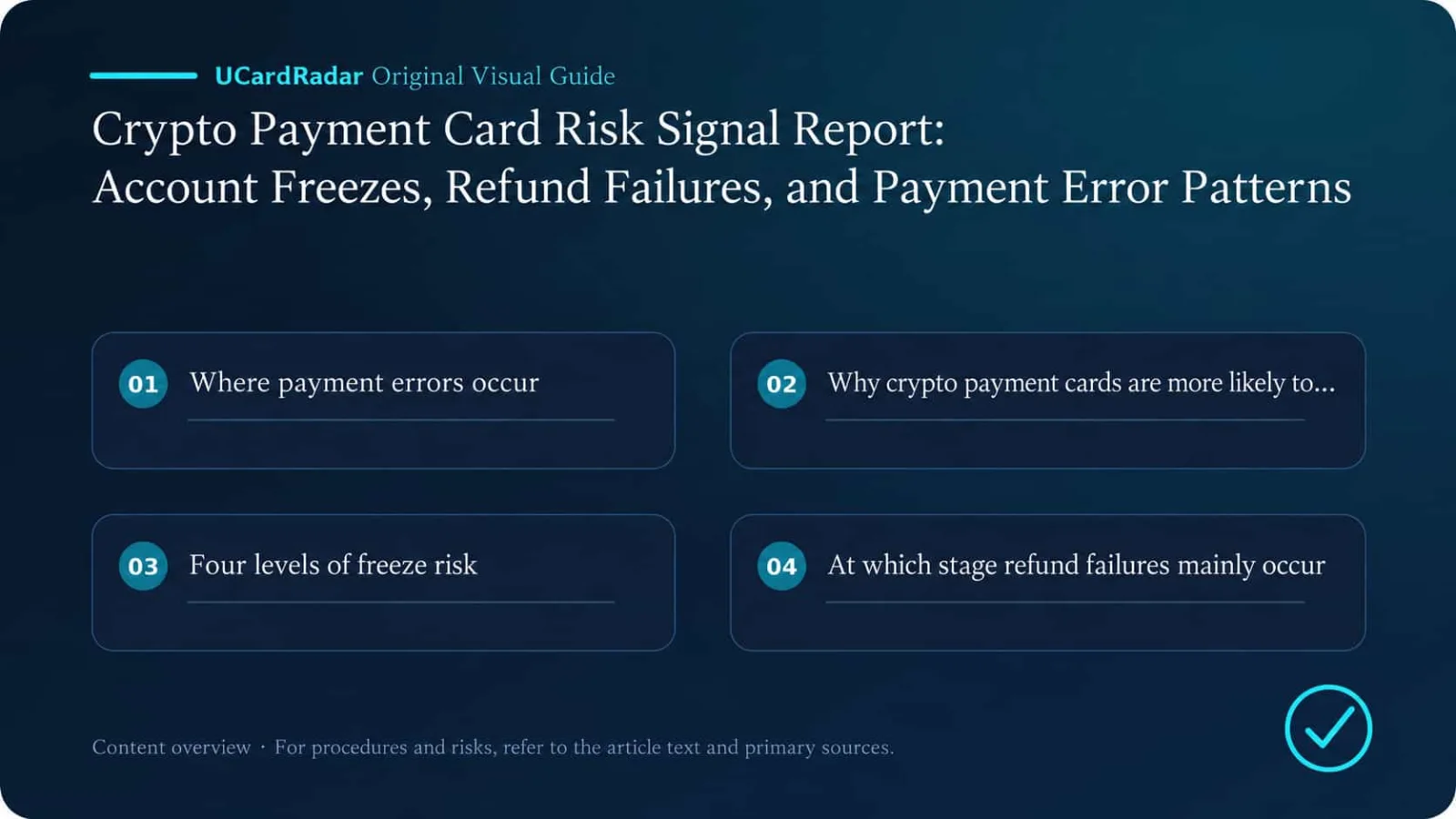
1. Where Payment Anomalies Occur
Crypto payment card anomalies are concentrated in four main areas:
Between authorization and settlement: the transaction has already tied up available funds, but the merchant has not completed the charge or released the authorization;
Online and cross-border payments: 3D Secure, merchant category, billing address, geographic location and risk-control rules can conflict;
The refund chain: processing passes through the merchant, acquirer, Visa/Mastercard network and issuer;
Account-level risk controls: suspicious transactions, negative balances, inconsistent identity information and source-of-funds reviews can cause a card or account to be suspended.
The most common misunderstanding is treating an “authorization hold” as an “account freeze.” The hardest cases are those in which the platform has entered a compliance review but the user cannot learn the specific trigger.
By payment channel, anomalous signals appear more often in:
Online subscriptions;
Cross-border spending;
Hotels, car rentals and fuel stations;
ATM withdrawals;
Merchants requiring deposits or delayed settlement;
Restricted merchant categories;
Payments involving automatic crypto-asset conversion;
Merchant-initiated recurring charges.
In terms of severity, a short-term payment failure is usually not the main concern. What deserves attention is when multiple scenarios fail at the same time, refunds remain missing for an extended period, the account is repeatedly asked to resubmit information, or card restrictions expand to withdrawals and asset transfers.
2. Why Crypto Payment Card Statuses Are Harder to Understand
The transaction chain of a traditional bank debit card is already complex. Crypto payment cards add one or more additional layers of asset processing.
A purchase may pass through the following sequence:
User crypto assets
→ Platform account or self-custody wallet
→ Crypto-asset conversion
→ Available fiat balance
→ Issuer authorization
→ Visa / Mastercard network
→ Merchant acquirer
→ Merchant settlement
For cross-currency payments, card-network exchange rates, platform conversion prices and FX fees are added. At hotels, car-rental companies, airlines or fuel stations, the merchant may also place a preauthorization before settling the final amount later.
This means that when a payment fails, the problem may come from:
Crypto assets not being converted in time;
Insufficient balance in the asset selected for payment;
A mismatch between the fiat balance and the card’s base currency;
The issuer declining the transaction;
The card network returning a decline;
The merchant terminal not accepting that type of card;
The merchant not completing settlement;
A failed 3D Secure verification;
The risk system flagging the transaction as abnormal;
An ongoing KYC or source-of-funds review.
Therefore, “sufficient balance” does not mean “payment is guaranteed to succeed.”
3. Four Levels of Freeze Risk
What users call a “freeze” covers at least four different situations. The first step is to determine which type applies before deciding whether to complain or appeal.
Type 1: Preauthorization Hold
This is the most common and lowest-risk situation.
After the user pays, the issuer first approves the transaction and temporarily locks the corresponding amount. Funds are only finally deducted after the merchant submits the transaction for settlement. If the merchant cancels the transaction or never completes settlement, the authorization is reversed and the funds become available again.
Bybit’s card documentation indicates that an authorized transaction may remain pending while the merchant completes presentment, during which the funds remain locked. This can last for up to 30 days. If the authorization is reversed, the held fiat balance is released.
This commonly occurs with:
Hotel deposits;
Car-rental deposits;
Self-service fuel stations;
Airlines;
Transportation platforms;
Small charges used by merchants to test whether a card is valid;
Cancelled orders where the merchant has not promptly released the authorization.
It does not mean the platform suspects the user, nor does it mean the account has entered a compliance review.
Identification signs:
Only one specific amount is unavailable;
The transaction status shows “Authorized,” “Pending” or similar;
Other purchases and withdrawals continue to work;
No request has been received for additional KYC or security confirmation.
If the issue is only a preauthorization hold, customer support usually cannot release it immediately. The final processing time depends on the merchant and card-network workflow.
Type 2: Card Security Freeze
This type of freeze is usually triggered by an abnormal transaction. It affects the card itself and does not necessarily affect the entire account.
Common triggers include:
Spending suddenly occurring in a new country;
Multiple transaction attempts within a short period;
Repeated incorrect PIN entries;
Abnormal online transaction amounts or devices;
The merchant location differing from the user’s login region;
Suspected unauthorized card use;
Transaction patterns that differ significantly from historical behavior.
Bybit states that when suspicious activity is detected, it may temporarily freeze a virtual or physical card and ask the user to confirm whether the transaction was initiated by them. The freeze can be lifted after confirmation.
This is essentially an anti-fraud measure. Users should check their transaction history first rather than repeatedly trying the card. Repeated retries may cause the risk system to interpret the activity as an ongoing unauthorized-use attempt.
Identification signs:
The card status clearly shows suspended or frozen;
The platform asks the user to confirm a specific transaction;
Account login, asset viewing and some transfers still work;
Access is usually restored after security verification.
Type 3: Restrictions Caused by Balance or Settlement Anomalies
These issues are often misunderstood as the platform “randomly blocking the card,” but they may actually result from a difference between the authorized amount and the final settlement amount.
For example, a cross-border transaction may be authorized using an estimated exchange rate, while the exchange rate rises by the time of final settlement. Alternatively, the merchant may submit a final amount greater than the original authorization. The account may then develop a negative balance.
Bybit explains that if the final exchange rate or merchant settlement amount exceeds the authorization-stage estimate, the account may become negative. Once a negative balance appears, the card may be suspended and withdrawals may also be restricted. After the user covers the difference, the restrictions are generally removed within a certain period.
This is especially likely in:
Foreign-currency transactions;
Restaurant tips;
Additional hotel charges;
Car-rental surcharges;
Offline terminals;
Merchants that submit settlement late;
Periods of rapid crypto-asset price movement.
Identification signs:
The account shows a negative balance or amount due;
The platform asks the user to cover a small shortfall;
Both the card and withdrawals are restricted;
There is no request to explain the source of funds or resubmit identity documents.
Type 4: Account-Level Compliance Freeze
This has the greatest impact and usually takes the longest to resolve.
Possible triggers include:
Expired KYC information;
A persistent mismatch between residential address and login location;
Use of another person’s bank card, wallet or payment account;
Unexplained source of funds;
Transactions involving high-risk addresses;
Transfers involving sanctioned jurisdictions;
Large transactions inconsistent with the declared occupation or income;
Suspicion that the account is being used for third-party collection, payments or business purposes;
Multiple accounts, shared devices or identity irregularities;
A request by the issuer for renewed due diligence.
Wirex’s terms expressly reserve the right to suspend or restrict regulated services for fraud, incorrect information, AML, sanctions or risk-management reasons. It may also delay account closure or restrict transactions during an investigation. Its card and transfer services may also be delayed or declined because of regulatory checks, geographic restrictions, third-party payment infrastructure or card-network rules.
Some card-issuance terms also state that a card may be suspended or cancelled if transactions deviate from normal usage patterns, financial crime is suspected, or the user fails to keep registration information up to date.
Identification signs:
Not only the card but also withdrawals, transfers or conversions are affected;
The platform asks the user to resubmit identity documents, proof of address or source-of-funds information;
Customer support cannot disclose the full trigger;
No clear review timeframe is promised;
The user must wait for a dedicated compliance team.
Repeatedly contacting customer support will not usually resolve this type of case. The effective approach is to submit a clear, complete and internally consistent set of documents in one go.
4. Where Refund Failures Usually Occur
A refund is not simply a “reversal” of the original transaction.
Once a merchant has completed settlement, a refund is usually a new reverse transaction initiated by the merchant. It must pass through the merchant system, the acquirer, the Visa or Mastercard network and the issuer before it reaches the user’s account.
As a result, there may be several days between “the merchant says it refunded the payment” and “the user’s balance has been restored.”
1. The Merchant Never Actually Initiated the Refund
This is one of the easiest situations to overlook.
Merchant support may have approved the refund, but the merchant’s finance system may not have actually submitted it. The user only receives an email saying “refund approved,” without a refund receipt or acquirer reference number.
The most important evidence that a refund has actually been sent is not the customer-service agent’s verbal confirmation, but:
Refund date;
Refund amount;
Original order number;
Refund receipt;
ARN, or Acquirer Reference Number.
Without an ARN, the card platform usually has difficulty tracing the refund through the payment network.
2. The Refund Is Being Processed Through the Card Network
Wirex’s refund guidance states that authorization funds from a failed or cancelled transaction may be automatically released within 14 days. Refunds initiated by merchants for completed transactions generally take 5 to 14 days to process. After that period, an ARN may be used for tracing.
Gnosis Pay gives a standard refund timeframe of within 5 business days after the merchant initiates the refund, with some cases taking up to 28 days. The refund appears as a new incoming transaction rather than altering the original purchase record.
Bybit’s rules indicate that, under normal circumstances, a refund that has entered its system may be credited to the Funding Account within two business days. Some refunds may trigger additional information review.
These timeframes cannot be directly compared because platforms use different starting points. Some count from the moment the merchant initiates the refund, while others count from the time the issuer receives the refund data.
3. The Refund Amount Differs from the Original Purchase Amount
This does not necessarily mean the user was under-refunded.
Common reasons include:
The exchange rate changed by the time of the refund;
The original purchase included an FX markup;
Shipping fees were not refunded;
The merchant deducted a return fee;
The original transaction converted crypto assets, while the refund is returned in the card’s base fiat currency;
The platform reverses cashback or rewards earned from the original transaction.
Gnosis Pay explicitly notes that cross-currency transactions may result in refund-amount differences due to exchange-rate movements.
Users should separately record:
Original purchase currency and amount
Actual card-debit currency and amount
Refund currency and amount
Exchange rate on purchase date
Exchange rate on refund date
Changes in platform cashback or rewards
Otherwise, an exchange-rate difference can easily be mistaken for a missing refund.
4. The Refund Enters Manual Review
A refund itself can become a risk signal.
Examples include:
A refund amount significantly higher than normal spending;
Frequent refunds from the same merchant;
Immediate refunds after large purchases;
The refund originating from a country different from the original transaction;
The original card having been replaced or closed;
The account undergoing KYC review;
Incomplete refund information submitted by the merchant.
The platform may then ask the user to provide the order, refund receipt or source-of-funds explanation. This does not mean the refund will never arrive, but processing time may become significantly longer.
5. The User Confuses a Dispute with an Ordinary Refund
An ordinary refund is voluntarily initiated by the merchant. A transaction dispute or chargeback is a request by the user for the issuer to recover funds through the card network.
Crypto.com’s card-dispute rules list common dispute reasons such as goods not received, services not provided, incorrect amounts, duplicate charges and ATM debit anomalies. Users generally need to contact the merchant first. Formal handling may take 30 to 45 days, and the submission deadline is typically within 120 days of the transaction.
Bybit similarly requires users to contact the merchant first and generally wait at least 14 days. Only qualifying successful transactions can proceed to a formal dispute. Its public rules also warn that incorrect or incomplete information may result in rejection and that some cases may incur administrative fees.
Therefore, a “slow refund” should not immediately be escalated to a chargeback. Filing too early may result in rejection because the merchant is still following the normal refund process.
5. Where Payment Anomalies Are Most Concentrated
1. Online Subscriptions
Online subscriptions are one of the scenarios where crypto payment card anomalies are most concentrated.
Common issues include:
The first payment succeeds, but renewal fails;
The 3D Secure page does not appear;
Merchant-initiated recurring charges are declined;
The original payment token becomes invalid after a card replacement;
The card is identified as prepaid;
The merchant does not accept the issuing country’s BIN;
The billing address does not match the platform-account region;
The subscription merchant falls under a restricted MCC;
The balance covers only the subscription price, not FX movement or additional charges.
A 2025 payment-fraud report published by the European Central Bank and European Banking Authority states that cards issued in the EU and EEA were involved in approximately 17.06 million fraudulent transactions in 2024, representing about 0.015% of all card transactions by number. Remote transactions and transactions without Strong Customer Authentication remained key risk areas, and fraud rates for some remote transactions without SCA were significantly higher than the overall card-transaction rate. The figures cover all payment cards rather than crypto cards specifically, but they help explain why issuers impose stricter verification on online, cross-border and recurring transactions.
Wirex’s payment troubleshooting guidance also lists insufficient balance, transaction limits, merchant-side declines and 3D Secure verification as common reasons for payment failure.
Therefore, determining whether a card supports subscriptions requires more than testing the first payment. At least one automatic renewal should also be observed.
2. Cross-Border Payments
Cross-border transactions can trigger geographic, exchange-rate and anti-fraud rules at the same time.
European regulatory data indicates that in 2024, fraud rates were significantly higher when the counterparty to a card transaction was located outside the EEA than for domestic transactions. Approximately one-third of card-fraud value was linked to cross-border transactions outside the EEA. Again, this is not crypto-card-specific data, but it is sufficient to explain why crypto payment cards may trigger additional verification or declines more often during cross-border spending.
Cross-border anomalies commonly appear as:
The first payment in a particular country fails;
In-store card payments succeed while online payments fail;
Small transactions succeed while larger ones fail;
Domestic-currency transactions succeed while foreign-currency transactions fail;
The same brand produces different payment outcomes on websites in different countries;
The merchant shows a decline but the platform does not generate a complete transaction record.
3. Merchant Category Restrictions
Issuers may restrict spending based on MCC, or Merchant Category Code.
Common restricted categories include:
Crypto-asset purchases;
Cash equivalents;
E-wallet top-ups;
Money-transfer services;
Gambling;
Adult content;
High-risk financial services;
Certain advertising or digital services;
Prepaid-card top-ups;
Certain government or tax payments.
Crypto.com’s card-help materials explicitly list unsupported MCCs as one of the common reasons transactions are declined.
A merchant name may look ordinary while the MCC registered by its acquirer is not. For example, a website selling digital gift cards may be classified as a cash-equivalent merchant rather than ordinary e-commerce.
4. Hotels, Car Rentals and Deposit Transactions
The main issue in these scenarios is not the balance itself, but preauthorization capability.
Hotels and car-rental companies may:
Hold a deposit greater than the order amount;
Submit settlement several days after checkout or vehicle return;
Add taxes, fuel charges or damage fees;
Require the card to support delayed charges;
Reject some prepaid or virtual cards.
When users see “the order has been cancelled but the money has not returned,” the cause is often an unreleased authorization rather than a formal refund failure.
For these transactions, the card balance should not merely equal the exact order amount. Users should also leave room for deposits and exchange-rate fluctuations.
5. ATM Withdrawals
ATM withdrawals are among the most complex scenarios for dispute handling.
Common anomalies include:
The account is debited but the ATM dispenses no cash;
Only part of the requested cash is dispensed;
The ATM debits the account twice;
Dynamic currency conversion creates additional losses;
The ATM operator charges an independent fee;
The card is retained after a successful withdrawal;
The ATM reports failure but the account still shows a pending authorization.
Crypto.com treats ATM cash-not-dispensed, incorrect amount, duplicate debit and unauthorized withdrawal as formal dispute scenarios.
When an ATM problem occurs, immediately preserve:
ATM address;
Machine ID;
Time;
Withdrawal amount;
Terminal receipt;
Error message;
Screenshot of the account transaction.
Without these materials, it is difficult for a later investigation to identify the responsible party.
6. Practical Distribution of Risk Signals
Based on transaction mechanics and platform rules, abnormal signals can be grouped by frequency and impact.
Risk Signal | Frequency | Impact | Main Location |
|---|---|---|---|
Single payment decline | High | Low to medium | Online subscriptions, cross-border, restricted MCC |
Long preauthorization hold | Medium-high | Medium | Hotels, car rentals, fuel, transportation |
Merchant refund delay | Medium | Medium | E-commerce, travel, digital services |
Duplicate charge or amount error | Medium-low | Medium | Merchant settlement, offline transactions |
ATM debit with no cash dispensed | Low | Medium-high | ATM |
Card security freeze | Medium-low | Medium | Abnormal device, location or transaction pattern |
Card suspension caused by negative balance | Low | Medium | FX, delayed settlement, additional charges |
KYC/AML account restriction | Low | High | Account-level risk controls |
Full card-program disruption | Low | Extremely high | Changes in issuer or card-network partnership |
This table is not a statistical percentage distribution. It is a risk ranking based on publicly available transaction rules.
Overall:
Single payment declines are the most common, but usually do not mean the product has failed;
Preauthorization holds are the situation most often mistaken for a freeze;
Refund delays are the most likely to generate prolonged complaints;
Compliance freezes occur less frequently but have the greatest user impact;
Simultaneous restrictions on payments, withdrawals and transfers are an important signal of account-level risk.
7. Which Anomalies Can Be Treated as Platform Risk Signals
One failed payment from one user has limited evidentiary value. Signals worth entering into a risk database are those that repeat and cluster.
Weak Signals
One online transaction fails;
A particular ATM does not support the card;
A single 3D Secure verification fails;
A refund is still within the official processing window;
A hotel deposit has not yet been released;
The user does not have enough balance.
These are more likely to be ordinary payment failures.
Medium Signals
Multiple users in the same country experience payment failures at the same time;
The same merchant category is continuously declined;
Apple Pay or Google Pay stops working for many users at once;
Refunds broadly exceed the official promised timeframe;
The same BIN is declined across multiple platforms;
Customer-support response times become significantly longer;
Physical and virtual cards both develop anomalies at the same time.
These situations should move into observation status.
Strong Signals
The platform requires large-scale KYC re-verification;
Multiple users report simultaneous account and withdrawal freezes;
The issuer or card-network partnership changes;
New-card applications or replacement cards are officially suspended;
Refund and chargeback channels stop responding;
User balances remain unavailable for extended periods;
Official terms or supported-country lists change suddenly;
Large numbers of cards stop working at the same time;
Regulators issue warnings or licensing status changes.
These signals may indicate product-level or issuance-structure risk rather than an isolated payment problem.
8. What Users Should Do When an Anomaly Occurs
Payment Declined
Check first:
Whether the card is frozen;
Whether the available fiat balance is sufficient;
Whether the selected crypto asset has enough balance;
Per-transaction and daily limits;
Billing address;
3D Secure;
Whether the merchant accepts prepaid or virtual cards;
Whether the merchant category is restricted.
Do not retry a failed payment dozens of times within a short period. Repeated failures can trigger stricter risk controls.
Balance Held
First determine whether the transaction status is:
Pending;
Authorized;
Reversed;
Completed;
Refunded.
If it is still authorized, contact the merchant and ask for the authorization to be released. The issuing platform usually cannot force a refund while the merchant’s authorization is still active.
Refund Not Received
Obtain, in order:
Merchant refund confirmation;
Refund date;
Refund amount;
ARN;
Original transaction record;
Refund receipt.
Only after the platform’s stated normal processing window has passed should a tracing request be submitted to the issuer.
Card or Account Frozen
Prepare:
Identity documents;
Proof of address;
Source-of-funds documents;
Relevant wallet addresses;
Exchange withdrawal records;
Bank deposit records;
Orders and invoices;
Explanation of abnormal transactions.
The materials must be mutually consistent. Temporarily changing an address, hiding wallet sources or submitting incomplete screenshots will usually only prolong the review.
9. Practical Ways to Reduce Losses
A crypto payment card should not be the user’s only everyday payment account.
A more resilient approach is to:
Keep only the balance needed for near-term spending on the card;
Keep large holdings in a separate wallet or regulated account;
Maintain at least one traditional bank card as backup;
Prefer a credit card for hotels, car rentals and deposit transactions;
Test a small amount when paying a new merchant for the first time;
Keep records for high-value orders, refund receipts and ARNs;
Export transaction records regularly;
Do not use another person’s identity, address, bank card or wallet;
Do not use a personal card for large-scale third-party payments or commercial fund transfers;
When an anomaly occurs, identify the transaction status before immediately initiating a chargeback.
In particular, avoid managing the balance so that it is only “just enough.” Differences may exist between crypto conversion prices, FX settlement rates and the merchant’s final charged amount.
10. How a Platform Should Record These Risks
For a crypto payment card database, a single “payment supported” field is no longer sufficient.
At minimum, the following should be recorded separately:
Payment scenario;
Merchant category;
Country where the event occurred;
Online or offline;
Card network;
Virtual or physical card;
Authorization status;
Settlement status;
Refund status;
Scope of the freeze;
Whether withdrawals are affected;
Whether KYC is triggered;
Official processing timeframe;
Actual recovery time;
Source type;
Number of user reports;
Whether the same signal repeats across multiple users.
Risk events should also be classified as:
Single-transaction anomaly
Card-level anomaly
Account-level anomaly
Region-level anomaly
Card-program-level anomaly
Only with this structure can a normal declined transaction be prevented from being incorrectly escalated into “the card has collapsed,” while genuinely concentrated freezes and changes in issuance structure can be identified in time. UCardRadar’s core value is not simply collecting card names, but continuously tracking fees, regions, KYC, issuance structures, payment compatibility and restriction risk.
The warning sign worth paying attention to is not one failed payment, but a combination of signals such as:
Multiple normal merchants failing at the same time;
Refunds exceeding official timeframes and still being untraceable;
Cards, withdrawals and transfers being restricted simultaneously;
The platform repeatedly requesting identity and source-of-funds documents;
Large numbers of users in the same region reporting anomalies at once;
Changes in the issuer, card network or product terms;
Customer-support and dispute channels no longer processing cases normally.
For users, the most important steps are to control the balance kept on the card, preserve complete evidence and maintain backup payment methods. For a data platform, the priority is to distinguish ordinary transaction failures from systemic risk and record the scenario, scope, timing and recovery outcome of each anomaly.
A card occasionally failing at checkout does not prove that the product has a problem. But when freezes, refund delays and payment failures begin repeating across users, merchants and regions, the issue is no longer merely a customer-service case. It becomes a product signal worth entering into a risk report. Follow UCardRadar for broader risk alerts and protect the funds you keep on these platforms.