
In the crypto payment card market, fees, supported regions, KYC requirements, card-issuing status, and payment compatibility can change frequently. Information about some products is scattered across official websites, help centers, terms of service, social media announcements, and user communities. Different pages may also be updated at different times, use different regional definitions, or contain inconsistent wording.
Relying on a card provider’s promotional pages alone is rarely enough to determine whether a card is currently open for applications, what identity verification is required, what the actual fees are, or whether the product is suitable for a particular country or payment scenario.
UCard Radar is a crypto payment card information, comparison, and risk analysis platform for Chinese-speaking users. By organizing publicly available information, the platform presents structured data on card products, operating entities, fees, application regions, KYC requirements, payment compatibility, and user risk signals.
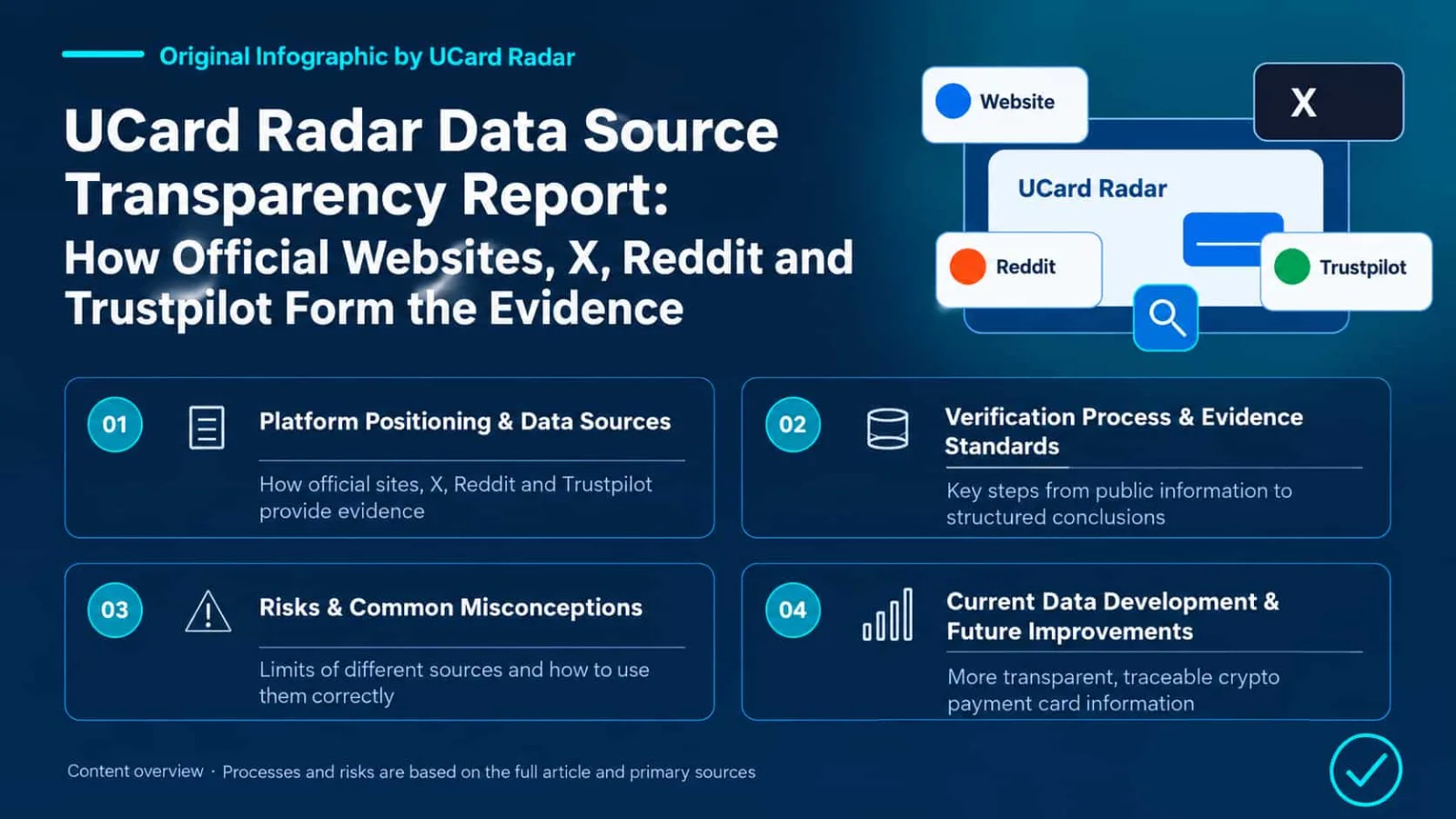
To improve data transparency, UCard Radar primarily relies on the following categories of public sources:
Card providers’ official websites, help centers, and terms of service;
Official announcements and public discussions on X;
Reddit posts and comments;
Trustpilot user reviews;
Where necessary, regulatory records, company registration information, app stores, and other public materials.
Each source serves a different purpose. Official websites are mainly used to confirm product rules; X is mainly used to track recent changes; Reddit and Trustpilot are used to observe issues users encounter during real-world application and use.
These sources are not interchangeable, and they are not assigned equal evidentiary weight.
Scope of Sources and Conclusions
Primary-source verification: Stablecoin-linked cards and money movement; Visa and Bridge Partner to Make Stablecoins Accessible for Everyday Purchases; FATF Standards on Virtual Assets and VASPs.
For verifiable facts concerning the network, issuing, and regulatory verification standards used in UCard Radar’s card research, the official or regulatory documents listed above take precedence. Actual service availability, fees, eligibility, and geographic coverage should always be confirmed with the card issuer or platform at the time of application.
The number of products covered, platform labels, and observational conclusions published by UCard Radar are editorial data. They do not replace platform announcements, registers of licensed entities, or cardholder agreements. User experiences, success rates, fee comparisons, or trend assessments that are not directly disclosed in the primary sources above should be treated as analysis or inference and have not necessarily been officially confirmed by the relevant institutions for any individual case.
1. UCard Radar’s Role
UCard Radar does not issue crypto payment cards and does not handle user funds.
The platform’s main work includes:
Collecting and organizing publicly available card information;
Structuring data on fees, regions, KYC requirements, and card features;
Comparing application requirements and use cases across products;
Tracking changes such as product suspensions, fee adjustments, and regional restrictions;
Organizing risk signals involving account freezes, refunds, payment failures, and customer-service disputes;
Providing users with source information and verification timestamps.
UCard Radar provides information aggregation and risk analysis services. It does not provide card applications, deposits, foreign exchange, withdrawals, third-party payments, or services intended to bypass KYC requirements or geographic restrictions.
Nothing displayed on the platform constitutes financial, legal, investment, or tax advice. Before applying for or using any card, users should review the product’s official website, terms of service, and the rules applicable in their country or region.
2. The Difference Between Information Sources and Formal Evidence
A large amount of information about crypto payment cards is available online, but not all of it can be used directly to support product-level conclusions.
UCard Radar broadly divides information into three levels.
Information Level | Meaning | Can It Directly Support a Public Conclusion? |
|---|---|---|
Monitoring target | An official website, account, community, or review page that requires ongoing monitoring | No |
Raw information | A webpage, announcement, post, comment, or user review | No |
Formal evidence | Information that has been linked to the relevant subject, verified, and assessed for credibility | Yes |
For example, monitoring the official X account of a card brand does not mean that every post published by that account is relevant to its card business.
Likewise, a Reddit post about an account freeze does not mean the cause of the freeze has been established, and it certainly does not mean that every user will encounter the same issue.
A negative Trustpilot review only shows that a user submitted that feedback. Further assessment is still required to determine whether the review concerns the card product, whether the event is recent, and whether it duplicates other reports.
Only information that has undergone the necessary verification and can be clearly linked to a specific product, issuer, region, fee item, KYC rule, payment compatibility issue, or risk event is treated as formal evidence.
3. How UCard Radar Reaches Public Conclusions
A piece of public information usually passes through several stages of review before it is reflected on a card page.
The basic process is:
Discover public information
→ Identify the source
→ Confirm the relevant product or operating entity
→ Verify the date, region, and product version
→ Check for duplication or conflicts
→ Assess credibility
→ Cross-check with other sources where necessary
→ Form a structured conclusion
→ Record the source and verification time
The purpose of this process is to avoid situations such as:
A single user complaint directly changing a card’s risk rating;
An outdated announcement overriding current fee information;
Complaints about an exchange being counted as card-related risk even when they are unrelated to the card;
An AI-generated summary being treated as an official fact;
A single social-media reply being expanded into a globally applicable policy;
An outdated list of supported regions remaining on a product page indefinitely.
For foundational fields such as fees, supported regions, KYC requirements, card issuers, and terms of service, UCard Radar generally gives priority to official sources.
For real-world experiences such as freezes, refunds, failed payments, and customer-service handling, community feedback, review trends, and official responses need to be assessed together.
4. Official Website Evidence: The Main Basis for Product Rules
Official website sources typically include:
Product pages;
Fee pages;
Supported country or region pages;
Official help centers;
Terms of service;
Privacy policies;
KYC and identity verification documentation;
Card issuer disclosures;
Official blogs;
System status pages;
Service adjustment announcements.
What Official Websites Are Best Suited to Confirm
Information Type | Value of Official Website Evidence |
|---|---|
Card issuance fees, monthly fees, annual fees, and ATM fees | High |
Supported application countries and restricted regions | High |
KYC documents and verification requirements | High |
Card type and card network | High |
Supported fiat currencies or crypto assets | High |
Official Apple Pay and Google Pay support | High |
Card issuer and legal entity | Medium-High |
Whether the product is currently open for applications | High |
Actual user payment success rate | Low |
Account freezes, refunds, and customer-service experience | Low |
Official websites are the primary source for confirming product rules, but official information may still be incomplete or outdated.
Common problems include:
Fees being spread across multiple help pages;
Product pages and terms of service using different wording;
Supported-region lists not being updated promptly;
Different country-specific pages using different versions of the terms;
Old pages remaining accessible through search engines;
Marketing pages not being updated after a card issuer changes;
Pages claiming a product is “available globally” without listing restricted countries;
Promotions that do not clearly state their duration or eligible users.
For this reason, when UCard Radar uses official website information, it checks more than just the URL. It also considers the applicable region, page date, product version, and most recent verification date.
When multiple official pages conflict, preference should generally be given to the source that is more recent, has greater legal authority, and defines its scope more clearly.
5. X Evidence: Tracking Product Changes
X is an important real-time information channel in the crypto payment card industry.
Card brands and operating entities frequently use X to announce:
New product launches;
New supported countries;
Temporary application or issuance suspensions;
System maintenance;
Apple Pay or Google Pay launches;
Fee or cashback changes;
Changes in issuing partnerships;
Temporary payment disruptions;
Security incidents or responses to service outages.
The Value of X as a Source
The main advantage of X is speed.
When an official website has not yet been updated, but the official account has already announced an issuance pause, system maintenance, or a change in supported regions, X can provide an early signal that the product’s status has changed.
Such information can trigger further verification, including checks of the official website, help center, status page, and terms of service to determine whether the change has been reflected elsewhere.
Limitations of X
X also has clear limitations:
Posts may be deleted;
Accounts may be renamed;
Official accounts may be confused with impersonation accounts;
Marketing copy often omits important conditions;
Customer-service replies may apply to only one user;
Regional announcements may be mistaken for global policies;
A single reply is not equivalent to formal terms of service;
KOL or promotional accounts may have referral or commission relationships.
For this reason, X is useful for answering “What changed recently?” but is usually not sufficient on its own to answer “What is the long-term rule?”
Use Case | Suitable as a Standalone Conclusion? |
|---|---|
Official announcement of system maintenance | Yes |
Official announcement of a service suspension | Yes, as evidence of current status |
Official announcement of a newly supported country | Useful as a change signal, but terms should still be checked |
An ordinary user says their account was frozen | No |
A KOL claims a card requires no KYC | No |
Official customer support replies to one user | Should not be generalized into a universal rule |
Official announcement of a limited-time fee promotion | The time period and region must also be verified |
6. Reddit Evidence: Identifying Real-World Usage Problems
Reddit users often describe their card application and usage experiences in detail, including:
Registration and KYC processes;
Failed card applications;
Frozen accounts;
Refunds that remain pending for long periods;
ATM withdrawals where the account was debited but no cash was dispensed;
Failed Apple Pay linking;
Declined overseas subscription payments;
Customer-support ticket handling;
Differences in application and usage experiences across countries.
Compared with short ratings, Reddit posts can sometimes provide a much more complete event timeline.
However, Reddit is also one of the noisier sources.
Posts may contain incorrect product names, outdated information, emotionally driven conclusions, promotional links, scam links, or complaints unrelated to the card business.
Assessing the Credibility of Reddit Content
Lower-credibility posts often have characteristics such as:
Only a simple negative conclusion;
No date, country, or card version;
No explanation of the transaction status;
No customer-service, email, or ticket records;
A newly created account;
Large numbers of promotional or referral links;
Content that does not match the named product.
More useful posts typically include:
A clear date when the problem occurred;
The user’s country or region;
A specific card name and version;
Transaction amount, status, and payment scenario;
Customer-service communication records;
Emails, screenshots, or ticket numbers;
Similar reports from multiple independent users;
A public response from an official account or customer-support team.
Even when a post provides relatively complete evidence, it usually proves only that “the event reported by this user has a certain degree of credibility.” It does not prove that the same issue affects all users.
Principles for Citing Comments
A Reddit comment section may contain useful supplementary information, emotional arguments, irrelevant discussion, promotional content, and official responses at the same time.
For that reason, when UCard Radar cites Reddit comments, it should identify the specific information being referenced rather than treating the entire discussion thread as a single conclusion.
7. Trustpilot Evidence: Monitoring Brand-Level Complaint Trends
Trustpilot mainly reflects user experience at the brand level.
Common review topics include:
Account freezes;
KYC reviews;
Customer-support responsiveness;
Withdrawal delays;
Refund problems;
Failed card payments;
Fee disputes;
Account closures;
Overall user assessments of the platform’s services.
Why the Average Star Rating Is Not Enough
An average rating should only be treated as a supporting indicator.
Two brands can both have a 4.5-star rating while the underlying review structure is completely different:
One may have very few reviews;
Another may have a very large review base;
Recent one-star reviews may be rising sharply while older five-star reviews keep the overall score high;
A company may actively invite satisfied users to leave reviews;
Reviews may concern the exchange as a whole rather than the card business;
Multiple brands or company pages may have been merged;
Users from different countries may share the same review page;
Negative reviews may concern services unrelated to the card.
For this reason, Trustpilot trend analysis should also consider:
Total number of reviews;
Number of new reviews in the recent period;
Proportion of one-star and two-star reviews;
Recent rating changes;
Whether the company responds;
How quickly the company responds;
Whether negative topics are concentrated around the same issue;
Whether reviews explicitly concern the card product;
The user’s country;
Whether there has been an abnormal short-term increase in reviews.
Conclusions Trustpilot Can Help Support
Data Conclusion | Reference Value |
|---|---|
Overall user satisfaction with the brand | Medium |
Whether complaints have increased noticeably in the recent period | Medium-High |
A specific user reports that their account was frozen | Medium-Low |
Specific card fees | Low |
Supported countries | Low |
Whether customer support is generally slow | Medium |
Whether repeated refund complaints are appearing | Medium-High |
Card issuer information | Low |
A single Trustpilot review cannot support a systemic risk conclusion on its own.
Only when multiple similar reviews appear within a concentrated period, concern the same issue, and can be cross-checked against other sources should the issue be considered for escalation into a formal risk-monitoring item.
8. How Different Sources Are Cross-Checked
Different sources answer different questions.
User Question | Preferred Source | Supporting Source |
|---|---|---|
What is the current card issuance fee? | Official fee page | Official X announcement |
Which countries are supported? | Official terms, help center | Official X update |
Which documents are required for KYC? | Official help center | Actual user feedback |
Has card issuance recently been suspended? | Official X, status page | Official product page |
Are concentrated account freezes being reported? | Reddit, Trustpilot | Official response |
What is the official refund timeframe? | Official help center | Actual user cases |
Is Apple Pay officially supported? | Official help center | X announcements, user feedback |
Are overseas subscription payments reliable? | Actual user feedback | Trustpilot trends |
Who is the card issuer? | Terms of service, regulatory records | Official announcement |
Are user complaints increasing? | Trustpilot, Reddit | Official customer-support responses |
A typical risk-verification workflow is:
An anomaly is discovered on Reddit or Trustpilot
→ Determine whether reports concern the same product and the same issue
→ Check whether the official X account or status page has responded
→ Verify the official website rules and terms of service
→ Assess the scope and duration of the impact
→ Decide whether to publish a risk alert
Conversely, if an official website simply changes its fee structure and there is no concentrated abnormal activity in user communities, that change should not automatically be interpreted as a risk event.
9. Source Credibility Cannot Be Ranked Simply by Platform
It would be wrong to assume that information on an official website is always the most reliable, or that Reddit content is always the least reliable.
The quality of information can vary significantly even within the same platform.
For example:
Official terms of service are generally more reliable than a marketing homepage;
A formal official announcement is generally more reliable than a single customer-support reply;
A Reddit post with complete transaction evidence may be more useful than a vague Trustpilot review;
A company response on Trustpilot proves only that the company responded, not that the issue was resolved;
An outdated official page should not continue to support a current conclusion.
When UCard Radar assesses information credibility, it mainly considers the following factors:
Assessment Dimension | Main Consideration |
|---|---|
Source identity | Whether the source is an official entity, a real company, or an identifiable user |
Completeness | Whether the information includes the date, region, product, and event details |
Verifiability | Whether there are orders, screenshots, announcements, or other supporting evidence |
Timeliness | Whether the information still applies to the current product |
Consistency | Whether the information aligns with other sources |
Independence | Whether multiple reports come from different users |
Relevance accuracy | Whether the information clearly relates to the same card or issuer |
Conflicts of interest | Whether there is a promotional, referral, commission, or commercial relationship |
Credibility is the result of a combined assessment. It is not a fixed label automatically assigned according to the platform where the information appears.
10. What Role Does AI Play in Data Processing?
UCard Radar uses AI to assist with the processing of publicly available unstructured information, but AI itself is not a formal source of evidence.
AI cannot directly:
Change a card’s fees;
Change supported regions;
Change KYC requirements;
Change a risk rating;
Create a public risk event;
Mark a user complaint as a confirmed fact;
Automatically publish an unreviewed conclusion.
AI can improve information-processing efficiency, but it cannot determine from a text description alone whether a screenshot is genuine, nor can it confirm whether the person who posted something omitted important context.
For that reason, AI output is used only as an aid for information organization and human review.
11. The Current State of UCard Radar’s Data Infrastructure
UCard Radar has established a data framework centered on product information, public sources, fees, regions, KYC, payment compatibility, and risk information.
The platform is continuing to work on:
Expanding coverage of mainstream crypto payment cards;
Filling gaps in fee and regional information;
Verifying KYC requirements and restricted countries;
Clarifying operating entities, product providers, and card issuers;
Tracking Apple Pay, Google Pay, and subscription-payment compatibility;
Organizing cases involving freezes, refunds, and payment abnormalities;
Adding source dates and latest verification status;
Improving cross-validation across different sources.
It is important to note that the crypto payment card industry changes quickly, and data completeness varies from product to product.
Some established products have relatively complete official websites, terms, and user feedback. Some newer products disclose only limited public information or have not yet published complete fee and regional policies.
Where evidence is insufficient or conflicting, UCard Radar marks the information accordingly. Community speculation, marketing claims, and AI inferences are not published directly as confirmed facts.
12. Areas Where the Platform Still Needs Improvement
The value of a public information platform depends not only on how many products it covers, but also on whether each key data field is supported by sufficient evidence.
UCard Radar still needs to improve in the following areas.
1. Improve Coverage of Core Data Fields
Fees, regions, KYC requirements, card issuers, and payment compatibility are among the most important pieces of information users consider when choosing a card.
The platform needs to continue filling missing fields and increase the proportion of data supported by official sources.
2. Strengthen Information Freshness Management
Crypto card fees and regional policies can change frequently.
The platform needs to continuously track and label:
Most recent verification date;
Period for which the information applies;
Sources that are no longer valid;
Old information replaced by newer rules;
Fields that have not been reverified for an extended period.
3. Distinguish Brand-Level Problems from Card-Specific Problems
Some companies operate exchanges, wallets, payment services, and card businesses at the same time.
Complaints about exchange withdrawals or account trading activity should not be counted as card-related risk unless there is a clear basis for linking them to the card product.
4. Raise the Cross-Verification Standard for Risk Events
Important risks such as account freezes, failed refunds, and concentrated payment failures should not be established on the basis of a single review.
The platform needs to continue improving multi-source verification and its ability to assess the scope of an incident.
5. Improve Public Transparency Metrics
Compared with simply publishing the number of records collected, more useful transparency indicators include:
Percentage of cards with an official fee source;
Percentage of cards with a clear regional source;
Percentage of cards with a KYC source;
Percentage of cards with a card issuer source;
Percentage of cards with a payment compatibility source;
Percentage of data points verified through multiple independent sources;
Percentage of information verified recently.
These metrics provide a better indication of whether the platform’s data is genuinely useful for product research and comparison.
13. How Users Should Read Information on UCard Radar
When reviewing card information, comparison results, or risk alerts, users should focus on four questions.
1. Where Does the Information Come From?
Is the source an official website, an official X account, a Reddit user, or a Trustpilot reviewer?
Different types of sources can support different types of conclusions.
2. What Does the Source Actually Prove?
A source may prove only that “someone reported a problem.” It does not necessarily prove that “the platform has a widespread problem.”
3. Is the Information Still Current?
Past supported regions, fees, or KYC requirements may no longer apply to the current version of a product.
Users should pay attention to the latest verification date displayed on the page.
4. Is There Cross-Source Evidence?
The following types of significant conclusions usually require verification from multiple channels:
Large-scale account freezes;
A complete suspension of card issuance;
A change of card issuer;
A significant tightening of KYC policy;
A refund-system failure;
Suspension of service in a particular country or region;
Loss of support for a payment network or mobile wallet.
If a conclusion is based only on a single piece of community content, the platform should clearly label it as a “user report,” “risk signal,” or “pending further verification,” rather than presenting it in definitive official language.
UCard Radar collects and verifies crypto payment card information using official websites, official help centers, X, Reddit, Trustpilot, and other public sources.
Different channels play different roles within the data system:
Official websites are used to confirm product rules;
X is used to track recent changes;
Reddit is used to identify detailed real-world usage cases;
Trustpilot is used to monitor brand-level complaint and user-experience trends;
Regulatory and corporate records are used to supplement information about operating entities and issuing relationships.
The platform does not treat collected information as automatically equivalent to fact, and it does not interpret a single user complaint as evidence of systemic risk.
Whether a piece of information is suitable for publication depends not only on whether it can be found online, but also on:
Whether the source identity is clear;
Whether the information relates to a specific product;
Whether the date and region are clear;
Whether the information remains current;
Whether independent sources provide additional support;
Whether the conclusion is proportionate to the evidence.
UCard Radar will continue improving data coverage, source labeling, verification timestamps, and risk evidence chains to provide Chinese-speaking users with clearer, more comparable, and more traceable information about crypto payment cards.
The platform provides only public-information aggregation, product comparison, and risk analysis. It does not participate in card issuance, fund handling, or circumvention of regulatory restrictions. Before applying for or using any product, users should review the official terms themselves and make decisions in accordance with the laws and regulations of their country or region.