
An unfamiliar charge on a crypto payment card does not necessarily mean the card number has been stolen. A cardholder may have disclosed payment card details on a fraudulent application website, shared a verification code with someone impersonating customer support, or unknowingly approved a malicious smart contract while connecting a wallet.
All three situations can lead to financial losses, but they require different responses. Unauthorized transactions processed through the Visa or Mastercard networks may qualify for card dispute procedures. Losses resulting from confirmed blockchain transfers, however, cannot be recovered directly through a card chargeback.
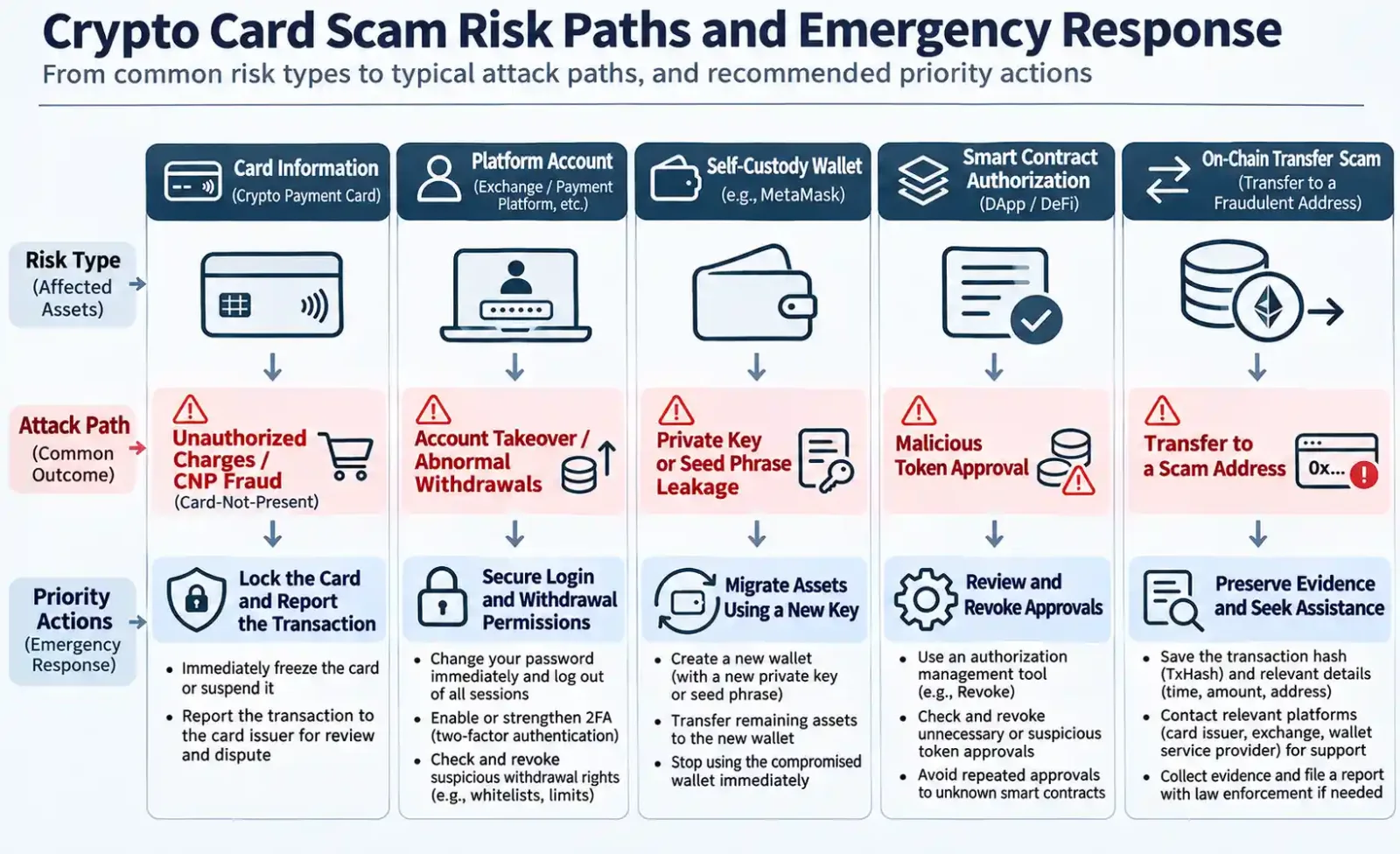
If you notice an unfamiliar charge or suspect a scam, take these steps first:
Unfamiliar card transaction: Lock the card through the official app, report the transaction to the issuer, and preserve the transaction records.
Suspected platform account takeover: Change your password from a trusted device, revoke suspicious login sessions, review withdrawal and authentication settings, and suspend further deposits.
Exposed wallet recovery phrase or private key: Create a wallet with entirely new keys in a secure environment, then promptly assess whether any assets still under your control can be transferred.
Suspicious smart contract approval: Review and revoke dangerous on-chain token approvals. Simply disconnecting a website is usually insufficient.
Transfer to a scam address: Preserve the transaction hash, recipient address, and communications. Contact the relevant platforms and report the incident to the appropriate authorities.
Never share one-time verification codes, passwords, private keys, or wallet recovery phrases with strangers claiming to represent customer support. Do not send additional funds for supposed account "unfreezing" or asset recovery services.
1. What Types of Fraud and Security Risks Affect Crypto Payment Cards?
Crypto payment cards do not all use the same funding structure.
Some products require users to deposit USDT or USDC in advance and convert those funds into a fiat-denominated spending balance. Others draw on crypto assets held in custodial platform accounts when payments are made. Still others connect to self-custodial wallets, involving on-chain asset conversions and smart contract approvals.
These arrangements expose different assets and account permissions to potential attackers.
Area at Risk | Information or Access an Attacker May Obtain | Main Consequences |
|---|---|---|
Payment card details | Card number, expiration date, CVV, and related information | Unauthorized card purchases |
Card management account | Login credentials, account sessions, authentication privileges | Card control and changes to settings |
Custodial platform account | Account access and withdrawal permissions | Asset withdrawals and account takeover |
Self-custodial wallet | Recovery phrase, private key, smart contract approvals | Unauthorized on-chain asset transfers |
Identity information | KYC documents, identity document photos, personal information | Identity theft and subsequent fraud |
Possessing a card number and CVV does not mean an attacker controls the associated self-custodial wallet. Likewise, freezing a payment card does nothing to invalidate a compromised wallet private key.
A separate risk arises when the platform account itself is taken over. Even after the card has been successfully frozen, an attacker may still be able to use account privileges to attempt other transactions involving the user's funds.
Identifying which accounts and permissions have been compromised is essential to choosing the appropriate response.
2. How Do Fake Support Agents Steal Verification Codes, Account Access, and Crypto Assets?
Customer support impersonation is a common form of social engineering fraud. Attackers do not necessarily need to defeat a platform's technical security controls. Instead, they exploit cardholders' concerns about frozen accounts, failed payments, or lost funds to persuade them to disclose sensitive information.
Common pretexts include:
An unusual card transaction requires immediate identity verification.
A KYC review has failed, and identity documents must be submitted again.
A card is about to be deactivated unless an activation fee is paid.
An account has been flagged for a policy violation, and funds must be transferred to a "safe address."
A refund has been approved, but a release or verification fee must be paid first.
These claims can sound plausible because legitimate card programs may require account restrictions, updated KYC information, or identity verification.
The key questions are whether the sender is genuinely authorized to represent the provider and whether the requested action is legitimate.
If someone asks for an account password, SMS verification code, wallet recovery phrase, or full card security code, or instructs you to transfer funds to a private wallet address supplied during the conversation, stop immediately.
The US Federal Trade Commission (FTC) warns in its guide to cryptocurrency scams that fraudsters frequently impersonate businesses or government agencies and persuade victims to transfer crypto assets under the pretext of protecting their money.
Can You Trust "Official Support" on Social Media?
Many crypto card providers operate communities on X, Telegram, and Discord. Scammers may copy a company's profile image and customer support name, then approach users who have publicly discussed payment problems.
Knowing the details of a user's problem does not establish that the person contacting them is legitimate. The information may have come directly from the user's earlier public messages.
To verify a support representative, access support through a previously verified official website or app rather than following links provided in unsolicited direct messages.
For example, Crypto.com offers Crypto.com Verify, a tool for checking certain official communication channels and contact details. This is a security feature specific to Crypto.com; similar tools are not available from every crypto card provider.
If you cannot verify the identity of someone claiming to be a support agent, end the conversation and submit your request through an official channel you open independently.
3. How Do Phishing Websites Steal Card Details and Wallet Permissions?
Crypto card phishing websites often imitate legitimate registration, card application, or account management pages. Users may arrive through search results, social media advertisements, or emails, believing they are accessing the provider's official service.
These pages generally fall into three categories, depending on what the attackers are trying to obtain.
1. Fake Registration Pages and Fraudulent Card Issuance Fees
Attackers reproduce a provider's branding, card designs, and application process to persuade users to register, upload KYC documents, or pay card issuance fees.
Submitting identity document photos and personal information may expose users to identity theft. Sending USDT to an address displayed on the fraudulent page may result in an immediate loss of on-chain assets.
Legitimate crypto payment cards may also charge issuance fees, so a payment requirement alone is not proof of fraud.
Before applying, confirm that the domain belongs to the official provider, that the fee appears in its published terms, and that any deposit address comes from a verified official account interface.
2. Login Pages Disguised as Account Security Centers
A user receives a notification claiming that their account has been compromised or their payment details need updating. After clicking the link, they reach an imitation login page and enter their password and one-time verification code. The attacker may then use those credentials to access the genuine account.
The presence of HTTPS does not establish that a website is operated by a legitimate provider. HTTPS protects the communication connection; it does not guarantee that the website's operator can be trusted.
The FTC's guide to recognizing and avoiding phishing scams describes how scammers use claims about account problems and payment information updates to direct users to fraudulent websites.
When you receive such a notice, open the verified official app or website independently and check whether the account actually has a corresponding alert.
3. Fake Wallet Connections and Smart Contract Approvals
Some wallet-linked crypto cards require users to connect a self-custodial wallet. Scammers may create fraudulent application pages that prompt users to sign messages or approve transactions after connecting their wallets.
A user may believe they are applying for a card when they are actually authorizing a smart contract to transfer certain tokens.
This attack does not necessarily require the attacker to obtain a wallet recovery phrase. A Token Approval signed by the user may allow a contract to transfer assets up to the approved allowance.
A familiar-looking wallet connection interface is not proof that a request is safe. Users must still verify the request's origin, the contract involved, the token, and the approval amount.
4. 3DS Verification Scams: Why Can Approving a Payment Still Lead to Fraud?
3D Secure (3DS) is a technical authentication mechanism used in online card payments to verify the cardholder's identity. An issuer may require a One-Time Password (OTP) or confirmation through its official app.
Scammers can exploit this authentication process to complete transactions the cardholder never genuinely intended to authorize.
For example, an attacker may already have the card number, expiration date, and CVV but still need additional authentication to make a payment. The cardholder then receives a message impersonating the issuer:
Suspicious payment detected. Please provide the SMS verification code to cancel the transaction.
In reality, the code may be needed to authenticate the payment the attacker is attempting.
Another tactic is to persuade the user to approve an unfamiliar transaction in the issuer's legitimate app, claiming the approval is necessary to "cancel the payment" or "remove a security restriction."
In these situations, reject authentication requests unrelated to a payment you initiated. Before confirming a transaction, check the amount, merchant, and other information shown. If anything does not match, do not proceed.
Successful 3DS authentication establishes only that the transaction passed the applicable authentication process. It does not, by itself, prove that the cardholder genuinely consented to the payment.
3DS authentication, card transaction authorization, and the cardholder's actual consent are three distinct concepts. Successful authentication does not guarantee that the issuer subsequently authorized the transaction. Nor does an authorized transaction necessarily establish that the cardholder consented to the purchase when a dispute arises.
If a verification code was obtained through deception, or the user was manipulated into approving an unfamiliar payment, the issuer must still investigate the transaction records, authentication results, cardholder's account of events, and other evidence.
3DS authentication results may affect the allocation of fraud liability and the evidence required in a card dispute, but they cannot determine the outcome on their own. In social engineering cases, the user's participation in authentication, whether they genuinely consented to the transaction, applicable card network rules, and local law may all affect the assessment of liability.
Even when a transaction involves fraud, whether the issuer must refund the payment or bear the loss depends on the investigation and applicable rules. The result cannot be determined solely by whether 3DS authentication succeeded or failed.
5. How Can You Tell Whether an Unfamiliar Card Charge Is Fraudulent?
Payment card fraud does not require the physical card to be lost.
In a Card-Not-Present (CNP) transaction, an attacker may use a compromised card number, expiration date, and security code to attempt an online payment.
The information may have been exposed through a phishing website, malware, a merchant security incident, or an account takeover. However, a single suspicious transaction usually cannot establish which merchant was responsible for a data leak, much less prove that the card provider's database was breached.
An Unfamiliar Merchant Name Does Not Always Mean Fraud
The merchant name on a card statement may differ from the brand a customer recognizes.
For example, a software subscription may be billed by an independent Merchant of Record, which acts as the seller and receives the payment. The statement may display that entity's name rather than the software brand.
When reviewing an unfamiliar charge, check recent orders, email receipts, App Store and Google Play billing records, and previous subscriptions.
If the source remains unclear, particularly when several unfamiliar transactions appear within a short period, lock the card and notify the issuer immediately. Do not delay protective action while checking old orders.
Small Unfamiliar Transactions May Be Preauthorizations or Card Testing
Some merchants use small authorization requests to check whether a card is valid. The amount may temporarily reduce the available balance without becoming a final charge.
Fraudsters may also use small transactions to test whether stolen card details work.
If you recently added the card to a service, check that provider's official verification practices. If you have not initiated any corresponding payment or card-linking activity, report the transaction to the issuer.
Pending Does Not Mean the Payment Has Been Completed
A Pending transaction is still being processed. It may involve an authorization hold, pending clearing, or a subsequent reversal.
Card payments typically involve authorization and clearing stages. A merchant might display a failed payment while the card account shows a Pending transaction because an earlier authorization has not yet been reversed or released.
This does not necessarily mean funds have been finally charged, but an unfamiliar authorization should not be ignored.
If you did not initiate the authorization, contact the issuer immediately. Whether the authorization can be reversed, when the held balance will be released, and whether a formal dispute is necessary depend on the transaction status and the issuer's policies.
For legitimate orders, avoid repeatedly attempting payment before confirming the status of the original attempt, as this can result in multiple authorization holds.
6. What Should You Do Immediately After Discovering Fraud or an Unauthorized Transaction?
Unauthorized Card Charges: Lock the Card and Report the Transaction
First, lock the card using the official app. Then report the unauthorized transaction to the issuer.
Coinbase's Coinbase Card security guidance explains how to temporarily lock a card and identifies unauthorized charges as a situation requiring protective action.
The scope of a card lock depends on the product. Some controls primarily prevent new transaction authorizations and may not cancel an existing authorization or stop a transaction from subsequently clearing.
When contacting the issuer, ask whether the existing card number should be canceled, a replacement card issued, and a fraud investigation or transaction dispute initiated.
Even if no charge has occurred, confirmed exposure of complete card details warrants contacting the issuer to assess card replacement and transaction monitoring measures.
Platform Account Takeover: Secure Logins, Email, and Withdrawal Permissions
Unusual login alerts, changes to account settings, or unexplained asset withdrawals may indicate a compromise extending beyond the payment card.
Use a trusted device to change your password, review logged-in devices and active sessions, revoke suspicious sessions, and reset or strengthen multi-factor authentication (MFA).
Also inspect withdrawal settings, trusted devices, and the email account linked to the platform. Email is commonly used for password resets. If the email account is compromised too, changing only the platform password may not prevent further unauthorized access.
If you suspect malware on a device, do not continue entering sensitive information on that device.
Until account security has been restored, suspend deposits to the affected account. In particular, never deposit USDT at the direction of an unfamiliar support representative in exchange for supposed fraud investigations or fund release services.
Exposed Recovery Phrase or Private Key: Move Assets You Still Control
If an attacker has obtained the recovery phrase or private key of a self-custodial wallet, the wallet's security must be treated as compromised.
On a trusted device in a secure environment, create a wallet using entirely new keys. Promptly assess whether assets that have not yet been transferred by the attacker can be moved to the new wallet.
The attacker may be attempting to transfer the assets at the same time, making prompt action important. However, a successful transfer cannot be guaranteed. The appropriate steps also depend on the wallet type, blockchain network, and the conditions governing control of the assets.
Importing the exposed recovery phrase into a different wallet app does not eliminate the risk. Freezing or replacing a payment card, or revoking ordinary token approvals, also cannot invalidate a compromised private key.
Malicious Token Approvals: Review and Revoke On-Chain Permissions
If you suspect that you signed a Token Approval on a phishing website, review the token allowances recorded on the relevant blockchain network.
A token approval and private key exposure are different security issues. Signing a suspicious approval does not necessarily mean the recovery phrase or private key has been compromised, and not every affected user must immediately create a new wallet.
MetaMask's token allowance management guide explains how to review and revoke token spending allowances. Revocation typically requires an on-chain transaction and payment of the applicable network fee.
Disconnecting a wallet from a website does not revoke an on-chain approval that has already taken effect.
Use a trusted approval management tool to verify the approved spender, token, allowance, and network, then revoke suspicious permissions when it is safe to do so. The precise method depends on the blockchain network, token contract, and support provided by the wallet or smart contract account.
Revoking an approval can restrict future use of that permission, but it cannot automatically recover assets already transferred. If the private key or recovery phrase has also been exposed, the incident must additionally be handled as a key compromise.
7. How Do Disputes and Recovery Options Differ for Card Fraud and On-Chain Losses?
Crypto payment cards involve two distinct transaction systems: card network payments and crypto asset transfers. Whether a refund is available, who handles the case, and which rules apply depend on where the loss occurred.
Unauthorized Card Transactions: File a Dispute With the Issuer
Cardholders may qualify for dispute procedures and liability protections for unauthorized transactions processed through payment card networks. However, the same policies do not necessarily apply to every crypto payment card.
Visa's Zero Liability Policy provides that eligible cardholders are not held responsible for unauthorized transactions.
The policy excludes certain commercial cards, anonymous prepaid card transactions, and transactions not processed through the Visa network. Cardholders must also take reasonable care to protect their cards and promptly report unauthorized use to the issuer. Actual reimbursement may depend on the investigation, timely reporting, and other applicable conditions.
Mastercard's Zero Liability Protection offers similar protection, subject to requirements to reasonably safeguard the card and promptly report a lost card or unauthorized transaction. Certain commercial cards and unregistered prepaid cards are excluded.
For crypto payment cards, a Visa or Mastercard logo alone does not establish that every account balance and transaction is covered by these protections. The actual issuer, card type, cardholder agreement, and country or region of issuance must also be examined.
Local laws may provide additional protections. For example, the US Consumer Financial Protection Bureau (CFPB) explains in its guidance on unauthorized prepaid card transactions that registered prepaid cards and certain other types of prepaid cards may qualify for error resolution rights under US federal law. Coverage depends on the card and account circumstances and should not be assumed to extend to other countries.
How Does a Fraud Dispute Differ From an Ordinary Merchant Refund?
An ordinary merchant refund generally concerns a transaction the customer authorized, such as a canceled order, merchandise that was not delivered, or a problem with a service.
A fraud dispute focuses on whether the cardholder authorized the transaction. Such cases are generally handled by the issuer through fraud investigation and dispute procedures.
A Chargeback is a mechanism for resolving eligible card transaction disputes under card network rules. It does not give cardholders an unconditional right to reverse any payment. Card network dispute rules, an issuer's cardholder agreement, and applicable consumer protection laws serve different purposes and are not interchangeable.
Coinbase Card's official dispute guidance distinguishes between authorized and unauthorized transactions and describes the corresponding dispute submission procedures.
Users should describe the events accurately and must not falsely report a purchase they explicitly authorized as unauthorized fraud. At the same time, providing card details to a merchant does not amount to permission to charge any amount at any time. Whether a transaction was validly authorized depends on the circumstances and applicable agreements.
On-Chain Transfers: Traceability Does Not Guarantee Recovery
If someone follows a scammer's instructions and sends USDT to a wallet address, that payment is an on-chain transfer. Its connection to a crypto payment card does not make it eligible for recovery through Visa or Mastercard chargeback procedures.
Confirmed blockchain transactions generally cannot be reversed unilaterally by the sender.
In its guidance on what to do after being scammed, the FTC advises victims of cryptocurrency payment scams to contact the relevant exchange or service provider promptly, report the fraud, and ask whether any remedial action is possible.
If the funds reach an account controlled by a centralized platform, the platform or law enforcement authorities may be in a position to take further action. Recovery can become substantially more difficult once the funds move beyond their control.
Blockchain transaction hashes and addresses can help trace the movement of funds. However, identifying an address does not establish who actually controls it, much less provide the authority to freeze or recover the assets.
8. How Should You Preserve Evidence and Avoid Recovery Scams?
Keep Transaction Records and Account Security Evidence
After discovering an unauthorized transaction, preserve the original records that document what happened.
Incident Type | Evidence to Preserve |
|---|---|
Unfamiliar card charge | Date, time and time zone, merchant name, currency, amount, last four digits of the card, transaction status |
Platform account takeover | Unusual login alerts, session records, account setting changes, withdrawal records |
Fake support and phishing websites | Chat histories, sender accounts, domain names, payment demands, related notifications |
On-chain asset transfers | Transaction hashes, blockchain network, token, sending and receiving addresses |
Dispute or complaint | Support ticket numbers, contact dates, submitted documents, platform responses |
Protect personal information when preserving evidence. Redacted copies of screenshots may be appropriate when contacting support, but never send a complete card number, CVV, OTP, account password, recovery phrase, or private key through ordinary chat attachments.
If identity documents must be uploaded, use an official secure submission channel that you have independently verified.
Beware of Scammers Impersonating Asset Recovery Services
After a victim publicly discusses financial losses, scammers may contact them again while posing as lawyers, blockchain investigators, regulators, or asset recovery teams.
They may claim to have located the stolen USDT but insist that taxes, verification fees, processing fees, or contract activation charges must be paid before the funds can be released.
In an August 2026 consumer alert about recovery scams, the FTC warned that these schemes target people who have already lost money, with fraudsters impersonating government agencies, law firms, or other organizations to obtain fees and personal financial information.
Legitimate legal representation and blockchain investigation services may charge reasonable fees. However, wallet tracing screenshots, purported success stories, or regulatory documents do not, by themselves, establish that someone can recover the funds.
Be particularly cautious of unsolicited organizations demanding an advance "fund release fee."
Suspected criminal activity can be reported to the police or competent authorities in the relevant jurisdiction. US users can submit fraud reports through the FTC's ReportFraud.gov. Users elsewhere should follow the official reporting procedures in their jurisdictions.
Reporting helps preserve an official record and may provide investigative leads, but it does not guarantee recovery.
9. Crypto Card Security Checklist and Incident Response Guide
Everyday crypto card security practices should reflect the product's funding structure.
For cards funded through prepaid balances, users can manage their available spending funds according to actual needs rather than keeping substantially more money available than they ordinarily spend. Where supported, transaction limits, online payment controls, and temporary card locks can be adjusted to match usage.
When using virtual cards for subscriptions, periodically review the merchants that retain card credentials. To stop using a service, cancel the subscription through the merchant's official process. Deleting or locking the card does not necessarily terminate an existing contract or payment obligation.
For wallet-linked products, regularly review smart contract approvals and allowances to avoid leaving unnecessarily large permissions active.
Keep official apps, operating systems, and authentication methods secure and up to date. Transaction notifications and MFA can help identify unusual activity and reduce account takeover risks, but they do not replace careful review of payment, signature, and approval requests.
The following table provides an initial response guide for suspicious activity.
Confirmed or Suspected Situation | Immediate Focus | Recommended Action |
|---|---|---|
Unfamiliar card purchase | Issuer and payment card | Lock the card, report the unauthorized transaction, request an investigation |
Unusual login or account setting change | Platform account | Change the password, revoke suspicious sessions, review withdrawal permissions |
Exposed card details | Payment card credentials | Contact the issuer about canceling the card number, replacing the card, and monitoring transactions |
Exposed recovery phrase or private key | Self-custodial wallet | Transfer assets still under your control using a wallet with entirely new keys |
Suspicious Token Approval signed | Smart contract permissions | Review the relevant network and revoke dangerous approvals |
Transfer induced by a scammer | On-chain assets and related accounts | Preserve transaction evidence, contact relevant service providers, report the incident to the authorities |
Unfamiliar charge traced to an old subscription | Merchant billing relationship | Review the agreement, cancel the subscription, or request an ordinary refund |
If the circumstances remain unclear, prioritize securing accounts and assets you still control. Do not make further deposits or follow unverified "security support" instructions to initiate new transfers or wallet approvals.