
A crypto payment card advertising 2% cashback may pay out no more than $5 a month at its entry-level tier. Another card promising 8% may require a paid subscription or a lockup of the platform's tokens. Even a successful card payment does not guarantee rewards: money transfers, stored-value account top-ups, and certain software purchases may be excluded.
To determine whether a cashback program is worthwhile, cardholders need to establish which purchases qualify, how reward caps apply, and what it costs to earn those rewards. Drawing on the published rules of Bybit, Crypto.com, Wirex, Nexo, and Coinbase, this article examines the gap between advertised rates and actual returns.
Key Takeaways
Calculate realized gross cashback against total spending. Once excluded transactions and monthly caps are taken into account, a card advertising 3% cashback may deliver a substantially lower realized gross rate.
Reward caps are measured differently across programs. Bybit limits monthly points and their corresponding reward value. Certain U.S. Crypto.com card tiers cap the amount of spending eligible for cashback, while Wirex sets per-transaction and monthly limits denominated in WXT.
A successful payment does not guarantee cashback. Merchant Category Codes (MCCs), funding sources, settlement timing, and the purchase channel used for certain merchants can all affect eligibility.
Net returns must account for actual costs. Subscription fees, conversion spreads, and transaction charges reduce reward value. Token-lockup risks and credit interest must also be assessed separately.
1. How to Calculate Advertised and Realized Cashback Rates
Crypto card rewards may be paid in stablecoins, BTC, or platform tokens. Some programs award points that users must subsequently redeem. Regardless of the payout method, three measures should be distinguished:
Advertised Cashback Rate: The percentage specified in the reward terms, generally applicable only to eligible purchases.
Realized Gross Cashback Rate: The value of rewards actually received during a given period divided by all card spending during that period, before deducting costs.
Net Reward Rate: The realizable value of rewards, less the associated costs of earning and redeeming them, divided by total card spending.
Suppose a cardholder spends $1,000 in a month, but only $600 qualifies for 3% cashback, with a monthly reward cap of $15. The theoretical reward is $600 × 3% = $18. After applying the cap, the cardholder receives $15, producing a gross cashback rate of $15 ÷ $1,000 = 1.5%.
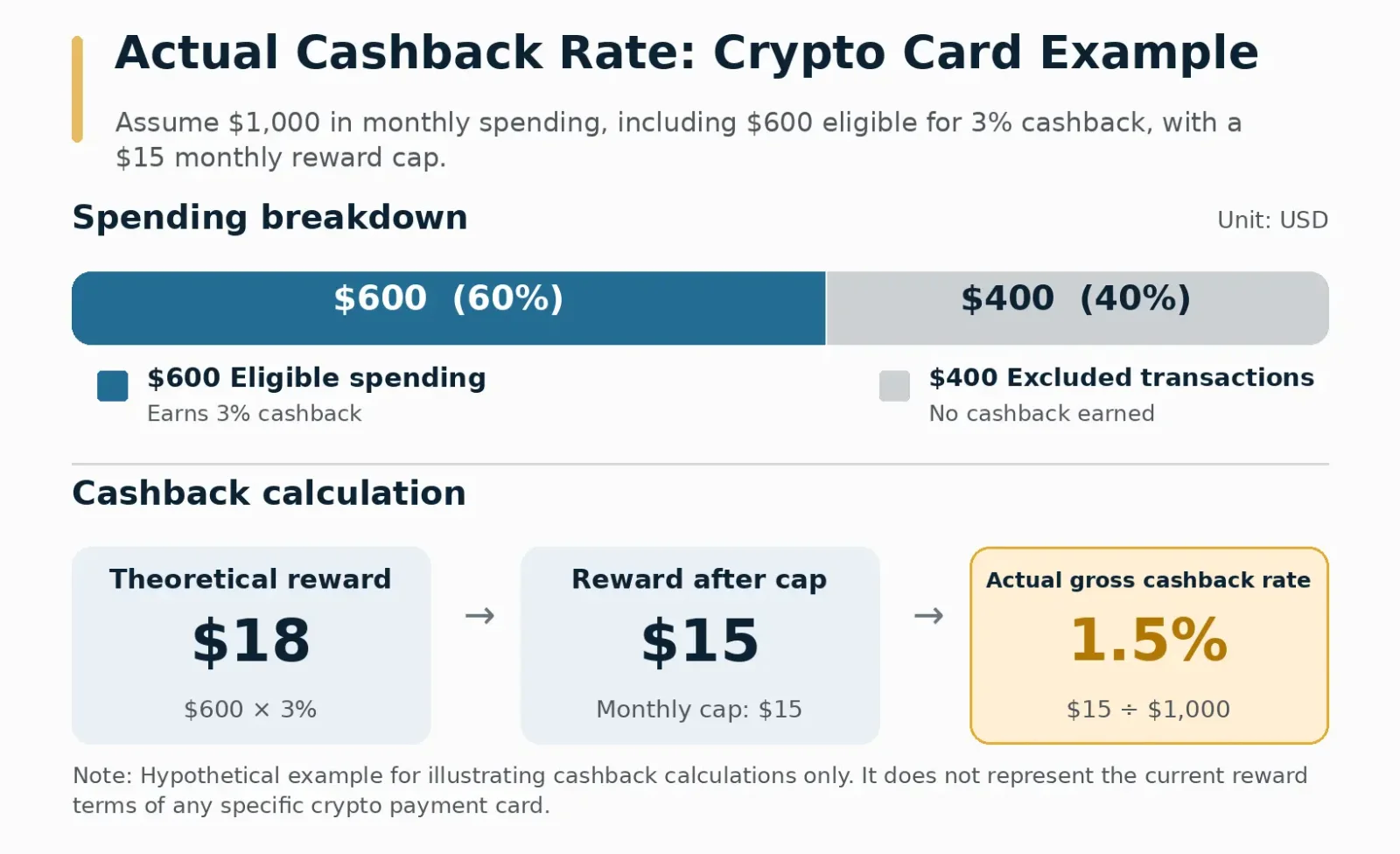
Reward calculations should begin by establishing transaction eligibility, the applicable tier and rate, and any reward caps. Transaction eligibility, applicable rates, and caps determine the quantity of rewards actually earned; the reward currency, redemption price, and associated fees determine the final net return. Platforms may differ in when tier changes take effect, how rewards are calculated, and which settlement dates govern eligibility.
The denominator must also be consistent. When promotional materials advertise "3% cashback on eligible purchases," the rate applies to eligible spending. This article instead measures realized gross cashback against all card spending in the same period, including transactions that earn no rewards. Calculating rewards against eligible spending alone can help verify whether the provider has applied its rules correctly, but it does not measure the card's contribution to a cardholder's overall spending.
For rewards that have not yet been converted, record their reference value when credited. Once the assets are sold or used for payment, calculate the net amount realized. Separating these two points in time makes it possible to distinguish the original reward from gains or losses incurred while holding cryptoassets.
2. How Cashback Caps Affect Returns
The term "cashback cap" can refer to very different limits. Depending on the card program, the restriction may apply to reward value, points earned, tokens awarded, or the amount of spending eligible for rewards. These differences determine how much spending can actually benefit from a higher advertised rate.
Reward Value Caps: Bybit Card
According to Bybit's reward rules, updated October 30, 2026, the Base tier for non-VIP users offers 2% cashback, with a monthly limit of 2,500 points worth $5. Beta also offers 2%, but raises the monthly cap to 25,000 points worth $50. Higher tiers offer 4%, 6%, 8%, or 10%, subject to their respective eligibility requirements and caps. Under these rules, the monthly reward limits for Alpha, Apex, Omega, and Infinite correspond to $150, $250, $400, and $600, respectively. The higher advertised percentages therefore do not translate into unlimited rewards.
Consider a non-VIP user with no other Bybit Card or Bybit Pay spending who makes $400 in eligible purchases during the month and remains at Base. At 2%, the expected reward would be $8, but the $5 cap reduces the gross cashback rate to $5 ÷ $400 = 1.25%. If the user spends only $200, the $4 reward remains below the cap.
Bybit reward tiers can change with spending. Non-VIP users can unlock Beta after reaching $500 in monthly spending and Alpha after reaching $3,500. Tiers unlocked through spending remain valid until the end of the following calendar month. VIP users have a base tier determined by their VIP status and can also upgrade through spending.
Bybit Card and Bybit Pay transactions count together toward tiers and points. Their regular reward caps cannot be applied separately. Once an upgrade threshold is reached, rewards must be calculated using the tier rules applicable to each transaction rather than assuming that Base applies throughout the month.
Eligible Spending Caps: Crypto.com
Crypto.com's U.S. Prepaid Visa Card Fees and Limits specify that the Plus tier (formerly Ruby) earns the applicable rewards on the first $750 in eligible monthly spending, while Pro (formerly Jade/Indigo) has a $1,500 threshold. Certain Private tiers continue earning rewards at a lower rate after reaching their spending thresholds. For Icy/Rose, the threshold is $3,000 per month, after which the rate falls to 0.5%. For Obsidian, the threshold is $5,000, after which the rate is 1.0%.
These are reward-eligible spending limits under the U.S. card program. They should not be used to infer cashback rules in other regions, and they are not limits on how much a cardholder can spend with the card.
For tiers that continue paying a reduced rate above the threshold, rewards must be calculated separately for spending below and above that amount.
Per-Transaction and Token Quantity Caps: Wirex
Wirex's Cryptoback rules specify reward limits in WXT tokens. Standard Entry allows up to 100 WXT per transaction and 10,000 WXT per month. The corresponding limits for Elite Ultimate are 9,000 WXT and 250,000 WXT.
Two cardholders with identical monthly spending may earn different rewards if their transaction sizes differ. Each transaction must therefore be checked against its individual cap before the month's WXT rewards are totaled and compared with the monthly limit. Because WXT's market price fluctuates, 10,000 WXT does not represent a fixed dollar reward value. Wirex also notes that reward amounts and currencies may differ for customers in the United Kingdom and United States, making the terms applicable to the individual account decisive.
3. Which Transactions Are Excluded From Cashback?
A transaction may be successfully authorized and ultimately settled without qualifying for cashback. Reward exclusions commonly depend on transaction type, merchant category, and funding source.
A Merchant Category Code (MCC) is assigned through the acquiring process according to the merchant's business activities and payment network rules. Issuers may exclude specific MCCs from rewards. Although two transactions may both be online payments, software sales, advertising services, and general retail purchases may fall into different categories. Cardholders generally cannot choose a merchant's MCC, and the product name or checkout page alone is rarely sufficient to establish it. Different legal entities or checkout channels operated by the same brand may also be classified differently.
Crypto.com's CRO reward exclusion rules, updated June 2, 2026, include the following categories:
MCC | Category | Common Transactions |
|---|---|---|
4829 | Money transfers | Wire transfers, remittances |
4900 | Utilities | Water, electricity, gas, and similar bills |
5734 | Computer software sales | Software purchases |
6012 | Financial institution goods and services | Certain account top-ups, financial product purchases, debt repayments |
6540 | Stored-value card purchases and loading | Stored-value account top-ups |
9311 | Tax payments | Taxes and related government charges |
For example, if a SaaS subscription is classified under MCC 5734 and the exclusion applies, the payment will not earn CRO rewards even if it succeeds. A merchant's name does not establish its MCC. Cardholders can review their transaction details or ask the issuer to confirm the actual classification.
Bybit's rewards FAQ excludes ATM withdrawals, financial institution services, certain prepaid and stored-value top-ups, money transfers, and canceled, reversed, or refunded transactions. It also identifies categories including MCC 6011 (cash disbursements at financial institutions) and MCC 6051 (foreign currency and non-fiat transactions), as well as certain person-to-person transfers through digital wallets. Wirex's Cryptoback rules exclude ATM withdrawals, person-to-person transfers, tax payments, and specified MCCs. Exclusion lists from one card program should not be applied to another.
Bybit also restricts the source of funds used for payment. Under its official reward rules, effective October 5, 2026, at 10:00 UTC, only eligible Bybit Card transactions funded with cryptoassets can earn regular points or cashback. Transactions paid from fiat balances no longer qualify. Bybit determines which rules apply using the settlement time submitted by the merchant, rather than the card authorization time. A transaction authorized before the change but settled on October 6 is therefore subject to the new rules.
4. Membership Fees, Token Lockups, and the Realizable Value of Rewards
A higher cashback percentage does not necessarily mean a higher net return. Some tiers require paid subscriptions, while others require users to hold or lock tokens. Once rewards are distributed, market price movements and transaction fees can further affect their value. Each component should be calculated separately.
Membership Upgrades: Calculate the Break-Even Spending Level
Wirex's X-tras pricing and tiers describe three plans: Standard, Premium, and Elite. Standard Entry offers 0.5% Cryptoback. Premium Entry offers 1% for a monthly fee of €9.99, while Elite Entry offers 4% for €29.99 per month.
Certain higher tiers also require users to lock specified amounts of WXT for 180 days. The amounts vary by tier: Standard Enhanced requires 150,000 WXT; Premium Enhanced and Premium Ultimate require 250,000 and 750,000 WXT, respectively; and Elite Enhanced and Elite Ultimate require 1,500,000 and 7,500,000 WXT.
When comparing a paid tier with a free one, the relevant question is whether the additional cashback earned after upgrading covers the membership fee. The entire reward from the paid tier should not be counted as an incremental benefit.
Suppose a free tier pays 1%, while a paid tier offers 3% for $15 per month. Assume both have identical eligible spending rules and no caps. The incremental cashback rate is two percentage points, giving the following break-even calculation:
$15 ÷ (3% − 1%) = $750 in eligible spending per month
At $400 in monthly eligible spending, upgrading generates only $8 in additional rewards. At $1,500, it produces an additional $30, leaving a net gain of $15 after the subscription fee. This simplified example excludes other plan benefits and token-related costs. If reward caps apply, the calculation must be adjusted.
A membership fee is a direct expense. Locking WXT, by contrast, restricts liquidity and exposes the holder to token price volatility. Users purchasing additional tokens to qualify for an upgrade must also account for trading spreads and fees. Existing WXT holders face a different incremental cost. The entire market value of locked tokens should not be treated as a membership fee, but the risks associated with holding locked assets cannot be ignored.
Token Rewards: Separate Distribution Value From Realized Value
According to Nexo Card's official documentation, the card is available to eligible users in certain European markets. When the account holds more than $5,000 worth of digital assets and meets the applicable loyalty requirements, purchases made in Credit Mode can earn NEXO Token or BTC rewards:
Tier | NEXO Token | BTC |
|---|---|---|
Base | 0.5% | 0.1% |
Silver | 0.7% | 0.2% |
Gold | 1% | 0.3% |
Platinum | 2% | 0.5% |
A Platinum user making $1,000 in eligible purchases could receive NEXO Tokens valued at $20 when awarded, or BTC valued at $5, under these rates. The amount ultimately realized depends on market prices and transaction fees when the rewards are sold. Loyalty tiers also depend on the proportion of NEXO Tokens in the account's assets. The rates above apply only to users who meet Nexo's geographic and account requirements.
If a token reward worth $20 when distributed loses 30% of its value before sale, its proceeds fall to $14 before fees. A price increase could instead generate additional gains. These are holding-period gains or losses, not changes to the original cashback rate. Rewards distributed in stablecoins such as USDT also involve potential depegging, liquidity, and issuer risks.
Points require redemption as well. Eligible Bybit points initially enter a pending state before they can be redeemed through its Rewards Market or automatically converted through Auto Cashback. The official documentation for the U.S. Coinbase Card debit card explains that users select crypto rewards from current offers. Reward rates can change, and offers have expiration dates. Rewards already earned do not expire simply because the promotional offer ends.
Rewards that have not been sold can be valued at current market prices, but unrealized appreciation should not be recorded prematurely as cash income.
Nexo's Credit Mode introduces borrowing costs. Cardholders spend against a credit line backed by digital assets, and any interest incurred must be deducted from cashback. For example, if $1,000 in eligible spending generates a $20 reward but accrues $12 in interest, only $8 remains before other expenses. The management and market risks of collateral must be assessed separately. Comparing a credit-backed transaction with spending from a prepaid balance solely on cashback rates would be misleading.
Interest also depends on the duration of borrowing. Two transactions may both earn $20 in cashback, yet produce very different net returns depending on whether the loan is repaid within days or remains outstanding for an extended period. Calculations for credit-backed card rewards should use actual borrowed amounts, the applicable interest methodology, and repayment dates, rather than simply subtracting an annualized borrowing rate from an advertised cashback percentage.
5. How 100% Subscription Rewards and Refunds Work
Bybit offers designated subscription promotions for services including ChatGPT Plus, Claude Pro, Netflix, Spotify, and TradingView, providing points equivalent to 100% of the purchase amount. Eligibility and redemption remain subject to specific conditions.
Under the official program rules, effective October 5, 2026, at 10:00 UTC, the benefit is available to non-VIP users at Tier 3 or above and to all VIP users. Purchases must be funded with cryptoassets and made directly on the merchant's official website using Bybit Card. Transactions processed through the App Store or other third-party payment channels do not qualify for this particular reward. Points are also subject to monthly reward caps.
Each $1 spent earns 500 points. In Bybit's example, paying $11.99 on Spotify's official website earns 5,995 points, which become available after a four-calendar-day pending period. The "100%" figure refers to the equivalent reward value of the points; it does not mean the subscription is free at checkout. Monthly reward limits still apply.
Merchants may also decline payments based on card type, issuing region, or billing address. A subscription's inclusion on the eligible services list only means that a qualifying purchase can participate in the promotion. The transaction must first be completed successfully before points are awarded.
Refunds can result in reward clawbacks. Bybit's official FAQ states that points already used may be deducted from the account at their corresponding value, while unused points may be revoked. A refund does not restore the monthly points cap already consumed.
Hotels, car rentals, and similar merchants may also place an initial authorization hold before settling the final amount. The temporary hold displayed in a payment notification is not necessarily the amount used for the final reward calculation. Transactions spanning a rule change should likewise be assessed using the merchant's actual settlement time. When investigating disputed reward calculations, the relevant records are the final posted transaction amount, the funding source, and the corresponding reward entries.
6. Spending $1,500 a Month: How Much Cashback Is Left After Costs?
Consider a standardized hypothetical example that does not represent any provider's current pricing. Monthly card spending totals $1,500, of which $1,000 qualifies for rewards and $500 consists of excluded transactions. The advertised cashback rate is 4%, capped at $25 per month. The cardholder also pays a $9.99 membership fee and incurs $8 in combined asset-conversion and foreign-exchange charges. Assume the rewards can be converted at the dollar values shown.
Item | Calculation | Amount (USD) |
|---|---|---|
Total spending | — | $1,500.00 |
Eligible spending | — | $1,000.00 |
Theoretical reward | $1,000 × 4% | $40.00 |
Reward after cap | min($40, $25) | $25.00 |
Membership fee | — | −$9.99 |
Conversion and FX charges | — | −$8.00 |
Net reward proceeds | $25 − $9.99 − $8 | $7.01 |
Measured against total spending, the realized gross cashback rate is $25 ÷ $1,500 ≈ 1.67%. After deducting the stated expenses, the net reward rate is $7.01 ÷ $1,500 ≈ 0.47%.
This example treats the membership fee and $8 in charges as costs incurred specifically by choosing this card arrangement. A comparison between two cards should go further and consider incremental costs. For instance, a conversion fee that is unavoidable under both payment methods should not be deducted exclusively from one card's returns. If the actual sale value of the reward tokens changes, the $25 figure should be replaced with the net amount realized.
Cross-card comparisons should also use consistent reporting periods, spending profiles, and exchange-rate assumptions.
7. How to Decide Whether a Card's Cashback Is Worthwhile
Examining your own monthly transactions is generally more useful than comparing providers' advertised "maximum cashback" figures. Everyday shopping, cross-border payments, and software subscriptions produce different spending profiles, which in turn affect eligible amounts and additional costs.
Users whose eligible monthly spending falls below the break-even threshold for a paid tier may be better served by a free tier with transparent rules. Frequent cross-currency spenders should include foreign-exchange and asset-conversion costs in the same calculation. Those who regularly pay for SaaS products and digital services should prioritize verifying the MCCs used by their principal merchants.
Check | What to Verify |
|---|---|
Eligibility | Whether the user's region, card program, and account tier qualify for rewards |
Eligible spending | Restrictions involving frequently used merchants' MCCs, transaction types, funding sources, and payment channels |
Cashback and caps | Applicable reward rate; per-transaction, monthly, and eligible-spending caps |
Tier costs | Membership fees, minimum holdings, and token-lockup amounts and periods |
Reward realization | Reward currency or points, crediting times, redemption requirements, and actual selling costs |
Special transactions | Whether refunds trigger reward clawbacks or restore caps; how settlement timing affects eligibility |
Additional expenses | Asset-conversion costs, FX charges, and any interest incurred in Credit Mode |
Identify the eligible purchases on your statement, calculate the rewards under the actual program limits, and subtract the additional costs of using that card arrangement. If a merchant's MCC or your account tier has not been confirmed, do not treat the highest advertised cashback percentage as a guaranteed return.