
Southeast Asia is one of the world’s more active regions for crypto-asset use, but the payment card landscape differs considerably across its four major markets.
Singapore already has compliant products issued specifically to local residents; users in Malaysia and Thailand rely more heavily on offshore platforms; and although Vietnam has a large crypto user base, its domestic card-issuing market remains at an early stage.
To determine whether a country “supports crypto payment cards,” it is not enough to ask whether a card can be used at local merchants. At least three separate questions need to be considered:
Can local residents apply using domestic identity documents and a local address?
Can an overseas-issued Visa or Mastercard be used locally?
Do local regulations allow merchants to accept cryptocurrency directly?
These three conditions do not always exist at the same time.
A Visa card funded with USDT may work in Bangkok or Kuala Lumpur, but during the transaction the platform will usually have converted the USDT into fiat currency. The merchant receives Thai baht or Malaysian ringgit, not cryptocurrency directly.
Sources and Scope of Conclusions
Primary-source verification: Payment Services Act and payment services regulation; Digital Asset Business; FATF Standards on Virtual Assets and VASPs.
For verifiable facts concerning the regulatory and availability boundaries of crypto payment cards relevant to users in Singapore, Malaysia, Thailand and Vietnam, the official and regulatory documents listed above take precedence. Actual service status, fees, eligibility and geographic coverage should be confirmed on the issuer’s or platform’s pages at the time of application.
Actual eligibility across Southeast Asian markets also depends on whether the issuer supports the applicant’s country of residence, local payment regulations and real-time KYC review. User experience, approval rates, fee comparisons or trend assessments not directly disclosed in the primary sources above are analysis or inference and have not been officially confirmed by the relevant institutions for individual cases.
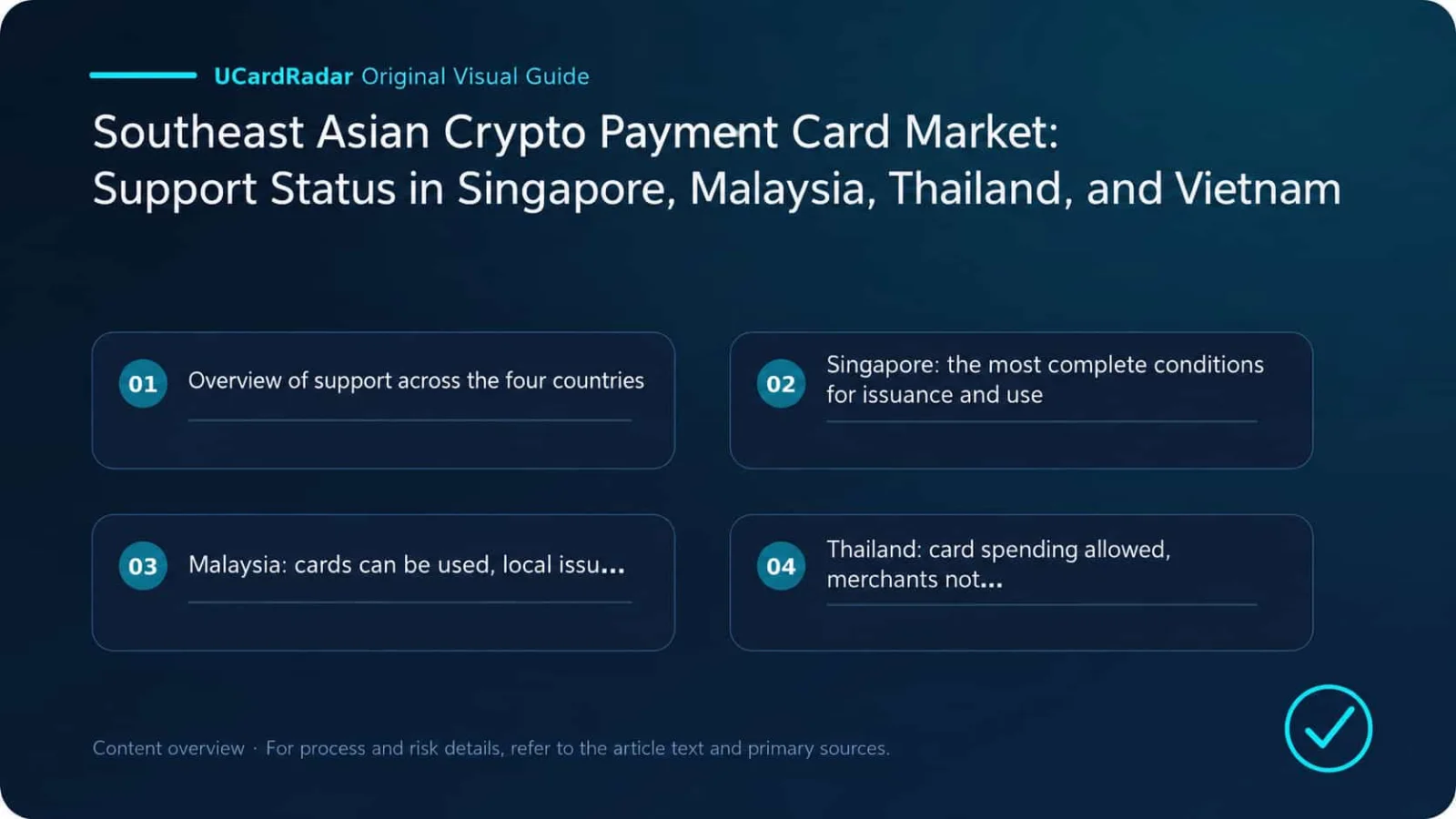
Overview of Support Across the Four Markets
Country | Local resident applications | Use of overseas crypto cards | Local issuance environment | Market status |
|---|---|---|---|---|
Singapore | Some products explicitly available | Most international cards generally work | Relatively mature compliant issuance arrangements already exist | Most mature of the four |
Malaysia | Some international products available | International cards usually work at accepting merchants | Few local products | Usable, but with limited choice |
Thailand | Some international products available | Visa and Mastercard acceptance available | Direct crypto payments are restricted | Cards can be used, but merchants receive baht |
Vietnam | Some international products available | Usable online and at large merchants | Local issuance still at an early stage | Strong demand, limited supply |
“Available to apply” does not mean every resident will pass review. Platforms may still verify nationality, residence, identity documents, proof of address, source of funds and account risk.
Singapore: The Most Complete Issuance and Usage Framework
Among the four markets, Singapore has the clearest support environment.
Singapore does not recognize Bitcoin or stablecoins as legal tender, but it has established a regulatory framework for digital payment token services. Companies involved in crypto-asset exchange, transfer, custody and payment services may need to obtain the appropriate licences depending on the nature of their activities.
The regulatory requirements are strict, but they also provide clearer operating boundaries for legitimate card programs. A platform cannot rely solely on having a Singapore-registered company to offer digital token services globally. Whether the appropriate licences are held, and which institutions are responsible for card issuance and custody, is becoming increasingly important.
Singapore Residents Have Clear Application Channels
Crypto.com has long offered prepaid Visa cards to users with Singapore residential addresses, with separate application requirements, limits and fee rules for Singapore users.
These products require users to submit a genuine residential address and supporting documents. This shows that they are not simply overseas cards issued under a single global framework, but products with a dedicated service arrangement for the Singapore market.
Some international stablecoin card platforms also do not list Singapore as a restricted jurisdiction. Users who pass KYC and address verification can generally apply for a virtual or physical card.
However, support for Singapore users should always be confirmed against the platform’s current onboarding page and card terms. The fact that a platform allows account registration does not by itself prove that its card is available.
Mature Card Acceptance, but Local Payments Do Not Depend on Crypto Cards
Card acceptance is high in Singapore. Visa and Mastercard are widely accepted at shopping malls, hotels, restaurants, transport services and online merchants. Unless restricted by the issuer or merchant, a crypto card can generally be used much like a conventional international bank card.
For residents who already have a Singapore bank account, however, a crypto card is not necessarily the most convenient way to make local payments.
PayNow, SGQR and local bank cards already cover a wide range of everyday use cases. Small transfers, dining and in-person payments usually do not require moving stablecoins onto a card and converting them into Singapore dollars first.
Crypto cards in Singapore are better suited to uses such as:
Paying for overseas software and subscriptions with stablecoins;
Converting on-chain assets into spendable everyday balances;
Managing cross-border income and expenses;
Serving as a backup to conventional credit cards;
Providing a payment account for international travel and overseas e-commerce.
Overall, Singapore has the clearest application requirements and card-issuing structure of the four markets. Local residents can not only use overseas crypto cards, but can also find products specifically issued for Singapore addresses.
Malaysia: Cards Can Be Used, but Local Issuance Remains Limited
Malaysia has an active digital-asset trading market, but regulators have remained cautious about the use of crypto assets for everyday payments.
Bank Negara Malaysia does not recognize crypto assets as legal tender or regulated payment instruments. Local digital-asset trading platforms are primarily regulated by the Securities Commission, and unregistered platforms may be restricted from providing services to Malaysian users.
This creates a common misconception: just because an exchange offers a crypto payment card globally does not mean it can issue that card to Malaysian residents.
Account services and card services often follow separate regional policies. A user may be able to register with an exchange and buy crypto assets while still having no card application option in the account.
International Stablecoin Cards Remain the Main Option
Some stablecoin card platforms serving global markets do not currently list Malaysia as a restricted jurisdiction. After completing identity and address verification, Malaysian residents may be able to apply for a virtual or physical card.
Other platforms, however, provide Malaysian users with wallet, trading or yield services but do not offer payment cards.
Before applying, users should therefore confirm the following separately:
Whether the platform accepts Malaysian users;
Whether card functionality is available to Malaysian addresses;
Whether physical cards can be delivered to Malaysia;
Whether Malaysian identity documents and proof of address are accepted;
Which country the actual card issuer is based in.
“Platform supports Malaysia” should not be treated as equivalent to “card supports Malaysia.”
International Card Merchants Usually Accept Them
Overseas-issued Visa or Mastercard crypto cards can usually be used at Malaysian merchants that accept international bank cards.
Users may fund the card with USDT or USDC, but when a purchase is made, the platform converts the crypto asset and the merchant receives Malaysian ringgit. From the merchant’s perspective, it is still a conventional card transaction.
Useful crypto-card use cases in Malaysia include:
Overseas software and AI-tool subscriptions;
International e-commerce purchases;
Advertising-account top-ups;
Overseas travel;
Converting stablecoins into spendable balances.
For small everyday payments, however, DuitNow QR already has very high penetration. Restaurants, convenience stores and individual merchants often prefer local QR payments, so a crypto card is not necessarily more convenient than a local bank account.
The practical reality of the Malaysian market is that crypto cards can be used and some international products can be applied for, but compliant local issuance remains limited and users depend mainly on offshore platforms.
Thailand: Card Payments Are Allowed, but Merchants Cannot Receive Crypto Directly
Thailand has a relatively clear policy boundary around crypto payments.
Licensed entities may offer digital-asset trading and related services, but authorities discourage the direct use of digital assets to pay for goods and services. A key regulatory objective is to prevent assets such as Bitcoin and USDT from bypassing the Thai-baht payment system and becoming direct merchant settlement instruments.
That does not mean crypto cards cannot be used in Thailand.
A typical crypto-card transaction works as follows:
The user holds stablecoins or other crypto assets, the platform converts them at the time of payment, and Visa or Mastercard settles the transaction to the merchant in Thai baht.
The merchant receives baht, so from the receiving side it remains an ordinary bank-card transaction.
Some International Cards Are Available to Thai Residents
Some international stablecoin card platforms do not list Thailand as a restricted market, allowing Thai residents to attempt KYC using local identity documents and addresses.
As in Malaysia, however, some platforms allow Thai users to open wallet or trading accounts without providing them with a payment card.
Users therefore need to check whether the card application page is actually open to Thailand rather than relying only on general platform availability.
TouristDigiPay Is Not Direct Cryptocurrency Payment
Thailand has previously introduced pilot schemes such as TouristDigiPay, which allow foreign tourists to convert digital assets into Thai baht and then spend through local electronic-money or QR-payment systems.
The purpose is not to enable merchants to accept Bitcoin or USDT directly, but to provide tourists with another route for converting digital assets into baht.
The logic is similar to a crypto card: crypto assets provide the source of funds, while the final payment still enters the Thai-baht system.
The difference is that crypto cards rely on the Visa or Mastercard merchant network, while TouristDigiPay is closer to local e-wallet and QR-payment infrastructure.
International Bank Cards Do Not Cover Every Local Payment Scenario
Large shopping malls, hotels, chain restaurants and tourist-oriented merchants in Thailand usually accept international bank cards, but small restaurants, night markets and individual merchants often accept only PromptPay.
Even if a Visa crypto card works in Thailand, it cannot replace local QR payments.
For tourists and users with international spending needs, a crypto card can supplement bank cards and cash. For long-term residents, a local bank account and PromptPay remain more suitable for everyday small-value payments.
The conclusion for Thailand is straightforward: some international crypto cards are available and can be used at merchants that accept international cards, but merchants ultimately receive Thai baht. This should not be interpreted as Thailand permitting direct cryptocurrency payments to merchants.
Vietnam: Many Crypto Users, but Limited Local Card Supply
Vietnam has a large crypto-asset user base, but the domestic crypto payment card market has not kept pace with user demand.
In recent years, Vietnam has begun building a legal framework for digital assets and promoting regulated market pilots. This means the legal status of digital assets is gradually becoming clearer, but card issuance, fiat settlement, consumer protection and local licensing frameworks still require further development.
Vietnam’s current regulatory focus on digital assets remains primarily on trading, issuance and market management rather than allowing ordinary merchants to accept Bitcoin or USDT directly.
As a result, most crypto cards used by Vietnamese users are still issued by overseas platforms. At payment, the platform converts the crypto asset and the international card network then settles with the merchant in Vietnamese dong or another fiat currency.
International Products Are Available, but Choice Is Still Limited
Some international stablecoin card platforms do not restrict applications from Vietnamese residents. Users may attempt verification using Vietnamese identity documents and residential addresses.
Other international wallet platforms provide Vietnamese users with accounts and crypto functionality but do not offer cards.
Vietnamese residents should pay particular attention to:
Whether Vietnamese identity documents are accepted;
Whether Vietnamese residential addresses are supported;
Whether both virtual and physical cards are available;
Whether physical cards can be delivered to Vietnam;
Whether long-term card renewal is supported for Vietnamese users;
Whether refunds can be returned to the original card balance;
Whether funds can still be withdrawn normally after an account review is triggered.
Many small virtual-card products may work in the short term, but renewal, refund and balance-withdrawal mechanisms are often unclear.
The Main Value Is in Online and Cross-Border Use
The most common reasons Vietnamese users use crypto cards are not local convenience-store purchases, but rather:
Subscriptions to AI tools such as ChatGPT;
Cloud servers, domains and developer tools;
International e-commerce;
Digital content and gaming platforms;
Overseas travel;
Remote-team and freelance expenses;
Converting USDT or USDC into international card balances.
For in-person payments, bank transfers, e-wallets and VietQR already cover a large number of merchants in Vietnam. Small merchants generally prefer QR transfers, while international bank cards are concentrated in hotels, shopping malls, airports, chain stores and tourist areas.
Vietnam is a market where demand clearly exceeds the supply of compliant products. Users are willing to use stablecoins to pay for overseas services, but there are still too few products with stable issuance structures, transparent refund rules and reliable long-term regional support.
The Main Difference Is Not Whether the Card “Works”
In practical terms, usable crypto cards exist in Singapore, Malaysia, Thailand and Vietnam, but the four markets are at very different stages of development.
Singapore has already resolved a significant portion of the compliant card-issuance challenge. Local residents can find products explicitly issued for Singapore addresses, with relatively clear regulatory entities and service terms.
Malaysia has a regulated digital-asset trading market, but local crypto payment card supply remains limited. Residents mainly rely on offshore stablecoin cards and virtual-card platforms.
Thailand allows users to hold and trade digital assets but restricts their direct use for purchasing goods and services. Crypto cards work because the platform converts the crypto assets into fiat before the transaction reaches the merchant.
Vietnam is only beginning to develop its digital-asset legal framework and market pilots. Local demand is strong, but the issuance system remains immature, leaving international cards to provide most of the current supply.
Why Local Banks Have Not Issued Crypto Cards at Scale
Southeast Asia does not lack payment tools.
Singapore has PayNow and SGQR, Malaysia has DuitNow QR, Thailand has PromptPay and Vietnam has VietQR. These systems offer low fees, fast settlement and broad coverage among small merchants.
For local residents, scanning a QR code from a bank account is often more convenient than funding a card with stablecoins, waiting for conversion and then paying by card.
Crypto cards therefore cannot compete with local systems simply by claiming “faster payments.” Their real value lies elsewhere:
Using on-chain stablecoins for real-world spending;
Paying overseas services that do not support local bank cards;
Managing cross-border income;
Providing expense accounts for international teams;
Offering an alternative for users who cannot obtain international credit cards;
Managing funds consistently across multiple countries.
This is also why crypto-card growth in Southeast Asia is being driven more by international stablecoin platforms than by local banks.
What Users Should Check Before Choosing a Card
In Singapore, priority should be given to products with clear local terms, identifiable issuing institutions and explicit address-support policies. Cards formally issued to Singapore residents are generally more stable than offshore virtual cards with unclear operating entities.
In Malaysia, users should not assume that card applications are available simply because platform registration is allowed. The geographic scope of trading accounts, wallets and payment cards must be checked separately.
In Thailand, crypto cards should be understood as fiat cards funded through stablecoins. They can be used at international card merchants, but they do not replace PromptPay and do not mean that merchants are accepting USDT directly.
In Vietnam, crypto cards are better suited to overseas subscriptions and online spending. Users of small virtual-card providers should avoid keeping large balances for long periods and should verify refund and withdrawal rules in advance.
In any market, users should confirm the following before applying:
Whether the platform explicitly supports residential addresses in the user’s country;
Which bank or electronic-money institution actually issues the card;
Which country or region the card’s BIN belongs to;
Who holds the user’s funds;
Whether virtual and physical cards are separately available;
How top-up, conversion and foreign-exchange fees are calculated;
Whether merchant refunds can be credited normally;
Whether remaining funds can be withdrawn after the card is disabled.
“Global acceptance” usually means the card can be used across a global merchant network. It does not mean users worldwide are eligible to apply.
Southeast Asia is not a single, unified crypto payment card market.
Singapore has the most mature issuance conditions, Malaysia and Thailand remain more dependent on offshore products, and Vietnam is characterized by strong user demand but insufficient local supply.
What all four markets share is that crypto assets can serve as the source of funds, while retail merchants ultimately receive local fiat currency.
The real value of crypto cards in Southeast Asia is not enabling convenience stores to receive USDT directly. It is connecting stablecoins, overseas subscriptions, cross-border income and international card networks.
Future competition will not be about who launches a virtual card first. It will be about who can maintain a stable issuing institution, clear regional policies, reasonable conversion fees and reliable refund and fund-exit mechanisms over the long term.