
Europe is one of the world's most concentrated markets for crypto payment cards and also one of the regions with the most developed regulatory frameworks. Platforms such as Crypto.com, Wirex, and Gnosis Pay operate card programs in Europe, while some exchanges and wallets are also attempting to provide payment services to European users through licensed entities.
However, saying that a card “works in Europe” is not precise enough.
Whether a crypto payment card can be applied for, activated, added to Apple Pay, used for online subscriptions, or used for spending in another country depends separately on the user's legal residence, the card issuer, the relevant Visa or Mastercard program, KYC results, merchant category, and the platform's own risk controls.
Sources and Limits of the Conclusions
Primary-source verification: Regulation (EU) 2023/1114 on markets in crypto-assets; Who can order the Nexo Card; Coinbase Card for the EU.
The verifiable facts in this article concerning regulation, regional eligibility, and program restrictions for crypto payment cards in the European Economic Area are based on the listed official or regulatory documents. Actual service status, fees, eligibility, and geographic availability should always be confirmed on the issuer's or platform's current pages at the time of application.
Different issuers, jurisdictions, account tiers, and merchant rules may produce different results. User experience, approval rates, fee comparisons, or trend assessments not directly disclosed in the primary sources above are analyses or inferences and have not been officially confirmed by the relevant institutions for individual cases.
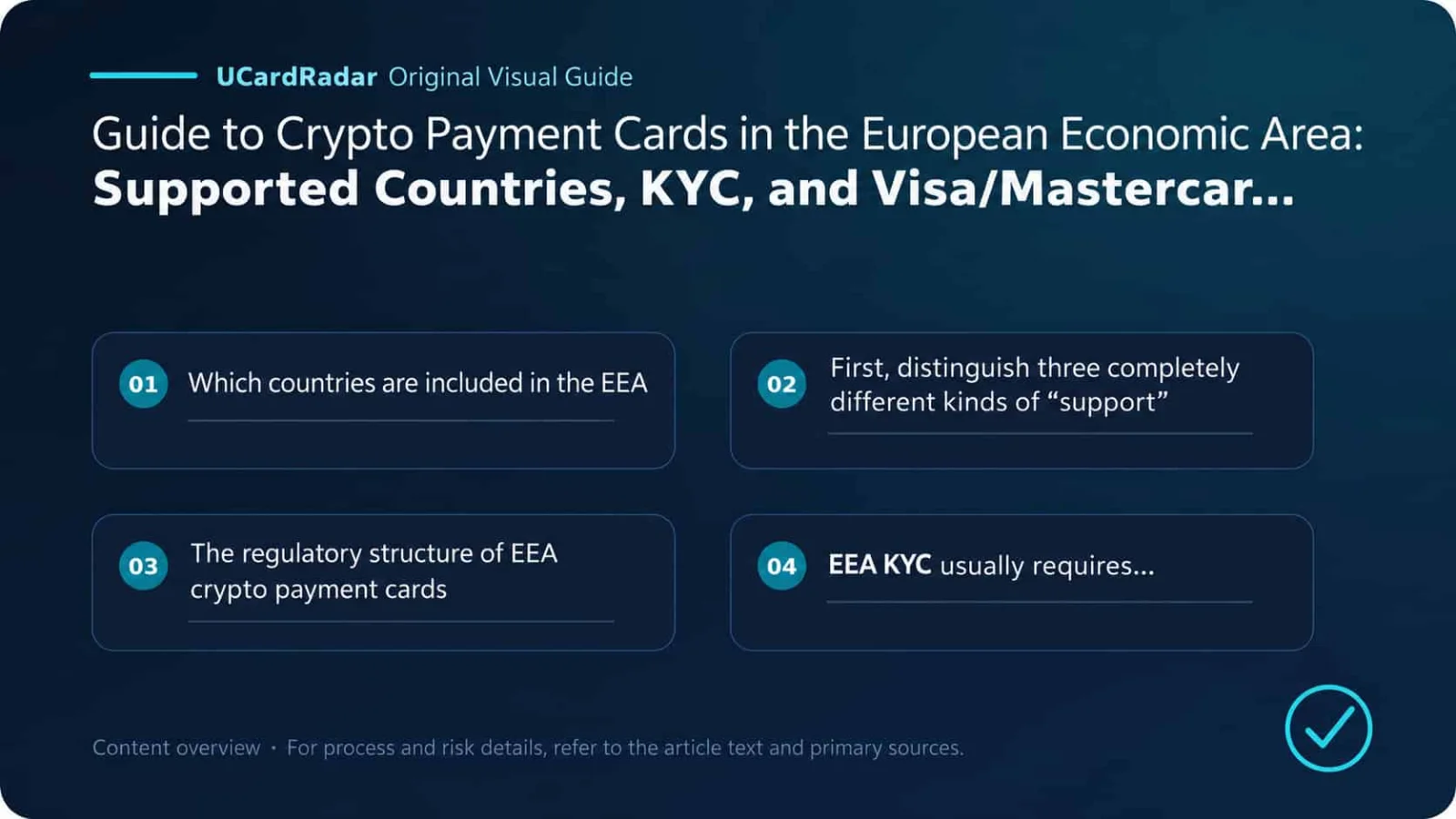
1. Which Countries Are in the European Economic Area?
The European Economic Area, commonly abbreviated as the EEA, consists of the EU Member States together with Iceland, Liechtenstein, and Norway. Switzerland has close relations with the EU and participates in the Schengen Area, but it is not an EEA member. The United Kingdom also ceased to belong to the EEA after leaving the European Union.
As of 2026, the EEA consists of the following 30 countries:
Region | Countries |
|---|---|
Western and Central Europe | Austria, Belgium, France, Germany, Ireland, Luxembourg, Netherlands |
Southern Europe | Croatia, Cyprus, Greece, Italy, Malta, Portugal, Spain |
Northern Europe | Denmark, Finland, Sweden, Iceland, Norway |
Central and Eastern Europe and the Baltics | Bulgaria, Czechia, Estonia, Hungary, Latvia, Lithuania, Poland, Romania, Slovakia, Slovenia |
Microstate | Liechtenstein |
The United Kingdom, Switzerland, Andorra, Monaco, and San Marino are often grouped into a general “Europe” region by card platforms, but they are not EEA countries. When a card provider states that a product is “Europe available,” this may include some of these countries, or it may cover only selected EU countries. Therefore, “Europe supported” should not automatically be interpreted as “full EEA coverage.”
2. First Distinguish Three Completely Different Types of “Support”
To determine whether a crypto payment card is actually usable in Europe, at least three separate layers must be distinguished.
1. Application Support
This refers to whether a user can submit an application and open an account based on their legal place of residence.
Platforms usually focus not on where the user happens to be physically located at the moment, but on:
Country of long-term residence;
Country that issued the identity document;
Residential address;
Tax residency;
Region of the user's phone number or bank account;
Whether sanctions, nationality restrictions, or internal risk policies apply.
Tourism, a student visa, or temporary entry into an EEA country does not automatically provide eligibility to apply for a local card.
2. Card Issuance and Delivery Support
A virtual card may be generated directly after an application is approved, but a physical card also depends on the issuing program, logistics coverage, and address verification. Some platforms allow residents of a country to obtain a virtual card but do not ship physical cards there. Others make metal cards, cashback cards, or IBAN features available only in selected countries.
3. Transaction Support
Once successfully issued, a Visa or Mastercard crypto payment card can generally be used at merchants that accept the relevant card network. However, every transaction still requires authorization from the issuer.
Mastercard's description of European card transaction flows makes clear that a transaction must first be authorized by the issuer. Visa rules likewise distinguish between card-network rules, regional rules, and the issuer's own product conditions. In other words, a Visa or Mastercard logo on the card does not mean that every Visa or Mastercard merchant will accept it without conditions.
The issuer may still decline a transaction for reasons such as:
Insufficient balance;
A risk model flags the transaction as unusual;
The merchant category is restricted;
The transaction country is sanctioned or restricted;
An online transaction does not complete 3D Secure authentication;
A hotel, car-rental company, or fuel station requires preauthorization;
The merchant does not accept prepaid cards or a particular type of debit card;
ATM, gambling, crypto-exchange, or cash-equivalent merchants are restricted by the card program.
Therefore, “can apply” and “can spend” must be verified separately.
3. Regulatory Structure of EEA Crypto Payment Cards
Crypto payment cards in Europe are not governed by a single law. They generally sit at the intersection of two regulatory systems: crypto-asset services and traditional payment services.
1. MiCA Regulates Crypto-Asset Services
The EU's Markets in Crypto-Assets Regulation, or MiCA, establishes common rules for the issuance, trading, custody, and related services of crypto-assets, including disclosure, authorization, supervision, and consumer risk warnings. MiCA became fully applicable on December 30, 2024, while provisions relating to stablecoins began applying earlier, in June 2024.
Crypto-asset service providers that were already operating could use transitional arrangements depending on the Member State, but the maximum EU-level transition period ended on July 1, 2026. By July 2026, determining whether a platform may continue providing crypto-asset services to EEA users requires more than checking whether it was historically registered as a VASP. Users should verify its current MiCA-authorized entity and its ESMA registration information. ESMA's interim MiCA register includes authorized crypto-asset service providers and non-compliant entities and is continuously updated.
2. Card Issuance Still Falls Under Payment Regulation
A MiCA licence is not the same thing as a card-issuing licence.
A crypto platform may operate the account, wallet, asset conversion, and front-end product, while the entity that actually issues a Visa or Mastercard card is typically a bank, electronic money institution, or payment institution. Users should identify all of the following:
The crypto platform operating entity;
The MiCA/CASP licensed entity;
The actual card issuer;
The BIN Sponsor;
The electronic money institution or payment institution;
The region to which the Visa or Mastercard card program belongs.
This is precisely the type of information this platform is designed to track, so cardholders can understand the complete structure behind a product.
When addressing the interaction between MiCA and PSD2, the European Banking Authority (EBA) has stated that custodial wallets involving e-money tokens and transfers made on behalf of customers may, in certain circumstances, also constitute payment services. Relevant institutions may therefore fall under both MiCA and payment-services rules. The EBA has also emphasized that strong customer authentication, payment-fraud reporting, and consumer protection cannot be ignored simply because stablecoins are being used.
This is also why an exchange business, wallet business, and card business under the same brand may be operated by different legal entities.
4. What KYC Is Generally Required in the EEA?
In the EEA market, mainstream crypto payment cards generally require full identity verification. Claims of a “no-KYC European Visa card” that can supposedly be used long term, mailed as a physical card, and linked to an identity-based payment wallet usually present clear authenticity or compliance risks.
Layer 1: Identity Verification
Common documents and checks include:
Passport;
EU or EEA national identity card;
Residence permit;
Driving licence accepted in some countries;
Selfie or liveness detection;
Date of birth and nationality information.
Platforms verify the name on the document, date of birth, document number, expiry date, and facial information. Some platforms accept only photographs of physical identity documents and do not accept scans or electronic copies.
Layer 2: Proof of Residential Address
Possible requirements include:
Utility bill;
Bank statement;
Tax document;
Government correspondence;
Rental agreement;
Proof of residence;
Bank account information in the user's own name.
A common reason for failure is not that “the country is unsupported,” but that the address shown on the identity documentation, the address entered on the account, and the user's actual place of residence do not match.
Layer 3: Ongoing Due Diligence
After the initial KYC has been completed, the platform may still request additional information based on risk factors, including:
Source of funds;
Occupation and income;
Source of crypto-assets;
Ownership of external wallets;
Explanation of large deposits;
Country of tax residence;
Tax identification number;
Purpose of transactions and expected transaction volume.
Wirex explicitly reserves the right in its terms to request additional documents, suspend transfers, or reject transactions as part of compliance, sanctions, or fraud reviews. Gnosis Pay also states that card onboarding requires identity, liveness, AML, and ongoing compliance checks through third-party KYC providers.
Layer 4: Verification of Crypto Transfer Information
The EU's crypto-asset “Travel Rule” requirements have applied since December 30, 2024. Crypto-asset service providers must determine whether information on both sides of a transfer is complete and establish procedures to suspend, reject, or further review transactions with missing information.
This means that when users transfer assets from an external exchange or self-custody wallet into a card account, they may be asked to explain:
Whether they control the wallet themselves;
Name of the originating platform;
Information about the sender and recipient;
Source of funds;
Purpose of the transaction.
The fact that a transaction has already arrived on-chain does not mean the platform must immediately make those assets available in the user's spendable balance.
5. Tax Residency Information Becomes More Important After 2026
From January 1, 2026, the EU's DAC8 crypto-asset tax-transparency rules began to apply. Relevant service providers are required to collect identity information and reportable transaction data for EU tax residents. The first reporting year is 2026, with the first cross-border information exchange due by the end of September 2027.
DAC8 does not mean that every card purchase directly generates a tax charge, but it does mean that crypto-platform accounts should no longer be viewed as anonymous payment tools. Users should retain records of:
When assets were purchased and their acquisition cost;
Amounts transferred into the card account;
Records of conversion into euros;
Asset prices at the time of spending;
Cashback and reward records;
Withdrawals, refunds, and reversals.
The actual tax treatment is still determined by the user's country of tax residence. Germany, France, Portugal, Austria, and other countries do not treat crypto disposals, holding periods, and capital gains in exactly the same way.
6. Regional Coverage of Common EEA Cards
The following are several representative crypto payment card models in Europe. Here, “coverage” refers only to the officially disclosed regional framework and does not mean every applicant is guaranteed to pass KYC.
Product | Network and Model | EEA Coverage Assessment | Points to Note |
|---|---|---|---|
Visa debit card, self-custodial account model | Official support list covers all 30 EEA countries | French overseas territories are not currently included; nationality, sanctions, and KYC may still affect eligibility | |
Visa/Mastercard card and custodial account model | Wirex has long operated regional EEA services | The specific card network, features, and promotions may vary by country; the account display should be treated as authoritative | |
Visa prepaid/payment card model | Operates a EUR card program for European residents | A European program does not mean every EEA resident is automatically approved; card tier, physical card availability, and features depend on the App | |
Different card programs by region | Bybit Global currently explicitly prohibits EEA residents from joining its global card program | MiCA business coverage through Bybit EU should not be interpreted as meaning Bybit Card has already opened to EEA users |
The official support list for Gnosis Pay includes Austria, Belgium, Bulgaria, Croatia, Cyprus, Czechia, Denmark, Estonia, Finland, France, Germany, Greece, Hungary, Iceland, Ireland, Italy, Latvia, Liechtenstein, Lithuania, Luxembourg, Malta, the Netherlands, Norway, Poland, Portugal, Romania, Slovakia, Slovenia, Spain, and Sweden—in other words, all EEA Member States. The product currently operates as a Visa debit card program.
Official information from Wirex shows that it provides regional services in the EEA and has card capabilities connected to both Visa and Mastercard. However, the actual card network a user receives, whether a physical card can be requested, and whether particular promotions or wallet functions are available may vary by jurisdiction.
Crypto.com has established a European EUR card system. European cards can be topped up using EUR balances, and dedicated European card fee and limit pages are available. However, the company uses wording such as “Europe residential address” rather than promising account access for every EEA country and every document type. Actual eligibility should therefore still be verified through the residence eligibility checks shown in the App.
The situation with Bybit requires particular attention. The current Bybit Global card page explicitly states that the product is not available to EEA customers and prohibits EEA participation. At the same time, Bybit is gradually migrating or directing European users to its MiCA-authorized Bybit EU platform. A June 2026 announcement listed 29 EEA countries within the migration scope and stated that Malta was not yet covered by its European licence. Obtaining a European crypto-services licence does not automatically mean that a global card program has also obtained authorization for issuance in Europe.
7. What Is the Difference Between Visa and Mastercard in Europe?
From the perspective of everyday consumer spending, the difference in core coverage between Visa and Mastercard within the EEA is usually less important than the differences between individual issuers.
What often matters more to the user experience is:
Whether the card is a debit card or prepaid card;
Which country issued the BIN;
Whether the base settlement currency is EUR, GBP, or another currency;
Whether 3D Secure is supported;
Whether Apple Pay or Google Pay is supported;
Whether ATM withdrawals are permitted;
Whether hotel, car-rental, and deposit preauthorizations are supported;
Whether gambling, remittance, crypto exchanges, or cash-equivalent merchants are restricted;
The issuer's real-time risk-control policies.
Mastercard's European rules provide that, within the relevant category, EEA merchants accepting Mastercard credit, debit, or prepaid cards should in principle accept equivalent EEA-issued cards. However, merchants may still choose not to accept a particular category—for example, accepting debit cards while refusing commercial cards—and issuers still retain transaction-authorization authority.
Visa is likewise a payment network rather than the direct manager of a user's account and funds. Card benefits, fees, regional policies, and transaction restrictions must therefore be checked with the actual issuer rather than inferred solely from the Visa logo.
Which Products More Commonly Use Visa?
European products such as Crypto.com Visa Card and Gnosis Pay Card currently use the Visa network. In the crypto payment card market, Visa commonly appears in both custodial prepaid-card products and newer self-custodial payment-card models.
Which Products More Commonly Use Mastercard?
Platforms such as Wirex have Mastercard programs, and some exchange cards and fintech cards also use Mastercard. For users, the Mastercard logo alone does not indicate whether a product is a credit card, debit card, or prepaid card. The product terms must be checked.
8. Apple Pay, Google Pay, and Online Subscriptions
The fact that a crypto payment card uses Visa or Mastercard does not automatically mean that it supports Apple Pay or Google Pay.
Mobile-wallet support depends on:
Whether the card BIN is enabled by the wallet platform;
Whether the issuer supports tokenization;
Whether the user's country is supported;
Whether the card type is eligible;
Whether the issuer can complete strong customer authentication;
Whether the phone-account region matches the card region.
The EBA has explicitly stated that adding a card to a digital wallet creates a digitized card or payment token. The issuer must perform strong customer authentication and is responsible for compliance with authentication requirements. Transactions initiated using the digital card may likewise require SCA unless a specific exemption applies.
Online subscriptions raise another issue: a successful first payment does not guarantee that subsequent automatic renewals will succeed. Common reasons for failure include:
The merchant does not correctly initiate 3D Secure;
The card does not support merchant-initiated transactions;
A subscription token becomes invalid after the card number changes;
Insufficient balance;
The merchant identifies the card as prepaid;
The issuer restricts digital-content, advertising, or cloud-service merchants;
The billing address does not match the merchant's verification information.
Therefore, when using a card for ChatGPT, Claude, Google, Apple, AWS, or other SaaS services, actual recurring payment history should be prioritized over the card network logo alone.
9. What Should You Check When Choosing an EEA Crypto Payment Card?
1. Check Your Place of Residence First, Not Just Your Nationality
The fact that an application page accepts your passport does not mean your actual country of residence is supported. Conversely, some platforms allow legal EEA residents holding non-EU passports to apply, but require a valid residence permit and proof of local address.
2. Identify the Actual Card Issuer
At a minimum, you should be able to identify:
Name of the card issuer;
Name of the electronic money institution or bank;
Whether the card uses Visa or Mastercard;
Issuing region;
Card terms;
Complaint-handling and fund-protection mechanisms.
A product that displays only a brand name but does not disclose the issuer or applicable terms is not suitable as a primary payment card.
3. Prefer EUR Settlement
When an EEA user's everyday spending is primarily in euros, maintaining a EUR base balance can generally reduce repeated currency conversion. In non-euro currency areas such as Denmark, Sweden, Norway, and Iceland, users should separately check foreign-exchange markups and weekend exchange rates.
4. Separate Crypto Conversion Costs from Card Fees
“Zero card fees” does not mean zero total cost. Real costs may come from:
Spread when selling crypto-assets;
Spread when converting stablecoins into EUR;
Top-up fees;
Foreign-exchange fees;
ATM fees;
Over-limit fees;
Physical card delivery fees;
Membership fees or staking costs;
Exchange-rate differences on refunds.
5. Do Not Treat Cashback as the Primary Metric
High cashback usually comes with token-holding requirements, lockups, membership tiers, monthly caps, or restrictions to selected merchants. For long-term users, issuance stability, fee transparency, refund handling, and account-appeal mechanisms are more important than short-term cashback.
10. Who Is Better Suited to EEA Crypto Payment Cards?
EEA crypto payment cards are generally better suited to users who:
Are already legal residents of the EEA;
Have stable identity and address documentation;
Commonly hold USDC, USDT, BTC, or ETH;
Need to convert part of their crypto holdings into an everyday spending balance;
Frequently use online subscriptions or make cross-border purchases;
Can maintain complete transaction and tax records;
Accept ongoing KYC and source-of-funds reviews by the platform.
People who should not rely heavily on this type of card include those who:
Do not have a stable residential address;
Want to spend anonymously;
Cannot explain the source of their assets;
Plan to use another person's address or identity documents;
Intend to use the card for large-scale fund transfers;
Want to use a single crypto card as their only everyday financial account;
Need to evade domestic tax or foreign-exchange regulations.
The European Economic Area is one of the world's more mature regions for crypto payment card infrastructure, but it is not a “low-barrier card-opening region.”
MiCA has harmonized the core regulatory framework for crypto-asset services. PSD2, electronic-money rules, and card-scheme rules continue to govern card issuance and payment activity. The Travel Rule has strengthened information verification for on-chain transfers, while DAC8 has further increased tax transparency from 2026 onward.
For ordinary users, the most important thing is not to find a card with a Visa or Mastercard logo. It is to confirm the following four points—and these are precisely the types of information that can be checked on this platform:
First, whether your legal country of residence is explicitly included in the supported region;
Second, which licensed institution actually issues the card;
Third, whether your KYC, source-of-funds information, and tax information can remain consistent over time;
Fourth, whether the product publicly discloses fees, restrictions, and complaint procedures.
In terms of the completeness of publicly available information, Gnosis Pay provides relatively clear disclosure regarding supported countries and issuing structure. Wirex and Crypto.com have relatively mature European regional products, but specific functions still need to be verified according to the country associated with the user's account. Bybit, meanwhile, is currently restructuring its European business. MiCA coverage through Bybit EU should not be interpreted as meaning that Bybit Card has already opened to EEA users.
UCardRadar records regional eligibility, KYC, fees, issuers, Visa/Mastercard networks, and payment compatibility for these products at the same time. It does not equate “the card can be used for payment” with “everyone can apply.” The platform provides information and risk analysis only. It does not provide card application services, top-ups, currency exchange, withdrawals, payment-on-behalf services, or KYC-bypass services. Additional information from users is welcome, and our goal is to provide as complete an information service as possible.