
Crypto payment cards are often described in Mainland China as a way to “spend USDT directly.” That description only explains what users see on the interface; it does not explain the legal relationships and payment flows behind the transaction.
Most crypto payment cards do not allow merchants to receive Bitcoin or stablecoins directly. When a user makes a purchase, the platform usually first converts the crypto assets in the account into fiat currencies such as U.S. dollars or euros, and then completes authorization and settlement through an overseas-issued Visa or Mastercard debit card or prepaid card. From the perspective of a merchant in Mainland China, this usually appears as an overseas bank-card transaction rather than the merchant directly receiving virtual currency.
This is precisely where the distinction matters: whether a card can be accepted by a particular POS terminal, whether a user in Mainland China is eligible to apply for the card, whether the source of funds in the account is compliant, and whether the platform is willing to continue providing service over the long term are separate issues.
As of July 2026, several major crypto payment platforms have placed Mainland China on lists of jurisdictions where registration is prohibited, services are restricted, or support is unavailable. For ordinary residents of Mainland China, the biggest challenge is usually not finding a card bearing the Visa or Mastercard logo, but continuously passing platform reviews using a genuine identity and a genuine residential address.
Sources and Limits of the Conclusions
Primary-source verification: Notice on Further Preventing and Disposing of Risks in Virtual Currency Trading and Speculation; Implementation of the new licensing regime for virtual asset trading platform operators; Regulations Governing the Registration of Virtual Asset Service Providers.
The verifiable facts in this article concerning regulation, KYC, and regional restrictions on crypto payment cards in Mainland China, Hong Kong, and Taiwan are based on the listed official or regulatory documents. Actual service status, fees, eligibility, and regional availability should be confirmed on the issuer’s or platform’s page at the time of application.
The legality of cross-border payments and crypto-asset activities must be assessed case by case based on the user’s location, purpose of funds, service provider, and rules in force at the time. Any observations on user experience, success rates, fee comparisons, or trends that are not directly disclosed in the primary sources above are analysis or inference and have not been officially confirmed by the relevant authorities for individual cases.
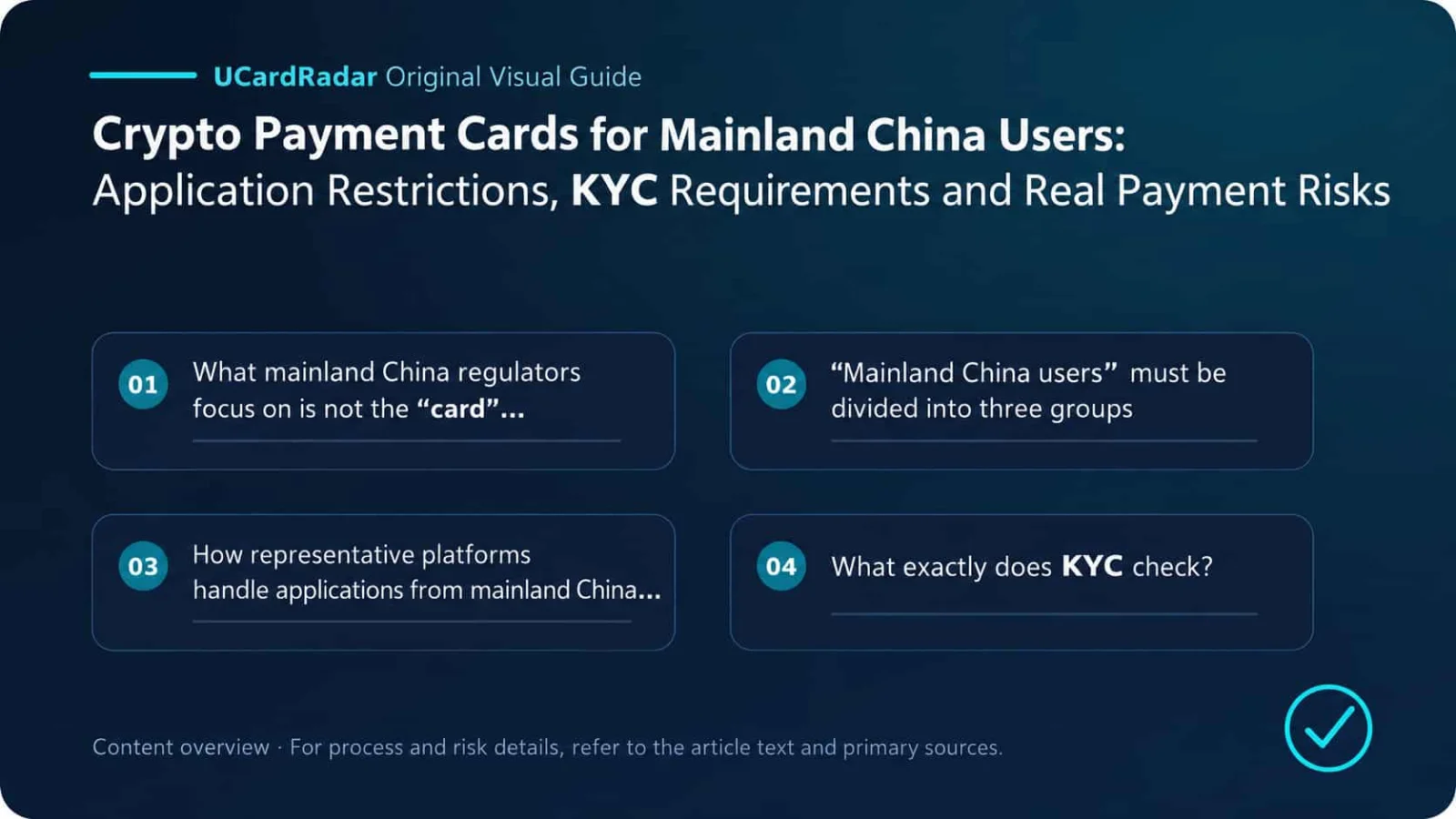
1. Mainland Chinese Regulation Focuses on the Substance of the Business, Not the Name of the Card
Public regulatory documents in Mainland China do not change their fundamental assessment of virtual-currency-related activities merely because a product is called a “payment card,” “stablecoin card,” or “Visa card.”
The 2021 Notice on Further Preventing and Disposing of Risks in Virtual Currency Trading and Speculation established three principles directly relevant to crypto payment cards:
Bitcoin, Ether, USDT, and other virtual currencies do not have the status of legal tender and cannot circulate in the market as currency;
Exchange between fiat currency and virtual currency, exchange between virtual currencies, transaction matching, pricing services, and similar activities are prohibited virtual-currency-related businesses;
Overseas virtual-currency exchanges that provide services to residents of Mainland China through the internet are also regarded as illegal financial activities.
This does not mean that every ordinary purchase made with an overseas Visa or Mastercard automatically constitutes an illegal act. The key questions are how the account was obtained, to whom the platform is providing services, how the assets were acquired and converted, and whether the user is involved in collecting or making payments on behalf of others, underground currency exchange, money laundering, or illegal cross-border transfer of funds.
A crypto payment card generally involves two stages of service:
Crypto-asset account and conversion services
→ Overseas bank-card payment and settlement services
The second stage may appear to be an ordinary overseas bank-card purchase, but the first stage may still involve virtual-currency services that are strictly restricted in Mainland China. Card networks can process authorization and settlement, but they cannot solve issues relating to the user’s location, KYC, or source of funds on behalf of the platform.
In a 2024 risk notice, Shenzhen’s local financial authorities reiterated the same regulatory position, indicating that this policy has not ceased to apply simply because Hong Kong has developed a virtual-asset market or other countries have introduced stablecoin regulation.
2. “Mainland China Users” Must Be Divided into Three Categories
When discussing eligibility, it is not enough to look only at passport or nationality.
1. Residents Who Live Long-Term in Mainland China
These users typically have several of the following characteristics at the same time:
A Mainland Chinese identity card or passport;
A residential address in Mainland China;
A Mainland Chinese mobile-phone number;
Primary login devices and IP addresses located in Mainland China;
Sources of funds mainly from Mainland Chinese bank accounts or personal wallets.
This is currently the category facing the strictest application restrictions. Even if a platform allows the user to download the app, register an email address, or view product pages, that does not mean the user can complete KYC, activate a card, or retain the account over the long term.
2. Chinese Passport Holders Who Legally Reside Overseas
For this group, it is necessary to distinguish whether the platform applies nationality-based restrictions or residence-based restrictions.
Some cards determine eligibility based on legal residence. A Chinese citizen who genuinely resides in a supported jurisdiction such as Europe, the United Kingdom, Canada, or the United Arab Emirates, and who can provide a valid residence permit, proof of address, tax documents, and a bank account in the same name, may satisfy the local application requirements.
However, some platforms impose restrictions based directly on document nationality. The unsupported-region rules published by RedotPay in 2026 state that Mainland Chinese citizens cannot complete identity verification or use its services. Therefore, even if the user is physically overseas, an overseas address alone does not prove that the application will be accepted.
3. People Who Already Hold a Compliant Overseas Card and Temporarily Enter Mainland China
This situation is mainly a payment-acceptance issue rather than an application issue.
For example, a Chinese citizen who has lived long-term in Europe and obtained a card under local European requirements may later return to Mainland China for a short stay. Whether the card can be used will mainly depend on:
Whether the issuer allows transactions in Mainland China;
Whether the merchant accepts foreign cards;
Whether the merchant category is restricted;
Whether the card supports RMB transactions;
Whether cross-border or unusual-location risk controls are triggered.
This situation should not be confused with “being physically in Mainland China and applying using a false overseas address.”
3. Application Restrictions for Mainland China on Representative Platforms
The following list illustrates current market conditions and does not represent every crypto payment card product.
Platform | Application Status for Mainland China | Issue Reflected in Official Rules |
|---|---|---|
Not supported | Mainland China is listed among unsupported countries and regions; Mainland Chinese citizens cannot complete KYC or use the service | |
Mainland China users not supported | Mainland China is an excluded jurisdiction; falsely declaring residence may result in account termination | |
Crypto.com | App services restricted | China is listed as a geographically restricted region for the Crypto.com App and cannot use the standard open-market service flow |
Major services shown as unsupported | In the Wirex supported-country table, major services for China are listed as N/A | |
European cards such as Gnosis Pay | Not offered to Mainland China residents | These products generally require genuine residence in the EEA, United Kingdom, or other specifically supported markets |
The current official pages of the relevant platforms show that RedotPay has included Mainland China in its unsupported scope; Bybit does not provide services to Mainland China users; Crypto.com lists China as a geographically restricted region for its App; and Wirex does not list China as having access to its main account and card services.
Therefore, seeing someone online demonstrate that a particular card can be used for spending in Mainland China does not mean residents of Mainland China are still eligible to apply for that card.
The card shown may belong to:
An old account opened before restrictions were changed;
A Chinese citizen who resides overseas long-term;
A foreign resident temporarily using the card in Mainland China;
A card issued in another region;
A high-risk account opened using false information;
A legacy product that is no longer open to new Mainland China users.
4. What Does KYC Actually Check?
KYC for crypto payment cards is usually more comprehensive than for ordinary virtual-card platforms because it involves crypto-asset services, fiat conversion, and bank-card issuance at the same time.
Layer 1: Identity Verification
Common requirements include:
Legal name;
Date of birth;
Nationality;
Passport, identity card, or residence permit;
Front and back of the identity document;
Selfie or dynamic liveness check;
Document expiration date;
Country of document issuance.
RedotPay requires identity information, current residential address, and questionnaire information to remain consistent and may require users to complete verification using the original physical document. Crypto.com’s basic KYC also includes legal name, government-issued identification, and a selfie.
Layer 2: Residential Address
Platforms may ask users to provide:
Water, electricity, gas, or fixed-communications bills;
Bank statements;
Government-issued proof of residence;
Tax documents;
Residence permits;
Rental agreements;
Local financial-account records in the user’s own name.
The proof-of-address documents listed by Bybit include utility bills, bank statements, and government-issued proof of residence. Wirex also explicitly requires identity, address, and source-of-funds information and may request recent proof-of-address documents.
A forwarding address, a friend’s address, or a hotel address is usually insufficient to establish a genuine residential relationship.
Layer 3: Source of Funds and Source of Wealth
Passing initial KYC does not mean there will be no subsequent review.
After frequent deposits, large top-ups, external-wallet transfers, or unusual spending, the platform may request:
Payslips;
Employment contracts;
Bank transaction statements;
Tax records;
Crypto-asset purchase records;
Exchange withdrawal records;
On-chain wallet addresses;
Investment-income evidence;
Asset-sale contracts;
Explanations of the intended use of funds.
Enhanced due diligence at Bybit may require proof of address, source of funds, and source of wealth, and may combine blockchain analysis to determine whether the origin of assets is consistent with the user’s declaration. Wirex and RedotPay also reserve the right to request additional source-of-funds information.
Layer 4: Consistency of Location Information
Platforms may also assess the overall consistency of:
Country of registration;
Nationality on identification documents;
Residential address;
Mobile-phone number;
Device language;
IP location;
Card delivery address;
Country of the bank account;
Countries where everyday transactions occur.
If this information remains inconsistent over time, even an account that was successfully approved and issued a card may re-enter review when the user updates information, replaces the card, withdraws funds, or makes a large purchase.
Bybit explicitly reserves the right to terminate accounts for false statements regarding location or residence. Wirex also states that where KYC information is incomplete, identity cannot be verified, or the user’s country of residence becomes unsupported, card top-ups may be suspended or service may be terminated.
5. Using a Hong Kong Address Does Not Automatically Solve the Problem
Hong Kong and Mainland China operate under different financial and virtual-asset regulatory regimes, but this does not mean a Mainland China resident can simply enter a Hong Kong address on an application.
Platforms usually assess genuine residence rather than merely asking which delivery address the user can provide.
Documents that may support genuine Hong Kong residence generally include:
Hong Kong identity card or valid residence permit;
Genuine residential address;
Bills in the user’s own name;
Hong Kong bank or financial accounts;
Tax and employment information;
Login and transaction records consistent with long-term life in Hong Kong.
A forwarding address, friend’s address, company registered address, or short-term hotel address usually cannot withstand ongoing review. Once identity information and actual location of use become inconsistent, the platform may restrict the card, request additional documents, or terminate the account.
6. After Obtaining the Card, Can It Be Used in Mainland China?
1. Offline POS Payments
The payment guide for visitors to China published by the People’s Bank of China explains that overseas bank cards bearing Visa, Mastercard, and other relevant logos can be used at merchants displaying the corresponding foreign-card acceptance logos. Where no acceptance logo is displayed, users should confirm with the merchant. UnionPay cards generally have broader domestic acceptance.
This means a crypto payment card may be usable in Mainland China at:
Large hotels;
Airports and major commercial districts;
Chain department stores;
International-brand stores;
Some restaurants and travel-related merchants;
Hospitals, schools, or transport scenarios that support foreign cards.
However, Visa or Mastercard foreign cards may still be unusable at many small merchants, neighborhood stores, personal QR-code payment scenarios, and online platforms that only accept domestic bank cards.
China has continued improving foreign-card acceptance in recent years, but the policy focus remains on major commercial districts, ports of entry, hotels, and foreign-facing scenarios. This does not mean every merchant nationwide has completed foreign-card acceptance upgrades. Public data from Shenzhen also indicate that improvements in foreign-card coverage have mainly concentrated on key merchants and demonstration scenarios.
2. Linking to Alipay and WeChat Pay
Some overseas Visa and Mastercard cards can be linked to Alipay or WeChat Pay, but the fact that ordinary overseas bank cards can be linked does not mean every crypto payment card can also be linked.
Success depends on factors including:
Whether the issuer allows wallet tokenization;
Whether the card is a credit card, debit card, or prepaid card;
Whether 3D Secure is supported;
The country associated with the card’s BIN;
The card billing address;
The card types supported by the payment institution;
Whether the merchant allows foreign-card transactions;
Whether the transaction falls within an allowed scenario.
The People’s Bank of China payment guide also notes that different payment institutions do not necessarily support exactly the same range of overseas bank cards.
Therefore, an online example showing that “this card can be linked to Alipay” only proves that a particular card, BIN, and account succeeded at that particular time. It does not prove that every card issued under that brand will continue to work over the long term.
3. ATM Withdrawals
ATM capability must be verified card by card.
The current card rules of Bybit explicitly state that ATM withdrawals are restricted in Mainland China. Even if the card can be used at some merchants, that does not mean it can be used to withdraw RMB from ATMs in Mainland China.
Other cards may theoretically support Visa Plus, Mastercard Cirrus, or related ATM networks, but may still be restricted by the issuer, ATM operator, card region, or anti-fraud rules.
4. Overseas Websites and Subscription Payments
For overseas subscriptions such as ChatGPT, Claude, Apple, Google, and AWS, the main risks include:
Whether the card allows merchant-initiated recurring charges;
Whether the billing country matches the account region;
Whether 3D Secure is supported;
Whether the card is identified as a prepaid card;
Whether the merchant restricts foreign BINs;
Whether the balance is sufficient at renewal;
Whether the payment token becomes invalid after the card number is updated.
Crypto.com also notes that some hotels, car-rental companies, and subscription merchants may require a credit card and may not accept prepaid cards. Gambling, cash advances, and purchases of crypto assets may also be restricted.
A successful first payment does not prove that subsequent automatic renewals will remain reliable.
7. Distribution of Real-World Payment Risks
Risk Scenario | Probability | Impact | Main Cause |
|---|---|---|---|
Ordinary POS transaction declined | Medium-high | Low | Merchant does not accept foreign cards, or BIN/prepaid-card restrictions |
Alipay or WeChat Pay card linking fails | Medium-high | Low | Card type, issuing region, or tokenization not supported |
Overseas subscription first payment succeeds but renewal fails | Medium | Medium | Recurring billing, 3DS, or insufficient balance |
High RMB conversion cost | Medium | Medium | Crypto conversion spread, FX fees, and issuer markup |
Refund takes a long time to arrive | Medium | Medium | Multi-stage processing by merchant, acquirer, and issuer |
ATM withdrawal unavailable | Medium | Medium | Product or regional restrictions |
Card suspended due to unusual-location transactions | Medium-low | Medium | Abnormal region, device, or transaction pattern |
Additional KYC or source-of-funds review | Medium-low | High | Address conflicts, large transactions, or on-chain risk |
Account terminated because of a false address | Low to medium | High | Application information does not match actual location |
Card, withdrawals, and transfers restricted at the same time | Low | Extremely high | Account-level compliance or AML review |
A single failed payment is usually only a compatibility issue. The genuinely dangerous combination is:
Card cannot be used for payment
+ Assets cannot be converted
+ Withdrawals cannot be made
+ Platform requires KYC to be resubmitted
At that point, the issue is no longer simply that a merchant does not accept foreign cards; the account itself has entered a restricted state.
8. Source of Funds Is One of the Most Easily Overlooked Risks for Mainland China Users
Card platforms do not only look at which wallet the funds came from; they may also assess how those assets were originally acquired.
Higher-risk behavior includes:
Using another person’s bank account to purchase crypto assets;
Receiving USDT from strangers or customers and spending it on their behalf;
Topping up, paying, or withdrawing for other people;
Frequently buying and selling assets through P2P channels;
Receiving large amounts of funds clearly inconsistent with the user’s occupation and income;
Receiving assets from addresses linked to fraud, gambling, or other high-risk activity;
Using the card as a fund-transfer or cash-out channel;
Purchasing large quantities of goods and then requesting refunds or extracting cash;
Using multiple cards to spread transactions.
The judicial interpretation on money-laundering crimes implemented in 2024 further clarified the standards for determining money-laundering offenses. Work materials from the Supreme People’s Procuratorate for 2024 also stated that judicial authorities continued to crack down on criminal activities involving the transfer of assets overseas through virtual currencies. The 2026 work report of the Supreme People’s Court again mentioned strict punishment for money laundering, illegal foreign-exchange activities, and illegal cross-border transfer of funds using virtual currencies as a medium.
This does not mean that every asset with a clear source and used for the user’s own consumption will be treated as criminal. The key distinctions are whether the funds involve illegal proceeds, whether the user is helping others transfer money, whether the transaction background is fabricated, and whether the activity amounts to collecting and paying on behalf of others, underground currency exchange, or illegal business operations.
9. Foreign-Exchange Rules Cannot Simply Be Applied to Crypto Payment Cards
The State Administration of Foreign Exchange applies MCC-based classification management to the overseas use of domestically issued bank cards, dividing transactions into prohibited categories, amount-restricted categories, and open categories. Ordinary current-account spending for tourism, business, study abroad, and similar purposes can generally be paid with domestic bank cards without using the individual annual USD 50,000 simplified foreign-exchange purchase quota.
However, these rules mainly apply to domestically issued bank cards used overseas and cannot be treated as the legal basis for using overseas crypto payment cards in Mainland China.
Crypto payment cards usually combine overseas issuance, overseas accounts, overseas asset conversion, and cross-border card-network settlement. Users cannot infer from the fact that ordinary domestic bank cards may be used for overseas spending that they may:
Use crypto assets to circumvent foreign-exchange controls;
Use cards for large-scale cross-border movement of funds;
Settle payments on behalf of other people;
Disguise business income as personal consumption;
Cash out through ATMs or refunds.
The outward appearance of a card payment does not change the true economic purpose of the transaction.
10. Risk Assessment for Different User Scenarios
User Scenario | Application Assessment | Actual-Use Assessment | Overall Risk |
|---|---|---|---|
Mainland resident applies with Mainland identity and address | Most major platforms do not support this | Even if registration succeeds, KYC may fail | High |
Mainland resident enters a false overseas address | Violates platform rules | May work in the short term, but account is vulnerable to later termination | Extremely high |
Chinese citizen genuinely resides overseas long-term | Depends on local program and nationality rules | May apply in a supported region and use the card cross-border | Medium |
Legitimate overseas cardholder temporarily enters Mainland China | No need to reapply | Can use the card at merchants that accept foreign cards | Medium-low |
Uses an account purchased from or transferred by another person | Identity mismatch | Login, payments, and withdrawals may all trigger risk controls | Extremely high |
Used only for the user’s own small everyday purchases | Still must satisfy application eligibility | Payments and source of funds are comparatively easier to explain | Medium |
Used for paying on behalf of others, receiving funds, or transferring money | Usually exceeds personal-card use | More likely to trigger platform and legal risks | Extremely high |
Frequently withdraws cash from ATMs in Mainland China | Depends on the product | May face regional or cash-transaction restrictions | High |
11. Practical Usage Recommendations
1. Check Application Eligibility Before Checking Payment Compatibility
The correct order is:
Is the user’s nationality supported?
→ Is the user’s genuine place of residence supported?
→ Can KYC be completed?
→ Who is the issuer and which card network is used?
→ Are transactions in Mainland China allowed?
→ Compatibility with Alipay, WeChat Pay, POS, and subscriptions
Do not skip the first four steps simply because you saw a post claiming a “successful real-world test.”
2. Do Not Use False Addresses or Other People’s Identities
Address packaging, buying and selling accounts, and outsourced KYC do not improve legitimate approval odds. They convert an ordinary payment risk into the risk of account termination and source-of-funds review.
3. Keep Only Near-Term Spending Funds on the Card
Crypto payment cards are not suitable for storing all of a user’s assets. Platforms may suspend service because of regional policy changes, issuer partnerships, KYC reviews, or system failures.
4. Keep Complete Records of Funds
At a minimum, retain:
Asset purchase records;
Bank-payment records;
Exchange withdrawal records;
Wallet addresses;
On-chain transaction hashes;
Salary or income evidence;
Purchase orders and invoices;
Merchant refund documentation.
5. Do Not Receive Assets from Strangers
Do not collect USDT for others, swipe cards on behalf of others, pay subscriptions for others, purchase goods on behalf of others, or withdraw cash for others. A small transaction amount does not mean the risk is low.
6. Prepare Backup Payment Methods
For everyday use in Mainland China, Alipay, WeChat Pay, UnionPay cards, and cash still have clearly broader acceptance than overseas Visa or Mastercard crypto cards. Crypto payment cards are more suitable as supplementary tools for specific cross-border scenarios rather than as the user’s only payment account.
Based on current public policies and platform rules, several major crypto payment card providers have explicitly restricted Mainland Chinese residents from registering or completing KYC. Even if an overseas card can successfully transact at some Visa or Mastercard merchants in Mainland China, that does not prove that Mainland residents are eligible to apply, nor does it mean that the upstream crypto-asset conversion service has been recognized by Mainland Chinese regulators.
Chinese citizens who genuinely and permanently reside in supported overseas jurisdictions may verify eligibility under the local resident rules, but they still need to satisfy the platform’s nationality policies, proof-of-address requirements, source-of-funds requirements, and tax requirements. For users who live long-term in Mainland China, using a false address, another person’s account, or a purchased ready-made card to bypass application restrictions may provide a card number in the short term, but the long-term risks are concentrated around additional KYC, account termination, and inability to withdraw funds in time.
Our platform has already screened the cards currently available on the market. In addition to showing the usage status of each card across countries worldwide, we have added a dedicated section explaining use in China. Users can refer to this information to determine whether a particular card can be registered for or used in China.