
Consider a crypto payment card funded with USDC. A user holds 1,000 USDC, normally worth approximately $1,000 in spending power. If USDC suddenly falls to $0.95 on the market, how much can the card still spend?
The answer depends on how the card manages its funds.
If the platform has already converted the USDC into a U.S. dollar balance when the card was funded, a subsequent depeg generally will not directly reduce that converted balance. If the card retains the stablecoins until a transaction occurs, however, the user's purchasing power may fluctuate with the conversion price.
There is another possibility: the amount of stablecoins in the account remains unchanged, but the card can no longer complete a payment. The problem may involve insufficient conversion liquidity, an interruption in payment services, or restrictions imposed by the card program in response to abnormal market conditions.
Understanding these differences requires examining how a crypto card handles funds, from asset custody and value conversion to transaction authorization and final settlement.
What Actually Changes in Value When a Stablecoin Depegs?
A stablecoin depeg occurs when a stablecoin's market trading price diverges from the value of the asset it is designed to track.
USDT and USDC, for example, are both intended to maintain a value linked to the U.S. dollar. When their market prices fall to $0.98, $0.95, or lower, they experience varying degrees of downward depegging.
A market price below one dollar does not, by itself, mean the issuer has defaulted. Nor does it establish that the stablecoin's reserves have suffered an equivalent loss.
Three distinct concepts matter here.
Market Price is the price established by buyers and sellers on an exchange or in a liquidity pool. It is influenced by order-book depth, trading demand, liquidity, and market expectations.
Issuer Redemption Value is the amount for which an eligible holder may redeem tokens into the reference currency under the issuer's governing documents and terms of service.
Realizable Value for the Cardholder depends on which conversion channels the user can access, the fees involved, and whether the transaction can be completed as expected.
These three values may be nearly identical under normal market conditions but diverge substantially during periods of stress.
In its USDC Terms, Circle explains that USDC is designed to maintain a value of one U.S. dollar per token and provides redemption arrangements subject to applicable conditions. Circle also acknowledges that USDC may trade above or below one dollar on third-party platforms.
These terms apply to USDC holders outside the European Economic Area (EEA). In those jurisdictions, redeeming USDC directly through Circle requires eligibility for a Circle Mint account and compliance with the relevant agreements. Direct redemption is not available to every retail holder.
Within the EEA, the applicable framework includes the USDC White Paper and MiCA Redemption Policy issued by Circle's European entity. Eligible retail holders may request redemption at par under the applicable rules, including through a process that does not require an existing Circle Mint account. Identity verification, bank account requirements, and other compliance conditions still apply.
Tether's official terms likewise establish the issuance and redemption arrangements for USDT. Its direct redemption service is available to verified customers who meet its eligibility requirements and is subject to minimum redemption amounts, fees, and other conditions.
According to Tether's published fee schedule, the minimum amount for direct redemption through its official channels is the equivalent of $100,000. The redemption fee is the greater of $1,000 or 0.1% of the redemption amount.
Even where an issuer offers redemption at par, ordinary crypto card users may have no direct access to that facility. In practice, they often depend on the conversion rates offered by their card provider and the provider's ability to convert assets during market disruptions.
The 2023 USDC Depeg Exposed the Link Between Reserve Assets and Payment Liquidity
In March 2023, the crisis at Silicon Valley Bank (SVB) in the United States triggered a severe loss of market confidence in USDC.
Circle disclosed at the time that approximately $3.3 billion of USDC reserves were held at Silicon Valley Bank, representing about 8% of USDC's total reserves.
As concerns emerged about the reserve bank, markets reassessed USDC's redemption capacity, and its secondary-market price moved significantly below one dollar.
On March 12, 2023, Circle stated in an official announcement that, under deposit protection measures announced by U.S. regulators, the reserves held at Silicon Valley Bank were expected to be fully recoverable. Circle also announced the restoration and expansion of banking channels supporting conversion.
The recovery of market confidence, however, did not mean that every part of the funds-transfer process immediately returned to normal.
In an operational update published on March 15, Circle reported that it had substantially cleared the backlog of USDC minting and redemption requests by the end of the U.S. banking day. Work to restore associated liquidity services was continuing.
The episode demonstrated that an issuer's reserve position, access to banking conversion channels, and secondary-market pricing are connected, but they do not necessarily recover at the same pace.
For crypto card users, the timing of conversion adds another dimension.
If a card sold USDC at secondary-market prices during the depeg, the price loss may already have been realized. A subsequent return to one dollar would not automatically reverse that completed conversion.
Cardholders whose spending funds had already been converted into a separate fiat balance faced a different set of risks.
How a Stablecoin Depeg Affects Three Crypto Card Funding Models
Crypto payment cards do not all operate under the same financial structure.
Some products require users to fund a card in advance, creating a fiat-denominated spending balance. Others retain crypto assets in an account and convert them when a transaction takes place. Still others provide spending capacity through self-custody wallets, smart contract authorizations, or credit arrangements.
These differences determine when depeg risk arises, who bears it, and how it appears in the user's account.
Already Converted to Fiat: A Falling Stablecoin Price Does Not Necessarily Reduce the Card Balance
Suppose a user funds a prepaid crypto payment card with 1,000 USDC.
At the time of funding, the platform converts the tokens into $998 at the applicable exchange rate and credits that amount to a U.S. dollar-denominated prepaid card balance.
If the conversion has been finalized and the user now holds a corresponding dollar-denominated balance or a contractual claim to fiat funds, a subsequent decline in USDC from $1.00 to $0.95 does not mean that the $998 automatically falls to approximately $948.
The asset or contractual right directly held by the cardholder is no longer the original 1,000 USDC.
Two questions still need to be resolved.
First, does the platform's displayed "USD balance" actually represent funds that have already been converted into fiat?
Some platforms show account values in USD while the underlying assets remain in USDT, USDC, or other cryptocurrencies. The dollar figure on the screen may be only a valuation based on a reference price, rather than an actual holding of U.S. dollars.
Second, has the platform completed both the conversion and the associated accounting entries?
If the funds are merely queued for conversion, or the platform still treats them as stablecoin assets internally, the depeg exposure may not have been eliminated.
Completed fiat conversion does not remove every other risk. The issuing institution's ability to meet its obligations, custody arrangements, platform credit risk, and applicable legal protections must still be assessed separately.
Conversion at the Time of Purchase: Spending Power Is Directly Exposed
Under the second model, the user's funds remain in stablecoins until the card converts the required assets into the currency needed for a purchase.
MetaMask Card provides one example of how this arrangement can work.
According to MetaMask's official card funding documentation, eligible users can authorize the card to access specified tokens from their self-custody wallets and set spending allowances. The funds may remain in the user's account until a purchase, when they are processed according to the product's operating model.
Consequently, the cardholder remains exposed to changes in the market value of the stablecoins before payment.
Suppose the user holds 1,000 USDC, initially valued at $1,000 on the assumption that each token is worth one dollar.
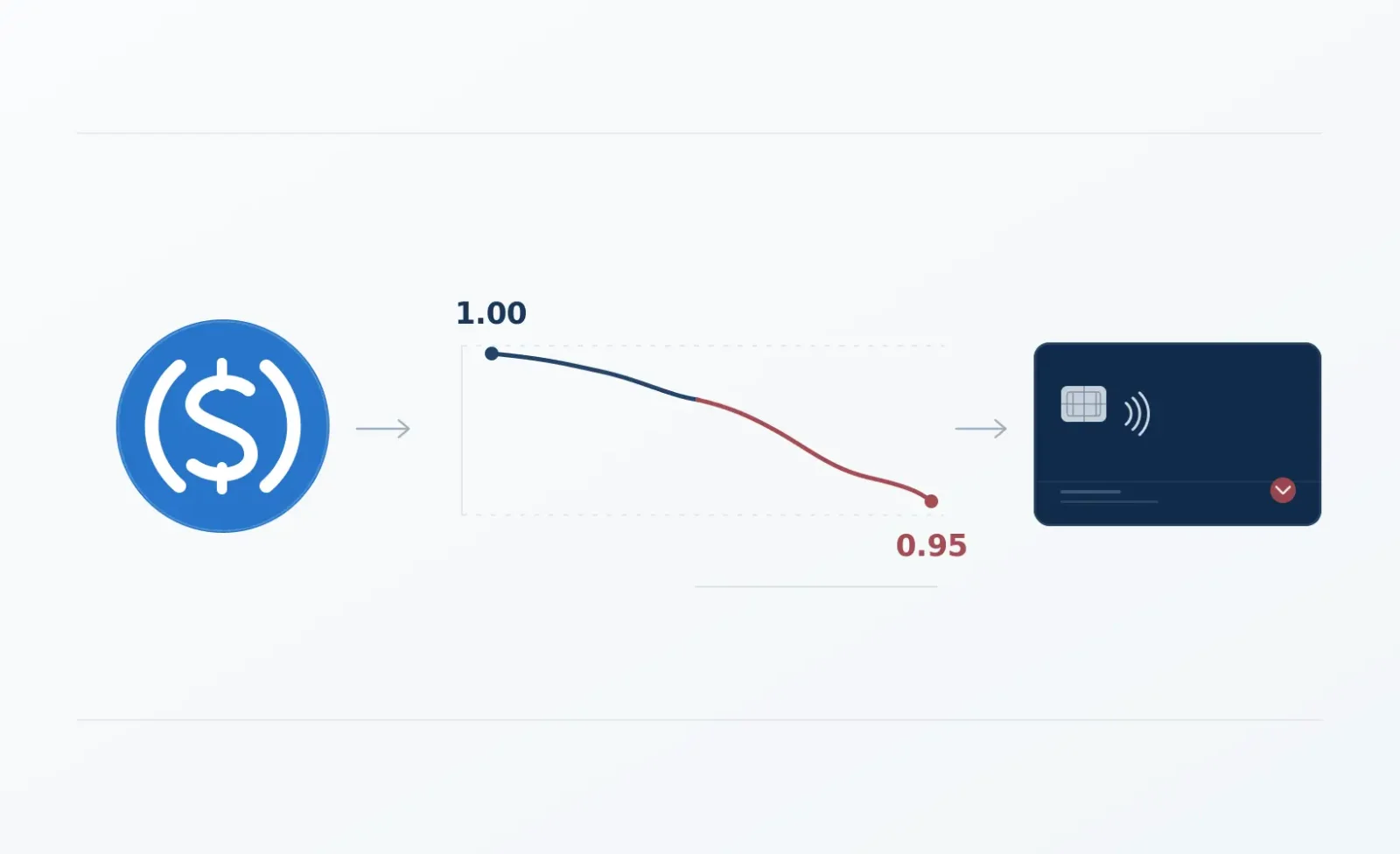
If the effective market conversion price falls to $0.95 and the card executes the conversion at that price, the theoretical realizable value of the assets falls to $950, before conversion spreads or fees.
The number of stablecoins required to buy a $100 item also changes.
Assumed Effective Conversion Price | Stablecoins Required for a $100 Purchase | Theoretical Purchasing Power of 1,000 Tokens |
|---|---|---|
$1.00 | 100.00 tokens | $1,000 |
$0.98 | 102.04 tokens | $980 |
$0.95 | 105.26 tokens | $950 |
$0.90 | 111.11 tokens | $900 |
These figures are mathematical illustrations only. They assume immediate execution at the stated prices and exclude conversion spreads, network fees, card fees, and liquidity constraints. They do not represent the execution price of any particular card.
At $0.95 per token, a $100 purchase requires approximately 105.26 stablecoins, about 5.26% more than at the intended one-dollar peg.
For users paying subscriptions, cross-border orders, or everyday expenses with USDT, USDC, or similar assets, such a decline directly affects how much their balances can cover.
Market disruptions can create another problem: even if the user accepts the prevailing price, the platform may be unable to execute the conversion, resulting in a declined payment.
Stablecoins Used for Lending or Collateral: Risk May Pass Through the Credit Limit
The third structure involves credit-based spending or collateralized lending.
Some crypto cards allow users to pledge crypto assets as collateral for a spending limit or link card transactions to a credit arrangement.
In these products, a falling stablecoin price may not directly reduce an existing fiat-denominated loan balance. It may, however, lower the recognized value of the collateral securing that loan.
Consider a credit product that accepts stablecoins as collateral. If the collateral's market value declines, the lender may recalculate the loan-to-value ratio (LTV) under the agreement.
If the revised collateral value no longer meets maintenance requirements, the user may be required to provide additional collateral, repay part of the debt, or face other contractual risk-management measures.
Whether forced liquidation is triggered depends on the eligible collateral, valuation methodology, liquidation thresholds, buffer mechanisms, and contractual terms.
Not all crypto-backed cards operate this way. Nor should every card with a credit limit be treated as a DeFi lending product subject to automatic liquidation.
For cardholders using this structure, a stablecoin depeg may affect not only their available credit but also the assets pledged as collateral.
Why Would a Payment Be Declined When the Account Still Holds 1,000 USDC?
Following an unusual movement in stablecoin prices, users may find that their account balance appears unchanged even though card payments suddenly fail.
This does not necessarily mean that assets have disappeared. The problem may arise at the balance valuation, asset conversion, or payment authorization stage.
Available Spending Funds Fall Below the Merchant's Authorization Request
If a card calculates available spending funds using the current market value of a stablecoin, a displayed balance of 100 USDC does not guarantee that the issuer will approve a $100 transaction.
At an effective conversion price of $0.95, the theoretical value of those 100 USDC is only $95.
If the merchant requests authorization for $100, the card may decline the transaction because the available funds are insufficient.
Some transactions also involve preauthorization amounts, payment fees, or additional balance requirements, depending on the merchant and card program rules.
Stablecoin Conversion Channels Become Restricted
During heightened market volatility, card providers may encounter insufficient liquidity through their conversion partners, abnormal execution quotes, or interruptions to services provided by third parties.
If the card program must sell stablecoins to obtain the funds required for a card payment, failure at the conversion stage may prevent subsequent authorization.
The stablecoins may still be present in the user's wallet but temporarily unavailable for conversion into a currency the card can spend.
The Card Supports Only Certain Tokens
Some wallet-linked cards permit spending only from specified tokens or assets on particular blockchain networks.
For example, Gnosis Pay's official troubleshooting guidance states that the spendable assets under its original consumer card program included EURe, GBPe, and USDCe. Other tokens did not automatically qualify as spendable funds.
Subsequent product changes are also important. On September 21, 2026, Gnosis Pay formally notified cardholders that transaction authorizations for its original consumer physical and virtual card program would cease at 23:59 UTC on December 20, 2026. The business was shifting its focus toward partner card programs. The token rules described above apply to the original program; supported assets, blockchain networks, and usage conditions for future partner-issued cards will depend on their respective updated terms.
Holding a dollar-pegged stablecoin, therefore, does not establish that it is supported by a particular card. Users must verify both the asset and its blockchain network.
Bridged tokens deserve particular attention. A token containing "USDC" in its name does not necessarily share the same risk profile, liquidity, or redemption arrangements as USDC issued natively by its issuer.
A market depeg, a discount on a bridged asset, and a card's lack of support for a particular token can occur simultaneously, but each requires a separate assessment.
The Platform Activates Temporary Risk Controls
Some issuers or service providers may adjust transaction limits, suspend funding, halt conversions, or restrict certain services during severe market disruptions, in accordance with their contracts and internal risk policies.
Such measures can affect card payments. They do not mean that every crypto card will automatically freeze when a stablecoin depegs.
If many users report payment failures at the same time, the cause should be assessed using official announcements, cardholder agreements, and actual transaction statuses. It should not immediately be attributed to an outage across the entire card network.
Can an Authorized Purchase Be Repriced After a Stablecoin Depeg?
Card payments generally pass through distinct stages, including authorization, clearing, and settlement.
When a user makes a payment at a merchant, the issuer may first approve a transaction for a specified amount. The merchant subsequently submits clearing data, after which the transaction is recorded as a final posted charge.
For conventional fiat-denominated debit cards, the authorized and final posted amounts may differ because of merchant adjustments, currency conversion, or other transaction-specific factors.
Crypto cards introduce an additional consideration: how the underlying funding assets are handled. The service provider must determine when and under what rules crypto assets are used to fund the payment.
If the product has already completed the necessary stablecoin conversion at authorization, a subsequent market depeg may have no effect on the amount converted for that transaction.
If stablecoin exposure remains between authorization and final processing of the funds, whether price movements affect the cardholder's final charge depends on the product agreement and transaction implementation.
It would therefore be incorrect to assume that all crypto cards recalculate stablecoin prices on the clearing date. It would be equally incorrect to assume that successful authorization eliminates every remaining exchange-rate or transaction-adjustment risk.
Transactions with longer preauthorization periods, including hotels, car rentals, and fuel purchases, deserve particular attention.
A merchant may initially authorize one amount and subsequently adjust it to reflect the final purchase. When a card is funded with crypto assets, users need to understand how the authorized amount is reserved, what funds are used for the final charge, and how the available balance is released if the transaction is reversed.
If authorization succeeds during a depeg but the order fails, users should verify the transaction status before attempting payment again. Repeated attempts may create multiple pending authorizations that further reduce available spending capacity.
If a Refund Occurs During a Depeg, Will the Original Number of Stablecoins Be Returned?
Suppose a user purchases a $100 item with a crypto payment card. At the time of purchase, the card consumes 100 USDC at the prevailing conversion rate.
Several days later, the user requests a refund, by which time USDC has fallen to $0.95.
The user might expect the refund to return the same 100 USDC originally deducted.
But a card payment and a crypto asset conversion are separate accounting events.
The merchant processes a card payment. Refunds are generally initiated according to the original transaction and the merchant's applicable currency rules, then processed through the acquirer, card network, issuer, and other relevant participants.
Once the refund reaches the card account, whether it appears as a fiat balance, platform credit, or crypto asset depends on the specific card program.
For example, the official MetaMask Card FAQ explains that refunds are credited to a Credits balance. Those Credits may be used for future card purchases or withdrawn to a wallet through supported product mechanisms.
Under the currently published guidance, eligible Credits withdrawals are processed in mUSD on either the Monad or Linea network, depending on the user's wallet configuration. Users with a linked Money Account can withdraw to the associated Monad wallet. Those without a linked Money Account can withdraw through Linea to a designated EVM wallet. Configurations with only a Solana wallet do not currently support this withdrawal method.
Thus, even when the original purchase was funded with USDC, the refund may not be returned in USDC, much less in the same number of tokens. Withdrawal routes may also depend on wallet configuration and the product's regional rules.
Other cards may use different arrangements. Four details should be checked:
The currency in which the original transaction was denominated;
The amount the merchant actually refunded;
The asset or balance type in which the refund was credited to the card account;
The conversion rate and fees that would apply if the funds were converted back into stablecoins.
If the original payment involved selling crypto assets, a refund will not ordinarily reverse that market sale automatically.
Once stablecoin prices have changed, the number of tokens or the economic value ultimately received may differ from the amount spent. Whether a refund restores the original token quantity must be determined from the card terms and actual transaction records.
Not All Stablecoin Depegs Stem from the Same Risk
A stablecoin trading below its intended peg is an observable market outcome. The underlying causes can differ considerably, as can their implications for payment functionality and the safety of funds.
Reserve and Issuer Credit Risk
For stablecoins backed by reserve assets and supported by an issuer's commitment to redeem at a specified value, key risk factors include reserve quality, liquidity, custody arrangements, and the issuer's ability to meet its obligations.
The 2023 USDC episode showed that even reserves containing relatively liquid assets, such as cash and short-term government securities, can be exposed to banking risks and market concerns about redemption. Those concerns can produce substantial secondary-market price movements.
If an issuer ultimately cannot honor its redemption obligations, what begins as a temporary market discount may develop into a more persistent credit loss.
Market Liquidity Risk
Concentrated selling pressure, reduced market-maker liquidity, or restricted trading channels can all push a stablecoin's market price away from its target value.
Even if the issuer's underlying redemption mechanism remains in place, ordinary holders may be unable to access it immediately. They may instead have to sell through trading platforms at prevailing market prices.
For cards that must sell stablecoins immediately to fund a purchase, short-term liquidity disruptions can reduce purchasing power or prevent payments altogether.
Smart Contract and Cross-Chain Asset Risk
Some crypto cards support stablecoins held in self-custody wallets or on specified blockchain networks.
Such products also carry risks associated with token contracts, wallet approvals, cross-chain bridges, oracles, and on-chain liquidity.
Where a card uses a bridged stablecoin, its value may depend on both the original stablecoin and the bridge mechanism.
Even if native USDC continues to trade normally, this does not guarantee that every cross-chain representation will maintain the same market price or conversion liquidity.
Payment Provider and Card Program Risk
A crypto payment card can become unusable even when the stablecoin price is stable. Possible causes include changes to an issuer's card program, suspension of conversion services, or changes in regional eligibility rules.
These risks can arise independently of a stablecoin depeg.
In supervisory guidance published on October 8, 2026, the European Securities and Markets Authority (ESMA) set out expectations under the EU Markets in Crypto-Assets Regulation (MiCA) concerning services involving asset-referenced tokens (ARTs) and e-money tokens (EMTs) that do not comply with MiCA requirements.
The guidance requires MiCA-authorized crypto-asset service providers (CASPs) to cease providing EU clients with relevant crypto-asset services involving those noncompliant tokens, including trading, exchange, custody, and transfers. For existing exposures, it permits necessary liquidation, conversion, withdrawal, transfer, or safekeeping activities under strict limitations.
The requirements apply to particular crypto-asset services provided by regulated entities. They do not amount to a blanket prohibition on individuals holding the stablecoins concerned, nor do they establish that every crypto card using those assets must cease operating.
Compliance requirements for stablecoin-related services are distinct from the authorization requirements for card issuance and the arrangements governing card programs. When using crypto payment cards across borders, users should examine both whether the underlying stablecoin services can lawfully be provided and whether the card itself complies with the applicable issuance and payment service requirements.
What Should Cardholders Check First When a Stablecoin Suddenly Depegs?
When a stablecoin experiences a significant price disruption, repeatedly funding a card, attempting conversions, or retrying payments without understanding the situation can create additional losses.
The immediate priority is to establish the actual status of the funds, then check affected transactions and service restrictions.
Check what the balance is actually denominated in.
If the card interface displays 1,000 USD, determine whether that amount represents a completed fiat balance, stablecoins valued in U.S. dollars, or funds still undergoing conversion.
If it displays 1,000 USDC, verify the blockchain network, token contract, and any relevant wallet approvals or conversion arrangements.
Identify any conversions that remain incomplete.
Review funding and conversion records to establish whether the assets have actually been exchanged.
For funds still held as stablecoins, check which conversion channels are currently available rather than assuming the platform will continue processing them at one dollar per token.
Verify the price at which the funds can actually be converted.
The latest trade price displayed on an exchange is not necessarily the rate offered by the card provider.
When liquidity is limited, the reference price for a small trade may differ substantially from the execution price available for a larger order.
A USDC/USD quote on a market-data page is not enough to calculate a particular card's actual spending capacity.
Review outstanding transactions.
Pay particular attention to pending funding transfers, conversions, card preauthorizations, refunds, and upcoming subscription renewals.
If card spending has been temporarily suspended, retain failure messages, order records, and transaction timestamps. Check for authorization holds that have not yet been released, and avoid repeated payments.
Verify official notices and withdrawal conditions.
If a stablecoin issuer, card platform, or conversion provider announces restrictions, establish precisely which services, dates, and assets are affected.
Before converting or transferring assets, consider market prices, fees, liquidity, and whether the provider supports the intended operation. Avoid rushed transactions where reliable quotes or sufficient liquidity are unavailable.
Users who depend on crypto cards for subscriptions or essential expenses should also maintain a backup payment method accepted by the merchant, rather than relying entirely on one stablecoin and one card provider.
How Can You Assess a Crypto Card's Stablecoin Risk Exposure?
When choosing a crypto card, statements such as "Supports USDT" or "Supports USDC" describe only part of its functionality. They do not fully explain its financial risks.
More important than the list of supported stablecoins is how the card manages those assets and how the spending funds relate to the stablecoin issuer, custodian, and card issuer.
Question to Verify | Why It Matters for Risk Assessment |
|---|---|
What asset do you actually hold after funding the card? | Determines whether the exposure is to stablecoins or a fiat balance |
When are stablecoins converted? | Identifies when market price changes can affect purchasing power |
Which conversion rate is used? | Establishes whether pricing follows market quotes, fixed rules, or provider-specific rates |
Can stablecoins be withdrawn directly? | Helps assess exit options and withdrawal restrictions |
Who controls and holds the funds? | Distinguishes the stablecoin issuer, card brand, and actual fund custodian or manager |
Are the tokens native stablecoins or bridged representations? | Identifies additional cross-chain and smart contract risks |
Can services be suspended during market disruptions? | Helps assess continuity of conversion, authorization, and withdrawals |
In what form are refunds credited? | Identifies the asset received and any subsequent conversion risk |
The most important distinction is the actual legal and economic nature of the card balance.
One platform may display a USD balance while retaining crypto assets in the background. Another may have completed the fiat conversion, but the user's rights to that balance may depend on a separate prepaid card issuer.
Two balances that look similar on screen can carry fundamentally different risks.
Likewise, keeping funds in a self-custody wallet does not make a card structure inherently safe. Users still need to understand spending allowances, smart contract permissions, token liquidity, conversion routes, and the conditions governing the card program's continued operation.
For users holding substantial stablecoin assets over the long term, separating everyday card spending funds from other holdings is generally prudent. Payment cards are primarily designed to facilitate spending; they are not necessarily suitable for storing an entire stablecoin portfolio over extended periods.
If a Stablecoin Regains Its Peg, Can Earlier Losses Be Recovered?
The answer depends on whether the cardholder converted assets during the price disruption and whether any other losses occurred.
If the user retained the original stablecoins without converting them or suffering other asset losses, the market value of those holdings may recover when the stablecoin returns to its peg. Spending or withdrawal services that were previously restricted, however, may not recover at the same time.
If the user sold stablecoins at a discount during the depeg, a subsequent price recovery does not automatically compensate for the loss realized on that sale.
If the user converted stablecoins into a fiat balance, that balance should be determined using the actual execution price and account terms, not recalculated retrospectively at the restored peg.
If the depeg was accompanied by platform insolvency, asset freezes, smart contract losses, or other independent events, a recovery in the stablecoin's price does not guarantee that the affected assets can be recovered.
The 2023 USDC episode demonstrates that a stablecoin depeg can be a temporary crisis of liquidity and confidence, with mechanisms that allow recovery. But one successful historical recovery does not establish that other stablecoins, issuers, or future incidents will produce the same outcome.
For crypto card users, a stablecoin returning to one dollar and the recovery of payment-related losses already incurred are two separate questions. Completed conversions, card transactions that remain unsettled, and independent losses involving platforms or smart contracts must each be assessed according to their respective fund-processing mechanisms and contractual relationships.
References
The following sources support verification of the stablecoin redemption mechanisms, historical events, and specific card funding models discussed in this article. Product terms, regional eligibility, and technical implementations may change. Sources reviewed: October 26, 2026.
Circle — USDC Terms: Terms of service, redemption eligibility, and price volatility risks for USDC holders outside the European Economic Area.
Circle — MiCA USDC White Paper: Rights of USDC holders in the European Economic Area and issuer arrangements.
Circle — MiCA Redemption Policy: Redemption conditions for USDC and EURC in the European Economic Area, retail holder eligibility, and application procedures.
Circle — USDC Reserve Risk Removed, March 2023: The Silicon Valley Bank episode and associated USDC reserve risk.
Circle — March 15 Update on USDC Operations: Backlogged redemption requests and the restoration of liquidity services.
Tether — Legal Terms: USDT reserves, redemption rules, and eligibility restrictions.
Tether — Fees: Minimum direct redemption amounts and applicable fees.
MetaMask — How to Fund Your Card: Self-custody funds, spending authorizations, and token spending mechanisms.
MetaMask — Card FAQs: Card balances, refunds, Credits, and related withdrawal arrangements.
Gnosis Pay — Card Problems: Spendable tokens and transaction authorization restrictions under the original consumer card program.
Gnosis Pay — Formal Notice: Closure of the Gnosis Pay Web App and Card: The formal notice dated September 21, 2026, the termination schedule for the original card program, and the distinction from partner card programs.
ESMA — Crypto-assets: Market Structures and EU Relevance: Research on crypto-asset market structures and associated market risks.
ESMA — Supervisory Expectations on Unauthorised Stablecoins, October 2026: Supervisory expectations for crypto-asset services involving noncompliant stablecoins under the EU MiCA framework.