
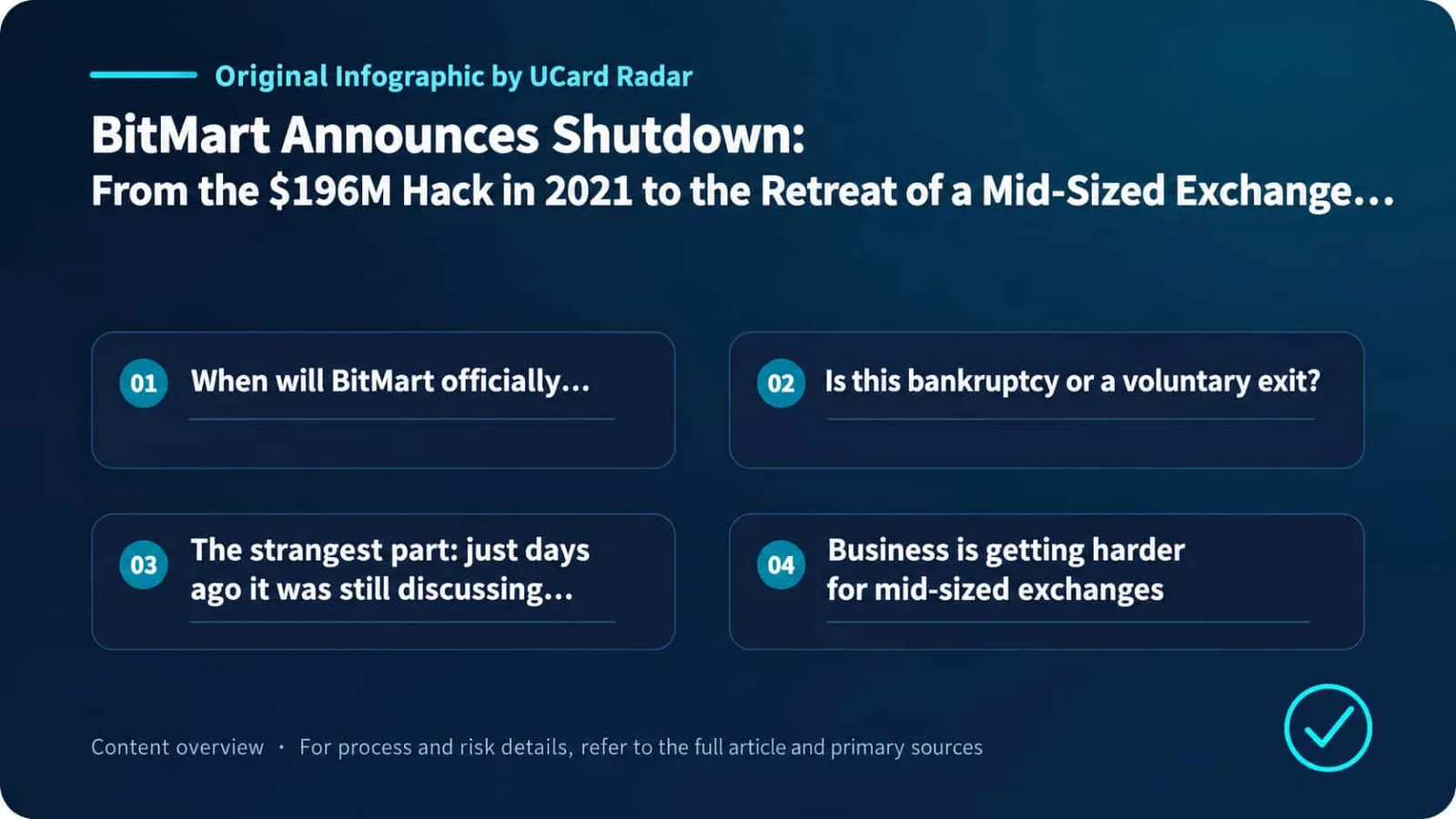
Why is BitMart shutting down? From the $196 million hack to the strategic retreat of a mid-sized exchange
On July 26, 2026, BitMart issued an announcement stating that it would begin an orderly cessation of its trading-platform operations.
This was not an abrupt system outage. The platform did not immediately disable logins, trading, or withdrawals. Instead, it set out a wind-down period of roughly six months and said withdrawal services would remain available during that time.
Even so, the announcement was unexpected.
Just days before the shutdown notice, BitMart was still publishing its operating data for the first half of 2026 and promoting its payment card, prediction-market, and TradFi products. Only a month earlier, the platform had announced that it had obtained an Australian financial services license. Moving from “continued expansion” to “ceasing operations” in such a short period is difficult to explain simply by weak market conditions.
Was BitMart making a voluntary strategic retreat, or had operating pressure accumulated to a point where continuing was no longer viable?
Sources and limits of the conclusions
Primary-source verification: Important Notice Regarding the Orderly Cessation of BitMart Operations; Announcement on the Discontinuation of BitMart Spot Margin Trading Service; BitMart H1 2026 Report: Resilience, Discipline, and the Broadening of Digital Asset Access.
Critical service-status information is based on BitMart’s official announcements, which set out the orderly cessation of operations, the discontinuation of margin services, and the final service deadlines.
BitMart has not published audited financial statements or a detailed causal explanation showing whether the closure was driven specifically by profitability, liquidity, security incidents, competition, or compliance costs. Any related conclusions in this article are analysis or inference and should not be treated as official confirmation from the platform.
When will BitMart officially shut down?
According to BitMart’s announcement, after reviewing its operating position, market environment, and future strategic direction, the platform decided to phase out its trading business.
The main timeline includes:
From 01:30 UTC on July 26, 2026, new user registrations will gradually stop;
At the same time, crypto and fiat deposits will begin to be restricted;
Derivatives accounts will enter reduce-only mode, with no new positions permitted;
Spot trading will stop accepting new orders;
Copy trading, grid trading, API trading, and other services will be progressively discontinued;
From 01:00 UTC on August 26, 2026, spot, derivatives, and other trading services will stop;
Earn, staking, lending, Launchpad, and similar products will be phased out;
At 15:59 UTC on January 31, 2027, the trading platform will formally cease operations.
BitMart recommends that users complete KYC and close open positions before 01:00 UTC on August 26, 2026, and submit withdrawal requests before 05:00 UTC that same day.
Users who have not withdrawn by the recommended deadline may later be required to enter a manual review process and provide identity documents, proof of address, source-of-funds documentation, or proof of ownership of the withdrawal address.
Therefore, while the formal final shutdown date is January 31, 2027, the more important date for ordinary users is August 26, 2026.
Is this bankruptcy, or a voluntary exit?
Based on the process announced so far, BitMart appears to be conducting an orderly wind-down rather than abruptly halting services during a liquidity crisis.
The platform has not announced bankruptcy proceedings. Users can still access their accounts, and existing positions have been given time to be managed. Withdrawals have not yet been shut down. This is materially different from the way FTX rapidly suspended withdrawals during its liquidity crisis.
However, an orderly wind-down does not automatically prove that the platform has no asset shortfall.
BitMart is a private company and does not publish complete audited financial statements. Outside observers cannot determine, from a shutdown announcement alone, the actual relationship among available assets, customer liabilities, operating capital, and other obligations.
A more accurate assessment at this stage is:
There is no public evidence showing that BitMart is insolvent, and its exit does not resemble a sudden liquidity collapse. At the same time, there is not enough public financial information to prove that the closure is completely unrelated to financial pressure.
The announcement repeatedly refers to manual review, source-of-funds checks, sanctions screening, and withdrawal-address verification, indicating that the platform is also trying to control fund outflows, compliance reviews, and operational risk during the wind-down.
The strangest part: just days earlier, BitMart was still talking about growth
BitMart’s shutdown attracted attention largely because the signals it had been sending before the announcement did not align with the final decision.
In its first-half 2026 report, BitMart said:
495 new spot assets were added in the first half of the year;
492 new perpetual contract trading pairs were added;
assets under management increased by approximately 256% quarter over quarter;
physical BitMart Card issuance increased by 150%;
payment-card transaction volume increased by 300%;
fiat on- and off-ramp services covered more than 120 countries;
the platform had established a licensed entity in Australia;
around 44% of prediction-market users were new trading users on the platform.
In the report, BitMart Global CEO Nathan Chow also said that the platform had been operating for eight years and hoped to remain in business for the next eight.
In June 2026, BitMart announced that it had obtained an Australian financial services license and planned to expand into RWA and traditional-finance products.
But from July 23 to July 26, the platform issued a series of notices covering changes to U.S. user services, suspension of AMM bots, discontinuation of spot margin trading, and finally the full cessation of operations.
This sequence suggests that the decision to shut down was unlikely to have been made suddenly on July 26. A more plausible interpretation is that the platform had already entered a systematic contraction and wind-down phase.
The question is: if users, products, and asset scale were all growing, why shut the business down?
The answer may be straightforward: growth in business scale does not necessarily mean sustainable profitability.
The figures BitMart disclosed focused mainly on the number of listed assets, number of trading pairs, card issuance, trading volume, and assets under management. It did not disclose net revenue, operating profit, free cash flow, security costs, compliance expenses, or customer-liability data.
A platform can continue adding users and products while becoming progressively harder to operate profitably.
The economics of mid-sized exchanges are getting harder
Centralized exchanges mainly generate revenue from spot and derivatives trading fees, token-listing services, lending spreads, wealth products, market making, payments, and fiat channels.
But the cost of operating a global exchange is also substantial:
wallet and private-key security;
matching engines and servers;
market-maker and liquidity incentives;
global customer-service operations;
KYC and AML systems;
Travel Rule infrastructure;
sanctions screening;
licenses and legal counsel across jurisdictions;
marketing, rebates, and new-user incentives;
compensation and reserves after security incidents.
In its first-half 2026 report, BitMart also acknowledged that spot trading volume at the largest centralized exchanges was cooling, while onchain perpetual platforms were absorbing an increasing share of derivatives users. This has increased the competitive pressure on small and mid-sized centralized exchanges.
BitMart was being squeezed from both sides.
On one side are major centralized exchanges such as Binance, OKX, and Bybit. They have deeper liquidity, lower marginal costs, much larger user bases, and more mature global compliance infrastructures.
On the other side are onchain perpetual platforms such as Hyperliquid. These platforms attract professional traders who do not want to keep assets with centralized custodians for long periods.
BitMart sits directly between these two groups.
It must bear technology, security, and compliance costs approaching those of a large exchange, without enjoying the same economies of scale. Even if headline daily trading volume remains high, that does not mean the platform generates enough profit.
Reported exchange volume may include market-maker activity, low-fee accounts, rebate-driven users, and promotional traffic. The portion that actually converts into net revenue can be much lower than the headline number suggests.
The long-term cost of the 2021 hack
The most serious crisis in BitMart’s history occurred in December 2021.
Attackers obtained the private keys to two hot wallets and transferred assets from Ethereum and Binance Smart Chain wallets. BitMart initially confirmed losses of around $150 million, while security firm PeckShield estimated the total at approximately $196 million.
BitMart founder Sheldon Xia later said the platform would compensate affected users using its own funds.
But more than a month after the incident, some users publicly said they still had not been reimbursed. What began as a wallet-security breach gradually turned into a crisis of trust and customer service.
The consequences for BitMart went beyond a one-time accounting loss.
First came the direct financial pressure. Regardless of the final compensation amount, a security incident approaching $200 million can materially drain the cash reserves of a mid-sized exchange.
Second came the ongoing security expenditure. After a major private-key compromise, a platform must redesign hot-wallet permissions, asset segregation, signing procedures, risk alerts, and incident-response systems. These are not one-off expenses; they become long-term fixed costs.
The harder thing to restore is user trust.
The most important asset of an exchange is not its app, the number of trading pairs, or its marketing campaigns. It is the belief that users can get their money back whenever they choose.
After a major hack, even if a platform keeps operating for years, high-net-worth users, institutions, and market makers may demand greater risk compensation or move assets elsewhere.
That raises customer-acquisition costs and weakens the exchange’s ability to attract long-duration and large-balance capital.
Compliance and reputational pressure from the FTC investigation
In 2022, the U.S. Federal Trade Commission began investigating BitMart’s U.S. operating entities.
According to public documents, the investigation covered more than the 2021 hack. It also examined whether BitMart had made misleading representations about its services and security capabilities, whether some users had been unable to access their accounts, whether customer information was adequately protected, and whether unfair or deceptive conduct had occurred in the platform’s operations and marketing.
BitMart-related operating entities attempted to limit or quash the FTC’s investigative demands, but the FTC rejected those requests.
It is important to distinguish an investigation from a finding of wrongdoing. The fact that the FTC opened an investigation does not mean BitMart was convicted or formally found to have violated the law.
Even if no penalty ultimately results, regulatory investigations impose costs of their own, including legal fees, document production, internal reviews, and substantial management attention.
They also keep the 2021 security incident present in the risk assessments of regulators, partners, and users.
Global compliance costs are eroding the margins of mid-sized platforms
BitMart has long served users across many countries and regions.
In the early years of crypto, global reach was a competitive advantage. As regulation has matured, it has also become a major burden.
Exchanges must now deal simultaneously with:
U.S. federal and state regulatory restrictions;
the EU MiCA framework;
Australian financial-services licensing requirements;
national Travel Rule regimes;
sanctions and high-risk-jurisdiction screening;
source-of-funds reviews;
fiat-payment and banking-partner requirements;
local consumer-protection and data-protection rules.
Although BitMart obtained an Australian financial services license in June 2026, obtaining a license is only the beginning.
Licensed entities must continuously bear the cost of audits, reporting, complaint handling, asset segregation, and compliance personnel. If a market does not generate enough revenue, maintaining local licenses, corporate entities, and legal structures may no longer make economic sense.
BitMart’s decision to first adjust services for U.S. users and then progressively shut down trading products may also indicate that the platform needed to unwind different contracts, accounts, and regulatory obligations on a jurisdiction-by-jurisdiction basis.
Many products, but no real moat
Over the past several years, BitMart launched spot trading, derivatives, copy trading, grid trading, Earn, staking, lending, Launchpad, payment cards, prediction markets, RWA, and TradFi products.
By product count, it had become a full-service crypto platform.
The problem is that almost all of these services can also be found on larger exchanges.
Some users may have chosen BitMart because certain small-cap assets listed there first, or because the platform offered rebates, subsidies, and short-term campaigns.
But such users often have limited long-term loyalty. Once another platform lists the same asset, or BitMart stops offering rewards, funds can move quickly.
Payment cards, prediction markets, and TradFi products can expand use cases, but they may not generate enough short-term profit to cover the fixed cost of the trading system, security infrastructure, and global compliance network.
The high growth rates in BitMart’s half-year report also need to be interpreted in the context of their starting base.
A 300% increase in payment-card transaction volume shows rapid expansion, but it does not prove the card business was profitable. A 256% increase in assets under management does not mean those assets belonged to the platform, nor does it mean company revenue grew at the same rate.
From a business perspective, BitMart’s problem may not have been too few products, but too many products and too much structural complexity without a new business line capable of replacing traditional trading fees as a stable profit center.
After management changes, the strategy may already have shifted
In April 2025, BitMart made a significant management change.
Founder Sheldon Xia moved into the role of Group President, focusing mainly on long-term strategy, product innovation, and platform security. Nenter Nathan Chow became Global CEO, responsible for daily operations and the next stage of development.
At the time, the change was presented as part of the platform’s transition into a new growth phase.
But looking at the eventual outcome, the new management team may have reached a different conclusion after reassessing the business:
Maintaining a globally distributed centralized exchange with a large number of products may have required more capital and management resources than the business was likely to generate in future returns.
This does not mean the 2025 management reshuffle was intended to prepare for a shutdown. But it may have created the conditions for a more systematic strategic review.
When a founder steps away from day-to-day operations and a new CEO takes control, companies often reassess more rigorously which businesses are worth continuing and which should be stopped.
Why did BitMart announce its exit after BitMEX?
A few days before BitMart announced the cessation of operations, long-established derivatives exchange BitMEX also announced that it would close its trading platform.
There is no publicly disclosed direct relationship between the two companies, and there is no evidence that BitMEX’s decision caused BitMart to exit.
But the timing of the two events still reflects a common trend: market share among centralized exchanges is becoming increasingly concentrated in the largest platforms.
Users are increasingly inclined to keep assets with a small number of exchanges that offer deeper liquidity, stronger brands, and broader licensing coverage. Market makers likewise prefer to deploy capital on venues with larger volumes and more counterparties.
The more liquidity concentrates, the better the trading experience becomes on leading platforms. As trading depth weakens on mid-sized platforms, large traders become less willing to use them.
This creates a feedback loop:
Users decline, market depth deteriorates; market depth deteriorates, market makers withdraw; fewer market makers then push even more users away.
For that reason, BitMart’s shutdown should not be viewed only as the isolated failure of one exchange. It is better understood as part of the shrinking survival space for mid-sized platforms as the industry enters a more mature competitive phase.
The real reasons behind BitMart’s shutdown
BitMart has not published complete financial data or explained the specific numbers behind its decision to close.
Therefore, no single factor can currently be treated as the sole confirmed reason.
Taken together, the official announcements, historical events, and industry environment suggest a more plausible explanation: multiple pressures accumulated over time and eventually changed the economics of continuing operations.
First, exchange economics are deteriorating. Security, compliance, technology, and liquidity costs continue to rise, while BitMart cannot achieve the same economies of scale as the largest exchanges.
Second, the 2021 hack imposed a long-term drain on both capital and trust. A security incident approaching $200 million created not only direct losses but also higher subsequent costs for security, operations, and customer acquisition.
Third, global compliance is becoming increasingly expensive. Licensing, KYC, Travel Rule implementation, sanctions screening, and source-of-funds reviews are turning into long-term fixed expenses for international trading platforms.
Fourth, liquidity is concentrating simultaneously at leading centralized exchanges and onchain platforms. BitMart has had to compete on both fronts without a sufficiently strong point of differentiation.
Fifth, newer businesses may have been growing quickly, but they had not yet become profit centers capable of supporting the entire platform. Payment cards, wealth products, prediction markets, and TradFi services can broaden the product range, but may not cover the exchange’s overall cost base.
Finally, management may simply have decided not to keep investing.
The orderly wind-down, rather than an emergency halt, makes this look more like a strategic exit after review than a sudden technical failure or liquidity collapse.
What should users do now?
Regardless of whether BitMart has an asset shortfall, users have little reason to keep funds on the platform until the final stage.
The more prudent approach is to complete the following steps as soon as possible:
Check balances in spot, funding, derivatives, and wealth-management accounts;
Cancel all open spot orders and automated trading strategies;
Close derivatives positions proactively instead of waiting for forced platform-wide settlement;
Redeem Earn, staking, lending, and other investment products;
Complete or update KYC;
Verify the asset, network, and destination address before withdrawing;
First make a small test withdrawal;
Save records of balances, deposits, withdrawals, and trades;
Do not wait until January 31, 2027 to begin taking action;
Be alert to supposed fees for “accelerated withdrawals,” “account unfreezing,” or “manual review.”
BitMart states that its staff will not contact users through Telegram, WhatsApp, WeChat, or private social accounts asking them to pay expedited-processing fees, unfreezing fees, or deposits. Staff will also not ask for passwords, SMS codes, Google Authenticator codes, private keys, or seed phrases.
Conclusion
BitMart’s closure does not look like an exchange suddenly going bankrupt in a single day. It looks more like a mid-sized centralized exchange deciding to stop committing capital after years of accumulated pressure.
The 2021 hack was the platform’s most visible historical burden, but it was not the entire story.
What appears to have changed BitMart’s trajectory is the combined effect of security costs, global compliance costs, liquidity competition, the pull of larger exchanges, the rise of onchain trading, and insufficient profitability from newer business lines.
BitMart tried to find new growth through more listed assets, more derivatives, payment cards, wealth products, RWA, and TradFi. But it ultimately did not build a moat strong enough to offset the pressure on its traditional trading business.
The exit also sends a broader industry signal:
As crypto exchanges move from an era of rapid expansion into mature competition, trading volume alone is no longer enough. Platforms also need sufficient capital, stable profits, continuous security investment, global compliance capabilities, and long-term user trust.
For ordinary users, the priority now is not to keep speculating about why BitMart is closing, but to complete position closures, redemptions, and withdrawals as soon as possible.
Whether a platform has truly achieved an “orderly exit” will ultimately be judged by whether its last user can successfully recover their assets.
Why is BitMart shutting down? From the $196 million hack to the strategic retreat of a mid-sized exchange
On July 26, 2026, BitMart issued an announcement stating that it would begin an orderly cessation of its trading-platform operations.
This was not an abrupt system outage. The platform did not immediately disable logins, trading, or withdrawals. Instead, it set out a wind-down period of roughly six months and said withdrawal services would remain available during that time.
Even so, the announcement was unexpected.
Just days before the shutdown notice, BitMart was still publishing its operating data for the first half of 2026 and promoting its payment card, prediction-market, and TradFi products. Only a month earlier, the platform had announced that it had obtained an Australian financial services license. Moving from “continued expansion” to “ceasing operations” in such a short period is difficult to explain simply by weak market conditions.
Was BitMart making a voluntary strategic retreat, or had operating pressure accumulated to a point where continuing was no longer viable?
When will BitMart officially shut down?
According to BitMart’s announcement, after reviewing its operating position, market environment, and future strategic direction, the platform decided to phase out its trading business.
The main timeline includes:
From 01:30 UTC on July 26, 2026, new user registrations will gradually stop;
At the same time, crypto and fiat deposits will begin to be restricted;
Derivatives accounts will enter reduce-only mode, with no new positions permitted;
Spot trading will stop accepting new orders;
Copy trading, grid trading, API trading, and other services will be progressively discontinued;
From 01:00 UTC on August 26, 2026, spot, derivatives, and other trading services will stop;
Earn, staking, lending, Launchpad, and similar products will be phased out;
At 15:59 UTC on January 31, 2027, the trading platform will formally cease operations.
BitMart recommends that users complete KYC and close open positions before 01:00 UTC on August 26, 2026, and submit withdrawal requests before 05:00 UTC that same day.
Users who have not withdrawn by the recommended deadline may later be required to enter a manual review process and provide identity documents, proof of address, source-of-funds documentation, or proof of ownership of the withdrawal address.
Therefore, while the formal final shutdown date is January 31, 2027, the more important date for ordinary users is August 26, 2026.
Is this bankruptcy, or a voluntary exit?
Based on the process announced so far, BitMart appears to be conducting an orderly wind-down rather than abruptly halting services during a liquidity crisis.
The platform has not announced bankruptcy proceedings. Users can still access their accounts, and existing positions have been given time to be managed. Withdrawals have not yet been shut down. This is materially different from the way FTX rapidly suspended withdrawals during its liquidity crisis.
However, an orderly wind-down does not automatically prove that the platform has no asset shortfall.
BitMart is a private company and does not publish complete audited financial statements. Outside observers cannot determine, from a shutdown announcement alone, the actual relationship among available assets, customer liabilities, operating capital, and other obligations.
A more accurate assessment at this stage is:
There is no public evidence showing that BitMart is insolvent, and its exit does not resemble a sudden liquidity collapse. At the same time, there is not enough public financial information to prove that the closure is completely unrelated to financial pressure.
The announcement repeatedly refers to manual review, source-of-funds checks, sanctions screening, and withdrawal-address verification, indicating that the platform is also trying to control fund outflows, compliance reviews, and operational risk during the wind-down.
The strangest part: just days earlier, it was still talking about growth
BitMart’s shutdown attracted attention largely because the signals it had been sending before the announcement did not align with the final decision.
In its first-half 2026 report, BitMart said:
495 new spot assets were added in the first half of the year;
492 new perpetual contract trading pairs were added;
assets under management increased by approximately 256% quarter over quarter;
physical BitMart Card issuance increased by 150%;
payment-card transaction volume increased by 300%;
fiat on- and off-ramp services covered more than 120 countries;
the platform had established a licensed entity in Australia;
around 44% of prediction-market users were new trading users on the platform.
In the report, BitMart Global CEO Nathan Chow also said that the platform had been operating for eight years and hoped to remain in business for the next eight.
In June 2026, BitMart announced that it had obtained an Australian financial services license and planned to expand into RWA and traditional-finance products.
But from July 23 to July 26, the platform issued a series of notices covering changes to U.S. user services, suspension of AMM bots, discontinuation of spot margin trading, and finally the full cessation of operations.
This sequence suggests that the decision to shut down was unlikely to have been made suddenly on July 26. A more plausible interpretation is that the platform had already entered a systematic contraction and wind-down phase.
The question is: if users, products, and asset scale were all growing, why shut the business down?
The answer may be straightforward: growth in business scale does not necessarily mean sustainable profitability.
The figures BitMart disclosed focused mainly on the number of listed assets, number of trading pairs, card issuance, trading volume, and assets under management. It did not disclose net revenue, operating profit, free cash flow, security costs, compliance expenses, or customer-liability data.
A platform can continue adding users and products while becoming progressively harder to operate profitably.
The economics of mid-sized exchanges are getting harder
Centralized exchanges mainly generate revenue from spot and derivatives trading fees, token-listing services, lending spreads, wealth products, market making, payments, and fiat channels.
But the cost of operating a global exchange is also substantial:
wallet and private-key security;
matching engines and servers;
market-maker and liquidity incentives;
global customer-service operations;
KYC and AML systems;
Travel Rule infrastructure;
sanctions screening;
licenses and legal counsel across jurisdictions;
marketing, rebates, and new-user incentives;
compensation and reserves after security incidents.
In its first-half 2026 report, BitMart also acknowledged that spot trading volume at the largest centralized exchanges was cooling, while onchain perpetual platforms were absorbing an increasing share of derivatives users. This has increased the competitive pressure on small and mid-sized centralized exchanges.
BitMart was being squeezed from both sides.
On one side are major centralized exchanges such as Binance, OKX, and Bybit. They have deeper liquidity, lower marginal costs, much larger user bases, and more mature global compliance infrastructures.
On the other side are onchain perpetual platforms such as Hyperliquid. These platforms attract professional traders who do not want to keep assets with centralized custodians for long periods.
BitMart sits directly between these two groups.
It must bear technology, security, and compliance costs approaching those of a large exchange, without enjoying the same economies of scale. Even if headline daily trading volume remains high, that does not mean the platform generates enough profit.
Reported exchange volume may include market-maker activity, low-fee accounts, rebate-driven users, and promotional traffic. The portion that actually converts into net revenue can be much lower than the headline number suggests.
The long-term cost of the 2021 hack
The most serious crisis in BitMart’s history occurred in December 2021.
Attackers obtained the private keys to two hot wallets and transferred assets from Ethereum and Binance Smart Chain wallets. BitMart initially confirmed losses of around $150 million, while security firm PeckShield estimated the total at approximately $196 million.
BitMart founder Sheldon Xia later said the platform would compensate affected users using its own funds.
But more than a month after the incident, some users publicly said they still had not been reimbursed. What began as a wallet-security breach gradually turned into a crisis of trust and customer service.
The consequences for BitMart went beyond a one-time accounting loss.
First came the direct financial pressure. Regardless of the final compensation amount, a security incident approaching $200 million can materially drain the cash reserves of a mid-sized exchange.
Second came the ongoing security expenditure. After a major private-key compromise, a platform must redesign hot-wallet permissions, asset segregation, signing procedures, risk alerts, and incident-response systems. These are not one-off expenses; they become long-term fixed costs.
The harder thing to restore is user trust.
The most important asset of an exchange is not its app, the number of trading pairs, or its marketing campaigns. It is the belief that users can get their money back whenever they choose.
After a major hack, even if a platform keeps operating for years, high-net-worth users, institutions, and market makers may demand greater risk compensation or move assets elsewhere.
That raises customer-acquisition costs and weakens the exchange’s ability to attract long-duration and large-balance capital.
Compliance and reputational pressure from the FTC investigation
In 2022, the U.S. Federal Trade Commission began investigating BitMart’s U.S. operating entities.
According to public documents, the investigation covered more than the 2021 hack. It also examined whether BitMart had made misleading representations about its services and security capabilities, whether some users had been unable to access their accounts, whether customer information was adequately protected, and whether unfair or deceptive conduct had occurred in the platform’s operations and marketing.
BitMart-related operating entities attempted to limit or quash the FTC’s investigative demands, but the FTC rejected those requests.
It is important to distinguish an investigation from a finding of wrongdoing. The fact that the FTC opened an investigation does not mean BitMart was convicted or formally found to have violated the law.
Even if no penalty ultimately results, regulatory investigations impose costs of their own, including legal fees, document production, internal reviews, and substantial management attention.
They also keep the 2021 security incident present in the risk assessments of regulators, partners, and users.
Global compliance costs are eroding the margins of mid-sized platforms
BitMart has long served users across many countries and regions.
In the early years of crypto, global reach was a competitive advantage. As regulation has matured, it has also become a major burden.
Exchanges must now deal simultaneously with:
U.S. federal and state regulatory restrictions;
the EU MiCA framework;
Australian financial-services licensing requirements;
national Travel Rule regimes;
sanctions and high-risk-jurisdiction screening;
source-of-funds reviews;
fiat-payment and banking-partner requirements;
local consumer-protection and data-protection rules.
Although BitMart obtained an Australian financial services license in June 2026, obtaining a license is only the beginning.
Licensed entities must continuously bear the cost of audits, reporting, complaint handling, asset segregation, and compliance personnel. If a market does not generate enough revenue, maintaining local licenses, corporate entities, and legal structures may no longer make economic sense.
BitMart’s decision to first adjust services for U.S. users and then progressively shut down trading products may also indicate that the platform needed to unwind different contracts, accounts, and regulatory obligations on a jurisdiction-by-jurisdiction basis.
Many products, but no real moat
Over the past several years, BitMart launched spot trading, derivatives, copy trading, grid trading, Earn, staking, lending, Launchpad, payment cards, prediction markets, RWA, and TradFi products.
By product count, it had become a full-service crypto platform.
The problem is that almost all of these services can also be found on larger exchanges.
Some users may have chosen BitMart because certain small-cap assets listed there first, or because the platform offered rebates, subsidies, and short-term campaigns.
But such users often have limited long-term loyalty. Once another platform lists the same asset, or BitMart stops offering rewards, funds can move quickly.
Payment cards, prediction markets, and TradFi products can expand use cases, but they may not generate enough short-term profit to cover the fixed cost of the trading system, security infrastructure, and global compliance network.
The high growth rates in BitMart’s half-year report also need to be interpreted in the context of their starting base.
A 300% increase in payment-card transaction volume shows rapid expansion, but it does not prove the card business was profitable. A 256% increase in assets under management does not mean those assets belonged to the platform, nor does it mean company revenue grew at the same rate.
From a business perspective, BitMart’s problem may not have been too few products, but too many products and too much structural complexity without a new business line capable of replacing traditional trading fees as a stable profit center.
After management changes, the strategy may already have shifted
In April 2025, BitMart made a significant management change.
Founder Sheldon Xia moved into the role of Group President, focusing mainly on long-term strategy, product innovation, and platform security. Nenter Nathan Chow became Global CEO, responsible for daily operations and the next stage of development.
At the time, the change was presented as part of the platform’s transition into a new growth phase.
But looking at the eventual outcome, the new management team may have reached a different conclusion after reassessing the business:
Maintaining a globally distributed centralized exchange with a large number of products may have required more capital and management resources than the business was likely to generate in future returns.
This does not mean the 2025 management reshuffle was intended to prepare for a shutdown. But it may have created the conditions for a more systematic strategic review.
When a founder steps away from day-to-day operations and a new CEO takes control, companies often reassess more rigorously which businesses are worth continuing and which should be stopped.
Why did BitMart announce its exit after BitMEX?
A few days before BitMart announced the cessation of operations, long-established derivatives exchange BitMEX also announced that it would close its trading platform.
There is no publicly disclosed direct relationship between the two companies, and there is no evidence that BitMEX’s decision caused BitMart to exit.
But the timing of the two events still reflects a common trend: market share among centralized exchanges is becoming increasingly concentrated in the largest platforms.
Users are increasingly inclined to keep assets with a small number of exchanges that offer deeper liquidity, stronger brands, and broader licensing coverage. Market makers likewise prefer to deploy capital on venues with larger volumes and more counterparties.
The more liquidity concentrates, the better the trading experience becomes on leading platforms. As trading depth weakens on mid-sized platforms, large traders become less willing to use them.
This creates a feedback loop:
Users decline, market depth deteriorates; market depth deteriorates, market makers withdraw; fewer market makers then push even more users away.
For that reason, BitMart’s shutdown should not be viewed only as the isolated failure of one exchange. It is better understood as part of the shrinking survival space for mid-sized platforms as the industry enters a more mature competitive phase.
The real reasons behind BitMart’s shutdown
BitMart has not published complete financial data or explained the specific numbers behind its decision to close.
Therefore, no single factor can currently be treated as the sole confirmed reason.
Taken together, the official announcements, historical events, and industry environment suggest a more plausible explanation: multiple pressures accumulated over time and eventually changed the economics of continuing operations.
First, exchange economics are deteriorating. Security, compliance, technology, and liquidity costs continue to rise, while BitMart cannot achieve the same economies of scale as the largest exchanges.
Second, the 2021 hack imposed a long-term drain on both capital and trust. A security incident approaching $200 million created not only direct losses but also higher subsequent costs for security, operations, and customer acquisition.
Third, global compliance is becoming increasingly expensive. Licensing, KYC, Travel Rule implementation, sanctions screening, and source-of-funds reviews are turning into long-term fixed expenses for international trading platforms.
Fourth, liquidity is concentrating simultaneously at leading centralized exchanges and onchain platforms. BitMart has had to compete on both fronts without a sufficiently strong point of differentiation.
Fifth, newer businesses may have been growing quickly, but they had not yet become profit centers capable of supporting the entire platform. Payment cards, wealth products, prediction markets, and TradFi services can broaden the product range, but may not cover the exchange’s overall cost base.
Finally, management may simply have decided not to keep investing.
The orderly wind-down, rather than an emergency halt, makes this look more like a strategic exit after review than a sudden technical failure or liquidity collapse.
What should users do now?
Regardless of whether BitMart has an asset shortfall, users have little reason to keep funds on the platform until the final stage.
The more prudent approach is to complete the following steps as soon as possible:
Check balances in spot, funding, derivatives, and wealth-management accounts;
Cancel all open spot orders and automated trading strategies;
Close derivatives positions proactively instead of waiting for forced platform-wide settlement;
Redeem Earn, staking, lending, and other investment products;
Complete or update KYC;
Verify the asset, network, and destination address before withdrawing;
First make a small test withdrawal;
Save records of balances, deposits, withdrawals, and trades;
Do not wait until January 31, 2027 to begin taking action;
Be alert to supposed fees for “accelerated withdrawals,” “account unfreezing,” or “manual review.”
BitMart states that its staff will not contact users through Telegram, WhatsApp, WeChat, or private social accounts asking them to pay expedited-processing fees, unfreezing fees, or deposits. Staff will also not ask for passwords, SMS codes, Google Authenticator codes, private keys, or seed phrases.
Conclusion
BitMart’s closure does not look like an exchange suddenly going bankrupt in a single day. It looks more like a mid-sized centralized exchange deciding to stop committing capital after years of accumulated pressure.
The 2021 hack was the platform’s most visible historical burden, but it was not the entire story.
What appears to have changed BitMart’s trajectory is the combined effect of security costs, global compliance costs, liquidity competition, the pull of larger exchanges, the rise of onchain trading, and insufficient profitability from newer business lines.
BitMart tried to find new growth through more listed assets, more derivatives, payment cards, wealth products, RWA, and TradFi. But it ultimately did not build a moat strong enough to offset the pressure on its traditional trading business.
The exit also sends a broader industry signal:
As crypto exchanges move from an era of rapid expansion into mature competition, trading volume alone is no longer enough. Platforms also need sufficient capital, stable profits, continuous security investment, global compliance capabilities, and long-term user trust.
For ordinary users, the priority now is not to keep speculating about why BitMart is closing, but to complete position closures, redemptions, and withdrawals as soon as possible.
Whether a platform has truly achieved an “orderly exit” will ultimately be judged by whether its last user can successfully recover their assets.