
Your crypto card suddenly stops working, and the app displays Card Frozen, Card Suspended, or Account Restricted. What should you do? Can you still withdraw the USDT or USDC held in your account?
The first step is to avoid repeatedly attempting payments or withdrawals. There is also no reason to assume immediately that your funds are lost. Card transactions, platform account permissions, and digital asset withdrawals may be managed by different systems. A restriction on one function does not necessarily mean the others are disabled.
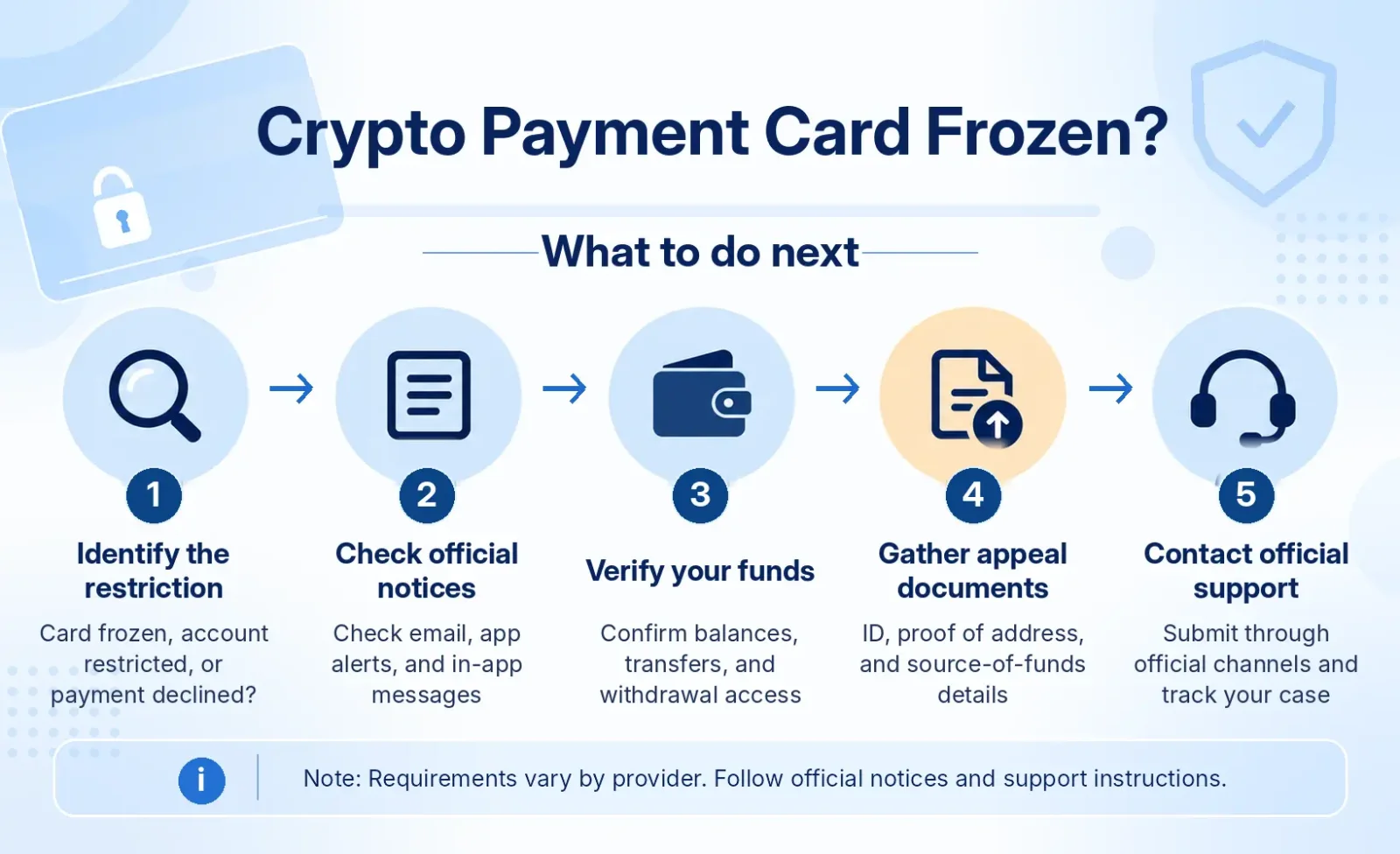
If your crypto card is frozen, take the following steps in order:
Identify the scope of the restriction. Determine whether the card itself is frozen, specific transaction functions are restricted, or the entire account is inaccessible.
Check the status of your funds. Review your account balance, available balance, transfer permissions, and withdrawal access separately.
Review security alerts. Look for unusual card transactions, logins from unfamiliar devices, or official identity verification notices.
Preserve account records. Save records of asset balances, transaction history, freeze notifications, and related emails.
Contact official support. Depending on the restriction, submit identity documents, request that functionality be restored, or ask for clarification of the next steps.
If you also discover unauthorized card transactions, prioritize account security. Promptly freeze any card that may have been compromised and report the transactions to the relevant card issuer or issuing service provider.
Is the Card Frozen, or Is the Entire Platform Account Restricted?
Crypto payment cards are often offered through arrangements involving a brand operator, a card issuer, and a digital asset service provider. Even when all functions appear in a single app, the underlying accounts and permissions may be separate.
A freeze notification therefore needs to be interpreted in the context of the functions actually affected.
Message or issue | Common symptoms | Recommended action |
|---|---|---|
Card Frozen / Locked | The card cannot be used for purchases or ATM cash withdrawals | Check whether the card can be unfrozen through the card management interface |
Card Suspended | Card transactions are suspended and may require manual review | Review security notifications and contact card support |
Account Restricted | Some functions, such as trading, transfers, or crypto withdrawals, are restricted | Identify the affected services and required review documents |
Account Closed | The individual account has been terminated and normal service is no longer available | Confirm the reason for closure and how remaining assets will be handled |
Payment Declined | A particular payment was declined, but the card may not be frozen | Review the transaction details and specific decline reason |
KYC / EDD Review | Identity verification or enhanced due diligence remains incomplete | Submit the required information and check the review status |
These terms are not all the same type of industry status code. Card Frozen describes a card's status; Account Restricted concerns account permissions; Payment Declined is a transaction outcome; and KYC / EDD Review refers to a review process. Different platforms may also use the same wording for different restrictions.
In particular, an ordinary payment failure should not automatically be treated as an account freeze.
For example, Bybit's card transaction FAQ lists several reasons a transaction may be declined, including insufficient spending funds, exceeded spending limits, a card that has not been activated, and an incorrect PIN or CVV. Users can review relevant authorization records and decline information in their card transaction history.
If a payment fails at only one merchant while other transactions work normally, the individual transaction should generally be investigated before requesting that an account restriction be lifted.
It is also important to distinguish three separate areas:
Card transaction functionality: Whether the card can be used for purchases, ATM cash withdrawals, and other card transactions.
Platform account permissions: Whether the user can log in, trade, convert assets, transfer funds, or access the funding account.
Control over digital assets: Where assets such as USDT and USDC are actually held, and whether the user can still transfer them independently.
For example, according to Bybit's official Card FAQ, Bybit Card does not maintain a separate wallet balance. Instead, eligible funds in the user's account support card spending. Funding sources may include the Funding Account and, where permitted by the applicable product rules, balances in Flexible Easy Earn.
This does not mean Bybit Card users in every region must use both funding sources. Eligible assets, spending priority, and debit arrangements depend on the user's region, card program, and current official rules.
Bybit also explains that restrictions on a user's main platform account do not necessarily result in the card itself being separately marked as suspended, although transactions may still fail.
These rules illustrate the relationship between card status and platform account permissions: suspending card transaction functionality does not necessarily freeze all USDT, USDC, or other digital assets held in the account.
Why Can an Account Be Frozen After KYC Approval?
Completing initial Know Your Customer (KYC) verification is only one requirement for opening an account and using the relevant services. Platforms may continue reviewing accounts based on user activity, changes in customer information, and applicable compliance requirements.
In its account review guidance, Coinbase explains that users may be required to update information about their accounts, transactions, sources of funds, or sources of wealth. The specific requirements depend on the user's jurisdiction, the entity providing the service, the product, and account activity.
Common reasons for further review include the following.
Identity or Residency Information Needs Updating
An expired identity document, a change of residential address, or discrepancies between current details and account registration information may trigger additional verification.
Coinbase's debit card troubleshooting guide notes that Coinbase Card may be temporarily restricted because of unusual transaction activity or a need to update identity information.
In these cases, review official notifications, verify that your name, date of birth, address, and identity documents are accurate, and complete the required steps through the verification section of your account.
The Source of Funds or Transaction Background Needs Clarification
This is a relatively common issue in crypto asset account reviews and one that basic identity verification alone may not resolve.
A platform may ask where funds originated, why they were transferred into the account, and whether the transactions are consistent with information previously provided by the user.
Two concepts frequently arise in these reviews:
Source of Funds (SOF): Explains the origin of specific funds or crypto assets, such as salary, proceeds from an asset sale, trading income, or another legitimate source.
Source of Wealth (SOW): Explains how a user's overall wealth or financial assets were accumulated, such as through long-term business income, investment returns, or inheritance.
These are not interchangeable. Proving that USDT was transferred from a particular wallet address to a platform does not necessarily establish where that USDT originally came from.
A platform may request additional supporting evidence, such as bank statements, exchange account statements, on-chain transaction records, business contracts, or other documentation.
An Enhanced Due Diligence Review Is Triggered
Enhanced Due Diligence (EDD) generally involves a more detailed examination of the customer and the background of their transactions.
Bybit's official EDD guidance states that certain deposits, withdrawals, Bybit Card services, and fiat services may require additional review even after a user has completed standard identity verification.
Users may be asked to provide identity documents, proof of address, or source-of-funds or source-of-wealth documentation. Failure to submit the requested information by the specified deadline may result in restrictions on certain transaction functions.
Unusual logins, suspected account takeovers, unsettled transactions, and transaction disputes may also trigger security measures or account risk controls.
These circumstances indicate that the platform needs to conduct further checks. They do not, by themselves, establish that the account holder has engaged in illegal activity.
Can You Still Withdraw USDT or USDC After an Account Freeze?
Withdrawal access depends on which account functions are restricted, not simply on the wording of the freeze notification.
Only Card Spending Is Restricted
If the Card page shows Frozen but the asset account continues operating normally, the user may still have permission to trade or withdraw digital assets.
Check the status of the actual asset account and whether any additional restrictions apply to it.
A card payment failure alone does not establish that USDT or USDC can no longer be transferred out.
Certain Transfers or Withdrawals Are Restricted
If the asset balance is still visible but the withdrawal button is disabled, or a withdrawal request produces a message such as Account Restricted or Withdrawal Suspended, check for:
An incomplete KYC or EDD review;
Security restrictions on specific funds or pending transactions;
A negative account balance or unresolved transaction issues;
Other account verification requirements imposed by the platform.
The specific cause should be determined from official platform notifications and the account's actual status.
Bybit's card transaction FAQ describes a particular scenario: when the Funding Account has a negative balance, Bybit Card is suspended and account withdrawals are also restricted.
For example, a negative balance may arise if the final settlement amount exceeds the amount originally authorized, or if exchange rates change before settlement and the account does not contain enough funds to cover the difference.
Under Bybit's published procedure, the user must repay the negative balance. Bybit states that the relevant restrictions will be removed within 24 hours after repayment. If access has not been restored, the user can follow up through an official support ticket.
This procedure applies to the circumstances described by Bybit. It should not be treated as a universal rule for other crypto payment cards.
The Entire Account Is Restricted or Inaccessible
If trading, transfers, withdrawals, and account access are all restricted, the issue should be handled through the platform's official account recovery or support channels.
A screenshot showing an account balance is not proof that the funds can be withdrawn immediately. The amount of assets displayed in an account and the withdrawal permissions currently available must be verified separately.
If the platform has terminated the user's individual account, the user should also request a clear explanation of how remaining balances will be handled, which withdrawal channels may be used, and whether any review requirements remain outstanding.
Do not attempt to bypass account restrictions by using someone else's identity, opening a new account, directing funds to a third party's receiving address, or submitting fabricated transaction documents. Such actions may violate platform rules and increase the risk of fund disputes and account security problems.
If the issue involves the platform shutting down entirely, a card program being terminated, or an issuing institution ending its partnership rather than an individual account freeze, see the separate article, "What Happens to Your Funds if a Crypto Card Platform Shuts Down? Balances, Refunds, and Recovery."
How to Unfreeze a Crypto Card or Restore Account Access
The appropriate recovery process depends on the type of restriction. A card voluntarily locked by its holder, a card suspended by the platform's risk controls, and an account restricted for compliance reasons do not necessarily follow the same recovery procedure.
First, Check Whether You Can Unfreeze the Card Yourself
If the user manually locked the card, some platforms allow it to be reactivated through the card management interface after security verification.
According to the official Bybit Card Management guide, users can open the Card Management page, select Unfreeze, and complete the security verification process to reactivate a card they previously froze themselves.
Security freezes initiated by the platform need to be handled differently. Bybit's transaction FAQ explains that its system may temporarily freeze a card when it detects a potentially suspicious transaction and ask the user to confirm whether the transaction was authorized. If the user verifies that the transaction is legitimate and was initiated by them, they can follow the official notification to authorize it. For the specific scenario covered by the FAQ, the system removes the freeze following confirmation. If the transaction was not authorized, the user should follow the platform's security instructions for the suspicious transaction and affected card, rather than approve an unfamiliar payment merely to restore card access.
This confirmation procedure applies to the particular security freeze described by Bybit. It does not cover every type of card suspension. If no confirmation option is available or the card remains unusable after verification, contact official card support. For declines displaying "The card is locked," Bybit also provides the following support ticket option: General Usage Inquiry → My Bybit Card is suspended.
Crypto.com's account lock guidance states that users whose accounts have been locked for security reasons may need to complete identity verification or contact support to restore account access. Eligible Crypto.com Visa Card holders must also unfreeze their cards separately in the app after account access has been restored.
This explains why some users regain the ability to log in but still cannot make card payments.
Prepare Documents Required for the Review
After accessing the official app or website, first check in-app notifications, outstanding tasks, identity verification pages, and support tickets.
For Bybit EDD reviews, the official guide provides the following app navigation path:
Profile → Settings → Additional Verification
Users can view pending EDD requests, submit questionnaires and supporting documents, and check the status of their reviews.
Common documents and their purposes include:
Document | Primary purpose |
|---|---|
Valid identification, such as a national ID card or passport | Verify identity and account ownership |
Bank statements and proof-of-address documents | Verify residential address |
Payslips, employment contracts, and business income records | Explain income or the source of funds |
Exchange statements and transaction history | Explain how crypto assets were acquired and transferred |
On-chain transaction hashes and wallet records | Help trace relevant on-chain fund movements |
These are common categories of supporting documents, not a list that must be submitted in full for every review. Prepare documents according to the platform's requested scope, dates, and formats.
For on-chain sources of funds, it is preferable to retain a complete set of records connecting the relevant transactions rather than provide only a screenshot from a blockchain explorer.
Check that all documents are legible, complete, current, and consistent with the information registered to the account.
What Should a Support Ticket Include?
If you cannot restore functionality yourself, or the review page does not explain the reason for the restriction, contact the support team through Help Center, Support, Contact Us, or the equivalent section of the platform's official website or app.
An effective support ticket should include:
Your account identifier and the last four digits of the card number, without disclosing the full card number or security code;
The date the freeze or restriction first appeared;
The functions currently affected and the exact error messages displayed;
The asset types, amounts, and relevant transaction identifiers;
Any identity verification steps completed or documents already submitted;
The specific outcome you are asking the platform to provide.
For example, you can ask whether any documents remain outstanding, whether the restriction applies only to the card, and whether unrestricted assets in the account can still be withdrawn.
Even if support cannot disclose the internal reasons for a risk control decision, try to confirm that a review case has been opened, whether additional documentation is needed, and which channel should be used for follow-up.
Save the case number, email acknowledgments, support responses, and attachment records. Following up on one well-documented case is generally easier to track than repeatedly opening duplicate tickets.
Submitting KYC or EDD documents does not guarantee immediate account restoration. The outcome and processing time depend on the platform, the account's circumstances, and the applicable requirements.
What if Customer Support Does Not Resolve the Issue?
If the account remains restricted for an extended period and support repeatedly asks you to wait without clarifying what documents are missing, consider initiating a formal complaint.
Before doing so, identify which entity is responsible for the dispute.
The card brand operator, actual issuing institution, and crypto asset custody platform may be separate legal entities.
Disputes involving card transactions generally need to be directed to the relevant card issuing service provider. Problems withdrawing digital assets may instead fall under the responsibility of the platform entity providing crypto asset services. The applicable cardholder agreement, account terms, and service jurisdiction determine how responsibility is allocated.
Submit a Complaint Through the Platform's Formal Channel
A formal complaint is not necessarily the same as an ordinary customer support inquiry.
For example, Coinbase provides a separate formal complaint submission process. Its official instructions ask users to provide their Coinbase Support case number, explain what happened, submit relevant evidence, and specify their desired resolution.
For a prolonged account freeze dispute, focus the complaint on verifiable facts:
When the account restriction began;
Which functions or funds have been affected;
What actions you have already completed as requested;
What specific responses support has previously provided;
Which functions you want restored, or what arrangements you want clarified for handling your funds.
If restricted access to funds has caused actual financial losses, preserve evidence supporting both the amount of the loss and its causal connection to the restriction rather than making an unsupported general compensation demand.
United Kingdom: Financial Ombudsman Service
For disputes involving electronic money or payment services that meet the eligibility criteria under the United Kingdom's financial complaints system, users may consider referring their case to the Financial Ombudsman Service (FOS).
The FOS explicitly states that it can consider whether an electronic money provider has unfairly restricted a customer's account.
According to the UK Financial Conduct Authority's complaints guidance, firms generally must provide a final response within 15 business days of receiving a complaint involving applicable payment services or electronic money.
If exceptional circumstances beyond the firm's control prevent a response within that period, the firm must explain the delay and provide a final response no later than 35 business days after receiving the complaint.
These deadlines apply to specific payment service and electronic money complaints under UK rules. They are not universal deadlines for all financial complaints, nor do they establish how quickly a crypto card account must be unfrozen.
If the user is dissatisfied with the final response, or the firm fails to respond within the applicable period, the matter may be referred to the FOS if it meets the relevant eligibility requirements.
The FOS's electronic money complaints remit does not directly extend to general cryptocurrency disputes.
United States: CFPB Consumer Complaints
The US Consumer Financial Protection Bureau (CFPB) provides a complaint submission portal covering categories such as prepaid cards, money transfers, virtual currencies, and related financial services.
If a dispute falls within its scope, users can submit details of the company involved, the account issue, transaction amounts, communication records, and supporting documents.
The CFPB handles or forwards complaints according to its applicable remit. Filing a complaint does not guarantee that an account will be unfrozen, and not every crypto asset dispute falls under the agency's authority to resolve.
Users in other countries and regions should identify the relevant contractual entity and jurisdiction, then consult the applicable local financial complaints, consumer dispute resolution, or legal remedies.
How to Avoid Further Financial Losses During an Account Freeze
During an account freeze, two risks deserve particular attention: unauthorized transactions and scams involving impersonation of customer support.
If you receive an unusual transaction alert, check the official transaction history to determine whether a payment was made without your authorization.
An unfamiliar merchant descriptor may sometimes differ from the merchant's consumer-facing brand. Check the transaction date, amount, and related order information first. But if you confirm the transaction was unauthorized, take immediate security measures rather than waiting for the account review to conclude.
Bybit's card transaction security FAQ instructs users who discover unauthorized transactions to report their card as lost or stolen immediately and submit a transaction dispute form as soon as possible, no later than 60 days after the relevant transaction date.
This deadline is part of Bybit's published rules for the applicable card program. Other issuers may impose different notification and dispute deadlines. Users should consult their own cardholder agreements and official instructions.
Unauthorized card payments and compliance reviews of a platform account are distinct issues and should be handled separately. The former requires prompt action to protect payment credentials and dispute the transactions. The latter generally concerns account information, sources of funds, or other review requirements.
At the same time, avoid anyone offering a supposed "paid account unfreezing service."
Scammers may impersonate platform risk control staff, demand account verification fees or deposits to release frozen funds, or persuade users to connect a wallet and sign unfamiliar transactions.
Legitimate KYC or EDD reviews may require identity documents, proof of address, and source-of-funds information, but these must be submitted through verified official channels.
Anyone claiming to represent customer support who requests a wallet recovery phrase, private key, account password, or one-time verification code should be treated as a serious security threat.
If you have already entered account credentials on a suspicious website, change your password through official channels as soon as possible, review your security settings, and notify the platform of a potential account takeover.
Frequently Asked Questions
Can Applying for a New Card Resolve a Freeze?
Not necessarily.
If the original card was disabled because it was lost, stolen, or physically damaged, the service provider may offer a replacement card process.
If the restriction stems from a platform account review, applying for another card usually will not resolve the underlying account permission issue. Whether a replacement card can be issued depends on the platform's specific rules.
What if KYC or EDD Documents Keep Getting Rejected?
Start by reviewing the stated reason for rejection. Check whether the identification document has expired, whether the files are complete, whether the name matches the account information, and whether the documents cover the time period requested by the platform.
Do not repeatedly submit the same noncompliant documents. If you cannot provide a specified document, ask through the official review channel whether alternative evidence is acceptable.
Can Merchant Refunds Still Be Credited While the Card Is Frozen?
Possibly, depending on the card account's status and the issuing service provider's refund processing rules.
A restriction on ordinary card purchases is not necessarily the same as a restriction on receiving a refund for a previous transaction.
If a merchant has issued a refund but the funds have not arrived, retain the original transaction details, the merchant's refund confirmation, and the reference number. Contact the actual issuing service provider to trace the refund.
Can You Request Remaining Assets After an Account Is Closed?
You can request arrangements for handling remaining assets. Whether withdrawals are permitted and which procedures apply depend on the account agreement, the reason for the restriction, and applicable law.
If the platform is still operating but has terminated an individual account, ask it to specify how remaining funds can be handled, what documents are required, and what restrictions apply. Do not assume that funds will automatically be returned when an account is closed.
Sources
Sources verified: October 28, 2026