
When a crypto payment card provider announces that it is shutting down, the most important question is not how much longer the card will work. It is which entity will be responsible for the money in your account.
Some providers simply withdraw from certain countries, allowing existing customers to withdraw their funds before a deadline. Others suspend card transactions while changing issuing partners, even though the card brand and underlying asset accounts continue operating. More serious situations arise when a service provider ceases operations or the institution holding customer funds enters insolvency or liquidation proceedings.
All of these events can prevent a card from working, but their implications for customer funds are very different.
If you receive a notice that your crypto card service is ending, check these six things immediately:
Card termination date: When will new transactions stop? Can existing cards still be used for purchases or ATM withdrawals?
Account status: Will the platform wallet, asset account, and withdrawal functions remain accessible?
Funds deadline: Is there a final date for converting balances, withdrawing funds, or closing accounts?
Responsible legal entity: Which legal entities are responsible for card balances and digital assets, respectively?
Pending transactions: How will merchant refunds, unsettled authorizations, and transaction disputes be handled?
Official documentation: Save the shutdown announcement, cardholder agreement, asset records, and customer support correspondence.
If the provider is still processing withdrawals normally, follow its official instructions promptly rather than waiting until the final business day. Funds already subject to formal liquidation proceedings or legal restrictions should be handled through the designated procedures. Avoid transferring assets through unverified channels.
What's the Difference Between Card Deactivation, Card Program Termination, and Platform Insolvency?
Crypto payment cards are not necessarily issued by the companies whose brands appear on them.
A crypto platform may handle customer onboarding, asset conversion, and app operations, while a partner institution issues the actual cards. Electronic money balances may be managed by yet another regulated institution.
A single card brand can therefore involve several layers of contractual and service relationships.
Type of Service Disruption | Potential Impact | What Cardholders Should Do |
|---|---|---|
Service Discontinued | Card services are withdrawn from a particular country or region | Confirm the affected jurisdictions, termination date, and balance arrangements |
Card Program Terminated | The entire card program ceases operations | Determine whether balances will be refunded, transferred, or handled by the existing provider |
Issuing Partnership Ends | Existing cards may stop working even if the brand continues operating | Check whether a new issuer is being appointed and how funds associated with old cards will be settled |
Platform-Wide Shutdown | Card, account, trading, and withdrawal services may be discontinued in stages | Preserve asset records and verify the formal closure procedures |
Provider Insolvency / Administration | The institution actually safeguarding or holding funds enters insolvency or statutory administration | Review regulatory, court, or administrator notices and confirm claim submission requirements |
The English labels in this table describe common service disruption scenarios. They are not standardized system statuses or formal notice titles used by every card provider.
One of the most consequential mistakes is assuming that an issuing partnership ending means the crypto platform itself has gone bankrupt.
For example, a platform may stop issuing Visa or Mastercard cards without affecting its crypto trading or custody operations. Conversely, a serious problem with the platform's wallet services may prevent customers from withdrawing custodial assets even when the card management interface remains accessible.
Assessing the risk to your funds requires identifying the legal entity that actually holds them, not merely the brand printed on the card.
If only an individual customer's account is restricted for KYC, enhanced due diligence (EDD), or account security reasons while services remain operational for other customers, see our guide, "What to Do If Your Crypto Payment Card Is Frozen: Account Recovery, Withdrawals, and Appeals." An individual account freeze and a provider-wide shutdown require different approaches.
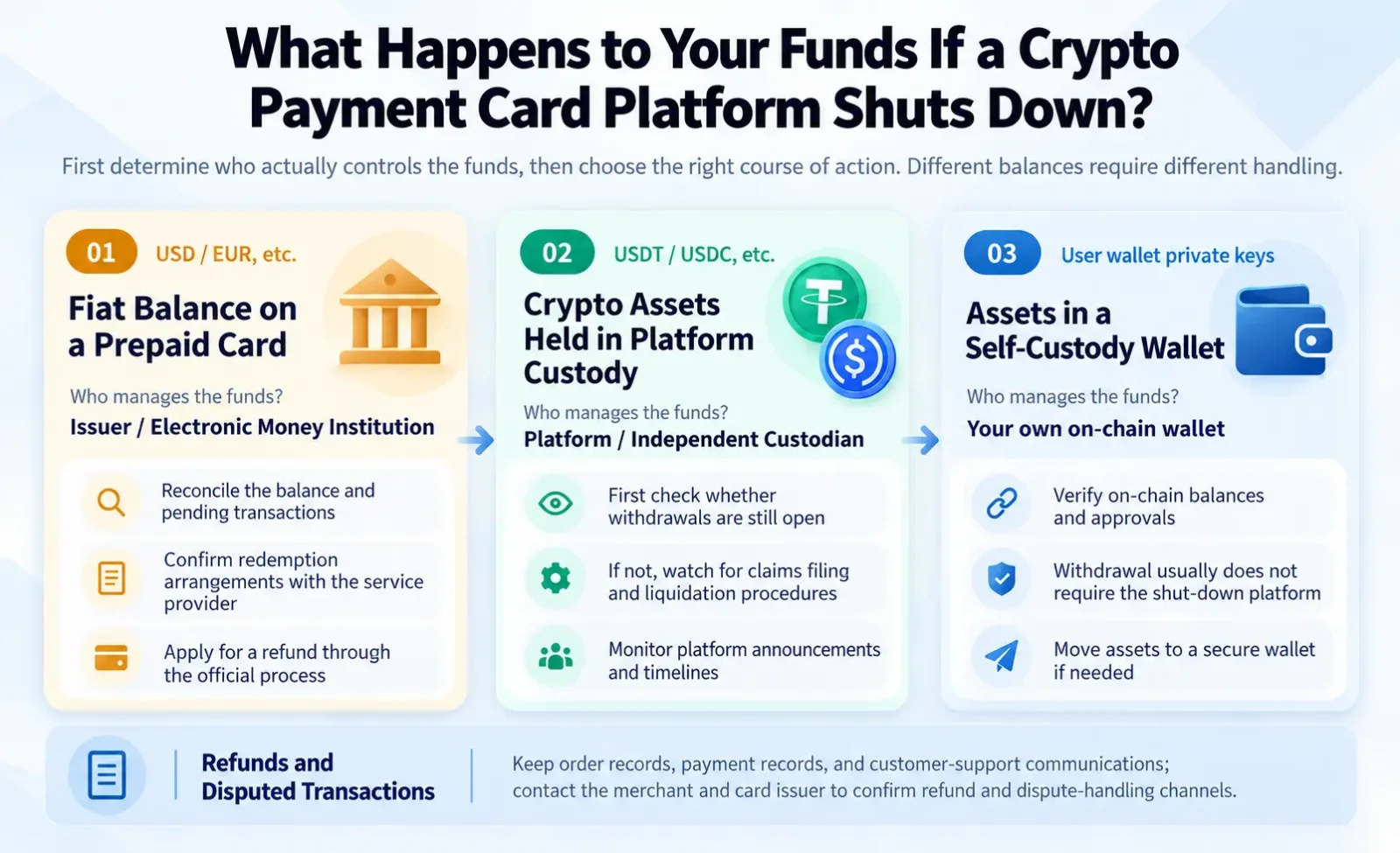
Can You Recover Your Card Balance, USDT, or USDC After a Shutdown?
This is the central question when a crypto card provider ceases operations.
Two customers may each see assets worth $1,000 in their accounts, yet those assets could represent entirely different things: a prepaid card balance denominated in fiat currency, stablecoins held in custody by the platform, or on-chain assets controlled directly by the customer. The custody arrangements and legal procedures governing these funds may differ substantially.
Fiat Balances Already Loaded onto a Prepaid Card
Some crypto payment cards operate on a prepaid basis. Customers first convert USDT, USDC, or other assets into a balance denominated in fiat currency, such as US dollars or euros, and then spend using the card.
After conversion, those funds are generally managed under the contractual arrangements applicable to the particular prepaid card or electronic money service. They may no longer be held in their original cryptoasset form.
If the card program is terminated, customers should establish:
Whether the remaining balance can be converted or withdrawn;
Whether the card brand or the actual issuing service provider is responsible for repayment;
Whether balances can be transferred to a replacement card program;
Whether refund fees, minimum processing amounts, or deadlines apply.
The contractual basis for any balance refund fee deserves particular attention.
For example, Crypto.com's official prepaid card help article specifies a $50 processing fee for the Crypto.com Prepaid Card product described when a cardholder voluntarily closes the card account and requests a refund of the remaining balance.
This is a voluntary closure rule for a particular product. It does not establish that all Crypto.com cards in every region carry the same fee, nor does it mean the fee necessarily applies when a provider involuntarily terminates a card program.
Voluntary account closure, termination of services by an issuer, and closure of an entire card program may be governed by different contractual terms and procedures.
In addition, a platform's ordinary minimum withdrawal amounts and fees must be distinguished from statutory electronic money redemption rights under applicable law. Holders of electronic money within the scope of the UK's Electronic Money Regulations 2011 have statutory redemption rights. A minimum amount imposed by a standard withdrawal interface does not, by itself, establish that the balance cannot be redeemed.
The relevant legal conditions are discussed in the FAQ section below.
USDT, USDC, and Other Cryptoassets Still Held in Custody
Some crypto payment cards have no separate prepaid balance. Instead, the platform deducts or converts designated assets in a customer's account when a purchase is made.
If the provider discontinues only its card services, cryptoassets in the platform account may remain available for trading or withdrawal.
However, if the cryptoasset custodian itself ceases operations, the treatment of customer funds depends on the custody agreement, asset segregation arrangements, and applicable law.
Customers need answers to three questions:
Who holds the assets? Is it the card brand operator, the trading platform, or a separate custodian?
How are the assets held legally? Does the contract treat the digital assets as customer assets? Are there other arrangements governing their use, transfer, or disposal?
What rights apply in insolvency? Can customers claim the return of specific assets, or must they file claims under the applicable insolvency proceedings?
An asset balance displayed in an app cannot answer these questions.
In particular, a platform's partnership with a licensed electronic money institution does not mean that all USDT or USDC held by that platform benefits from electronic money safeguarding protections.
Regulated card and electronic money services may operate under different regulatory frameworks and customer asset arrangements from cryptoasset custody services.
Assets Held in Self-Custody Wallets
Another category of crypto payment cards allows customers to retain control of on-chain assets until they are spent.
MetaMask Card offers this type of spending, although the arrangements differ depending on which account supplies the funds.
According to MetaMask's official card funding documentation, eligible self-custodial MetaMask accounts can be used to fund purchases by setting a Spending Limit that authorizes the card to use specified tokens. For these accounts, assets remain in the relevant wallet until they are actually spent, and users can adjust or revoke the authorization.
MetaMask Card also supports spending through a linked Money Account.
Under its current US product documentation, users can link a Money Account to MetaMask Card. Once linked, the Money Account becomes the card's primary funding source, and the spending limit defaults to the account's entire available balance. Users can also set their own limits. The default authorization does not require an on-chain network fee, while setting a custom limit manually may incur one.
To spend assets from another MetaMask account, users must first unlink the Money Account from the card. See the official card management guide for the relevant steps and spending limit controls.
It would therefore be inaccurate to describe every MetaMask Card user as spending through the same self-custodial token authorization mechanism. Nor does the name Money Account, by itself, establish that the account represents a conventional platform-custodied balance. Asset control and legal arrangements must be assessed against the relevant product documentation and account terms.
If card services stop, customers' control over assets in their self-custody wallets may not be directly affected.
Any token permissions previously granted to the card can be checked and revoked using the official card management features. MetaMask explains that users can set the Spending Limit for a specified token to zero or revoke token approvals through the appropriate tools. These on-chain actions may incur network fees.
Actual control over digital assets depends on where the funds are held, who controls the wallet, and how spending permissions are structured—not on the card's brand name.
Which Dates Matter Most in a Crypto Card Shutdown Notice?
A crypto card shutdown does not necessarily mean every service ends on the same day.
A provider may stop accepting new customers several weeks before disabling top-ups and purchases, with the balance withdrawal channel remaining open until a later date.
Cardholders should review each operational change announced, rather than recording only the final shutdown date.
Announcement Item | Practical Impact on Customers |
|---|---|
New Applications End | New customer applications close; existing cards may remain usable |
Card Issuance End | New and replacement cards are no longer issued; existing cards may be unaffected |
Top-Ups Disabled | Additional funds can no longer be loaded onto designated cards or accounts |
Card Transactions End | New card purchases and cash withdrawals stop |
Withdrawal Deadline | Final date or time for using a specified asset or balance withdrawal channel |
Refund / Dispute Period | Arrangements for refunds and disputes involving earlier transactions |
Account Closure Date | Account services close or move into subsequent processing procedures |
Not every provider publishes a complete schedule covering all seven items. Customers should seek official clarification on anything omitted from the announcement.
Different funds may have different deadlines. Fiat card balances, cryptoasset withdrawals, and merchant refunds may be handled by separate institutions and operational systems.
For electronic money covered by applicable law, the closure of a routine withdrawal channel must also be distinguished from statutory redemption rights. Discontinuing one withdrawal method does not necessarily extinguish a holder's legal right to request redemption.
For example, regulations 39–43 of the UK's Electronic Money Regulations 2011 address electronic money redemption, fees, and requests made after a contract ends. These provisions do not mean all balances can be recovered without any time limit, nor do they guarantee immediate repayment through ordinary procedures after an institution becomes insolvent.
The time zone used in the announcement also matters. International providers may specify deadlines in UTC, the issuer's local time, or the customer's local time. A time zone conversion error near the end of a withdrawal window could cause customers to miss the deadline.
If the provider intends to disable account access, export complete transaction records before the deadline rather than relying on a screenshot of the current balance.
Can Refunds Still Arrive After the Card Has Been Deactivated?
Even after a card stops accepting new purchases, refunds relating to previous transactions may still need to be processed through the original card payment network.
Whether the money ultimately reaches the customer depends on whether the original card account remains active, whether the issuer continues processing refunds, and the settlement arrangements following termination of the card program.
Four different types of fund movements need to be distinguished.
Merchant Refunds: First Confirm That the Merchant Initiated the Refund
If a customer canceled a hotel booking, online order, or subscription before the card was deactivated, they should keep the merchant's refund confirmation and the original transaction records.
For example, Bybit's card transaction FAQ explains that, under its normal operating procedures, eligible card refunds generally return to the corresponding Funding Account. Some refunds may require additional documentation or review.
That policy does not guarantee that a terminated Bybit Card program would continue processing refunds in the same way, and it should not be generalized to other cards.
If the merchant confirms a refund but the funds do not appear, provide the card service provider with the transaction date, amount, and any available refund reference number, and request an update on the refund's status.
Closed Card Accounts: Establish How Earlier Transactions Will Be Handled
Once a card program has terminated, the original card account may no longer be able to receive refunds through standard procedures.
Contact the original issuing service provider to establish whether the money can return to the original account, be transferred to a replacement account, or must be handled through another process.
If the card brand has changed issuers, do not assume the new institution automatically assumes responsibility for refunds relating to all transactions made with the old card.
Chargebacks: Available for Eligible Card Transaction Disputes
A chargeback is a dispute resolution mechanism within the card payment system. It is not a general-purpose tool for recovering funds after a platform collapses.
Visa's cardholder support guidance and Mastercard's official dispute guidance both direct cardholders to their actual card issuer when raising a transaction dispute.
A chargeback is worth investigating only when there is an underlying card transaction that can be disputed under the applicable rules. Eligibility depends on the nature of the original transaction, the grounds for the dispute, available evidence, relevant card network rules, and applicable time limits. Filing a dispute does not guarantee reimbursement.
For example, if someone used a bank card to fund a platform account or purchase a service that was subsequently not delivered, they could ask the issuer of the card used for that payment whether the transaction qualifies for a dispute.
By contrast, an internal USDT, USDC, or other asset balance on a crypto platform is not itself a transaction that can be disputed directly through a card network. Holding a crypto payment card does not make every asset on the platform recoverable through that card's chargeback mechanism.
On-Chain Transfers: They Cannot Simply Be Reversed Through a Card Chargeback
If a customer transfers USDT or USDC to a platform through a blockchain network and the on-chain transaction is confirmed, that transfer generally cannot be disputed directly with Visa or Mastercard as a card chargeback.
Recovery options must instead be evaluated based on the custody relationship, receiving address, transaction records, and applicable law.
Merchant refunds, card chargebacks, card balance repayments, and recovery of custodial assets are four distinct mechanisms. The original payment route must be established before deciding how to pursue the funds.
The Wirecard Case: Why Can Problems at One Issuer Affect Multiple Card Brands?
The 2020 Wirecard case illustrates how risks at an underlying payment institution can spread across multiple services.
On June 26, 2020, the UK's Financial Conduct Authority (FCA) imposed restrictions on Wirecard Card Solutions Limited, suspending relevant regulated activities. Some customers were consequently unable to make payments or withdraw funds. On June 29, the FCA agreed that the relevant services could resume, and the restrictions were lifted on June 30. On August 28, Wirecard Card Solutions announced plans to wind down its UK regulated business, with arrangements to migrate customers and products to other providers during the process.
The company supplied the underlying electronic money and payment services; it was not the operator of every customer-facing card brand. The case demonstrates how multiple brands may depend on the same infrastructure provider, leaving several card programs exposed when a single institution experiences an operational disruption.
The timeline is documented in the FCA's announcement on the resumption of services and its statement on the business wind-down.
Can Customer Funds Be Recovered During Insolvency or Liquidation?
Once an institution holding customer funds enters formal insolvency, liquidation, or special administration, decisions about customer money may no longer be handled directly by ordinary customer support teams.
Customers need to determine whether an administrator or liquidator has been legally appointed and how their rights under the original contracts will be treated.
A recent case in the UK's electronic money sector provides a verifiable example.
ePayments Systems Limited: Who Is Responsible for Customer Funds?
On October 15, 2026, the UK FCA announced that electronic money institution ePayments Systems Limited (EPS) had entered special administration.
According to the FCA, Mark Boast and Allister Manson, both of Opus Restructuring LLP, were appointed as joint special administrators.
The announcement states that the administrators are responsible for handling customer claims against EPS and returning funds where possible. The outcome for individual customers is subject to the formal administration process.
Source: FCA — ePayments Systems Limited Enters Special Administration.
This was not a crypto card platform shutdown. It illustrates how responsibility for customer funds changes when a regulated electronic money institution encounters serious financial or operational difficulties.
Once formal administration begins, customers generally cannot assume that the full balance will remain immediately available through ordinary withdrawal procedures.
Electronic Money Safeguarding Is Not Bank Deposit Insurance
In the UK, electronic money institutions and payment institutions covered by the relevant rules must protect customer funds through safeguarding arrangements.
These arrangements are designed to separate certain customer funds from an institution's own assets, or to provide protection through other methods permitted by regulation, reducing potential customer losses if the institution fails.
The FCA's safeguarding requirements guidance describes the relevant obligations. Updated rules that took effect on May 7, 2026 strengthened customer funds recordkeeping, reconciliation, and management requirements. The relevant provisions are set out in FCA Handbook CASS 15.
Safeguarding, however, is not equivalent to the bank deposit protection offered by the UK's Financial Services Compensation Scheme (FSCS).
The FCA explains in its consumer guidance that customer money held by non-bank payment providers and electronic money institutions is generally not covered by FSCS deposit protection. Instead, the applicable customer funds safeguarding arrangements apply.
After an institution fails, even safeguarded funds may be subject to asset verification, reconciliation, and statutory distribution procedures before they can be returned. Administration costs and any shortfall in available assets may also reduce the amount ultimately recovered.
An institution's statutory obligation to redeem electronic money while operating normally and its actual ability to repay customers after becoming insolvent are two separate issues.
For example, regulation 39 of the UK's Electronic Money Regulations 2011 establishes a requirement for qualifying electronic money to be redeemed at par value. It does not guarantee that, after an institution enters insolvency or special administration, every holder will receive an immediate and full repayment.
These rules concern payment and electronic money services subject to UK law. Crypto payment cards issued in other countries may fall under different legal frameworks. Cryptoassets held in custody by a platform do not automatically receive the same protections merely because its card issuing partner is regulated.
What Documents Are Needed for a Formal Funds Claim?
If a regulator or court has confirmed that an institution is entering administration or liquidation, customers should follow the requirements published by the appointed administrator.
The documentation commonly required includes:
Cardholder agreements, account contracts, and the names of the actual service providers;
Account identifiers, the last four digits of card numbers, and customer identification details;
Balance records as of the account closure or service termination date;
Top-up, conversion, withdrawal, and transaction histories;
Outstanding refunds, unsettled transactions, and records of fund transfers;
Transaction hashes, blockchain networks, and token details for cryptoasset transactions;
Acknowledgments of claims already submitted, case reference numbers, and related correspondence.
When filing, customers should also verify the asset category, denomination, legal basis of the claim, and applicable deadline.
Customers with both prepaid card balances and cryptoassets held in platform custody should not assume that one administrator will handle both categories under the same rules.
Once formal administration begins, rely on verified regulatory announcements, court filings, and administrator notices rather than earlier customer support assurances about ordinary withdrawal timelines.
Who Should You Contact to File a Complaint or Recover Funds After a Shutdown?
Responsibility for a dispute depends on the type of funds involved.
Issue | Who to Contact First |
|---|---|
The card program is still operating, but balance withdrawal arrangements are unclear | The card brand operator and actual issuing service provider |
Refunds relating to transactions on a deactivated card | The original card service provider, issuer, and relevant merchant |
Cryptoassets held by the platform cannot be withdrawn | The digital asset custodian or entity providing the platform account |
Electronic money balances are subject to formal administration | The legally appointed administrator or liquidator |
An eligible payment services complaint remains unresolved | The financial complaints or dispute resolution body with jurisdiction |
The actual issuing institution can usually be identified in the cardholder agreement, electronic money terms, formal account documentation, or regulatory registration records.
If the provider remains operational and the issue is simply an unclear balance refund arrangement, start by filing a formal complaint with the provider.
When an institution is already in statutory liquidation or administration, customers generally need to follow the funds claim process published by the administrator. A complaint and a formal claim for assets are not the same thing. Submitting an ordinary support ticket does not necessarily constitute a valid creditor claim or customer funds claim.
What Formal Channels Are Available in the UK and US?
In the UK, customers with eligible electronic money or payment service disputes can first complain to the relevant institution and, subject to the applicable rules, refer the matter to the Financial Ombudsman Service.
The service can review certain electronic money complaints, but its relevant complaints process does not cover general cryptocurrency disputes.
If the business has entered insolvency or special administration, customer funds generally must be handled by the appointed administrator under the applicable legal process. An ordinary complaint does not replace a formal claim.
In the US, the Consumer Financial Protection Bureau (CFPB) provides a financial products and services complaint portal, with categories covering prepaid cards, money transfers, virtual currency, and related financial services.
Whether a particular complaint can be considered depends on the service involved, the relevant legal entity, and jurisdiction.
Regardless of the channel used, customers should support their claims with clear financial records and contractual documentation rather than relying solely on the platform's marketing materials.
How Can You Limit Additional Losses When a Platform Shuts Down?
Beyond recovering existing balances, customers should prevent a service shutdown from disrupting other payments and ongoing business activities.
Preserve complete statements. While account access remains available, export balance histories, card transactions, asset conversions, and on-chain transfer records. Screenshots can supplement this evidence but should not replace official records entirely.
Track pending transactions. Maintain a list of hotel deposits, preauthorizations, merchant refunds, and unsettled payments, recording original amounts, merchants, and reference numbers.
Update critical subscriptions. Customers using the card for cloud servers, domains, business software, or other recurring services should switch payment methods promptly. A failed card payment does not automatically cancel the underlying subscription agreement.
Watch for asset recovery scams. Fraudsters may impersonate customer support staff, regulators, or liquidators and demand supposed unfreezing charges, taxes, or fund verification deposits. Do not connect a wallet through an unverified link or disclose recovery phrases, private keys, or one-time verification codes.
In its special administration announcement for ePayments Systems Limited, the FCA specifically warned customers about scams involving impersonation of the institution or its administrators.
Customers who hold multiple crypto payment cards should also identify the actual issuers and payment service providers behind each card.
Different brands may rely on the same underlying institution. Spreading payments across multiple brands does not necessarily diversify the risks associated with their shared infrastructure.
Frequently Asked Questions
If a Platform Stops Issuing New Cards, Do Existing Cards Stop Working Immediately?
Not necessarily.
The end of new card issuance, the suspension of spending on existing cards, and final account closure may occur on different dates. Follow the official service notice applicable to existing cardholders.
If the platform is changing issuers, confirm how existing cards can be used during the migration period.
Can I Request a Refund if My Card Balance Is Below the Minimum Withdrawal Amount?
You can ask the provider to explain how the remaining balance will be handled. However, routine platform withdrawal thresholds must be distinguished from statutory electronic money redemption rights.
For electronic money within the scope of regulation 38 of the UK's Electronic Money Regulations 2011, regulation 39 generally requires the issuer to redeem electronic money at par value at any time upon the holder's request. Accordingly, a minimum amount imposed by an ordinary withdrawal channel does not automatically establish a legal minimum redemption amount.
Redemption conditions and fees are also subject to statutory restrictions:
Before contract termination: Under regulation 42, holders may request full or partial redemption. Where the conditions of regulation 41 are met, issuers may charge a redemption fee that was clearly disclosed in the contract and is proportionate to actual costs.
At termination and during the following year: For holders covered by regulation 42, issuers are generally required to redeem the full electronic money balance without charging a redemption fee.
More than one year after termination: Issuers may charge a redemption fee where permitted under regulation 41, but contractual disclosure and cost proportionality requirements still apply.
This does not mean redemption rights are unlimited in time. Regulation 43 permits issuers to refuse redemption requests made more than six years after the contract was terminated.
If the institution has entered insolvency or special administration, a holder may retain a statutory right to request redemption while actual recovery remains subject to formal claims, asset verification, and distribution procedures. Neither immediate nor full repayment can be guaranteed.
These provisions cannot automatically be applied to prepaid cards issued in every country, nor do they necessarily cover platform-custodied USDT, USDC, or other cryptoassets.
Legal reference: The Electronic Money Regulations 2011 — Part 5, Regulations 38–43.
Will Visa or Mastercard Directly Reimburse Balances Held by a Failed Card Provider?
Customers generally cannot demand repayment of a platform balance directly from the card networks.
Visa and Mastercard establish rules and provide infrastructure for card payment transactions. They are generally not the direct custodians of cardholders' account funds.
Card balance recovery depends on the actual issuer, the electronic money arrangements, and the applicable contract. Eligible card transaction disputes should be raised with the issuer under the relevant rules.
Will Existing Balances Transfer Automatically When a New Issuer Takes Over a Card Program?
An automatic transfer should not be assumed.
Migrating a card program may involve issuing replacement cards, signing new agreements, transferring balances, or arranging for the previous institution to refund customers separately.
Customers should verify whether responsibility for funds associated with the old cards has been transferred and who will continue to manage historical refunds, transaction disputes, and account records.
Even after a replacement card becomes usable, retain the old card records until every balance and outstanding transaction has been properly resolved.
Sources
UK FCA — Wirecard Has Announced That It Is Winding Down Its Business
UK FCA — ePayments Systems Limited Enters Special Administration
UK FCA — Payment Services and Electronic Money: Our Approach
UK FCA — Safeguarding Requirements for Payment and E-Money Institutions
UK FCA Handbook — CASS 15: Payment Services and Electronic Money
Crypto.com — What Additional Details Should I Know About My Crypto.com Prepaid Card?
Sources verified: October 29, 2026