
When looking to apply for a crypto payment card, many people start by searching for "Crypto Card Supported Countries," hoping a country list will tell them whether they are eligible.
But "Supported Countries," "Available Regions," and "Worldwide Acceptance" on an official website do not necessarily mean the same thing.
A crypto payment card may be available as a virtual card to residents of a particular country without offering physical card delivery there. Another product may allow existing cardholders to make purchases in that country while declining applications from local residents. Some programs also impose separate restrictions based on country of residence, nationality, the country that issued an identity document, and the applicant's physical location.
To determine whether a crypto payment card supports a particular country, the essential questions are: Do you meet the eligibility requirements of the specific card program? Can you complete identity verification? Which type of card can you obtain? And, if approved, will you be able to use it as intended?
What "Supported Countries" Really Means: Five Different Questions
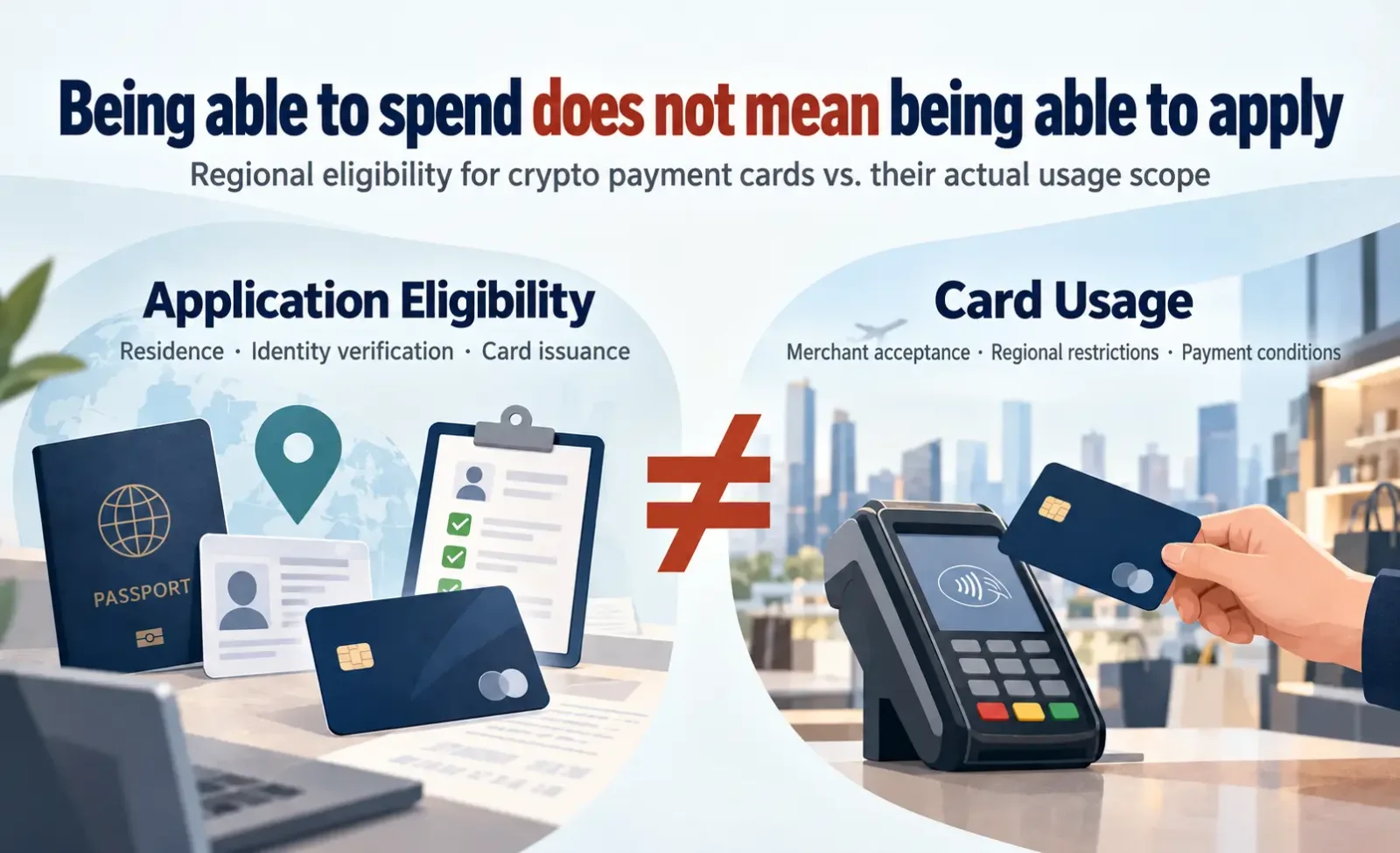
Geographic availability is not a simple yes-or-no question. Platform registration, identity verification, card issuance, physical card delivery, and actual card use may each be governed by different rules.
What to Check | Key Question | Common Sources of Restrictions |
|---|---|---|
Platform availability | Can residents of the region register for and use the platform's services? | Platform operating policies, local laws, sanctions, and compliance requirements |
Card application eligibility | Can local residents apply for this specific card program? | Issuers, card programs, and regional eligibility rules |
Identity verification eligibility | Does the applicant's identity and documentation meet the requirements? | KYC, nationality, residence, and document verification policies |
Physical card delivery eligibility | Can a physical card be shipped to the specified country and address? | Delivery coverage, logistics, customs, and issuing arrangements |
Where the card can be used | Can an issued card be used for purchases in the intended country or at the intended merchant? | Payment network acceptance, issuer restrictions, merchant policies, and local payment infrastructure |
For example, being allowed to register a trading account with a platform does not necessarily make someone eligible for its crypto payment card. Trading services and card issuance may be provided by different legal entities, each with its own geographic restrictions.
Global Visa or Mastercard Acceptance Does Not Mean Global Application Eligibility
Visa and Mastercard operate payment networks across numerous markets. Crypto payment cards on these networks may be used to initiate payments at eligible merchants and terminals, but eligibility to apply is still determined by the individual card program.
The official MetaMask Card FAQ distinguishes between where people can apply and where issued cards can be used. A region that is ineligible for new applications is not necessarily a region where existing cards are prohibited from being used. Cardholders may pay at merchants that accept Mastercard, subject to applicable restrictions.
Mastercard acceptance does not guarantee that every transaction will succeed. Some merchants may decline particular card types, while transactions may also fail because of fraud controls, card status, or local rules.
If you do not yet have a card, start by checking application eligibility. UCard Radar's regional availability database provides a way to look up application status, usage status, and supporting sources by country or region. It can help narrow down potential options before you verify the details against each product's official terms.
Country of Residence, Nationality, or Document Issuance: What Determines Eligibility?
Crypto payment card providers generally need to verify an applicant's identity and residence, but eligibility criteria differ between card programs. Several terms that appear during the application process are particularly important to distinguish.
Country of Residence generally means the country or territory where an applicant actually lives. Providers may verify this through a residential address, identity documents, residence permits, or other supporting evidence.
Nationality / Citizenship is distinct from residence. Someone may live legally and permanently outside their country of citizenship, but nationality can still affect eligibility for certain financial services.
Document Issuing Country refers to the country or territory that issued an identity document. A platform may accept a particular type of document while rejecting documents of that type issued in certain jurisdictions.
Tax Residency relates to tax compliance and reporting obligations. Some financial service providers require users to declare their tax residency, although it is not necessarily a primary eligibility criterion for every crypto payment card.
Consider someone who holds a passport from Country A but has been legally residing in Country B for years. That person should accurately disclose their nationality, residence, and identity document details. Even if a card program accepts residents of Country B, the applicant may not satisfy all requirements if the provider imposes additional nationality or document-issuance restrictions.
Conversely, holding a passport from Country B does not automatically qualify someone who lives in an unsupported region for a card program intended for residents of Country B.
How RedotPay Distinguishes Nationality, Residence, and Physical Location
RedotPay's Unsupported Countries & Regions list, published on August 28, 2026, identifies citizens of certain countries or regions who cannot complete identity verification or use its services.
Its separately published Card Issuance Restrictions, dated the same day, apply to residents of specified regions. Those residents are ineligible to apply for virtual or physical cards, and the affected regions cannot be registered as billing addresses.
RedotPay also maintains separate location-based restrictions on app access, based on where the service is actually accessed.
An applicant may therefore need to meet nationality, residency, and service-access requirements simultaneously. People who live across multiple countries or have international residency arrangements should contact customer support before applying or paying any card issuance fee if the published terms do not clearly establish their eligibility.
How to Find the Official Country List That Actually Applies to You
Geographic eligibility information is often spread across help centers, application pages, cardholder agreements, and service announcements. Marketing claims such as "global payments" or "available in multiple countries" are not, by themselves, evidence that residents of a particular country can apply.
Useful terms to look for include:
Eligible Countries / Regions: Countries or regions whose residents may be eligible to apply.
Supported Countries for Card Issuance: Regions where the card program supports issuance.
Country of Residence Requirements: Requirements concerning the applicant's country of residence.
Cardholder Terms and Conditions: The terms governing the cardholder relationship.
KYC / Identity Verification Requirements: Identity verification requirements.
Physical Card Delivery Restrictions: Restrictions on shipping physical cards.
Make sure the page refers to the service you are investigating. For instance, an exchange's "Bank Card Payment Supported Countries" list may identify countries where users can buy crypto with existing bank cards. It may have nothing to do with eligibility to apply for that exchange's own crypto payment card.
Bybit Card: An Application Page Does Not Mean Issuance Is Open
Bybit's card application guide instructs users to select their country or region of residence and explains that Bybit Card is only available in certain regions.
If the selected region is unsupported, the platform records the user's interest for future notification instead of taking them directly through the card issuance process.
Even if a Card section appears in the account interface, or the user has already registered an exchange account, they still need to verify that their current country of residence meets the requirements of the relevant card program.
If a Country Is Not on the Restricted List, Can Residents Apply?
Not necessarily.
Some providers publish an explicit list of eligible countries, while others mainly identify unsupported jurisdictions. The absence of a country from a restrictions list means only that the document does not explicitly exclude it. It does not establish that applications from new residents are currently being accepted.
UCard Radar's regional availability database currently uses four application statuses:
Application Status | How to Interpret It |
|---|---|
Available to apply | Clear evidence indicates that applications are open in the region, subject to individual eligibility and product requirements |
Restricted application | Additional restrictions apply; the relevant record and specific eligibility conditions must be reviewed |
Unsupported | Clear evidence indicates that the region is not eligible for the relevant card program |
Pending verification | Available evidence is insufficient or the relevant information remains unconfirmed |
Two situations also need to be distinguished: additional regional eligibility requirements are not the same as a program having suspended new applications.
Where a product has stopped accepting new applications, the suspension should be recorded separately, along with whether it affects existing cardholders. A "restricted application" label alone does not establish that new users can still apply. Likewise, continued service for existing cardholders should not be interpreted as the reopening of applications.
Why You May Still Be Ineligible for a Crypto Payment Card After Passing KYC
Identity verification for a platform account and approval for a card application may be separate processes.
KYC completed for crypto trading, funding, or custody services does not necessarily satisfy a card issuer's requirements. The card application process may require additional verification of residential addresses, identity documents, or other customer information.
Bybit's Individual KYC guide treats Proof of Identity (POI) and Proof of Address (POA) as separate verification components. Its card application guide also states that users may need to update their identity information when applying for Bybit Card, even if they have previously completed account verification.
Crypto.com's proof-of-address requirements list acceptable documents such as utility bills, government documents, and statements or correspondence from financial institutions. The page generally requires documents to have been issued within the previous six months, with a three-month limit for documents issued in the United Kingdom and Turkey.
These are provider-specific requirements, not a universal KYC standard for crypto payment cards.
Before applying, check the accepted document types, issuing countries, proof-of-address rules, document age limits, and requirements for consistent personal information. Applicants whose nationality differs from their country of residence should also confirm that both circumstances are acceptable under the card program.
Some credit card products also involve credit eligibility assessments. Passing standard account KYC does not establish that a credit card application will be approved.
The Same Brand May Issue Different Types of Cards in Different Countries
Crypto payment cards offered under the same brand are not necessarily the same type of financial product.
Depending on the market, a platform may offer prepaid, debit, or credit cards, with different issuing partners, payment networks, settlement currencies, and fee structures.
Bybit's Card General Inquiries identifies different card types by region. For example, its official information categorizes the relevant offerings in Argentina and Peru as prepaid cards, while card programs in Mexico and parts of the Asia-Pacific region involve credit card products.
Crypto.com similarly distinguishes its prepaid card offerings from the Visa Signature credit card offered to the U.S. market. According to its official U.S. credit card application guidance, the product is available in U.S. states where the Crypto.com App operates, and the application involves credit prequalification followed by a formal application.
Although these products share similar branding, they cannot be assessed using the same eligibility criteria or underwriting requirements.
The brand operator must also be distinguished from the actual card issuer. The official U.S. MetaMask Card FAQ identifies Crypto Life as the card service provider, Monovate as the issuer, and Mastercard as the payment network.
Before comparing cards offered in different markets, establish the exact product version, card type, issuing entity, and applicable cardholder terms. Information about a European product version may not accurately describe its Latin American counterpart, which could differ even in card type and payment network.
If You Can Apply for a Virtual Card, Can You Also Get a Physical Card?
Not necessarily.
Virtual and physical cards may be subject to different rollout schedules, eligibility requirements, fees, and delivery coverage. Availability of virtual cards in a region does not establish that residents can order physical cards.
Bybit's official application guide explains that physical cards are being introduced in stages and are not currently available in Peru. Applicants must also obtain a virtual card first and meet the applicable delivery requirements.
RedotPay separately publishes card issuance restrictions and physical card delivery restrictions.
In its 2026 documentation, Egypt and Tunisia appear on an additional physical card delivery restrictions list but not on the corresponding card issuance restrictions list from the same period. This demonstrates that the two lists cover different restrictions; it does not, by itself, confirm that residents of those countries are eligible to obtain cards.
Can You Pay at a Physical POS Terminal Without a Physical Card?
Yes, provided the card supports an appropriate digital wallet.
Some virtual crypto payment cards can be added to Apple Pay, Google Wallet, or similar digital wallets. If the issuer, country or region, device, and merchant terminal all support the feature, users may make NFC contactless payments with a phone or another compatible device without carrying a physical card.
MetaMask's official card usage guide explains that eligible cardholders can add their cards to Apple Pay or Google Wallet and pay at supported physical merchants.
Not every virtual card supports digital wallets, however, and the feature may vary by region.
Payments requiring insertion of a chip card or a magnetic stripe swipe generally require a physical card with those capabilities. ATM withdrawals must be checked separately: the card must support cash withdrawals, and the relevant terminal, PIN verification, and any cardless withdrawal requirements must also be considered. Being able to pay in a store is not proof that a card supports ATM withdrawals.
Physical Card Delivery Also Depends on the Actual Shipping Address
Physical cards generally require a genuine, valid delivery address. Missing or incomplete postal codes, states or provinces, phone numbers, or recipient details can cause delivery failures.
International courier coverage in a country does not mean the card issuer accepts that country as a shipping destination.
For example, Bybit's application guide requires the delivery address for a physical card to be in the same country or region as the residential address provided by the user.
Using a third-party parcel forwarding address does not change an applicant's actual country of residence. Where a card program requires delivery to a verified residential address, providing an ineligible forwarding address may result in rejection or additional review.
For products that charge nonrefundable card issuance fees, confirm both physical card eligibility and address requirements before paying.
Why Was a Card Available Before but Is Now Listed as Unsupported?
Card programs may enter new markets, pause applications, change issuing partners, or revise identity verification and eligibility rules. These changes do not necessarily affect new applicants and existing cardholders in the same way.
MetaMask Card in the United States provides an example.
Its official getting-started page states that new card applications in the United States have been temporarily paused, while existing cardholders are unaffected by the pause and can continue using their issued cards.
A third-party website that simply says "MetaMask Card is supported in the United States" would fail to disclose the pause on new applications. Conversely, labeling the United States "unsupported" could incorrectly suggest to existing cardholders that their card service has ended.
For such products, new-applicant eligibility and existing-cardholder service status must be tracked separately, with a policy verification date. Previous availability is not evidence that new applications remain open.
Can You Apply for a Local Crypto Payment Card While Traveling Abroad?
Short-term travel generally does not change a person's actual country of residence.
Suppose someone who normally lives in Country A visits Country B, which happens to appear on a crypto payment card's eligible-country list. That does not mean the visitor can use a hotel address to apply as a resident of Country B.
If the issuer requires applicants to reside in Country B and provide a residential address or proof of residence, a short-term visitor generally cannot satisfy those requirements merely by showing an entry record.
People who relocate long-term, work across borders, or hold residency rights in multiple jurisdictions should assess eligibility based on where they actually reside and the relevant product terms. GPS location, IP address, passport nationality, and actual residence are not interchangeable.
Can You Keep Using Your Crypto Payment Card After Moving to Another Country?
A long-term move may change which regional rules apply to a cardholder.
After moving from a supported region to another country, cardholders should update their residential information as required by the issuer. If the new country is outside the original card program's eligible area, they should determine whether they can keep the card, whether migration to a different regional program is necessary, and how balances, unsettled transactions, and refunds will be handled.
Some platforms may require renewed KYC, a new cardholder agreement, or replacement of the card. Physical cardholders may also need to update billing and mailing addresses.
Continued access to the app does not mean card eligibility is unchanged. Cardholders planning a permanent move should review the relevant terms before relocating, particularly those covering card termination, remaining balances, and reissuance.
Once Your Card Is Approved, Can You Use It in Every Country?
Successful card issuance does not guarantee that the card will work in every country, at every merchant, or for every transaction type.
Actual payments depend on payment network acceptance, merchant policies, issuer risk controls, and regional rules. Some providers also restrict transactions in sanctioned jurisdictions or certain transaction categories.
RedotPay's card usage guidance explains that its cards can be used at merchants accepting the relevant payment network, but some merchants may restrict prepaid or crypto payment cards. Transactions in sanctioned regions are also subject to restrictions.
When traveling internationally, shopping online, or paying for subscriptions, check whether:
The merchant accepts internationally issued payment cards and the specific card type;
The card supports any 3D Secure authentication required for the transaction;
Foreign-currency transactions incur additional fees;
The merchant imposes restrictions based on billing country, account registration region, or transaction category;
The card supports ATM cash withdrawals and the applicable limits, if cash access is needed.
Users who rely on Apple Pay or Google Wallet should also verify the conditions for using their digital wallet in the destination region and at the relevant payment terminals.
The Most Effective Order for Checking Card Eligibility
For a specific crypto payment card, following a structured verification process can help avoid paying fees before establishing that you qualify.
1. Identify the Exact Product and Regional Version
Find the official card website and establish the product name, whether it is prepaid, debit, or credit, its payment network, and its actual issuer.
If a brand operates several regional programs, use the version that corresponds to your country or region of residence.
2. Check Whether New Applications Are Open in Your Country of Residence
Review Eligible Countries, Country of Residence Requirements, the current application process, and official announcements.
Being able to join a Waitlist does not mean applications have formally opened. If the provider only publishes an unsupported-country list, look for explicit eligibility rules as well.
3. Verify Nationality and Identity Document Requirements
Check whether the platform has separate nationality restrictions, which documents it accepts, and whether the issuing country of those documents meets its requirements.
Applicants whose nationality and country of residence differ should verify both sets of conditions independently.
4. Review KYC and Proof-of-Address Requirements
Determine whether additional card-specific verification, proof of residential address, or other identification is required. Check acceptable document types and issuance-date limits.
5. Check Virtual Cards, Physical Cards, and Delivery Eligibility Separately
If the card is mainly for online shopping, review virtual card payment features, 3D Secure support, and merchant restrictions.
For in-store contactless payments, check digital wallet compatibility. If you require chip-card payments, physical delivery, or ATM withdrawals, verify the relevant eligibility and features separately.
6. Read the Actual Card Issuance Terms
Focus on the responsible legal entity, cardholder agreement, fees, treatment of balances, geographic usage restrictions, and conditions for terminating service.
For credit cards, check the relevant credit application requirements rather than applying prepaid card standards.
7. Save the Official Sources and Verification Date
Record the official page URLs, the specific requirements that apply, and the date you checked them. If help center information differs from a newer service announcement, investigate the effective dates and scope of each policy.
A practical regional eligibility record can use the following format:
Verification Field | Information to Record |
|---|---|
Product and version | Exact card name, regional program, and card type |
Applicant's residence | Actual current country or region of residence |
Regional application status | Available to apply / Restricted application / Unsupported / Pending verification |
New application status | Open / Paused / Waitlist / Pending verification |
Existing cardholder service | Active / Restricted / Terminated / Pending verification |
Nationality and documents | Relevant eligibility conditions, restrictions, and verification findings |
KYC requirements | Required identity and residential address documents |
Virtual card | Application eligibility and digital wallet compatibility |
Physical card and delivery | Issuance status, shipping destinations, and address requirements |
Usage coverage | Merchant networks, geographic restrictions, ATM features, and other functions |
Official sources | Application rules, service announcements, or cardholder agreement URLs |
Verification date | Date the information was checked |
This record is useful both for individual applications and for comparing regional card programs under the same brand.
What Should You Trust When Official Sources Conflict?
Help centers, marketing pages, and older announcements for the same product sometimes contain different information.
First, establish whether they refer to the same card program, the same region, and the same service.
For example, an earlier announcement may say a card launched in the United States, while a later help center article states that new applications are paused. Those statements are not necessarily contradictory: the first describes a historical launch, while the second reflects the current status for new applicants.
If the sources concern the same users and their effective periods overlap, yet they materially disagree, prioritize checking the currently applicable cardholder agreement, formal service announcements, and application rules. Cross-check the conclusions against the actual application process where possible.
A more recently updated webpage does not automatically have greater legal authority than a formal agreement. Amendments and policy effective dates also matter.
Where nationality, residence, or document-issuing jurisdiction creates an unusual eligibility case and the public documentation offers no clear answer, seek confirmation from the issuer or its authorized service provider.
Until eligibility is established, avoid paying nonrefundable issuance fees or transferring substantial funds into a card account that has not been confirmed as usable.
What Makes a Supported-Country List Reliable?
A reliable country availability list for crypto payment cards should do more than identify countries where a card can be used. It should also provide the official basis for each conclusion, specify the product concerned, and record when the information was verified.
A country may allow virtual card applications but not physical card delivery. Another may have stopped accepting new applicants while continuing to serve existing cardholders. These distinctions should be recorded independently.
Regions without sufficient evidence should be labeled "Pending verification" rather than assumed to be supported. Even where applications are open, regional eligibility must be distinguished from the outcome of an individual's application.
Applications being open in a country or region means only that residents who meet the applicable requirements can enter the application process. It does not guarantee approval for every applicant.
For anyone considering a crypto payment card, the most important question is not how many countries appear on a list. It is whether that list refers to the right card product, the right eligibility criteria, and official rules that are still in force.
Policy information verified as of: October 24, 2026