
Crypto card refunds typically take 5–10 business days to appear in a cardholder's account, according to the general timelines provided by services such as Stripe and Coinbase Card. This is not a universal refund deadline for all Visa and Mastercard crypto cards. A merchant displaying a Refunded status does not necessarily mean the issuer has credited the cardholder's account.
If a refund has not arrived after the card provider's published processing period, first establish whether the merchant actually submitted it and whether the transaction is still pending. You can then use the refund reference number to request a trace from the issuer. Because crypto cards may involve fiat accounts, stablecoin balances, and digital asset conversions, the final refund amount, currency, and asset type depend on the product's specific processing arrangements.
How Long Does a Crypto Card Refund Usually Take?
When a card payment has already been captured, the merchant typically initiates a refund through its acquirer or payment service provider. The refund information then passes through the card network to the issuer, which ultimately credits the cardholder's account.
Consider a $120 purchase made with a Visa crypto card. Once the merchant approves a full refund, the typical processing sequence is:
Merchant initiates refund → Acquirer or payment service provider processes refund → Card network transmits refund information → Issuer receives and posts refund → Cardholder's available balance is updated.
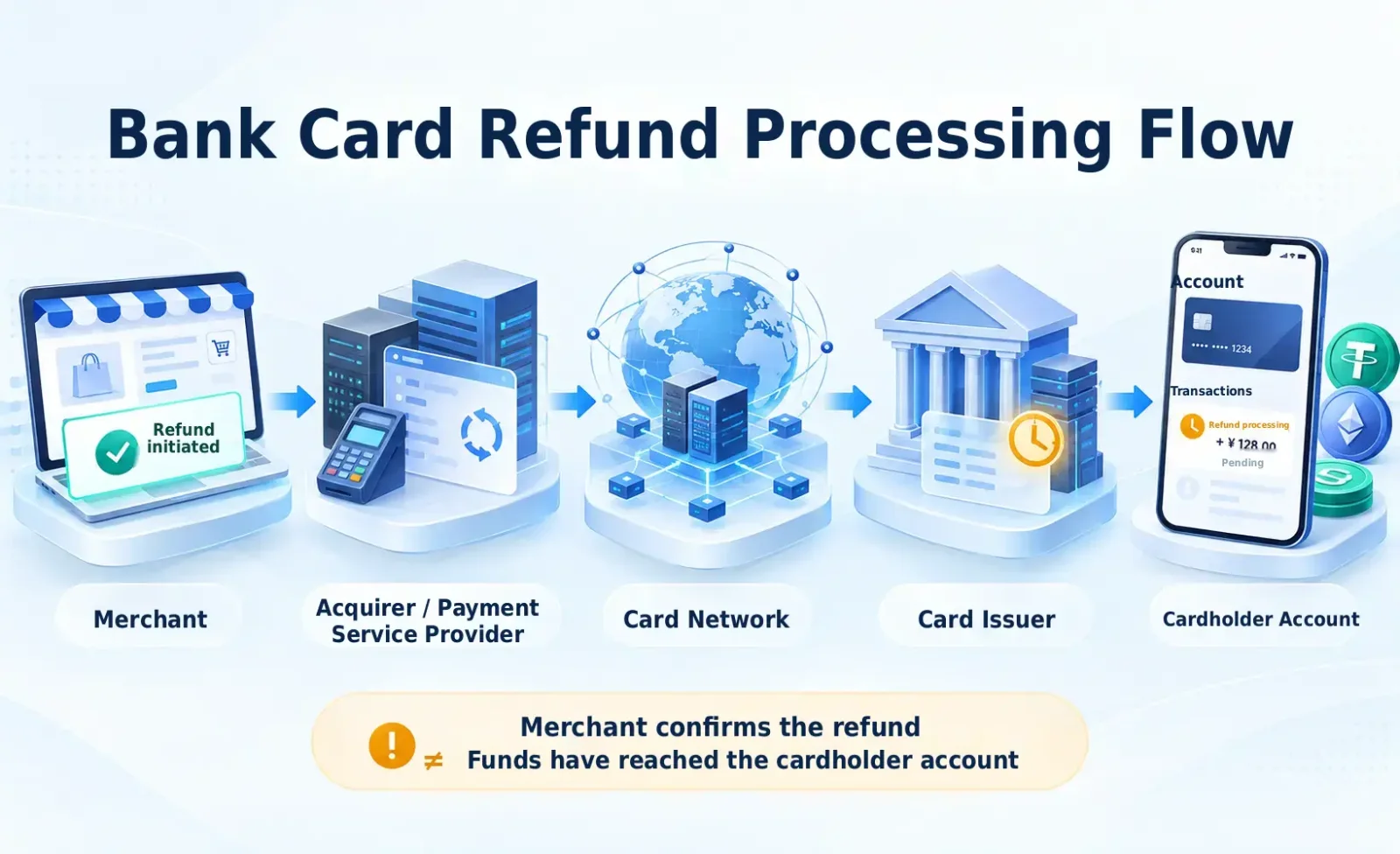
Each stage has its own processing timeline.
Stripe states in its card refund processing guidance that refunds generally take 5–10 business days to appear in a customer's account.
Coinbase Card's official troubleshooting guide also identifies 5–10 business days as a common timeframe for many refunds. It advises cardholders to contact support with the merchant's refund receipt if the expected period has passed.
Not every refund is completed within that window.
Adyen's payment lifecycle documentation explains that, for certain transactions already marked Refunded, funds may take up to 40 days to reach the customer's account, depending on how the financial institutions involved process the refund.
That longer period relates to Adyen's handling of specific refund states. It should not be interpreted to mean that a 40-day wait is normal for every crypto card refund.
Determining whether a refund is overdue also requires distinguishing the merchant's internal approval process from the actual processing of a refund transaction.
For example, a merchant might approve a refund on Monday but not submit it through its payment service provider until Wednesday. Those first two days are part of the merchant's internal processing time; they do not necessarily mean the card network has already started processing the refund.
Business days also differ from calendar days. Weekends and public holidays observed by financial institutions involved in cross-border transactions can extend the actual waiting period.
Once a refund exceeds the relevant card provider's published processing timeframe, you can initiate an investigation. There is no reason to keep waiting solely because another provider allows a longer processing period.
Why Does the Merchant Show a Successful Refund When Nothing Has Reached the Card?
A refund status in the merchant's dashboard describes a particular stage of payment processing, not necessarily the final outcome in the cardholder's account.
A customer service message saying "Your refund has been approved" generally establishes only that the merchant has approved the request. Even when the dashboard shows Refunded, the meaning of that status depends on the payment service provider's system.
The Refund Was Submitted, but the Issuer Has Not Credited the Account
Adyen distinguishes between several refund processing states.
SentForRefund means the refund request has been sent to the financial institution and is awaiting further processing confirmation.
Refunded indicates that the refund funds have been debited from the merchant's side and that the relevant financial institution is expected to return them to the customer. The cardholder may still need to wait for the funds to appear in the account.
There is another complication: a refund request can pass the payment service provider's checks and still fail at the card network stage.
Adyen's card refund documentation explains that even after a merchant receives a REFUND notification indicating a successful refund request, the card scheme may reject the refund several days later. In such cases, Adyen can send the merchant a REFUND_FAILED notification.
Adyen also uses a RefundedReversed status and the corresponding REFUNDED_REVERSED notification. These indicate that a previously attempted refund could not be delivered to the customer and the funds were returned. Its documentation specifically identifies certain bank transfers, iDEAL, and Bancontact payments among the methods to which these notifications apply.
REFUNDED_REVERSED should therefore not be treated as a universal status for failed card refunds.
For a customer who paid by card, the more useful questions are whether the merchant has sent the refund to the card network, whether any failure notification was received, and whether the transaction needs to be processed again.
A Refund Stuck in Pending May Be a Merchant Account Problem
Not every refund delay originates with the card issuer.
Stripe's pending refund guidance identifies several reasons a refund may remain in Pending status, including an underlying payment that has not yet settled, ongoing processing by a financial partner, or insufficient funds in the merchant's Stripe account.
If the merchant lacks sufficient available funds to cover the refund, the transaction may not be sent to the customer until the merchant adds funds or subsequent payments cover the shortfall.
This is different from a refund that has already entered the card network but has not yet been posted by the issuer.
Stripe also explains that pending refunds which cannot be processed may eventually fail. Its merchant support documentation describes a 45-day automatic failure period for the relevant pending refund mechanism. That rule does not establish a general waiting period for all card refunds.
If the merchant's refund remains Pending, ask the merchant to investigate the processing issue rather than immediately asking the issuer to locate a refund that may not have been successfully sent.
The Refund Failed or the Funds Were Returned
Card refunds can also fail because the original card account is no longer valid, transaction data is incorrect, a payment processor rejects the transaction, or processing fails within the card network.
Stripe's guidance notes that when the cardholder's bank cannot process a refund, the money may be returned to the merchant's Stripe account.
If the merchant confirms that a refund failed, request the reason and establish whether it can be resubmitted through the original payment channel.
Repeatedly asking the issuer to trace the original refund may accomplish little in this situation. The merchant may first need to submit a new, valid refund transaction.
No Refund Appears After an Order Cancellation. Does That Mean It Failed?
Canceling an order and issuing a formal refund are not the same card payment operation.
Card payments typically involve authorization and capture. If the merchant has not yet captured the payment, canceling the order may release the held amount through an authorization reversal rather than generate a separate refund credit.
Suppose a customer has a $200 available balance and places an $80 order with an online retailer.
After the merchant obtains authorization, the available balance falls to $120. The customer then cancels the order, and the merchant successfully reverses the authorization. Once the hold is released, the available balance returns to $200.
In this scenario, the original Pending transaction may disappear or be marked as reversed. The cardholder may never see a separate +$80 refund entry.
If the merchant has already captured the payment, returning the money normally requires a refund.
However, a refund initiated shortly after capture may also appear on the statement as a reversal.
Stripe's official guidance explains that certain early refunds can appear as reversals: the original charge disappears from the statement instead of a separate refund credit appearing.
Stripe also describes situations involving partial reversals.
For example, if $30 is returned from a $100 purchase, the cardholder may ultimately see a single $70 charge rather than a $100 debit and a separate $30 credit.
If an order has been canceled but no separate refund entry appears, check:
Whether the original transaction moved from
Pendingto a captured charge;Whether the original charge disappeared or its amount changed;
Whether the card's available balance was restored;
Whether the merchant performed an authorization reversal or issued a formal refund.
If the merchant reversed the authorization but the hold remains for an extended period, ask the merchant to confirm that the reversal succeeded. The issuer may also need to investigate the outstanding authorization hold.
How Can You Trace a Refund Using an ARN?
Once the merchant confirms that it has formally submitted a refund and the normal processing window has passed, the investigation should shift from estimated arrival dates to the actual transaction records.
Obtain Refund Evidence From the Merchant
Ask the merchant for the refund's actual initiation date, amount, currency, processing status, and any available transaction reference numbers.
If the refund is still Pending, first establish why the merchant's payment service provider has not completed processing.
If the merchant says the refund has been completed, request a refund receipt and any reference number that can be used to trace it through the card system.
ARN (Acquirer Reference Number) is one of the most important identifiers used for this purpose.
For card refunds that support ARN tracking, the merchant can obtain the number from its payment service provider. The cardholder can then give it to the issuer to help investigate the refund.
Stripe's refund reference number guidance describes three identifiers that may assist with tracing:
Reference | Meaning and Primary Use |
|---|---|
ARN | Acquirer Reference Number, used to trace card refunds for which this identifier is supported |
STAN | System Trace Audit Number, a transaction identifier in card payment messages that can assist with certain reversal investigations |
RRN | Retrieval Reference Number, which may be used to identify and investigate certain card network transactions |
These identifiers are not interchangeable in every situation.
An ARN is generally the preferred reference when tracing applicable Visa and Mastercard refunds. A STAN is not inherently unique across all transactions, while the availability and use of an RRN depend on the network and processing arrangements.
Stripe explains that some networks do not support ARNs and may provide RRNs instead. Certain reversal transactions may require a STAN.
Not every refund has an ARN accessible to the consumer, and not every issuer supports the same reference-based tracing procedures.
If an ARN is unavailable, ask the merchant for another refund reference and let the issuer determine which identifier it can use.
What Information Should You Give the Card Issuer?
Having complete transaction details reduces repeated requests for information from customer support.
Information | What to Provide |
|---|---|
Original payment | Merchant name, payment date, amount, currency, and transaction status |
Card details | Last four digits of the card number, not the full number |
Refund details | Actual initiation date, refund amount, currency, and processing status |
Tracking references | ARN, STAN, RRN, or the payment service provider's refund transaction ID |
Supporting documents | Refund receipt, order cancellation email, and merchant support confirmation |
Account records | Original charge, current balance, and any related refund entries |
When requesting an investigation from the issuer, you can explain:
The merchant has confirmed that it initiated a refund through the original payment channel. Please use the refund transaction reference to check whether the refund reached the issuing system, whether it was rejected or returned, and whether any account posting remains outstanding.
If frontline customer support cannot investigate, ask whether the case needs to be escalated to the actual card issuer or card payment processor.
Many crypto card platforms provide the customer-facing service while a partner issuer and processor operate the underlying card program. The platform's support team may not be the institution directly responsible for processing the refund.
Keep the support ticket number, response date, and findings from each investigation. These records can be useful if the issue needs to be escalated or becomes a transaction dispute.
What Happens if the Original Card Has Expired, Been Frozen, or Been Closed?
A crypto card becoming unusable for new purchases does not automatically mean refunds will fail.
What matters is the status of the underlying account and whether the issuer can identify and receive funds returned to the old card.
The card has expired or been replaced.
Even if the old card number is no longer valid, the underlying account may remain active. Some issuers can automatically associate an incoming refund with the replacement card account.
Coinbase Card's official support documentation states that refunds sent to an old card can typically be transferred automatically to the replacement card account.
That mechanism should not be assumed to apply to every crypto card.
The card has been frozen.
Blocking new card purchases does not necessarily prevent the account from receiving refunds.
A cardholder-initiated lock, risk controls imposed by a platform, and an account restriction applied by an issuer for compliance reasons may each have different implications for refunds.
Ask the card provider to clarify the scope of the restriction instead of assuming the refund will fail.
The card account has been closed.
Following account closure, the issuer may no longer be able to credit a refund directly to the original account. It may be necessary to determine whether the refund was rejected and whether another permitted method can be used to return the funds.
The April 2026 edition of the Visa Core Rules and Visa Product and Service Rules generally requires merchants to process refunds back to the original payment credential whenever possible.
If that credential is no longer valid, the account is closed, or the refund authorization is declined, other qualifying payment credentials or permitted alternative refund methods may be available under the applicable conditions.
This does not mean a cardholder can freely nominate any third-party bank card or crypto wallet to receive the money.
For a discontinued crypto card, first contact the original card provider or underlying issuer. Establish whether the funds arrived, whether they were returned, and which repayment methods are available before coordinating further action with the merchant.
If someone claims that a failed refund requires an on-chain verification fee, a wallet recovery phrase, or a private key, stop the interaction and verify the claim through the card platform's official channels. A legitimate card refund investigation does not require disclosure of that information.
Why Might the Refund Amount Be Lower Than the Original Charge?
Even after a merchant approves a full refund, the amount ultimately credited to the card account can differ from the original debit.
Potential causes include foreign exchange conversion, dynamic currency conversion (DCC), digital asset conversions, separate service fees, and the amount the merchant actually approved for refund.
These factors need to be examined separately. Not every shortfall can be attributed to exchange rate movements.
Ordinary Cross-Currency Refunds Can Produce Exchange Rate Differences
Suppose a customer uses a USD-denominated crypto card to make a €100 purchase from a European merchant.
At the time of payment, the card account is debited $110 under the applicable exchange rate and fee rules.
Several days later, the merchant refunds the full €100.
If the refund is independently converted back into dollars using a new applicable rate, assume the exchange rate is now:
€1 = $1.08
The €100 refund would then be worth $108.
Assuming no other fees apply and the card product converts the refund separately under this mechanism, the cardholder originally paid $110 but receives $108, a difference of $2.
Such a difference may result from exchange rate changes between the purchase and the refund. It does not, by itself, mean that the merchant refunded less than the original purchase amount.
Actual card products may use different exchange rate calculations and refund posting methods. Check the original transaction currency, refund currency, card billing currency, and the exchange rates and fees applied to both transactions.
Incorrect DCC Refund Processing May Provide Grounds for a Dispute
Dynamic Currency Conversion (DCC) generally occurs during a cross-border card payment when a merchant or its payment service provider offers the cardholder the option of paying in the cardholder's home currency.
This differs from ordinary foreign currency conversion performed by a card network or issuer.
Suppose a cardholder with a USD-denominated card spends €100 at a European merchant. The merchant offers DCC, and the cardholder agrees to complete the purchase for a specified dollar amount.
If a refund is later required, the merchant cannot arbitrarily change the refund currency or exchange rate treatment of the original transaction.
Mastercard's 2025 Dynamic Currency Conversion Performance Guide explicitly addresses the requirement to maintain the appropriate original transaction currency when processing DCC refunds.
For DCC transactions, the relevant refund procedures may include:
Reversing the original transaction;
Refunding the corresponding amount in the original DCC currency;
Processing the DCC refund using exactly the same exchange rate as the original transaction.
The guide also states that cardholders may have chargeback rights for losses resulting from a second currency conversion caused by improper refund processing.
Visa's 2026 rules likewise establish requirements concerning cardholder choice in DCC transactions and disputes involving incorrect currencies. Dispute Condition 12.3 (Incorrect Currency) covers circumstances including DCC applied without the cardholder's express agreement.
Whether a dispute is valid still depends on the actual transaction currency, the DCC authorization, refund records, and applicable card network rules.
When a cross-currency refund produces a lower amount, it is therefore important to distinguish between ordinary exchange rate movements and currency or conversion errors caused by a merchant or payment processor breaching applicable requirements.
The latter should not simply be dismissed as an exchange rate risk that the consumer must bear.
Can Digital Asset Conversion Affect the Refund Amount?
An important difference between crypto cards and conventional payment cards is that the original funding source and the asset used to credit a refund may not be the same.
Some cards spend from fiat balances funded or converted in advance. Others use balances in stablecoins such as USDT or USDC, while certain products may convert crypto assets at the time of purchase.
For cards that convert digital assets into fiat before a purchase, a merchant refund does not necessarily trigger an automatic repurchase of the originally held crypto assets.
Other products may credit refunds to the designated fiat account, stablecoin balance, or another asset account, depending on the card program.
The actual treatment must be determined from the product's operating model and cardholder agreement.
For example, Coinbase Card's European product guidance explains that where certain merchants authorize more than the final purchase amount, the unused amount may be used to repurchase crypto assets at the prevailing market price and returned to the spending balance.
This describes a particular mechanism for releasing unused preauthorized funds. It should not be used to explain a formal merchant refund made after a payment has been captured.
Unless the platform explicitly states that formal refunds involve repurchasing BTC or other digital assets, changes in the quantity of assets returned should not be inferred from that example.
Which Refund-Related Fees Should Be Returned?
A full refund of a purchased product does not automatically reverse every separate fee incurred before or after the payment.
For example, blockchain network fees, crypto funding fees, or completed standalone conversion service fees may relate to services separate from the underlying merchant purchase.
Whether those fees are refundable depends on the relevant service provider's agreement and applicable requirements.
Merchant surcharges imposed for accepting card payments require a different analysis.
Visa's 2026 rules contain requirements for refunding applicable surcharges in markets including Australia, New Zealand, Canada, Europe, and the United States. Surcharges covered by those requirements must be refunded in full when the purchase is fully refunded, or proportionally when a partial refund is issued.
Mastercard's 2026 rules also establish full or proportional refund requirements for relevant credit card brand-level and product-level surcharges in Canada and the United States.
These requirements are subject to geographic and card product restrictions. Debit and prepaid cards, which are common among crypto card products, cannot automatically be treated as subject to every rule governing credit card surcharges.
If a merchant excludes a card surcharge from a refund, first identify the nature of the fee, the transaction jurisdiction, and the card category. Then determine which refund requirements apply rather than assuming the merchant has unrestricted discretion to retain it.
Partial and Split Refunds Can Also Explain a Difference
A merchant may approve only a partial refund. For example, a customer might return one item from a multi-item order, or a hotel or travel provider may deduct a nonrefundable charge under its disclosed policy.
In other cases, the merchant approves a full refund but returns the money through several separate transactions.
Consider a $200 order refunded in two installments: $120 and $80.
The cardholder might receive the first $120, with the remaining $80 arriving several days later.
Payment service providers such as Stripe support multiple partial refunds against eligible original transactions, provided the cumulative refunded amount does not exceed the available refundable balance.
If a refund appears insufficient, first establish the total amount actually approved by the merchant, how many refund transactions were initiated, and whether each has been completed.
If the card program offers cashback, points, or other purchase rewards, check whether those rewards are reversed after the refund. A rewards adjustment may appear as a separate account entry and should not automatically be characterized as an additional refund fee.
When Should You File a Card Transaction Dispute Over a Missing Refund?
A normal merchant refund and a card transaction dispute are different procedures.
In a standard refund, the merchant voluntarily returns the funds through the relevant payment channel.
A chargeback is a formal dispute process initiated by the cardholder through the issuer for a transaction that meets the applicable dispute conditions. The institutions involved then handle the case under the relevant card network rules.
If the merchant has agreed to issue a refund and the transaction remains within the normal processing period, checking the refund's progress is generally the appropriate first step.
However, contact the issuer promptly about a possible dispute if:
The merchant explicitly promised a refund but has not actually submitted it after an extended period;
The merchant refuses to honor a refund obligation under its policy or applicable rules;
The merchant has become unreachable and cannot provide valid processing records;
The refund was rejected or failed, and the merchant refuses to resolve the problem;
There is a substantiated dispute over the refund amount, or the currency handling may violate applicable card network rules;
The dispute filing deadline is approaching, and continued waiting could eliminate the opportunity to file.
Crypto.com's prepaid card dispute guidance requires cardholders to attempt to resolve ordinary merchant disputes directly with the merchant and retain supporting evidence.
Its guidance identifies a filing window of up to 120 days after the transaction or ATM withdrawal. Disputes are generally expected to take 30–45 days to resolve, although the actual duration can vary with case complexity.
These are the published procedures for the relevant Crypto.com prepaid card program, not universal deadlines for all crypto cards.
Visa and Mastercard dispute rules impose different requirements depending on the dispute reason, transaction type, applicable region, and other factors. For certain disputes, the filing period may not begin on the original purchase date.
When a transaction is approaching its applicable dispute deadline, a merchant's repeated promises that a refund is "coming soon" should not justify waiting indefinitely.
Ask the issuer to confirm your dispute eligibility, the final filing date, and the evidence required as early as possible.
If the merchant refund has already been credited successfully, you cannot seek duplicate reimbursement for the same funds. Disclose any ongoing merchant refund and transaction dispute to the issuer to avoid overlapping recovery procedures.
Report Unauthorized Transactions Immediately
If you discover a charge from a completely unfamiliar merchant, suspect card fraud, or believe your card credentials have been compromised, do not treat the situation as an ordinary merchant refund subject to standard waiting periods.
Immediately use official channels to lock the card, report the unauthorized transaction, and begin any security investigation or dispute procedure required by the issuer.
Prompt reporting can materially affect subsequent fraud prevention measures and dispute handling.
Missing Crypto Card Refund: Troubleshooting Checklist
When investigating a missing refund, the transaction's current status can help determine which party to contact first.
Issue Identified | Who to Contact First | Recommended Action |
|---|---|---|
Merchant approved a refund but provided no proof | Merchant | Confirm whether the refund was formally submitted and request processing records |
Refund has remained Pending for an extended period | Merchant and its payment service provider | Investigate merchant account balance, payment settlement, and the reason for the pending status |
Funds remain on hold after an order cancellation | Merchant; issuer if necessary | Verify whether the authorization was reversed and when the hold will be released |
Merchant submitted the refund and it is still within the normal timeframe | Merchant or payment service provider | Obtain refund status, date, and reference number |
Refund has not arrived after the normal timeframe | Issuer or card provider | Supply the ARN or another reference and request a refund trace |
Refund failed or money was returned to the merchant | Merchant and its payment service provider | Identify the failure reason and arrange for the refund to be resubmitted |
Original card expired, was frozen, or the account was closed | Original issuer | Determine whether the account can receive the refund and what alternative procedures are available |
Refund amount is lower than the original charge | Merchant and issuer | Review refund currency, exchange rates, surcharges, and split refunds |
Merchant refuses a refund and the dispute deadline is approaching | Issuer | Confirm dispute eligibility and submit supporting evidence promptly |
A potentially unauthorized charge appears | Issuer's security and dispute team | Secure the account immediately and report the transaction |
Before contacting a merchant or issuer, retain the original order, payment record, refund confirmation email, transaction references, and relevant customer support correspondence.
For cards involving digital asset conversion, also keep records of the assets deducted at the time of purchase, the converted amount, the currency, and the account balances before and after the refund. These details can help reconcile any difference.
When submitting screenshots to customer support, redact unrelated personal information and complete card details. Never disclose your CVV, wallet private key, or recovery phrase.
If the merchant has formally submitted the refund, the issuer should help establish whether it has arrived and whether account posting is complete. If the refund has not been successfully sent, the merchant and its payment service provider will generally need to resolve the problem.
When an ordinary refund investigation cannot resolve the issue, use the transaction evidence, applicable card network rules, and relevant dispute deadlines to seek further assistance from the issuer.