
After paying with a crypto card, you may find that a transaction remains marked "Pending" for an extended period. The merchant has confirmed your order, and your available card balance has decreased, yet the transaction has not changed to "Completed." Sometimes, even after an order is canceled, the amount previously held does not immediately become available again.
This does not necessarily mean the merchant has collected the payment or that something has gone wrong with the card provider.
In card payment networks such as Visa and Mastercard, payment authorization and final settlement do not happen simultaneously. A Pending transaction generally means that an amount has been reserved, but subsequent processing has not yet been completed.
Crypto cards introduce another consideration: how the card is funded. Is the purchase deducted from a preloaded balance, or does the platform convert crypto assets when the payment is made? Depending on the funding model, authorization holds, balance restoration, and asset returns may work differently.
To determine whether funds have actually been debited, you first need to establish which stage of processing the transaction has reached.
What Does a Pending Transaction Mean? Authorization vs. Final Payment
A card payment does not necessarily complete every stage of processing the moment a user clicks "Pay."
A typical card transaction involves three stages: authorization, merchant capture, and clearing and settlement.
Authorization occurs when a merchant requests approval for a transaction from the card issuer. The issuer decides whether to approve it based on factors such as the card's status, available funds, transaction limits, and risk controls.
For debit or prepaid cards that draw on an account balance, a successful authorization typically reserves the corresponding amount so those funds cannot be used again for another purchase. This reservation is known as an authorization hold.
Merchant capture is the process in which the merchant confirms the amount to be collected and submits the transaction for subsequent payment processing.
Some online transactions use automatic capture, moving to the next stage shortly after authorization. Other merchants delay capture. For example, an e-commerce retailer may wait until an order is ready to ship before confirming the charge.
Payment service provider Adyen distinguishes between automatic capture, delayed automatic capture, and manual capture in its official capture documentation. It also explains that funds can be reserved on the cardholder's account during authorization.
After capture, the transaction still needs to go through clearing and settlement across the card network. Once the issuer receives and processes the final transaction information, the cardholder's transaction record will generally move from a pending state to a posted transaction.
Importantly, labels such as "Pending," "Completed," and "Settled" in a card app do not necessarily correspond to standardized processing stages across all card networks. Providers have their own accounting procedures and rules for displaying transaction statuses.
Therefore, Pending only indicates that a transaction has not completed the processing workflow defined by the relevant system. The label alone cannot establish whether the merchant has already received the funds.
Why Has My Card Balance Decreased While the Transaction Is Still Pending?
The most common explanation is an authorization hold.
Suppose a prepaid crypto card initially has $300 available for purchases. When the cardholder checks into a hotel, the hotel requests a $200 preauthorization. After the issuer approves it, $200 is temporarily reserved, reducing the card's available balance to $100.
The account may then show the following:
Account Item | Amount |
|---|---|
Original available balance | $300 |
Hotel preauthorization amount | $200 |
Temporarily available balance | $100 |
Final confirmed hotel charge | Not yet determined |
Now suppose the cardholder's final hotel bill is only $78. Once the merchant captures the appropriate amount and the remaining authorization hold is released, the available balance should return to $222, assuming there are no other transactions or fees.
Of the original $200 reservation, $78 becomes the actual charge, while the remaining $122 is released.
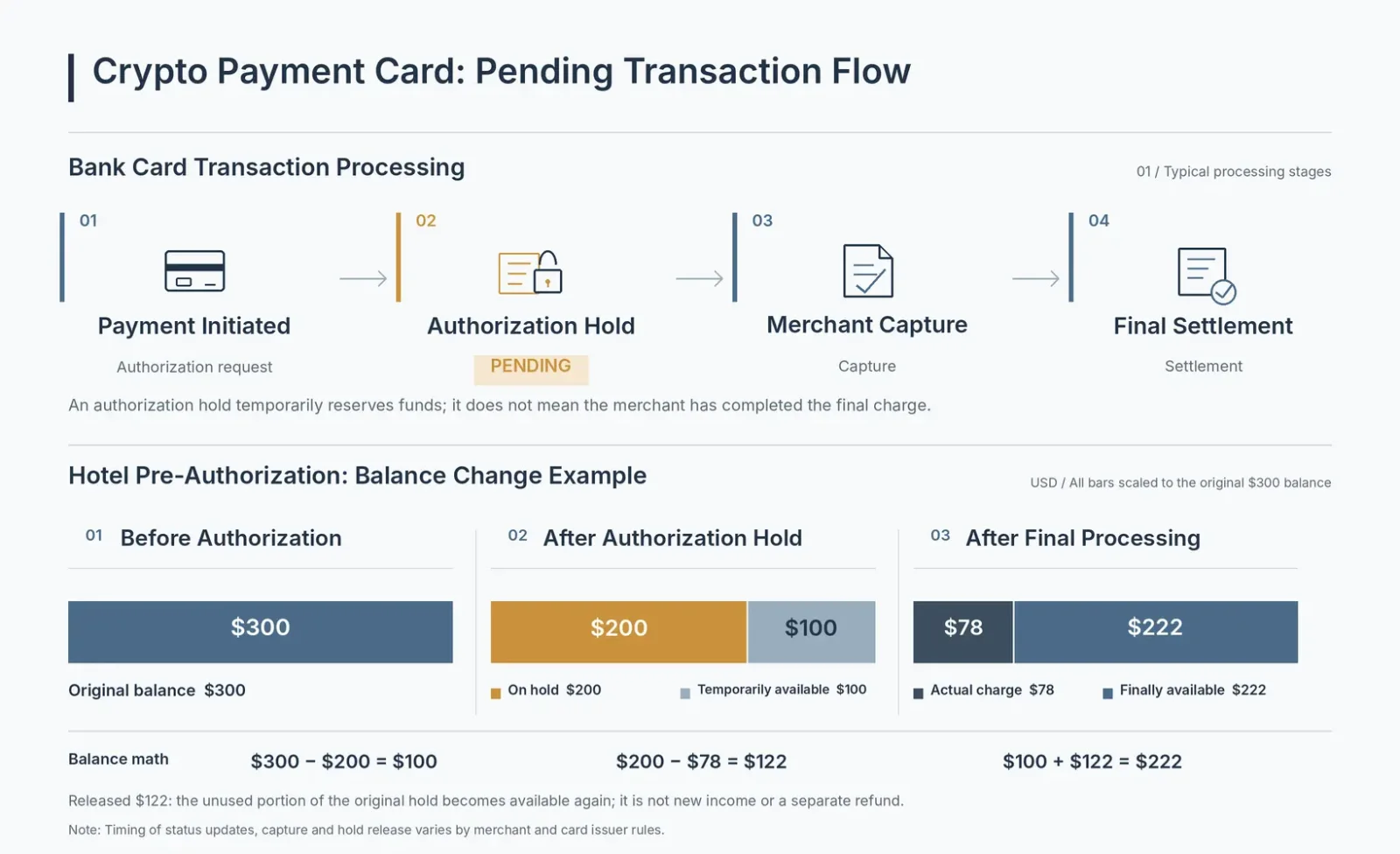
How these transactions appear in the account history can vary. Some systems adjust the original authorization amount, others release the remaining hold separately, and some display the temporary authorization and final posted transaction as separate entries.
As a result, cardholders may see two entries for similar amounts: one representing the preauthorization and the other the final charge. Those entries may later be combined or adjusted as processing completes. Their presence alone does not prove that the card has been charged twice.
Crypto.com notes in its prepaid card fees and limits documentation that gas stations, hotels, car rental companies, and certain restaurants may preauthorize amounts greater than the final purchase price. Until the transaction is finalized, the reserved funds may be unavailable for other purchases.
Why Are Pending Amounts Often Higher Than the Actual Charge at Hotels, Car Rentals, and Gas Stations?
The key issue is whether the merchant knows the final charge when requesting authorization. Ordinary retail purchases generally have a fixed price, but hotels, car rentals, and pay-at-the-pump fuel purchases often require an estimate of the eventual cost.
At hotel check-in, the final bill may include room charges, taxes, and additional expenses incurred during the stay. Car rental companies may also reserve extra funds based on the rental period, fuel policies, and other contractual charges.
An automated fuel pump cannot determine how much fuel a customer will purchase before fueling begins, so it may first request authorization for an estimated amount.
These merchants process payments through preauthorizations, authorization adjustments, and subsequent capture, subject to applicable payment rules and their own policies.
Two situations need to be distinguished:
A preauthorization amount higher than the actual purchase does not mean the merchant has charged an additional fee. The difference may simply be subject to a temporary hold.
A final posted amount higher than the initially displayed price requires checking whether the charge includes service fees, taxes, foreign exchange fees, or other additional costs.
The first is a matter of reserved funds; the second concerns the amount actually billed.
Crypto.com's official guidance also notes that some restaurants reserve an amount above the bill to account for a potential tip.
For example, a restaurant purchase may total $80 while the Pending amount on the card shows $100. Before assuming that an extra $20 has been charged, the cardholder should check whether the merchant uses a preauthorization amount that includes an allowance for gratuities.
If the merchant ultimately captures $80, the remaining held amount should be released through the applicable authorization process.
Why Is a Transaction Still Pending After the Order Has Been Canceled?
Canceling an order and releasing its payment authorization do not necessarily happen at the same time.
After a customer cancels an e-commerce order, the merchant may immediately mark it as "Cancelled," while the previously approved payment authorization remains active in the issuer's system.
There are generally two ways for the reserved funds to become available again.
One is for the merchant or its payment service provider to submit an authorization reversal, releasing the funds reserved by the original authorization.
The other is for an authorization that has not been validly captured to reach its applicable expiration date, after which the issuer releases the held amount according to the relevant rules.
Adyen explains in its issuing authorization holds documentation that, within its issuing system, authorized funds remain reserved until the transaction is captured or the hold is released. A hold may be released through a merchant-initiated authorization reversal or when the authorization expires.
For the relevant issuing arrangements described by Adyen, the merchant processing the transaction must initiate the authorization reversal. The issuer cannot directly cancel the existing authorization on the merchant's behalf.
However, operational permissions differ between issuers and payment processing systems. This rule should not be assumed to apply to every crypto card.
An Authorization Reversal Is Not the Same as a Refund
If the merchant has not completed capture and simply reverses the previously approved authorization, the process generally involves canceling the preauthorization. Once the funds become available again, the account may not show a separate incoming refund.
If the merchant has already completed the final charge and the order is subsequently canceled, returning the money generally requires a refund.
Processing Method | When It Applies | What the Cardholder May See |
|---|---|---|
Authorization Reversal | A transaction is canceled before the corresponding capture is completed | Pending status disappears, the authorization hold is released, and the available balance is restored |
Authorization Expiry | An authorization that has not been validly processed reaches its applicable expiration date | The hold is released and the available balance is restored |
Refund | A purchase that has already been charged is returned or canceled | A refund entry appears and is credited according to the issuer's procedures |
Some payment systems provide a unified reversal interface that cancels an authorization or initiates a refund, depending on whether the transaction has already been captured. Adyen's Reversal functionality follows this approach.
For cardholders, what matters is how the funds are returned, not whether the merchant's interface displays "Refund" or "Cancel."
How Long Does a Pending Transaction Usually Take to Clear?
There is no single processing deadline that applies to every crypto card.
An ordinary card purchase may proceed through capture and posting quickly, or it may remain Pending because the merchant delays processing. Holds associated with hotel deposits and car rental preauthorizations may last considerably longer than those for typical online purchases.
Authorization validity periods depend on the card network, transaction type, merchant category, issuer, and payment processor. The time needed to release funds may also differ depending on whether the merchant actively reverses an authorization or allows it to expire.
For example, under Adyen Issuing's published authorization hold rules, standard Visa authorizations outside Japan that do not fall into the listed special categories generally expire after 7 days. Authorizations for merchant categories associated with hotel accommodations, car rentals, and cruises have a 31-day validity period. Mastercard final authorizations and default authorizations generally expire after 7 days, while preauthorizations have a 30-day validity period.
These are the authorization expiration arrangements published for Adyen's issuing processing system. They are not universal deadlines for all Visa or Mastercard cards, or for crypto cards generally. Separate rules apply to transactions in Japan, and certain special merchant categories and eligible authorization extensions may also affect the actual validity period.
The 7-day, 30-day, and 31-day periods refer to the expiration of the relevant authorizations. They do not represent the time required for merchants to complete capture and final posting, nor do they guarantee that the available balance shown in the card app will update on the expiration date.
Crypto.com's official prepaid card help documentation states that, for hotel and car rental transactions, preauthorized funds exceeding the final purchase amount may take up to 60 days after checkout or the end of the rental to become available again. This is guidance for specific transaction scenarios involving that product, not a general deadline for all crypto cards.
Even when a merchant has submitted a reversal request, the cardholder may not see an immediate balance adjustment in the app.
The payment service provider may receive the reversal request, the issuer may release the authorization, the platform may update its internal accounting records, and the app may refresh the transaction status at different times.
An expired authorization and the release of held funds do not necessarily mean the merchant has abandoned the charge. Adyen Issuing's technical documentation explicitly states that its system will still process captures submitted by merchants after the original authorization has expired. Consequently, funds that were previously released may subsequently be charged, reducing the available balance again.
If this happens, the cardholder should verify that the subsequent posted charge corresponds to the original purchase. If the amount does not match the bill, or the transaction itself was unauthorized, the cardholder can contact the issuer for an investigation and raise a transaction dispute under the applicable rules.
Whether it is time to contact customer support should be determined by the processing periods published by the specific card provider.
If an ordinary purchase has exceeded a reasonable processing period and the funds remain reserved, the cardholder can ask the provider to investigate the authorization status.
For larger preauthorizations involving hotels or car rentals, the final bill, checkout or vehicle return date, and the issuer's authorization rules should also be considered.
Why Does a Crypto Card's Pending Status Also Depend on Asset Conversion?
With a conventional prepaid card, an authorization hold generally applies to funds already loaded into the card's spending balance.
Crypto cards may use different funding arrangements.
Under one model, users first convert USDT, USDC, or other crypto assets into fiat currency and then load the proceeds onto a prepaid card. Once the card is funded, purchases are primarily processed under the rules governing the corresponding fiat-denominated account.
Under another model, the card converts crypto assets held by the user at the time of payment, subject to the product's rules, or provides spending capacity through other funding arrangements.
Some products also use mechanisms involving wallet connections or smart contract permissions.
Because funding sources and conversion methods differ, the processes affecting assets behind the same Pending status may not be identical.
Preloaded Cards: Focus on the Fiat Card Balance
For preloaded cards where crypto assets have already been converted into fiat balances denominated in currencies such as US dollars or euros, spending generally follows conventional card authorization and accounting procedures. When an authorization is released, what becomes available again is typically the corresponding balance in the card account, not necessarily the original crypto assets.
Under this model, a Pending card purchase does not mean that a blockchain transaction is awaiting confirmation.
Conversion at the Time of Purchase: Asset Prices May Matter
If a card sells or converts crypto assets when a purchase is made, the transaction record may involve both a fiat-denominated authorization amount and the value of the crypto assets.
Some products process crypto assets based on the authorized amount and return funds through a specific mechanism when the amount is subsequently adjusted or the authorization is released.
Coinbase explains in its debit card troubleshooting guidance that, for certain transactions where the preauthorized amount exceeds the actual purchase, excess funds may be returned to the spending balance by repurchasing crypto assets at the prevailing market price.
As a result, the quantity of crypto assets ultimately restored after the authorization is released may differ from the quantity originally deducted.
This mechanism is not used by every crypto card. Cards funded through stablecoin preloading, purely fiat balances, or other settlement structures may not involve the same asset repurchase process.
If a Pending transaction results in a change in asset quantities, the cardholder needs to examine the specific product's funding source, conversion rules, and authorization reversal policies to determine the reason for the difference.
Blockchain Pending and Card Payment Pending Are Not the Same
When users fund a crypto card platform through a blockchain transfer, the deposit record may also display Pending.
This could mean that the on-chain transaction has not yet reached the number of confirmations required by the platform, or that the platform's internal deposit review has not been completed.
A Pending status arising from a card purchase, by contrast, is generally associated with card payment authorization and subsequent transaction processing.
Even if both statuses appear in the same app, they may be handled by entirely different systems.
For a blockchain deposit issue, check the transaction hash, block confirmations, and the platform's deposit records.
For a Pending merchant card purchase, check the merchant order, card authorization, and final posting status.
Failing to find a card authorization in a blockchain explorer does not prove that the card transaction does not exist.
A Pending Transaction Has Not Cleared: Should You Contact the Merchant or the Card Issuer First?
First determine whether the transaction has reached the final charging stage, then decide whom to contact.
If an order has been canceled but the card still displays Pending, the usual first step is to ask the merchant whether the payment authorization has been reversed.
An order cancellation email only confirms that the merchant canceled the order. It does not necessarily establish that an authorization reversal request was sent.
You can ask the merchant to confirm the payment processing status and, where available, provide transaction reference information for the authorization reversal.
If the merchant confirms that the reversal has been completed but the funds remain frozen for an extended period, submit the relevant records to the issuer or card provider. Ask whether the reversal notification has been received and when the reserved funds are expected to become available.
If the merchant has already captured the payment but the card app still shows the original Pending entry, the issuer needs to investigate how the final posted transaction is matched to the original authorization.
The appropriate response depends on the circumstances.
The Order Was Canceled, but the Balance Has Not Been Restored
Contact the merchant first to confirm whether an authorization reversal has been completed. If not, ask the merchant to process it through its payment system.
If the merchant confirms the reversal and the transaction has exceeded the issuer's published processing period, request an investigation from the card provider.
The Payment Failed, but a Pending Transaction Appeared
The card authorization may have been approved even though the merchant's subsequent order processing failed.
In this situation, establish whether the authorization relates to a valid order and whether the merchant still intends to capture the payment.
Until this is confirmed, avoid repeatedly submitting the same payment request. Doing so could generate multiple authorizations and further reduce the available card balance.
Two Transactions for the Same Amount Appear Under One Merchant
First check whether the two entries represent a temporary authorization and the final posted transaction, or whether duplicate authorizations were created.
If they are simply different processing stages of the same purchase, they do not necessarily constitute duplicate charges.
However, if both amounts have been formally posted and the cardholder made only one purchase, the issue should be raised with the merchant or issuer as a potential duplicate transaction.
A Pending Transaction Appears for an Unrecognized Merchant
This should not be treated as an ordinary settlement delay.
Even if the transaction has not been finally posted, it may involve unauthorized card use.
The cardholder should promptly freeze or restrict the card through official channels, contact the issuer for an investigation, and follow the unauthorized transaction procedures applicable to the card program.
What Transaction Information Should You Provide When Contacting Support?
To investigate a Pending transaction, the issuer needs to identify the original authorization and its subsequent processing records accurately.
A screenshot showing a reduced balance is usually not enough.
Prepare the following information in advance:
Transaction date, time, and time zone;
Merchant name, transaction amount, and currency;
Last four digits of the card number;
Transaction status displayed in the card app;
Relevant order number or transaction reference;
Order cancellation confirmation, refund notice, or other response provided by the merchant.
Some card transactions may also involve technical identifiers such as the Retrieval Reference Number (RRN) and System Trace Audit Number (STAN), depending on the payment processing system.
If a transaction has already been posted or has entered the refund process, the Acquirer Reference Number (ARN) may also help with tracing in certain circumstances. However, not every Pending authorization generates these identifiers, and not every payment service provider makes them available to consumers.
Cardholders do not need to obtain every technical identifier themselves. When communicating with support, clearly identifying the stage that needs investigation is usually more useful.
If the order has been canceled, you can ask:
This transaction is still showing as Pending, although the merchant has confirmed that the order was canceled. Could you check whether an authorization reversal request has been received for the original authorization and when the held funds are expected to become available again?
If the merchant has not confirmed the payment processing status, you can ask:
Could you confirm whether this transaction has been captured or whether it is still subject to an authorization hold?
These questions are more precise than simply requesting a "refund of the Pending amount." They also help support staff determine whether the issue concerns authorization, capture, or an accounting update.
When submitting information, provide only the last four digits of the card and the transaction details necessary for the investigation. Never share the full card number, CVV, account password, one-time password (OTP), or wallet recovery phrase.
How Can You Prevent Pending Holds From Disrupting Future Purchases?
If you frequently use a crypto card for hotels, car rentals, or pay-at-the-pump fuel purchases, check the merchant's preauthorization policy in advance and maintain enough available funds to cover an authorization that may exceed the actual purchase amount.
For example, suppose your card has only $120 available and you expect to spend $40 on fuel. If the pump requires an initial preauthorization of more than $120, the transaction may still be declined.
Some gas stations allow customers to pay a specified amount at the cashier, but availability depends on the merchant and local payment terminal rules.
For e-commerce purchases, if an order has not yet been confirmed, check the original transaction status before attempting payment again. Repeatedly clicking the payment button can result in multiple authorization holds.
For recurring subscriptions, pay attention to other outstanding authorizations that may be reducing the available balance. This is particularly important when the subscription charge is close to the available funds. Even if the total assets displayed in the account appear sufficient, the payment may fail because the spendable balance is too low.
Coinbase's official debit card help documentation similarly notes that pending authorizations can reduce the amount available for card purchases and recommends checking the transaction details for the relevant status.
When using a crypto card, distinguish between three figures: the total assets displayed in the app, the balance in the card account, and the amount currently available to authorize a purchase.
If some assets are still undergoing deposit confirmation, conversion review, or another fund restriction process, their appearance in the account's asset list does not necessarily mean they can be spent immediately.
Do You Still Need to Check the Final Statement After Pending Disappears?
Yes, particularly for cross-border purchases and transactions where the preauthorized amount was higher than the actual charge.
When Pending disappears, it usually means only that the previous processing status has changed. Cardholders should still verify that the final posted amount matches the merchant's bill.
If the authorization currency, merchant transaction currency, and card billing currency differ, the final posted amount may be affected by applicable exchange rates and actual fees.
For cards that support converting crypto assets at the time of purchase, the product's conversion timing and pricing mechanism must also be considered.
Consequently, the final posted amount may not exactly match the temporary authorization amount shown when the payment was made.
If the difference results from an adjustment to the preauthorized amount and the release of excess funds, the available account balance will generally update as processing continues.
However, if the final posted amount exceeds the charges actually confirmed by the merchant, the cardholder should review the merchant's bill, transaction currency, foreign exchange fees, and any separate authorizations or additional charges. Any unexplained difference should be investigated promptly with the merchant or issuer, with a transaction dispute raised if necessary.
For a transaction that remains Pending for an extended period, three facts matter most: whether the merchant has captured the payment, whether the original authorization is still valid, and whether the held funds have become available again.
If an order has been canceled but the authorization remains active, the usual next step is to ask the merchant to initiate a reversal. If the merchant has captured the payment but the transaction has not been posted correctly, the issuer needs to investigate further.
If the transaction involves an unfamiliar merchant or suspected unauthorized activity, take immediate steps to secure the account rather than waiting for Pending to disappear on its own.