
A crypto payment card advertises “0% card transaction fees.” You use it to buy something worth $100. That does not necessarily mean you only need to fund the card with $100 worth of cryptocurrency.
If the funds come from USDT or USDC, you may first pay a blockchain transfer fee, followed by an account funding charge or a conversion spread. Foreign-currency purchases may also involve card-network exchange rates and additional issuer fees. Some charges appear as separate items on your statement. Others are built into the amount credited to your account or the exchange rate you receive.
The most practical way to compare crypto card costs is to follow the money and check three figures: how much actually left your wallet, how much reached your card account, and how much was ultimately deducted for the purchase. Taken together, these numbers reveal what a “zero-fee” offer actually waives.
Where Do Crypto Card Fees Arise Between Funding and Spending?
The charges depend on how funds enter the card account. Some products convert crypto into fiat before funding the card; others convert it at the point of purchase. Some debit an associated wallet through an authorization mechanism. The following fees can arise along these different routes, although not every card charges all of them.
Fee category | When it arises | What to check |
|---|---|---|
Card issuance, physical card and delivery fees | Applying for or receiving a card | Whether virtual and physical cards have separate charges; whether fees are one-off |
Membership, administration and inactivity fees | While holding the card | Subscription periods, waiver conditions and when inactivity charges begin |
Blockchain network fees (Gas) | Transferring funds on-chain from a personal wallet | Which network is used, who pays the fee and whether payment requires the network's native token |
Top-up or funding fees | Adding funds to a platform account or card balance | Whether rates differ for crypto, bank transfers and funding through another payment card |
Conversion fees or spreads | Converting USDT, USDC or other assets into fiat | Whether a separate conversion fee is charged and how far the quoted rate differs from a reference rate |
Card transaction fees | At payment authorization or transaction posting | Whether charged per transaction and whether card tier, currency or transaction type matters |
Foreign-currency and cross-border fees | Cross-currency transactions or transactions meeting cross-border fee criteria | The card-network exchange rate, issuer markups and applicable regions |
ATM and other service fees | Cash withdrawals, replacement cards, disputes or account closure | Whether the issuer and ATM operator charge separately and whether any fee-free allowance applies |
Another commonly misunderstood term is interchange. This is generally a fee allocated among institutions within the card-payment system, not the same thing as a card transaction fee charged separately to the cardholder. Unless the product terms or transaction records show that the cardholder is explicitly responsible for it, interchange should not simply be added to personal card costs.
If You Top Up 1,000 USDC, How Much Can You Actually Spend?
Consider a hypothetical transaction.
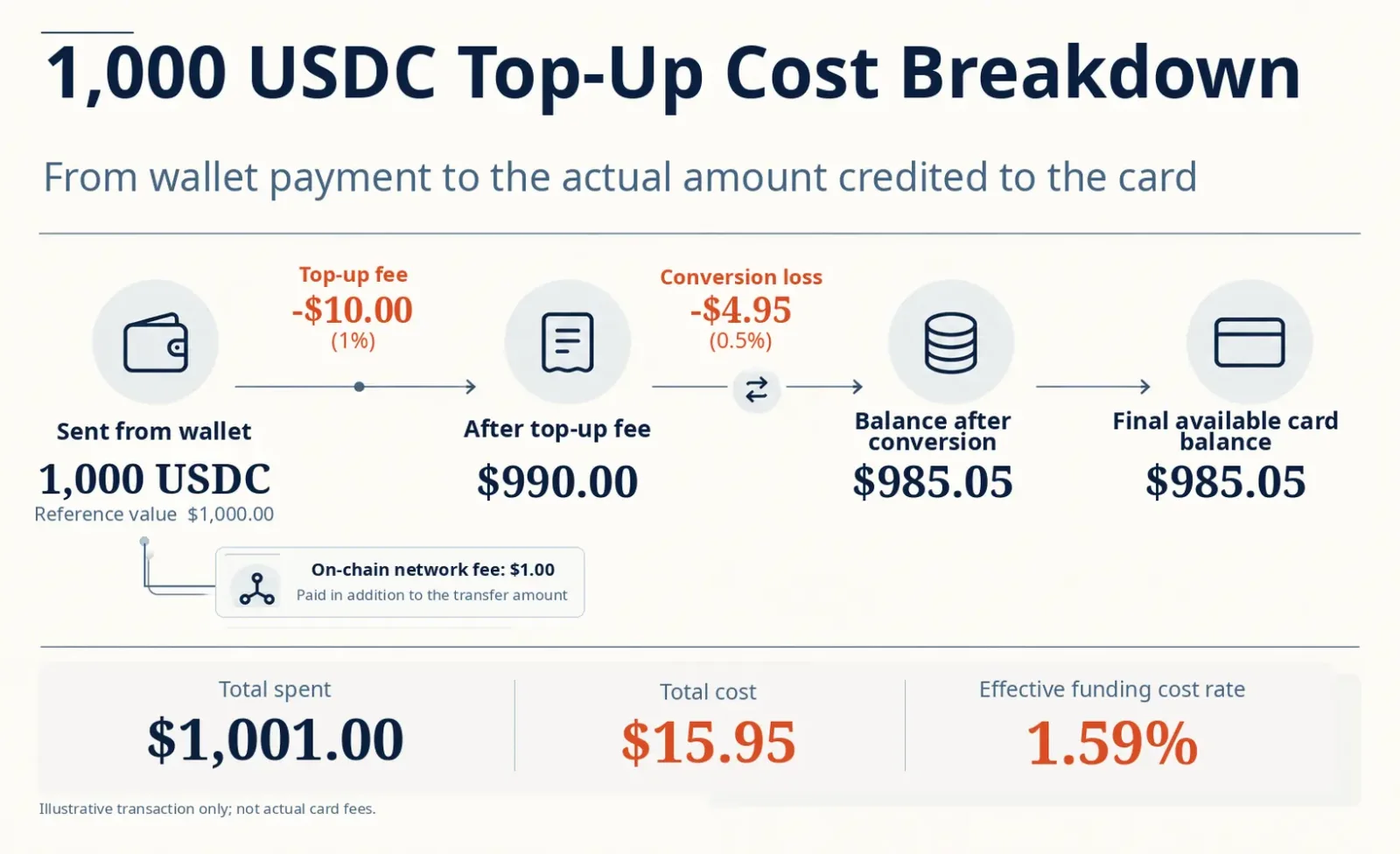
You transfer 1,000 USDC from your personal wallet, with an assumed reference value of $1,000. The platform deducts a 1% top-up fee from the deposited amount, followed by a 0.5% conversion cost on the remainder. Your wallet also pays a network fee worth $1 outside the 1,000 USDC transferred. The card account is denominated in US dollars.
Funding stage | Calculation | Amount (USD) |
|---|---|---|
Reference value of 1,000 USDC transferred | 1,000 × $1.00 | $1,000.00 |
Assumed top-up fee | $1,000.00 × 1% | −$10.00 |
Balance after top-up fee | $1,000.00 − $10.00 | $990.00 |
Assumed conversion cost | $990.00 × 0.5% | −$4.95 |
Final available card balance | $990.00 − $4.95 | $985.05 |
Separately paid network fee | Paid in addition to the 1,000 USDC | $1.00 |
The top-up fee and conversion cost total $14.95. Including the additional $1 network fee, you have committed assets worth $1,001 to obtain a card balance of $985.05. The difference is $15.95.
Looking only at the “1% top-up fee” would miss the conversion cost and network fee. To capture the combined effect, this article defines the following measure as the transaction's effective funding cost rate:
Effective funding cost rate = (Total reference value of assets committed − Final available card balance) ÷ Total reference value of assets committed × 100%
For this example:
($1,001.00 − $985.05) ÷ $1,001.00 × 100% ≈ 1.59%
The network fee is included in the total outlay at its US-dollar equivalent when paid. The 1.59% represents the combined cost of funding and conversion in this particular transaction.
What Happens If You Then Make a Foreign-Currency Purchase?
Continue with the same USD-denominated card. Suppose an overseas purchase converts to $100 at the applicable exchange rate, before any issuer foreign-transaction surcharge, with no other fees. If the issuer adds a 2% foreign-transaction fee, the card account is ultimately charged $102, leaving $883.05.
The additional charge for this purchase is $2. The earlier $14.95 relates to funding and converting the entire top-up; it should not be charged in full to every subsequent card purchase in a cost calculation. Allocating that cost to individual purchases depends on how much of the funded balance is spent and how fixed fees or cashback rewards are distributed.
What Does “0% Card Transaction Fees” Actually Mean?
Official fee disclosures from two real products help illustrate the distinction.
Coinbase Card: Separate Purchase Fees from Crypto Trading Spreads
Coinbase explains that spending with Coinbase Card using supported funding sources does not incur an additional Coinbase card transaction fee. However, buying, selling or trading crypto on Coinbase may involve a spread built into the quoted price. ATM operators may also impose their own fees.
The key distinction is between making a purchase and trading crypto. Spending USDC does not necessarily involve a conversion spread, but “zero card transaction fees” does not cover every asset or activity.
Official source: Coinbase Card fees and tax information.
Crypto.com: The 1% Top-Up Fee Depends on the Funding Method
Crypto.com's EU/UK prepaid card top-up guidance states that using another credit or debit card to top up the prepaid card incurs a 1% fee. That is a card-funded top-up charge, not a blanket 1% fee on all USDT or USDC deposits. Funding with crypto instead requires checking the specific asset, conversion quote and applicable terms shown in the app.
The official fee schedule for European residents also links non-EUR transaction fees to card tiers and transaction regions. Under rules effective from October 1, 2026, the Midnight card incurs a 0.2% foreign transaction fee on non-EUR purchases and ATM transactions within the EU and UK, and 2% outside those regions. Other card tiers have their own rules and fee-free allowances.
Official sources: EU/UK prepaid card top-up guidance; card fees and limits for European residents.
Comparing the “0%” and “1%” figures alone leads to the wrong conclusion. Coinbase and Crypto.com apply these rates to different activities and regions. First establish where the funds come from and at which stage a charge applies. Only then can you meaningfully compare which card costs less.
Exchange-Rate Costs: Three Different Conversions
Exchange-rate costs do not arise only when you tap or swipe your card. Converting crypto to fiat, processing a cross-currency card transaction and accepting dynamic currency conversion offered by a merchant or ATM are three separate pricing processes.
Converting Crypto Assets into Fiat
Consider funding a USD- or EUR-denominated card balance with USDT or USDC. A platform may show a separate conversion fee or simply present a buy/sell quote. What matters is the execution rate compared with a relevant reference price at the same time and in the same transaction direction. Even though USDC is pegged to the dollar, converting it into a USD card balance can still incur costs.
Card-Network Exchange Rates and Issuer Surcharges
When a USD-billed card is used at a merchant charging euros, Visa or Mastercard may convert the transaction into dollars at the applicable network exchange rate. The issuer may then add a foreign-currency or cross-border surcharge under its terms.
These are two distinct sources of cost: the difference between the card-network rate and a market reference rate, and any additional fee explicitly charged by the issuer. Calling both an “official exchange-rate fee” obscures where each cost originates.
Visa's foreign-exchange documentation distinguishes network conversion rates, reference rates and additional markups: Visa foreign-exchange services documentation.
Dynamic Currency Conversion (DCC) Offered by Merchants or ATMs
When paying abroad, a payment terminal may offer two choices: pay in the local currency, or let the merchant or ATM convert the amount into a currency more familiar to the cardholder. The latter is known as Dynamic Currency Conversion (DCC).
With DCC, the exchange rate and markup may be set by the merchant or ATM service provider rather than following the standard card-network currency conversion route. A DCC exchange-rate markup should therefore not simply be added to the cost of a card-network conversion as if both conversions applied in full.
It is more useful to compare the two currency amounts, exchange rate and additional charges disclosed on the terminal than to rely on a vague “currency conversion fee.” Even when you choose to pay in the local currency, your issuer may still charge fees under its terms.
Official reference: Visa: What is Dynamic Currency Conversion?.
How Do You Compare Two Crypto Cards Fairly?
Before comparing fee schedules, establish a consistent spending scenario. Suppose both cards are evaluated for the same country of residence and equivalent card tier. Each is topped up once a month with 1,000 USDC over a specified network, followed by $600 worth of same-currency purchases and $200 worth of foreign-currency purchases. With those conditions fixed, cost differences can be traced back to funding, conversion or spending.
Comparison item | Information to record |
|---|---|
Eligibility and card program | Country or region of residence, issuer and card tier actually available to the applicant |
Funding conditions | Asset and network, amount credited, Gas paid separately and minimum top-up amount |
Conversion outcome | Quote timestamp, actual execution rate and balance available after conversion |
Purchase deductions | Transaction currency, billing currency, posted amount and additional transaction fees |
Fixed and subsequent fees | Issuance, membership, replacement, inactivity, refund and closure fees |
Reward offsets | Cashback currency, caps, lockup conditions and whether rewards can actually be redeemed |
Unconfirmed charges | Fees not disclosed by the provider or only applicable in certain markets |
Two types of cost are particularly easy to confuse: the amount lost while funds enter the card account and the amount deducted when the card is later used. They can be expressed using separate measures.
Funding credit ratio = Final available card balance ÷ Total reference value of assets committed × 100%. This indicates how efficiently the original funds reach the card account. In our example, it is approximately 98.41%.
Actual cost difference per purchase = Final card-account deduction expressed in a common reference currency − Benchmark purchase price in that same currency. For cross-currency purchases, you also need a benchmark exchange rate tied to a specific time to distinguish exchange-rate differences from additional fees. The entire gap between the final deduction and the benchmark price should not be labeled a “card transaction fee.”
Cashback is best calculated separately. A headline 3% reward may be subject to spending categories, caps, subscription requirements or token lockups, leaving it worth less than the advertised figure. Automatically offsetting every cost by the advertised cashback percentage can overstate a card's value.
Several other expenses are easy to overlook. Promotional rates on a homepage may apply only to certain markets or card tiers. Subscription charges, card issuance fees and network fees on each top-up need to be assessed against the actual holding period and transaction frequency. Similarly, “zero conversion fees” mean little without examining whether the quoted exchange rate is close to the reference rate. The amount ultimately credited provides a more useful check.
Other costs may only become apparent when requesting a refund, withdrawing funds or closing the account. Some cards make it difficult to return unused balances through the original funding route, and the cost of recovering those funds belongs in the overall assessment. Keep the fee terms and transaction evidence, including conversion quotes, funding records, authorizations and final posted amounts. An authorization hold may differ from the final settlement, and these records help explain discrepancies.
Publicly available fee information can be found on the UCard Radar fee comparison page. For an introduction to how stablecoins enter card-payment workflows, see What Is a USDT Payment Card? How to Spend USDT on Everyday Purchases.
Frequently Asked Questions
Are There Really Crypto Payment Cards With Zero Fees?
Some cards genuinely charge no per-purchase card transaction fee. But funding, conversion, subscriptions, foreign-currency transactions and cash withdrawals may still cost money. “Zero fees” in promotional material usually refers to a particular fee category.
Is Paying With USDC Always Cheaper Than Paying With BTC?
USDC's dollar peg can reduce exposure to asset-price fluctuations in certain situations, but it does not guarantee cheaper conversions. Actual costs depend on execution quotes, the card program, payment currency and funding method. USDC also carries depegging and issuer-related risks.
If the Foreign Transaction Fee Is 0%, Is There No Exchange-Rate Loss?
A 0% foreign transaction fee means the issuer does not add that particular charge. The exchange rate used for the purchase can still affect the final deduction. If you choose DCC, the rate offered by the merchant or ATM can also increase costs.
Do I Have to Pay Gas Every Time I Use a Crypto Card?
With prefunded cards or products holding custodial balances, on-chain transfers may occur only when adding funds, not with every purchase. Wallet-linked cards depend on their specific funding and authorization design, so there is no universal rule.
Which Cost Metric Should I Check First When Comparing Two Crypto Cards?
Frequent users should pay particular attention to the funding credit ratio and the final amount deducted for each purchase. Occasional users should not overlook issuance, subscription and inactivity fees. A single percentage rarely tells you which card is cheaper.
Sources and Scope
This article explains crypto payment card fee mechanisms; it does not recommend a particular card for any individual. The top-up amount, fee percentages, network charge and foreign-transaction surcharge used above are independently chosen hypothetical inputs, not the complete fee schedule of any actual card.
Official sources last checked: October 21, 2026. Fees, geographic coverage and eligibility conditions may subsequently change. The issuer's latest cardholder agreement, official fee schedule and exchange quote displayed at the time of the transaction take precedence.
The example excludes subsequent card purchase fees, fixed cardholding costs and any taxes applicable in particular jurisdictions. Actual transaction costs may also depend on the amount funded, the network used, exchange-rate movements, authorization holds, refund methods and tax consequences of cryptoasset conversions. Applicable fees, supported transaction types and tax treatment ultimately depend on the source of funds, cardholder terms and transaction records. Fee schedules cited for particular regional card programs should not be used to determine eligibility in other markets.