
Why can a U Card suddenly die? The real risk is buried deep in the card-issuing chain
Yesterday, the card worked normally. The next day, every transaction suddenly started failing.
Customer support replies with a single line: “System maintenance.” No explanation, no recovery time. Then withdrawals become slower, the official community starts restricting comments, and eventually both the website and the App become inaccessible.
When this happens, many people immediately assume the platform has disappeared with the money.
Sometimes that conclusion is correct. But it is not always the full story.
A U Card can suddenly stop working because of problems involving the card network, issuer, CaaS provider, settlement account, anti-money-laundering reviews, or layers of outsourced intermediaries. The user sees only a brand, a card, and a top-up page. What actually keeps the product running is a long—and potentially fragile—supply chain.
If any one link in that chain fails, the result for the user often looks the same: the card stops working and the balance becomes inaccessible.
Sources and limits of the conclusions
Primary-source verification: Visa Core Rules and Visa Product and Service Rules; What should I do if my prepaid card or PIN is lost or stolen, or I see unauthorized charges?; FATF Standards on Virtual Assets and VASPs.
For verifiable facts concerning program rules and compliance risks when a U Card is restricted, frozen, or closed, this article relies on the official and regulatory documents listed above. Actual service status, pricing, eligibility, and geographic availability should be confirmed on the issuer’s or platform’s page at the time of application.
Different issuers, jurisdictions, account tiers, and merchant rules can produce different outcomes. User experiences, success rates, fee comparisons, and trend assessments that are not directly disclosed in the primary sources above are analysis or inference and have not been officially confirmed by the relevant institutions for any individual case.
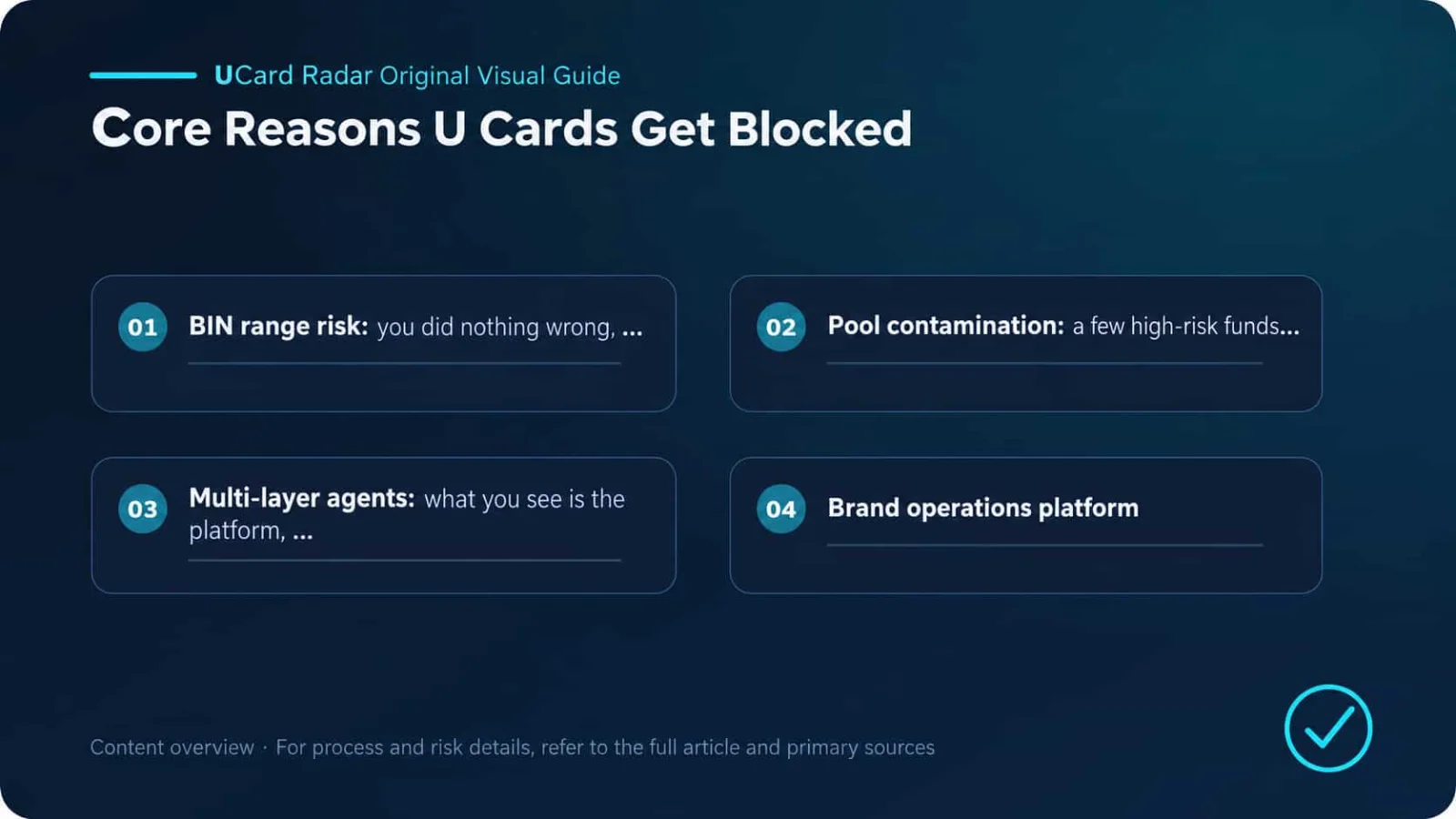
1. BIN-level risk: you may do nothing wrong and still be dragged down by others
The first digits of a payment card are commonly referred to as the BIN, or Bank Identification Number. They can be used to identify the card network, issuing institution, issuing region, and card type.
Many U Card platforms do not hold their own issuing capabilities and cannot build a full issuing relationship directly with a bank. Instead, they usually connect to a third-party CaaS provider—Card as a Service.
A single CaaS provider may supply virtual or physical cards to multiple Web3 platforms at the same time. This creates a common situation:
On the surface, the cards appear to come from different brands. Underneath, however, they may share the same card program, the same BIN range, and even the same risk-control and settlement infrastructure.
If a particular card program sees a concentration of abusive chargebacks, stolen-card transactions, fraud, mass registrations, abnormal cross-border spending, or heavy use at high-risk merchants, the risk rating of the entire program may be raised.
Activities that commonly trigger problems include:
large volumes of abusive chargebacks or false disputes;
stolen-card use, fraud, and abnormal authorization activity;
mass registration and mass card issuance;
high-frequency cross-border transactions;
inability to explain user identity or source of funds;
concentrated spending on advertising accounts or high-risk merchants;
repeated exploitation of card-opening promotions for arbitrage;
use of cards for scams, gambling, or other gray-market activity.
As risk accumulates, the issuer may first restrict certain merchant categories, countries, or transaction types. It may then suspend new card issuance, disable payments in some regions, or, in serious cases, terminate the entire card program.
The users affected are not limited to those who broke the rules.
You may never have used stolen funds or filed a chargeback. You may only use the card for software subscriptions or routine spending. Yet because you share the same underlying channel, you can still face declined transactions, a frozen card, or even an unusable balance.
This is also why some U Card failures appear to happen with almost no transition period.
It may not be your individual card that failed. The entire issuing channel may have been tightened—or cut off completely.
2. Contaminated pooled funds: a small amount of high-risk money can freeze an entire platform
Many users assume that the USDT they deposit will be converted into dollars and held separately in a bank account belonging specifically to them.
That is often not how the system works.
A more common flow is this: the user deposits USDT, the platform converts it or records it internally, and then uses a partner’s prepaid account, safeguarding account, or settlement account to provide spendable card balance.
Funds from many users may ultimately be pooled into one or a small number of shared accounts for settlement.
That is where the problem begins.
Suppose a platform has 10,000 legitimate users, but some suspicious funds enter the system—for example, stablecoins received from scam-linked addresses, stolen assets, proceeds from hacks, or funds associated with sanctioned addresses, mixers, gambling, or fraud.
Even if such funds account for only a small percentage of the total, once they enter a shared funding channel, the entire account may fall within the review scope of a bank or payment institution.
Anti-money-laundering monitoring by financial institutions does not end after the account-opening check. Once an account is active, the direction of funds, transaction frequency, user geography, source of funds, and spending patterns may all be monitored continuously.
If suspicious activity is detected, a partner may require the platform to provide additional information such as:
user identity documents;
proof of source of funds;
on-chain transaction records;
an explanation of the business model;
merchant and user distribution;
transaction purpose and settlement documentation.
If the risk cannot be adequately explained, the platform may face suspended deposits, restricted withdrawals, frozen settlement accounts, delayed clearing, a full re-review of users, or even termination of the partnership.
Ordinary users are rarely warned in advance about this type of review. In some cases, the platform itself may not understand how serious the situation has become until the channel has already been suspended.
What users see is simple: the card suddenly stops working and withdrawals start queueing.
Externally, the platform may describe the issue as “channel maintenance,” a “bank upgrade,” or a “system error.” Those explanations are not necessarily fabricated. But the “maintenance” may actually involve an account review, frozen funds, or an upstream provider preparing to terminate the relationship.
3. Multi-layer intermediaries: the platform you see may be several steps removed from the actual issuer
When users open the App, they see the platform name, logo, card page, and customer-support entry point.
But in the actual issuing chain, that platform may be only the layer closest to the end user.
The structure behind a U Card may look like this:
Card network
↓
Issuing bank or licensed institution
↓
CaaS provider
↓
Program aggregator or channel intermediary
↓
Consumer-facing brand platform
↓
End user
The longer the chain, the less control the consumer-facing platform usually has over the underlying infrastructure.
Some platforms are really responsible only for marketing, the top-up interface, the user dashboard, and customer support. They may not deal directly with the issuing bank and may not even have access to complete risk-control and settlement information.
If an upstream provider shuts down the channel, the downstream platform may have little ability to restore it on its own.
Customer support may be able to do little more than chase the intermediary, which then contacts the CaaS provider, which in turn asks the issuer for confirmation. After information passes through several layers, the user often receives nothing more than a generic template response with no substantive detail.
Multi-layer intermediation creates another problem: every layer needs to make money.
The card-opening fee, top-up fee, conversion fee, and transaction fees paid by the user must be divided among different participants:
the card network collects network and transaction-related fees;
the issuer bears compliance, account, and funding costs;
the CaaS provider charges system and card-issuing service fees;
the aggregator or intermediary takes a channel margin;
the consumer-facing platform still has customer acquisition, support, and operating costs.
When user growth is rapid, the model can appear to work normally. New customers, card-opening fees, and transaction fees can temporarily cover the costs of all participants.
Once growth slows, the weaknesses become visible.
For example, the issuer may suddenly raise reserve or collateral requirements, compliance-review costs may increase, chargeback rates may rise, user transaction volume may fall, or the upstream provider may raise prices with little notice. Any of these can quickly erase the downstream platform’s margin.
If the platform must also cover large-scale refunds, chargeback losses, or the redemption of user balances, cash-flow pressure becomes even more severe.
A relatively well-run platform will stop issuing new cards and accepting top-ups in advance, announce a wind-down schedule, and arrange for remaining balances to be returned.
A platform with weak governance and poor segregation of funds may instead keep delaying, restrict withdrawals first, shut down customer support later, and eventually disappear altogether.
4. What might actually be happening behind “system maintenance”?
When a U Card platform announces “system maintenance,” it does not necessarily mean that engineers are simply upgrading servers.
In the payments industry, “maintenance” can correspond to very different situations:
the issuer has temporarily disabled transaction authorization;
the platform’s prepaid or settlement account has been frozen;
the upstream provider has required a full re-review of all users;
the existing BIN or card program has been terminated;
the platform is urgently migrating to a new issuing channel;
the upstream provider has demanded additional reserves or prefunding;
the platform lacks sufficient cash flow to complete settlement;
the platform has already decided to exit but has not yet announced the plan.
A short maintenance window does not, by itself, mean a platform has a serious problem. Payment systems can genuinely suspend part of their service because of API upgrades, issuer migrations, or risk-control adjustments.
The real warning sign is when maintenance has no clear boundaries and the platform stops providing verifiable information.
For example:
it does not state which functions are affected;
it provides no estimated recovery time;
the recovery date is repeatedly postponed;
customer support only sends the same template response;
payments, withdrawals, and refunds are all suspended at once;
community channels begin deleting user feedback or restricting comments;
key executives stop appearing publicly;
the card no longer works, but the platform continues accepting deposits;
users are asked to pay more money to “unfreeze” their balances.
When several of these signals appear together, the main question should no longer be “When will service return?” but “Can I still get my money out?”
5. To judge whether a U Card is reliable, do not look only at the card-opening fee and rewards
When most users choose a U Card, they first compare:
the card-opening fee;
the top-up fee;
whether it supports Apple Pay or Google Wallet;
whether it can pay for ChatGPT;
whether it offers rewards or cashback;
whether it supports users in mainland China.
These details matter, but they tell you only whether the card is convenient to use. They do not tell you whether the platform can operate reliably over the long term.
The factors that truly affect stability are often the questions that marketing pages are least eager to highlight:
Which institution issues the card?
Is the underlying issuing bank disclosed?
Which BIN and card program are being used?
Does the platform depend on a single upstream provider?
Are user funds segregated from the platform’s operating funds?
How does the platform custody and settle user assets?
Which legal entity signs the service agreement with the user?
What licenses or registrations does that entity hold?
If the channel is interrupted, who is responsible for returning the balance?
Can users export complete transaction and refund records?
Has the platform previously handled a large-scale refund event or card-program migration?
A platform can have a polished interface, a large community, and extensive marketing coverage and still be little more than a branding layer placed on top of a third-party channel.
What determines the lifespan of the card is not how refined the front end looks, but whether the platform can control its issuing relationships, settlement accounts, and compliance risk.
6. How can ordinary users reduce potential losses?
It is difficult for an ordinary user to investigate every relationship behind a U Card.
Many platforms do not disclose the full issuing chain. Even when they do, partner institutions can change at any time. Using a particular issuer today does not guarantee that the same setup will still exist several months later.
The most practical approach, therefore, is not to search for a card that will “never have problems,” but to limit the amount of money you expose to any single platform.
1. Top up only when needed; do not leave funds on the platform for long periods
If you plan to spend a certain amount, deposit roughly the amount you expect to use.
Do not leave a balance far beyond your near-term spending needs merely to save a few top-up fees. Paying a little more in fees is usually easier to control than the risk of a platform freeze, channel interruption, or disappearance.
2. Do not treat a U Card as a savings account
A U Card is first and foremost a payment tool, not a bank deposit.
A dollar balance shown on the platform does not mean you own a separate dollar-denominated bank account. Nor does it necessarily mean the funds are covered by deposit insurance or a client-money protection regime.
As long as your funds remain inside the platform’s system, you are exposed not only to exchange-rate risk, but also to platform risk, upstream-provider risk, and settlement-account risk.
3. Test before making a large purchase
Before buying an expensive item, booking a hotel or flight, or starting a long-term subscription, consider making a small transaction first to confirm that the card is currently authorizing normally.
A successful small transaction, however, only proves that the card worked at that moment, for that merchant category, and for that transaction amount. It does not guarantee that a later large transaction will be approved.
4. Do not rely on only one card
It is better to keep at least two payment options through different channels.
But two different brands do not necessarily mean two independent infrastructures. They may use the same CaaS provider, the same issuer, or even the same BIN.
A meaningful backup should, as far as possible, come from a different issuing program, a different funding structure, or an entirely different type of payment instrument.
5. Save transaction records regularly
Top-up records, on-chain transaction hashes, order numbers, card statements, platform notices, and customer-support conversations should all be saved regularly.
Do not wait until the platform’s website becomes inaccessible to discover that every transaction record can only be viewed inside the App.
If a dispute occurs, these records may become important evidence for filing a claim, tracing funds, or proving the account balance.
6. If the platform shows signs of trouble, stop depositing more money
If card payments, withdrawals, and customer support begin failing at the same time, stop adding funds immediately.
Be especially cautious if the platform asks users to make additional payments to “unfreeze the account,” “add collateral,” “pay taxes,” “complete advanced verification,” or “upgrade membership.”
Legitimate identity verification may require additional documents, but it should not require repeated transfers of money as a condition for restoring withdrawals.
About UCard Radar — our goal is to help users identify risks earlier and reduce losses.
When a U Card suddenly stops working, it may look like a simple payment failure. In reality, an entire supply chain may have lost stability at the same time.
High-risk users in the same card program can affect legitimate users. Suspicious assets entering a shared funding account can trigger anti-money-laundering reviews. A business structure built on layers of intermediaries can leave the consumer-facing platform with little control and insufficient profit or liquidity to manage a crisis.
That is why the most important principle when using a U Card is not to believe that any platform is “absolutely safe,” but to accept one reality in advance: any payment channel can be interrupted.
Effective risk management is often simple:
Top up only when needed, keep balances low, do not treat a U Card as a savings account, and do not place all of your payment needs on a single channel.
This is not a pessimistic judgment about any particular platform. It is a practical form of self-protection for ordinary users in a market where information is opaque, supply chains are complex, and compliance rules continue to change.
Why can a U Card suddenly die? The real risk is buried deep in the card-issuing chain
Yesterday, the card worked normally. The next day, every transaction suddenly started failing.
Customer support replies with a single line: “System maintenance.” No explanation, no recovery time. Then withdrawals become slower, the official community starts restricting comments, and eventually both the website and the App become inaccessible.
When this happens, many people immediately assume the platform has disappeared with the money.
Sometimes that conclusion is correct. But it is not always the full story.
A U Card can suddenly stop working because of problems involving the card network, issuer, CaaS provider, settlement account, anti-money-laundering reviews, or layers of outsourced intermediaries. The user sees only a brand, a card, and a top-up page. What actually keeps the product running is a long—and potentially fragile—supply chain.
If any one link in that chain fails, the result for the user often looks the same: the card stops working and the balance becomes inaccessible.