
Crypto Payment Cards Across Mainland China, Hong Kong, Macau, and Taiwan: The Wide Gap Between Policy Barriers and Real-World Availability
The shift from merely “holding” cryptocurrency to actually “spending” it has been one of the clearest developments in the industry over the past several years. Everyday use cases for stablecoins are becoming more defined, while the number of crypto-linked debit cards running on the Visa and Mastercard networks continues to grow. Yet when the focus returns to Greater China, the same card can face completely different outcomes depending on the jurisdiction.
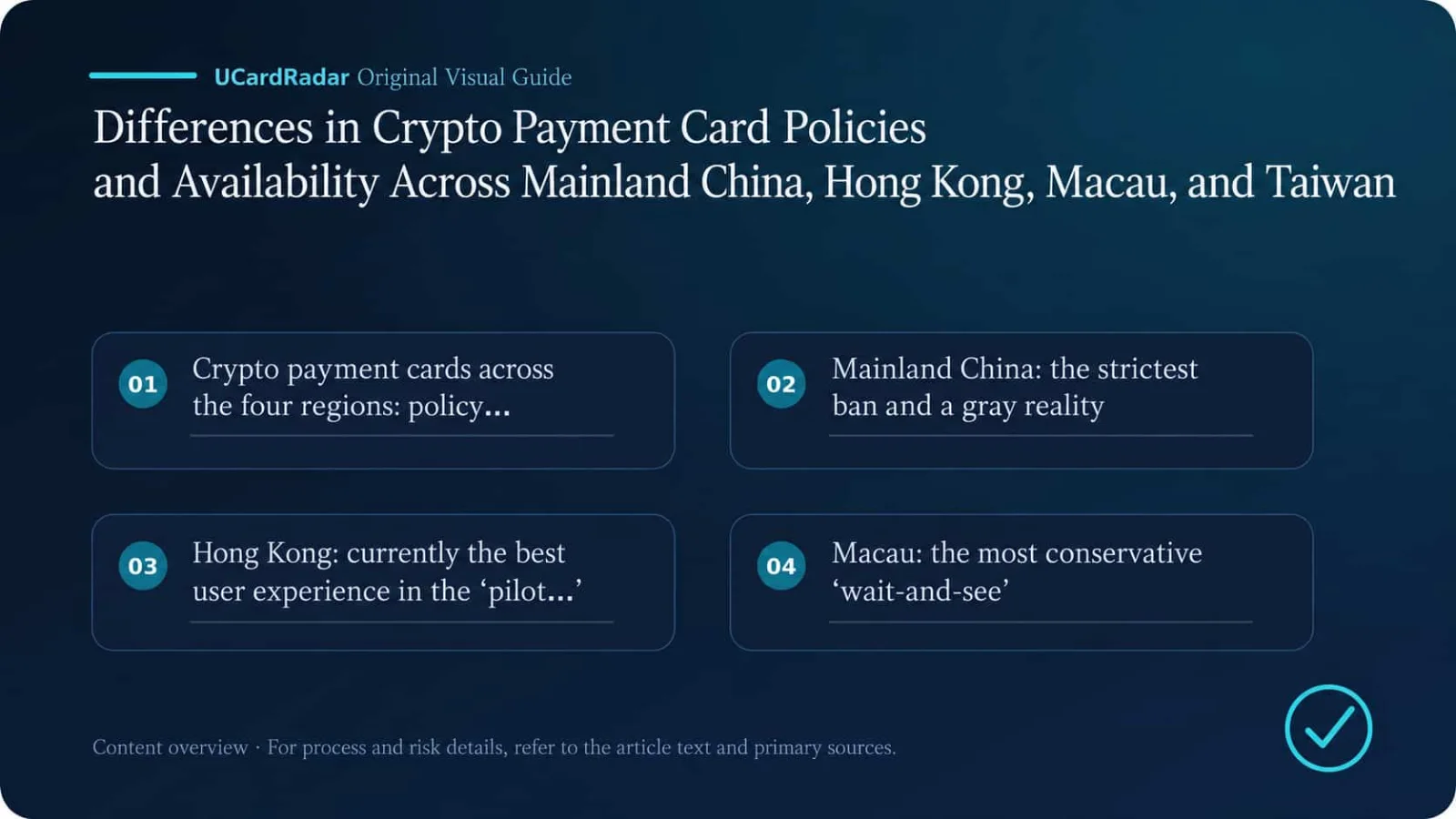
Mainland China maintains strict prohibitions, Hong Kong has developed a relatively mature ecosystem, Macau remains cautious, and Taiwan completed a major transition from a registration-based regime to a licensing regime through new legislation at the end of June 2026. These differences in regulatory stance directly determine whether ordinary users can turn USDT or BTC into a cup of coffee or a supermarket bill.
Sources and Limits of the Conclusions
Primary-source verification: Notice on Further Preventing and Handling the Risks of Speculation in Virtual Currency Transactions; Implementation of the new licensing regime for virtual asset trading platform operators; AMCM reiterates virtual currencies are not legal tenders.
The availability comparisons below are based on public regulatory statements concerning virtual-asset services, payment services, and legal-tender status. Whether a particular card can actually be applied for or used for spending must still be confirmed by the specific issuer based on the user's location, KYC status, card BIN, and merchant rules.
The cross-regional conclusions in this article concerning “availability” are analytical and should not be interpreted as approval or endorsement by any regulator of a specific crypto card product.
Mainland China: The Strictest Prohibition and a Gray-Market Reality
Mainland China's stance toward virtual currencies has remained consistent and has continued to tighten. A multi-agency announcement in 2021 classified virtual-currency-related activities as illegal financial activities, and restrictions have continued to intensify since then. In 2026, regulators further clarified a position of “strict prohibition domestically and strict supervision overseas” toward stablecoins and real-world asset (RWA) tokenization. Banks and payment institutions are not permitted to provide services related to virtual-currency exchange, trading, or payments.
Under these conditions, locally issued crypto payment cards effectively do not exist. It is almost impossible to obtain a Visa or Mastercard debit card directly linked to crypto assets from a mainland Chinese bank or licensed payment institution.
In practice, some users try to obtain cards through overseas platforms such as RedotPay, Bybit Card, or PokePay, but the process involves substantial obstacles:
KYC often requires proof of residence outside mainland China, an overseas address, or a passport; relying only on a mainland Chinese identity card generally has a very low success rate;
Even if a card is successfully issued, platforms may restrict or close accounts linked to mainland China because of risk controls;
Legal risks are real—there have been cases involving frozen accounts and illegal-business allegations where users directly exchanged RMB for USDT through OTC channels before spending it.
In practical terms, mainland users seeking to use crypto payment cards are largely limited to a “high-risk gray route,” with very low compliance certainty and sustainability. The regulatory logic is straightforward: virtual currencies are not to be given a channel into the traditional payment system.
Hong Kong: Currently the Best “Testing Ground” for User Experience
Hong Kong has the most mature crypto payment card ecosystem among the four regions. The SFC's VASP licensing regime has been operating since 2023, and licensed exchanges such as HashKey and OSL can legally serve retail customers. Following the implementation of the Stablecoins Ordinance in August 2025, the HKMA began issuing licences for fiat-referenced stablecoins. In 2026, the first group of institutions received approval, including Anchorpoint, which is associated with Standard Chartered and Animoca.
This combination of “licensing + stablecoins” provides a relatively solid foundation for crypto payment cards.
Hong Kong users currently have access to a number of crypto debit card options, with RedotPay being among the most representative:
A Hong Kong-based company with KYC that is relatively friendly to Hong Kong identity-card holders;
Supports deposits in USDT, USDC, BTC, ETH, SOL, and other assets;
Uses the Visa network and offers both physical and virtual cards, with broad support for Apple Pay and Google Pay;
Can be used normally at many Hong Kong merchants, including supermarkets, food-delivery services, convenience stores, and HKTVmall.
Other options include ether.fi Cash Card, Tria Card, Kast Card, Bitget Wallet Card, Crypto.com Visa Card, and others. Conversion fees for many of these cards generally fall within the 1%-2.5% range, depending on the asset and whether the card is denominated in USD.
Practical limitations still exist: most of these cards cannot directly top up Octopus and cannot directly transfer funds into FPS or PayMe without first withdrawing funds to a local bank account. Even so, they already cover a substantial portion of everyday spending scenarios.
Hong Kong positions itself as a “Web3 hub,” with a policy approach that combines “strict regulation + active innovation,” giving the industry a relatively predictable operating environment.
Macau: The Most Conservative “Wait-and-See” Approach
Macau's regulatory stance contrasts sharply with Hong Kong's. As early as 2017, the Monetary Authority of Macao (AMCM) explicitly prohibited banks and payment institutions from participating in or providing financial services related to virtual currencies. In 2026, Macau further strengthened anti-money-laundering supervision, tightened rules around virtual assets, proposed introducing a licensing regime for virtual-asset operators, and advanced measures including a central beneficial ownership registry.
Under these conditions, there are almost no mainstream locally available crypto payment card products in Macau. It is difficult to find a Visa or Mastercard crypto debit card that offers the same combination of direct KYC access and stable usability as in Hong Kong.
Macau residents who want to use crypto payments generally have to rely on cross-border channels, such as cards opened in Hong Kong. However, these users also face strict monitoring of fund flows, particularly where transactions are connected to the gaming industry, where AML reviews can be especially detailed.
It is also worth noting that Macau is advancing sandbox trials for the “digital pataca” (e-Pataca), which may eventually be used in government services, transport, campuses, and other settings. This resembles a CBDC-oriented initiative rather than an opening of private crypto payments.
Overall, Macau remains the most difficult of the four regions in which to use crypto payment cards.
Taiwan: Catching Up Under a New Regulatory Framework
On June 30, 2026, Taiwan passed the Virtual Asset Service Act on its third reading. This was the island's first dedicated cryptocurrency law and marked a shift from the previous anti-money-laundering registration regime toward a comprehensive licensing framework.
Key elements of the new law include:
Virtual asset service providers (VASPs) must apply for licences from the Financial Supervisory Commission, covering seven categories of business including exchanges, custody, transfers, and lending;
Stablecoin issuance is initially limited to banks, requiring approval from both the Financial Supervisory Commission and the central bank, along with 100% reserves and segregated trust arrangements;
Illegal operations may carry prison sentences of up to seven years, while more serious conduct such as market manipulation can carry penalties of up to ten years.
For ordinary users, this means crypto payments are likely to become more standardized over time, although platforms remain in a transition period in the short term, with existing AML-registered platforms receiving a 12-21 month transition window.
At the card level, Taiwan currently relies mainly on international crypto payment cards such as Crypto.com, Bitget, and KAST, while local exchanges have yet to launch mainstream proprietary cards. According to 2026 data, around 40 crypto card products are available in the Taiwanese market, providing reasonable coverage. Usage scenarios are similar to Hong Kong: Visa and Mastercard merchants generally accept the cards, but users need to pay attention to tax reporting obligations, as certain categories of other income may become taxable above specified thresholds.
Taiwan's path can be described as “establish the framework first, then open gradually.” It shares similarities with Hong Kong but started later and is still catching up in terms of ecosystem maturity.
Comparison Across the Four Regions
Region | Core Regulatory Logic | Crypto Payment Card Availability | Resident Account Opening / KYC Difficulty | Typical Costs and Restrictions | Future Trend |
|---|---|---|---|---|---|
Mainland China | Comprehensive prohibition | Extremely low (gray-market, high risk) | Extremely high | High legal and account-security risks | Continued tightening |
Hong Kong | Licensing regulation + innovation pilots | High (multiple Visa cards) | Low (HKID-friendly) | Conversion fees around 1%-2.5%; convenient Apple Pay support | Deeper stablecoin ecosystem |
Macau | Institutional exclusion + strict AML | Low | Medium-high | Very few options; strong dependence on cross-border access | Digital pataca (CBDC) direction |
Taiwan | New licensing regime + bank-issued stablecoins | Medium-high (mainly international cards) | Medium | Depends on platform; tax compliance requires attention | More standardized development after new rules take effect |
Practical Advice for Users
For convenient everyday use: Hong Kong is currently the strongest option. Locally friendly products such as RedotPay can cover most day-to-day spending scenarios.
In Taiwan: International cards remain reasonably usable, but users should watch for platform adjustments as the new regulatory framework is implemented during 2026-2027.
In mainland China and Macau: Compliant access channels are extremely limited. Any attempt requires careful assessment of legal and fund-security risks and is not recommended as a routine payment method.
General reminder: Even if a card can be issued, users should monitor platform fees, exchange-rate losses, changes in KYC policy, and local tax-reporting obligations. A crypto payment card is fundamentally an instant conversion tool from “crypto assets → fiat currency,” not a cost-free solution.
The differences across mainland China, Hong Kong, Macau, and Taiwan ultimately reflect different financial strategies and risk preferences. Hong Kong has chosen to embrace innovation under strict supervision, Taiwan is rapidly filling gaps in its regulatory framework, mainland China continues to prioritize a strict risk-control baseline, while Macau is seeking a balance between its gaming sector and financial stability.
For ordinary users, the most important rule remains the same: understand the rules where you live before deciding what to do. Policies change and technology changes, but compliance awareness and risk awareness are always necessary.