
Many people judge a U card platform by whether it can bind to WeChat, pay for ChatGPT, or whether the card shows a Visa or Mastercard logo. One successful payment only proves that the card worked at that moment. It does not answer who holds the money, why an account may be frozen, or how a balance would be returned if the platform shuts down.
A U card is rarely provided by a single entity acting alone. What the user sees is an app, but behind it there may be a crypto custodian, a payment institution, a card issuer, and a card network. If any link in that chain is unclear, problems can end in the platform telling you to contact the issuer, while the issuer tells you to go back to the platform.
So when reviewing a U card platform, it is best to follow two lines of inquiry. One is the responsibility line: who operates it, who issues the card, and who handles disputes. The other is the money line: where your USDT goes, when it is converted into fiat, and who holds the balance. Then use a small amount of money to test deposit, spending, and withdrawal once yourself.
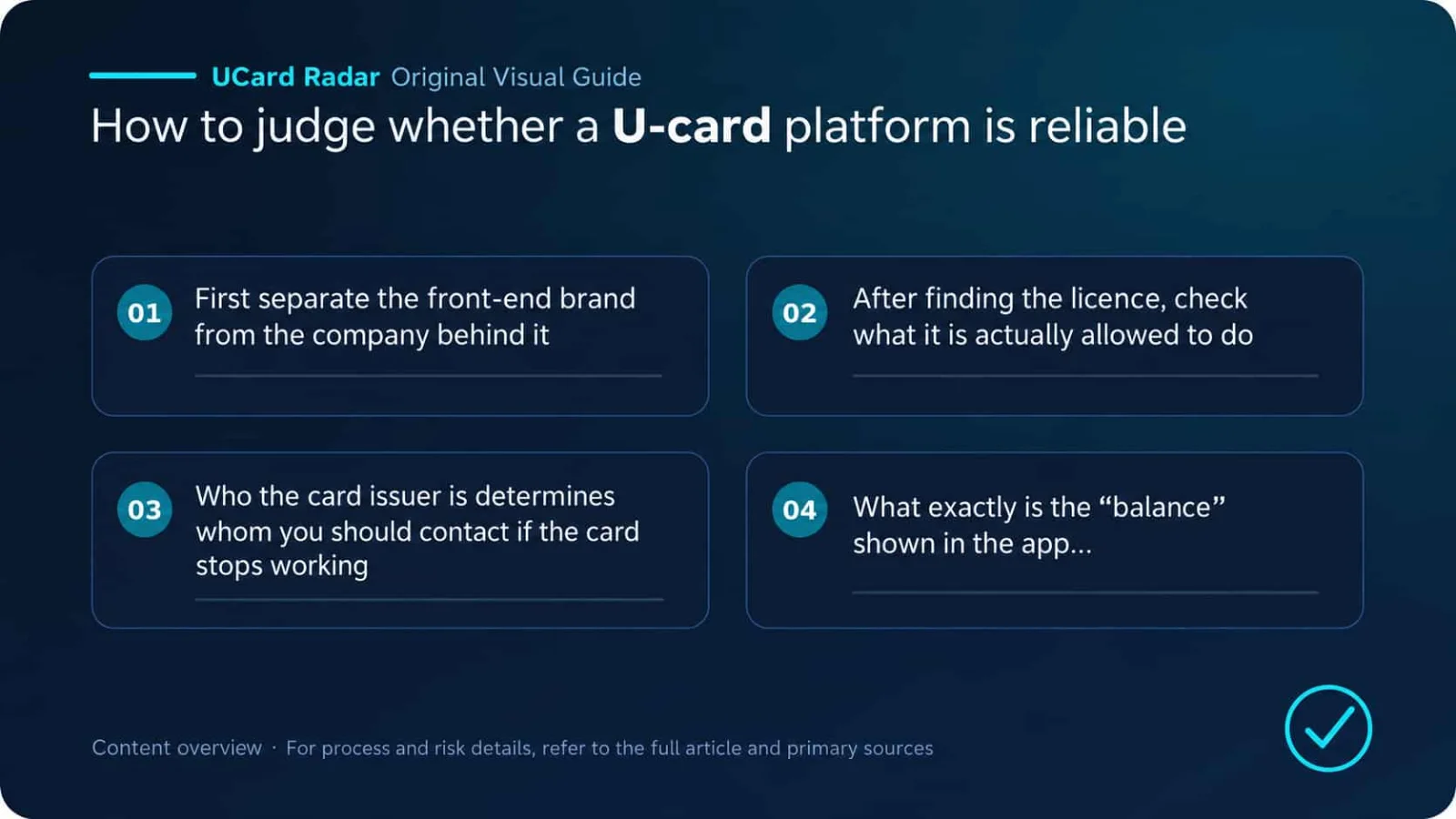
Original infographic: key points and decision flow for judging whether a U card platform is reliable
Scope of Sources and Conclusions
Primary verification sources: Updated Guidance for a Risk-Based Approach to Virtual Assets and VASPs; Financial Services Register; List of Virtual Asset Trading Platforms.
Verifiable facts in this article about U card platform entities, licensing scope, fund custody, and risk signals are based on the listed official or regulatory documents. Actual service status, fees, eligibility, and geographic coverage should be confirmed from the issuer or platform page at the time of application.
Regulatory registration only proves the listed entity and permissions in the register. It does not replace verification of the actual issuer, custodian, or cardholder agreement. Any user experience, success-rate claims, fee comparisons, or trend judgments not directly disclosed in the above primary sources are analysis or inference and have not been officially confirmed by the relevant institutions for individual cases.
1. Separate the Front-End Brand From the Company Behind It
A common structure looks like this: the user signs up in Brand A’s app, the terms of service are signed by Company B, the USDT is held by Company C, and the card is issued by Institution D. They may belong to one group, or they may simply be partners.
Before registering, identify the following names.
:---: | :---: | :---: |
|---|---|---|
Role | What to check | Common risk |
Front-end platform or brand | Full legal company name, place of registration, office address, website domain | Only a brand name is shown, with no trace of the actual company |
Crypto-asset service provider | Who receives and custodies USDT/USDC, and who handles conversion | After the user deposits coins, it is unclear who controls the assets |
Payment institution or e-money institution | Who manages the fiat balance, and how customer funds are segregated | The platform packages an ordinary corporate account as a “custody account” |
Actual issuing institution | Name of the bank or licensed institution, applicable regions, and card network | Only Visa or Mastercard logos are shown, while the issuer is not disclosed |
Visa and Mastercard mainly provide the payment network here. Their logos on the card do not mean that they hold user assets, nor do they mean that they stand behind the platform’s credit risk.
The actual issuer matters especially. Card suspension, fraud disputes, chargebacks, and refunds ultimately have to be handled by a specific institution. If the platform does not even disclose the issuer’s name, any later attempt to protect your rights will mostly depend on customer service.
2. After Finding a License, Check What It Actually Allows
Start by finding the legal name of the operating company in the terms of service, privacy policy, or website footer. A brand name, translated name, or community nickname is not enough. More standardized platforms also disclose the company registration number, regulator, and license number.
Once you have that information, verify it in the official regulator database. Certificate images uploaded by the platform can be forged, and they may already be expired. When checking, focus on five things:
Whether the company name in the regulatory register matches the terms of service;
Whether the license status is still active;
Whether the permitted activities cover payments, e-money, crypto conversion, or custody;
Whether the official registered domain, email, phone number, and address match the platform;
Whether the license belongs to the platform itself or to another company it cooperates with.
The UK FCA’s Firm Checker can be used to verify whether a company is authorized and whether that authorization covers the services it is selling. Matching company name and registration number is not enough; the domain, email, and phone number should also be checked. The FCA has warned that clone firms may directly copy the name, address, and even regulatory number of a real institution, while changing only the website or contact details. FCA Firm Checker · FCA guidance on clone firms
Common official lookup channels include:
:---: | :---: | :---: |
|---|---|---|
Region | Official lookup channel | What to focus on |
United Kingdom | FCA Firm Checker | Authorization status, permission scope, official contact details |
European Union | EBA Central Register of payment and e-money institutions | Registration status of PIs/EMIs and their home country |
Singapore | MAS Financial Institutions Directory | Institution category and the specific services it is authorized to provide |
Hong Kong, China | HKMA register of licensed stored value facility issuers | Whether it holds an SVF license and the name of the licensed entity |
United States | FinCEN MSB Registrant Search and state-level regulator databases | MSB registration and state money transmitter/remittance licenses |
For the EU, check the EBA central register. For Singapore, check the MAS Financial Institutions Directory. In Hong Kong, there is the HKMA’s list of licensed SVF issuers.
US MSB registration is often overstated in marketing. FinCEN has made it very clear: appearing on the MSB registration site does not mean government approval, and it is not a legality certification or endorsement. It only shows that the business submitted relevant anti-money-laundering information. It is not a banking license and cannot by itself prove fund safety. FinCEN MSB Registration
3. Who the Issuer Is Determines Who You Must Contact if the Card Stops Working
Many U cards use a co-branded or joint issuance model. The front-end platform handles the app and customer support, the licensed institution handles the account or the card, and transaction authorization may be handled by yet another processor.
If the terms do not make this clear, send the following six questions directly to customer support:
Who is the actual issuing institution of the card?
Which company signs the cardholder agreement with the user?
Is the card a debit, prepaid, or credit card?
Which countries and regions are supported for applications?
If the card is suspended, who returns the remaining balance?
In the event of fraud, who handles disputes and chargeback requests?
A proper answer should include specific company names and corresponding clauses in the cardholder agreement. If customer support keeps repeating phrases such as “international banking partner,” “top-tier card issuance channel,” or “official Visa partner,” but will not provide the entity name or agreement link, further follow-up usually yields little useful information.
4. What Exactly Is the “Balance” in the App?
If the app shows a balance of 1,000 USD, that does not mean it is definitely a bank deposit. It may be USDT held by the platform, converted e-money, or simply an accounting balance available for card spending. The interface may look similar, but the legal nature and the way problems are handled can be very different.
:---: | :---: | :---: |
|---|---|---|
Balance type | Questions to confirm | Main risks |
Platform-custodied USDT/USDC | Who controls the wallet, whether it can be verified on-chain, and how assets are handled in insolvency | Custody, private-key, freezing, stablecoin, and platform insolvency risks |
E-money or payment-account balance | Whether it is managed by a licensed PI/EMI and whether customer fund segregation is used | Segregation execution, liquidation delays, and institutional insolvency risks |
Bank deposit | Whether the account is genuinely held at an insured deposit institution and whether the user meets protection requirements | Account structure, pass-through bookkeeping, and deposit-insurance eligibility conditions |
Non-custodial wallet with instant settlement | Contract permissions, authorization scope, and exchange/settlement mechanics | Smart-contract, authorization, and settlement-failure risks |
Customer fund segregation and deposit insurance are two different arrangements. The UK FCA requires payment institutions and e-money institutions to apply safeguarding measures to relevant customer funds, but that does not mean the user is holding a bank deposit covered by deposit insurance. FCA safeguarding requirements
The US FDIC also clearly states that crypto assets issued by non-bank crypto companies are not covered by FDIC deposit insurance. Only deposits that actually sit in insured banks and meet the relevant conditions may qualify for protection. FDIC guidance on crypto companies and deposit insurance
When you see claims such as “100% fund protection,” “bank-grade custody,” or “full balance insurance,” ask four follow-up questions: who provides the protection, whether it covers fiat or crypto assets, whether platform insolvency is covered, and whether the user can make a direct claim. If the platform cannot explain these points, the word “insurance” on the page has little practical value.
5. Use a Small Amount to Complete One Full Cycle
Fast top-up is the part most platforms are happiest to showcase. Withdrawals, refunds, and account closure reveal more about whether the back end is really functioning normally.
For a first use, keep the amount within a range you can afford to lose, and then complete the following test cycle:
Deposit a small amount from your own wallet that you can afford to lose;
Observe the arrival time and the actual network, top-up, and conversion fees deducted;
Complete one real small-value purchase;
Try withdrawing the remaining assets;
If possible, test a reversal or refund;
Contact customer support once and see whether you get answers that address the actual problem.
If “security deposit,” “unfreeze fee,” or “account verification fee” suddenly appears during withdrawal, stop paying immediately. A publicly disclosed withdrawal fee is one thing; a customer-service agent privately asking you to keep sending money to an unfamiliar wallet after your funds are frozen is something else entirely. Anti-money-laundering review may require supporting documents about fund source, but it should never require repeated top-ups as a form of verification.
6. Do Not Compare Only the Card-Issuance Fee
Some cards cost only a few dollars to open but are expensive to use in practice. Fees are often split across multiple steps:
Card issuance fee and monthly fee;
Crypto top-up or conversion fee;
Fiat exchange-rate markup;
Foreign transaction fee;
ATM withdrawal fee;
Top-up, refund, or failed-transaction processing fee;
Dormancy fee, account closure fee, and replacement-card fee;
Balance occupation caused by merchant pre-authorizations.
You can calculate the total cost using a real scenario: top up 500 USDT, convert it to USD, spend 100 USD, and then withdraw the remaining assets back to your wallet. Calculate each step using the published fee schedule, and then look at the actual loss. If you cannot find a complete fee table, if fee figures conflict across different pages, or if customer support only says “the overall fee rate is very low,” that indicates poor fee transparency.
7. Be Extra Cautious When “No KYC” Is Used as a Selling Point
Payment and crypto-asset services usually need to verify customer identity, source of funds, and transaction risk. Asking for ID documents, liveness checks, or proof of address does not by itself prove that a platform is reliable; you still need to see how it stores that information.
But if you see “anonymous card issuance,” “large top-ups,” “no review required,” “bulk accounts supported,” and “can receive funds on behalf of others” at the same time, the risk is already obvious. Such a business model is unlikely to satisfy banks and issuers’ compliance requirements for long. Once partner channels tighten, the impact often falls not only on new users but also on existing accounts, which may be frozen.
At minimum, the account should include these security features:
Two-factor authentication for login;
Withdrawal address whitelist and a cooling-off period for newly added addresses;
One-click freeze and unfreeze for the card;
Per-transaction and daily limits;
New-device login alerts;
Transaction notifications;
Viewable and revocable logged-in devices;
A dedicated anti-phishing code or clear official-domain guidance.
If a platform collects passports, ID cards, and facial data but does not disclose the data controller, retention period, or deletion method, the identity data itself becomes a risk. Even if the card works, it is not worth handing over your full identity documents to such a company for the long term.
8. When Reading Reviews, Look for Concrete Events, Not Emotions
A wall of positive reviews may simply mean the platform has just launched, or it may be the result of affiliate promotion. A lot of negative reviews also need to be separated into genuine failures, user misconduct, and pure emotion.
Compared with “works great” or “never use this,” the following details are much more useful:
How long withdrawals take;
Whether refunds return to the balance;
Whether users can submit documents for a second review after an account freeze;
Whether customer support provides ticket numbers and handling time frames;
Whether the platform announces changes of issuer or service suspension in advance;
Whether users can recover remaining assets after closing the account.
“Can bind to WeChat,” “successfully paid for ChatGPT,” and “cashback arrived” only record one transaction. They do not prove that the platform can operate sustainably, nor do they imply safety for holding large balances.
9. If You See These Signals, Stop Topping Up
If one signal appears, continue checking. If several appear at the same time, there is no need to continue topping up:
The legal name of the operating company cannot be found;
The license number belongs to another company, and there is no contract explaining the relationship;
The platform shows only MSB registration, a company registration certificate, or card-network logos while avoiding the permission scope;
The issuing institution and cardholder agreement are not disclosed;
It promises fixed high returns or abnormally high cashback for a long time without explaining the source of funds;
It encourages buying pre-made accounts, using fake addresses, or bypassing KYC;
It asks you to transfer money to a personal wallet temporarily provided by customer support;
During withdrawal, it repeatedly asks for extra deposits, taxes, or unfreeze fees;
It frequently changes domains, app download links, and receiving wallets;
It disables comments, deletes questions about withdrawals, or only allows problems to be handled in private chat;
After service suspension, there is no formal announcement, ticketing system, or balance-exit plan.
10. Quick Scoring Table for U Card Platforms
The following score is only for preliminary screening. It measures whether information is complete and whether exit is smooth. It is not a guarantee of future platform safety. Regulatory changes, card-issuance interruptions, liquidity problems, and cyberattacks can all cause even a high-scoring platform to stop working suddenly.
:---: | :---: | :---: |
|---|---|---|
Item | Score | Full-score condition |
Entity and licenses | 25 | Legal entity is clear, license can be verified in official databases, and permission scope matches |
Issuance chain | 15 | Issuing institution, card type, cardholder agreement, and dispute-handling party are clearly identified |
Fund arrangement | 20 | Custody method and protection boundaries for crypto assets, fiat, and card balance are clearly stated |
Withdrawals and refunds | 15 | Rules are public, small-value testing works normally, and no ad hoc extra payment is demanded |
Fee transparency | 10 | A complete fee table is available and actual deductions match what is shown |
Account security | 10 | Has 2FA, device management, withdrawal protection, card freeze, and transaction alerts |
Customer service and notices | 5 | Has formal support tickets, handling deadlines, and traceable service notices |
You can interpret the total score like this:
:---: | :---: | :---: |
|---|---|---|
Score | Initial judgment | Recommendation |
85–100 | Information is relatively complete | Still start with a small test and do not hold large balances long term |
70–84 | Basically verifiable, but with gaps | Control your balance and decide on long-term use only after confirming the missing information |
55–69 | Higher risk | Suitable only for further investigation; not recommended for direct top-up |
Below 55 | Severe lack of key information | Change platform |
In the end, checking a U card platform comes down to two questions: where is the money, and who do you turn to when something goes wrong?
Only when the company entity, license scope, cardholder agreement, fund custody, and exit rules can all be checked is it worth testing with a small amount of money. If any one of these is missing, control your balance. If the platform cannot even clearly explain the operator and the issuer, it is best to walk away.
There is also one easily overlooked issue: a platform that looks reliable today may not still have the same card channel, regulatory status, or withdrawal conditions six months later. A U card account is better suited to short-term spending turnover than to long-term storage of large amounts of USDT or fiat. Top up only what you need. In practice, that is usually more sensible than chasing high cashback.