
After activating a U Card, many users leave USDT directly on the platform and let spending be deducted from that balance. This is convenient and avoids repeated top-ups. The problem is that the balance shown in the app is not the same as a bank deposit. If the platform suspends withdrawals, its card partnership ends, the account triggers risk controls, or the company enters liquidation, whether the money can be recovered depends on where it was actually held at that time.
A more suitable approach is this: keep only the balance needed for near-term spending on a U Card. Do not use it as a long-term place to store large funds, emergency funds, or all of your virtual assets.
The platform may not necessarily run into problems. However, once users transfer assets in, they usually take on multiple layers of risk at the same time, including platform risk, custodian risk, stablecoin risk, issuer risk, and compliance review risk. A card continuing to work only shows that the current payment chain is still operating. It does not prove that the platform’s assets and liabilities, customer fund safeguarding, or insolvency arrangements are all sound.
Scope and Limits of the Evidence and Conclusions
Primary sources reviewed: Legal; Safeguarding requirements for authorised payment institutions and electronic money institutions; Fact Sheet: What the Public Needs to Know About FDIC Deposit Insurance and Crypto Companies.
The verifiable facts in this article regarding U Card balance custody, stablecoins, freezes, and customer fund protection risks are based on the official or regulatory documents listed above. Actual service status, fees, eligibility, and regional coverage should be determined by the issuer or platform pages available at the time of application.
Different issuers, regions, account tiers, and merchant rules may lead to different outcomes. User experiences, success rates, fee comparisons, or trend judgments that are not directly disclosed in the primary sources above are analysis or inference and have not been officially confirmed by the relevant institutions for any specific case.
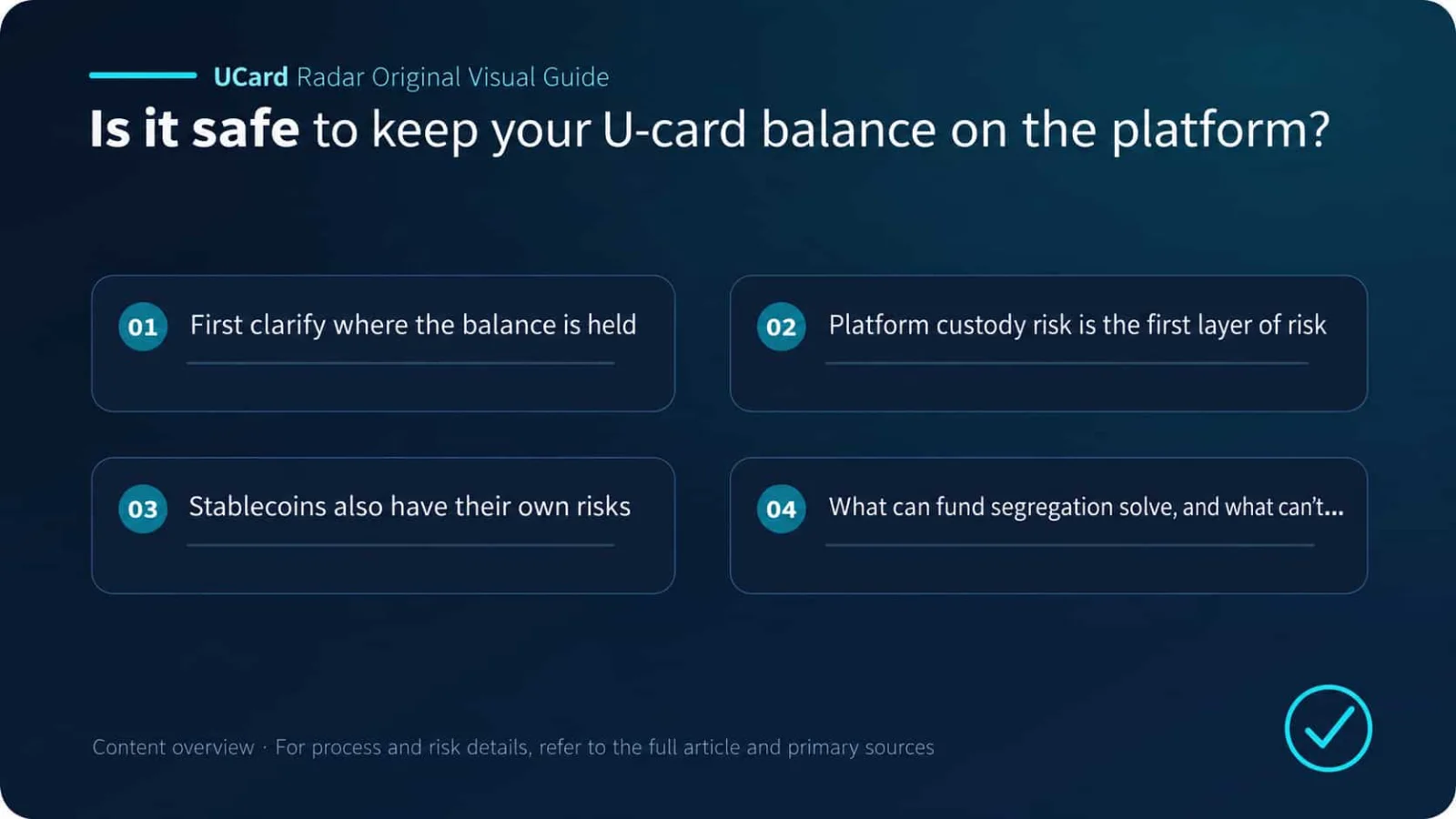
First Clarify Where the Balance Is Held
Even if the screen shows the same “100 USDT” or “100 USD,” the underlying legal relationship may be completely different. Before judging safety, first determine which structure the product uses.
U Card model | Where the balance is typically held | Main risks |
|---|---|---|
Pre-funded custodial model | A wallet controlled by the platform or a partner custodian | Platform insolvency, asset misuse, hacking, or suspended withdrawals |
Auto-conversion model | The user first deposits virtual assets on the platform, which are converted into fiat when spending occurs | Custody risk, stablecoin risk, conversion loss, and liquidity risk |
Fiat prepaid model | An e-money account or prepaid card balance | Insolvency of the issuer or electronic money institution, and follow-up liquidation risk |
Self-custody or smart-contract model | Assets remain in the user’s wallet and are authorized or transferred at the time of payment | Smart-contract bugs, malicious approvals, oracle risk, and settlement failure risk |
Linked bank account model | A bank deposit account in the user’s own name | Bank risk, account-freeze risk, and regional compliance risk; overall it is closer to an ordinary bank card |
The first two are the most common and also the easiest for users to mistake as meaning the assets still “belong to them on-chain.” If the platform controls the private keys, what the user usually has is only a claim to request withdrawal from the platform. The balance shown on the page does not mean the user can bypass the platform and directly retrieve on-chain assets.
Self-custody reduces the amount of time the platform directly holds the asset, but it is not risk-free. Users may need to grant spending approval to a smart contract, and spending still has to go through quoting, conversion, card-account funding, and fiat settlement. Contract bugs, malicious approvals, or a failed settlement service can all affect usability.
Platform Custody Risk Is the First Layer of Risk
After USDT is loaded onto a custodial U Card, the platform controls the wallet and the withdrawal rights. As long as withdrawals work normally, users may barely notice the difference. When an incident occurs, the difference becomes obvious.
A platform may restrict withdrawals because of operating losses, insufficient liquidity, recourse claims from partners, or regulatory investigations. If customer assets are not strictly segregated, a gap may also arise between the platform’s recorded balance and the assets actually available. Users usually cannot see these changes in real time.
In the UK Financial Conduct Authority’s consumer guidance on cryptoassets, company failure, poor safeguarding of customer funds, and cyberattacks are all listed as cryptoasset risks. The FCA also reminds consumers that most direct cryptoasset activities are generally not protected by the UK Financial Services Compensation Scheme (FSCS). See FCA: Investing in crypto.
A large platform with a long operating history may reduce some uncertainty, but it cannot replace asset segregation and a clear legal structure. Even large platforms may suddenly adjust top-up, withdrawal, and card-issuance services because of partner issues, regulation, or liquidity problems.
The Issuance Chain Is Longer Than It Looks
A U Card usually involves more than a card brand. The full chain may include:
the U Card platform facing the end user;
a virtual-asset custodian or conversion provider;
an electronic money institution or program manager;
the actual issuing bank or card issuer;
card schemes such as Visa or Mastercard;
payment processors and merchant acquirers.
If any one of these parties stops cooperating, top-ups may be closed, cards may be suspended, balances may need to be migrated, or refunds may be delayed. A card-scheme logo mainly shows which payment network processes the transaction. It does not mean Visa or Mastercard will stand behind the platform balance.
Users should distinguish between “the platform account can still be logged into” and “the card can still be used.” Sometimes the card is already unusable while the platform wallet still allows withdrawals. In other cases, the card still works but top-ups and conversion have already been suspended. Keeping all funds on a platform that depends on multiple counterparties naturally concentrates the risk.
Stablecoins Have Their Own Risks Too
U Card balances are often denominated in USDT or USDC. Stablecoin price fluctuations are usually smaller than those of BTC or ETH, but “pegged to 1 USD” is not an unconditional promise of redemption.
Users still bear risks relating to the stablecoin issuer, reserve assets, custody banks, redemption channels, on-chain contracts, and sanctions-related freezes. If a stablecoin briefly de-pegs, the platform’s conversion quote may worsen. If market liquidity is insufficient, card spending may be declined or may incur higher conversion loss than usual.
The U.S. Federal Deposit Insurance Corporation clearly states that deposit insurance does not protect virtual assets issued by non-bank institutions. Even if a virtual-asset platform works with an insured bank, that does not mean the virtual assets on the platform themselves are protected by the FDIC. See the FDIC crypto fact sheet.
Therefore, when a platform says a stablecoin has reserves, that does not mean “the user balance has deposit insurance.” Reserve assets, customer fund segregation, and deposit insurance are different systems.
What Safeguarding Can and Cannot Solve
Some U Cards place fiat balances under the management of a licensed electronic money institution. Local rules may require the institution to place customer funds in separate accounts and not mix them with the company’s day-to-day operating funds. This arrangement is often called safeguarding.
It is indeed better than having no segregation at all. If the platform fails, safeguarded funds should in principle not be used directly to pay ordinary corporate debts. But it is still not the same as bank deposit insurance.
The UK FCA explains that customer funds held by electronic money institutions and non-bank payment institutions are not directly protected by the FSCS. If the institution fails, a liquidator usually reconciles the accounts and returns the funds. This process may take time, and the final amount may still be affected by any shortfall and by liquidation costs. See FCA: Using payment service providers. The UK’s strengthened safeguarding rules for payment funds took effect on 7 May 2026, requiring more frequent reconciliation of customer funds and improved failure planning. However, the new rules still do not turn e-money into a bank deposit. See the FCA announcement on the new rules.
“Safeguarding” mainly addresses platform insolvency and commingling of assets. It does not normally compensate for stablecoin de-pegging, account theft, erroneous transfers, merchant disputes, compliance freezes, or losses caused by the user disclosing passwords.
An Insured Partner Bank Does Not Mean the Entire Platform Balance Is Insured
Some U Cards advertise that “funds are held with an insured bank.” That statement may be true, but several decisive conditions are still missing:
whether the funds have already been converted from virtual assets into fiat;
whether the fiat has actually entered a bank that participates in a deposit-protection scheme;
whether the bank account is in the user’s own name or a pooled account in the platform’s name;
whether the bank and the platform can accurately identify each end user and that user’s balance;
whether the local jurisdiction allows pass-through deposit protection;
whether the user’s other deposits at the same bank are aggregated with that balance.
The FDIC warns that after a user transfers money to a non-bank app, deposit insurance may apply only when the funds have actually been placed in an FDIC-insured bank and all relevant conditions are met. A non-bank platform failing on its own is not an FDIC insurance event. See FDIC: Banking With Third-Party Apps.
The Hong Kong Deposit Protection Board also makes clear that virtual assets and stored-value payment instruments are outside the scope of the Hong Kong Deposit Protection Scheme. Even if a related product is issued or distributed by a bank, that alone does not mean the card balance is insured. See the scope of protection under the Hong Kong Deposit Protection Scheme.
Account Freezes Are Often More Common Than Platform Failure
For ordinary users, the more realistic problem may not be that the platform suddenly disappears, but that the balance is still there while the account is temporarily unusable.
Common triggers include:
identity documents, residential address, or tax information needing re-review;
a top-up address being linked on-chain to fraud, gambling, sanctions, or high-risk services;
frequent top-ups, card swipes, withdrawals, or purchases of highly liquid goods within a short period;
multiple people transferring funds into the same account, with transaction activity not matching the user’s income;
the use of proxy registration, false addresses, or another person’s identity documents;
frequent changes in login device, region, or billing address;
investigation requests received by the platform from law-enforcement, judicial, or partner institutions.
A freeze does not automatically mean the funds are lost, but the user may have to submit proof of income, coin-purchase records, on-chain hashes, transaction purposes, and merchant orders. If the source of funds cannot be clearly explained, the review may take longer. In serious cases, law-enforcement inquiries may also become involved.
Users in mainland China must also consider domestic virtual-currency policy and the difficulty of cross-border recourse. The Yinfɑ [2026] No. 42 notice issued in February 2026 makes clear that virtual currencies do not have legal tender status, and that if related investment activity violates public order or good morals, the civil legal act may be deemed invalid, with losses borne by the participant. After a dispute arises on an offshore platform, users may also face issues involving governing law, overseas litigation, and enforcement costs. See the notice issued by the People’s Bank of China and seven other departments.
Which Storage Methods Carry Higher Risk
Usage pattern | Approximate risk | Reasoning |
|---|---|---|
Top up only the amount needed for near-term spending, and replenish after it is used | Lower, but not zero | Funds remain on the platform for a shorter period, so the risk exposure is smaller |
Fiat balance managed by a clearly identified licensed EMI, with public safeguarding arrangements | Moderate | There is a safeguarding regime, but it is usually not protected by deposit insurance |
Assets remain in the user’s own wallet and are authorized for settlement only at the time of spending | Moderate | Platform custody risk is lower, but smart-contract, approval, and settlement risks still remain |
Keeping a large amount of USDT in a custodial U Card account for a long time | High | This combines platform risk, custodian risk, stablecoin risk, and account-freeze risk |
The platform offers high yield on balances but does not disclose how the funds are used | Very high | It may involve lending, investment, or maturity mismatch |
The platform does not disclose the actual issuer, licensed entity, or withdrawal rules | Very high | You cannot confirm asset ownership, where the money goes, or who is responsible if something goes wrong |
Using fake KYC or buying pre-made accounts to store funds | Very high | The account may be frozen at any time, and the actual user may also find it difficult to prove ownership of the account and funds |
Risk levels are only general judgments. The result can change depending on the platform’s jurisdiction, asset type, contractual structure, and the user’s transaction behavior.
How to Judge Whether a Platform Is Suitable for Holding a Balance
You do not need to study dozens of pages of legal documents first. Start by clarifying the following questions. If a platform does not even disclose basic information, it is not suitable for storing a large balance.
Who Custodies the Virtual Assets
Check the full legal name of the virtual-asset custodian in the user agreement. Confirm whether the platform controls the wallet itself or uses an independent custodian. A vague phrase such as “industry-leading custody solution” has no real decision value.
Who Issues the Card
Confirm the issuing bank, electronic money institution, or program manager, as well as the countries and regions where the card applies. A BIN lookup can only provide clues. The card agreement and issuer disclosures remain the final reference.
What the Fiat Balance Legally Is
Look for wording such as e-money, prepaid balance, custodial account, safeguarded funds, not a bank account, and not deposit insured. A USD display in the app is not enough to prove that it is a bank deposit.
Whether Withdrawals Work Normally
Safety cannot be judged only by testing top-ups and card payments. After a small top-up, users should also test virtual-asset withdrawal, fiat redemption, and refund flows, and understand the processing time, fees, and minimum amounts.
Whether the Platform Publicly Discloses Restrictions and Service Issues
Even legitimate platforms may carry out maintenance, decline transactions, or change partners. What matters is whether the platform promptly publishes status updates, explains which functions are affected, and provides an exit path for balances. If it only markets the card but does not disclose service status or refund procedures, users will be at a disadvantage when problems occur.
Whether Customer Funds Are Accounted for Independently
“Proof of reserves” only reflects a specific point in time and a specific asset scope. You also need to see whether liabilities are complete, whether customer assets are segregated, who the audit party is, and whether the report covers card issuance and fiat accounts. Showing a few on-chain addresses alone cannot prove that the platform as a whole is solvent.
More Prudent Balance Management
The purpose of a U Card is spending. Balance management should also be arranged around spending needs.
Keep only the amount already planned for near-term spending on the card.
Separate long-term virtual-asset holdings from the account used for daily payments.
Do not put all salary, emergency savings, or operating cash flow into a U Card platform.
Regularly withdraw unused balances back to a wallet you control or to a qualified bank account.
Keep copies of the account-opening agreement, statements, top-up records, and on-chain transaction hashes.
Enable a separate password, two-factor authentication, a withdrawal whitelist, and device alerts.
If the platform changes issuer, pauses top-ups, or slows withdrawals, reduce the balance promptly.
Do not collect funds for others, make proxy payments, or hold USDT of unclear origin for others.
There is no single fixed balance limit suitable for everyone. A simple test is this: if this money were frozen for one month, would it affect your rent, living expenses, or business operations? If the answer is yes, it should not be kept on a U Card platform for a long time.
What to Do If Something Goes Wrong
If you find that a top-up does not arrive, a withdrawal is delayed, or the card is suddenly suspended, do not continue transferring more funds in, and do not repeatedly initiate the same transaction.
Save the account balance, transaction records, on-chain hashes, system notices, and customer-service tickets in order. Then confirm whether the issue is a card-transaction failure, platform wallet maintenance, a KYC review, or a service halt by the issuing partner. Different issues have different handling channels.
If the platform asks for additional materials, submit them only through the official app or website. Do not send identity documents or verification codes to “customer service” in group chats. If large sums are involved, the platform is unreachable for a long time, or law-enforcement freezes are involved, seek legal advice as soon as possible from a lawyer familiar with virtual assets and cross-border disputes. Do not forge proof of source of funds, and do not ask others to “unfreeze” the account through so-called internal channels.
Frequently Asked Questions
If a U Card platform is licensed, does that make the balance safe?
A license only means that a particular legal entity is authorized to conduct a specific business. It does not mean the platform cannot fail, and it does not mean that all affiliated companies and products fall under the same license. You still need to verify whether the licensed company is the exact entity contracting with the user and holding the balance.
If the platform provides proof of reserves, can I keep funds there long term?
Proof of reserves is useful information, but it is not a full audit, and it is not the same as customer-asset segregation or deposit insurance. You still need to review the liability scope, custody structure, withdrawal conditions, and the audit explanation.
If the balance is shown in USD, is it safer than USDT?
Not necessarily. It may be e-money, a prepaid balance, or merely an internal accounting unit displayed in dollars by the platform. Only the agreement and the account structure can clarify its legal nature.
Does a self-custody U Card mean there is no platform risk at all?
No. Keeping assets out of the platform for the long term can reduce custody risk, but the user still interacts with smart-contract approvals, conversion services, card issuers, and payment processors. Self-custody also requires the user to safeguard their own private keys.
If the platform pauses new card issuance, can I still withdraw?
The two functions may be independent of each other. Check the official status page and notifications, and separately test card spending, top-ups, conversion, and withdrawals. As long as withdrawals remain open, it is usually worth considering reducing the balance first rather than waiting for all functions to recover.
A U Card balance is not inherently unsafe, but it usually carries more risk than an ordinary bank deposit. A custodial platform controls the assets and the withdrawal rights. An e-money balance depends on safeguarding arrangements and liquidation handling. A self-custody product still has contract, approval, and settlement risk.
To judge whether a U Card is suitable for holding a balance, focus on four things: who holds the assets, who issues the card, what the legal nature of the balance is, and whether the user can exit smoothly. Platforms with transparent information, reliable withdrawals, and clear safeguarding arrangements are more suitable for small day-to-day payments, but they are still not appropriate as long-term savings accounts.
For most users, a practical approach is to top up only what they need and regularly withdraw idle balances. This will not eliminate every failure, but it can keep losses within a tolerable range if the platform runs into trouble.
Main References
UK FCA: Investing in crypto
UK FCA: Using payment service providers
UK FCA: New safeguarding rules for payment and e-money institutions
U.S. FDIC: Fact Sheet on Crypto Assets and Deposit Insurance
U.S. FDIC: Banking With Third-Party Apps
Hong Kong Deposit Protection Board: Scope of the Deposit Protection Scheme
People’s Bank of China and seven other departments: Notice on Further Preventing and Handling Risks Related to Virtual Currencies (Yinfa [2026] No. 42)