
Many U Card platforms write things like “partnered with licensed banks,” “customer funds are safeguarded,” or “funds are held with regulated institutions” on their marketing pages. These claims sound similar to bank deposits, but they do not necessarily qualify for deposit insurance.
In most cases, the answer is no. Most USDT balances, fiat balances, and prepaid card balances held in U Cards do not have deposit insurance.
Only in a small number of structures might the user’s fiat funds actually qualify as protected deposits, be held at a bank that participates in a deposit guarantee scheme, and meet local rules on account ownership, recordkeeping, and other conditions. Even then, the protection usually covers only the failure of the partner bank. It does not cover the bankruptcy of the U Card platform, a stablecoin depeg, account theft, payment disputes, or frozen assets.
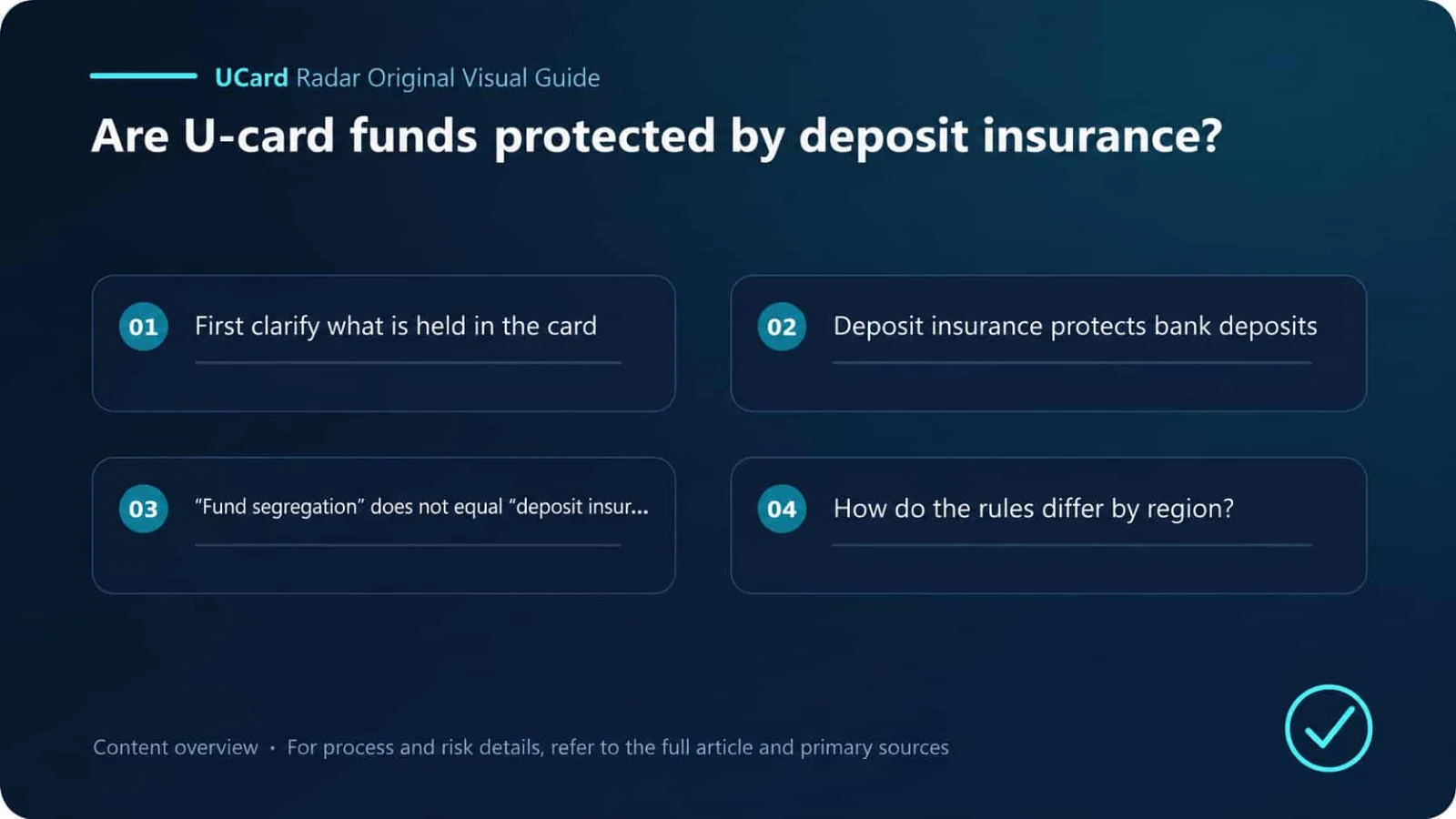
Scope of Sources and Conclusions
Primary-source verification: Prepaid Cards and Deposit Insurance Coverage; Fact Sheet: What the Public Needs to Know About FDIC Deposit Insurance and Crypto Companies; Safeguarding requirements for authorised payment institutions and electronic money institutions.
The verifiable facts in this article about whether U Card balances meet the conditions for bank deposit insurance or customer fund protection are based on the official and regulatory materials listed above. Actual service status, fees, eligibility, and geographic scope should be based on the issuer or platform page at the time of application.
Whether protection applies depends on the legal nature of the funds at the time the loss occurs, the account registration, the underlying bank, and the applicable jurisdiction. It cannot be determined solely from the card design or platform marketing. Any experience-based claims, success rates, fee comparisons, or trend judgments not directly disclosed in the primary materials above are analysis or inference and have not been officially confirmed by the relevant institutions for any specific case.
First, Identify What Is Actually Held in the Card
To determine whether deposit insurance exists, you cannot look only at whether the card is Visa or Mastercard, nor only at whether the platform has a banking partner. You must first determine what type of asset the balance legally represents.
Asset Shown in the Card | Common Legal Nature | Usually Covered by Deposit Insurance? |
|---|---|---|
Virtual assets such as USDT, USDC, BTC | Virtual assets or a claim against a custody platform | Usually no |
USD or EUR balances shown within the platform | E-money, payment account balances, or a platform liability | Usually no; safeguarding may apply |
Reloaded prepaid card balance | Stored value funds or e-money | Usually no |
A partner bank deposit account in the user’s own name | Bank deposit | Possibly yes if local conditions are met |
A pooled bank account opened by the platform in its own name | Custodial, client-money, or omnibus account | Depends on pass-through protection and recordkeeping; do not assume yes |
The second and fifth categories are the easiest to misunderstand. Seeing “100 USD” in an app does not mean a bank has opened a personal USD deposit account for the user. It may simply be an internal ledger balance on the platform, with the actual funds held in a pooled account, or it may even still be unconverted USDT.
Deposit Insurance Protects Bank Deposits
Deposit insurance is a statutory system designed to deal with bank failure risk. It usually protects eligible deposits taken by qualified banks, not every product that can make payments, transfer funds, or display a fiat balance.
China’s current Deposit Insurance Regulation protects RMB and foreign-currency deposits taken by insured institutions. If the combined principal and interest of protected deposits held by the same depositor at the same insured institution does not exceed RMB 500,000, the amount is fully reimbursed. In September 2025, the People’s Bank of China again confirmed that the current maximum reimbursement limit remains RMB 500,000.
This system applies to deposit-taking institutions in mainland China that participate in the deposit insurance scheme. Balances on offshore U Card platforms, offshore bank accounts, e-wallet balances, and USDT do not automatically fall under China’s deposit insurance simply because the user lives in mainland China. Once RMB is used to buy virtual assets and transferred to a U Card platform, the deposit insurance attached to the original bank account does not follow the funds.
From today on, recognize deposits by this sign
“Safeguarding” Is Not the Same as “Deposit Insurance”
Many U Cards are operated by e-money institutions or payment institutions. These firms normally cannot take deposits the way banks do, but regulators may require them to keep customer funds separate from the firm’s own funds. This arrangement is commonly called safeguarding.
The differences are practical:
Comparison Item | Deposit Insurance | Safeguarding |
|---|---|---|
Main risk addressed | Failure of a bank participating in a protection scheme | Misuse or commingling of customer funds by a payment or e-money institution |
Who pays or returns the funds | Statutory deposit protection body | Insolvency practitioner returns funds based on safeguarded accounts and records |
Is there a clear cap? | Usually yes, with a legal limit | Usually not handled under one uniform insurance cap |
Speed of recovery | Processed under the local deposit protection scheme | May require insolvency proceedings and account reconciliation |
Is full recovery guaranteed? | Clear rules exist within coverage limits and eligibility conditions | Not necessarily; shortfalls and insolvency costs may reduce the returned amount |
Does it protect virtual asset prices? | No | No |
The UK Financial Conduct Authority explains that customer funds held with e-money institutions and non-bank payment institutions are not directly protected by the UK Financial Services Compensation Scheme (FSCS). Instead, safeguarding rules apply. If a platform fails, customers may need to wait for insolvency proceedings, and they may not recover the full balance due to shortfalls or insolvency costs. The strengthened UK payment safeguarding rules took effect on 7 May 2026, but they are still not FSCS deposit insurance. See the FCA consumer guidance and the new rule announcement.
So when you see “100% safeguarded,” interpret it as an asset-protection and custody rule, not as a government promise to compensate you under bank deposit insurance.
How Do the Rules Differ Across Regions?
The table below summarizes the basic position in several common card-issuing regions. Coverage limits apply only to eligible deposits and are not a general payout standard for U Card balances.
Region | Bank Deposit Protection Limit | General Position for U Cards, E-Wallets, and Virtual Assets |
|---|---|---|
Mainland China | Up to RMB 500,000 in combined principal and interest per depositor at the same insured institution | Offshore U Cards, e-wallets, and virtual assets are not protected by mainland Chinese deposit insurance merely because the user lives in mainland China |
United States | Up to USD 250,000 per depositor, per FDIC-insured bank, per ownership category | Non-bank platforms and virtual assets themselves are not FDIC-insured; some fiat deposits at banks may qualify for pass-through coverage |
United Kingdom | Up to GBP 120,000 per eligible depositor, per authorised institution | Balances at non-bank payment institutions such as EMIs and APIs are not directly covered by FSCS and usually rely on safeguarding rules |
European Union | Up to EUR 100,000 per depositor, per bank | E-money is generally not a bank deposit and is not included in deposit guarantee schemes |
Hong Kong, China | Up to HKD 800,000 per depositor, per scheme member bank | Virtual assets and stored-value payment instruments are not protected by the Hong Kong Deposit Protection Scheme |
Singapore | Up to SGD 100,000 per depositor, per scheme member, limited to eligible SGD deposits | E-money is not a bank deposit and is not protected by deposit insurance; major payment institutions must safeguard relevant float funds |
The FDIC’s standard coverage amount in the United States is USD 250,000 per depositor, per insured bank, per ownership category. But the FDIC also warns that non-bank companies are not themselves FDIC-insured institutions. After a user gives money to a non-bank app, protection is only possible if the funds are actually placed at an insured bank and the account registration and recordkeeping satisfy pass-through deposit insurance requirements. The platform’s own bankruptcy is not an FDIC deposit insurance event. See the FDIC guidance on third-party financial apps. In the UK, the FSCS limit for eligible bank deposits was raised to GBP 120,000 per eligible depositor, per authorised institution, effective 1 December 2025, but e-money balances still do not become protected as a result.
In the EU, the standard bank deposit protection amount is EUR 100,000 per depositor, as clearly explained by the European Central Bank. E-money is not deposit-taking business, so e-money balances are generally outside deposit guarantee schemes. Even if an e-money institution places customer funds in a bank, whether end users receive pass-through protection still depends on the implementation rules, account structure, and recordkeeping in the relevant member state. You cannot decide solely because “the money is in a bank.”
Hong Kong’s rules are even more straightforward. The Hong Kong Deposit Protection Board states that eligible deposits are protected up to HKD 800,000 per depositor at each scheme member bank, but both virtual assets and stored-value payment instruments are excluded. Deposits held in overseas branches are also outside the scheme.
The Monetary Authority of Singapore likewise states that e-money is not a bank deposit and therefore is not protected by deposit insurance. Major payment institutions are instead required to protect relevant e-money float. Under Singapore’s deposit insurance system, only eligible Singapore-dollar deposits are covered, up to SGD 100,000 per depositor at each scheme member.
If the Partner Bank Is Protected, Why Might Users Still Not Receive a Payout?
This is one of the easiest points to confuse in U Card marketing. A platform may say “our partner bank is an FDIC member” or “customer funds are held at an insured bank.” That only proves the bank has insured status. It does not, by itself, prove that each user’s balance satisfies the conditions for payout.
You still need to verify the following.
Whether the Account Belongs to the User
If the bank directly opens an individual deposit account for the user, the legal relationship is relatively clear. If the account is opened in the platform’s name and the user only has an internal platform ledger balance, protection depends on the custody structure and pass-through rules.
Whether the Bank Can Identify Each End User
A pooled account may hold funds from many cardholders. The bank, platform, or trustee needs accurate records that identify each ultimate beneficiary and the amount attributable to them. If records are incomplete, pass-through protection may fail and liquidation may take much longer.
Whether the Funds Had Actually Reached the Bank at the Relevant Time
From the time the user transfers USDT to the platform until conversion, settlement, and deposit of fiat into the partner bank, the funds may pass through exchanges, custodians, payment processors, and card issuers. The layer where the funds are sitting when a failure occurs determines whether the user is dealing with a bank deposit, e-money balance, or a claim against the platform.
Whether Balances at the Same Bank Must Be Aggregated
Deposit insurance limits are usually aggregated by “the same depositor at the same bank,” not calculated separately for each card. If the user already has a personal deposit at the partner bank, any qualifying pass-through deposit balance in the U Card may be combined with that existing balance and use the same coverage limit.
What Losses Are Usually Outside Deposit Insurance?
Even if some fiat funds qualify for deposit protection, the following losses usually cannot be claimed from a deposit insurance body:
failure, disappearance, or withdrawal suspension of the U Card platform;
depegging of stablecoins such as USDT or USDC;
reserve shortfalls at a stablecoin issuer or custodian;
platform account theft, private-key leakage, or phishing scams targeting the user;
card fraud, merchant chargebacks, and subscription disputes;
frozen accounts due to sanctions, AML reviews, or KYC problems;
price declines in virtual assets voluntarily purchased by the user;
balances still sitting on-chain, at an exchange, or inside the platform rather than already becoming bank deposits.
A stablecoin may have reserve assets, but that does not turn it into a government-insured bank deposit. Reserve backing, asset segregation, and deposit insurance are three different mechanisms.
How to Check Whether a U Card Has Deposit Protection
Do not just ask customer service, “Are funds safe?” Check in the following order and the answer becomes much clearer.
Find the real contracting entity
Review the card terms, account agreement, and privacy policy. Identify the full legal name of the company responsible for the card account, fiat balance, and virtual-asset custody. The brand name, app name, and actual licensed entity are often not the same company.Confirm whether it is a bank or a non-bank institution
Search the local regulator’s register for the contracting entity. Banks, e-money institutions, payment institutions, virtual asset service providers, and ordinary tech companies are governed by different rules. Being “regulated” does not mean the platform is allowed to take deposits.Search for limiting language in the agreement
Focus on these English phrases:
not a bank account
not FDIC insured or FDIC insurance eligible
pass-through deposit insurance
e-money, prepaid balance
safeguarded funds, segregated account
custodial account, omnibus account
eligible deposit, deposit guarantee scheme
Saying only “funds held with a regulated bank” is still not enough. A reliable explanation should clearly state the partner bank’s name, the type of protected funds, account ownership, applicable limits, aggregation rules, and exclusions.
4. Identify Which Insolvency Scenario the Protection Actually Covers
Ask the platform to clarify who handles claims if the partner bank fails, if the U Card operator fails, if the e-money institution fails, or if the virtual-asset custodian fails. If customer service only repeats “funds are safe” without explaining the legal entity and payout conditions, that is not proof of deposit protection.
5. Keep Records of Balances and Transactions
Save the account-opening agreement, periodic statements, top-up records, on-chain transaction hashes, and fiat conversion records. If the platform later has problems, the user first needs to prove who they are, how much balance they hold, and with which entity the funds were sitting.
How to Reduce Fund Risk When Using a U Card
U Cards are suitable for payments, not for storing large balances over the long term. A more prudent approach is to top up according to actual spending needs and keep only a short-term balance on the card. If the platform changes its issuing entity, account agreement, or custody arrangement, you should re-check the protection terms rather than relying on the assumptions made when the card was first opened.
You can also do the following:
keep long-term virtual-asset holdings separate from everyday spending balances;
do not leave large balances on the card simply because “the partner bank is insured”;
avoid concentrating all funds on one platform, one custodian, or one stablecoin;
regularly download statements and agreements instead of relying only on app screenshots;
reduce balances promptly if withdrawals slow down, the issuer changes frequently, or the terms remove redemption rights.
These steps cannot eliminate platform risk, but they can reduce the amount exposed if the platform stops operating and can make later claims or insolvency registration easier.
Frequently Asked Questions
If the card has a Visa or Mastercard logo, does that mean the balance is insured?
No. Card networks mainly provide payment rails and transaction rules. They do not provide deposit insurance for the cardholder’s balance. Whether the balance is protected depends on the actual issuing entity, the nature of the account, and the local legal framework.
If the platform says the funds are held by a bank, does that mean they are protected by deposit insurance?
No. Bank custody can reduce the risk that the platform misuses client funds, but the user may still only be an unsecured creditor of the platform. You still need to confirm account ownership and the pass-through protection conditions.
If USDT in the card is converted into USD only at the time of spending, what part might be protected?
USDT that has not yet been converted is usually not protected by deposit insurance. Even after conversion into USD, you still have to determine whether it is legally a bank deposit, e-money balance, or prepaid balance. Showing the unit in dollars inside the app is not enough to prove the funds have become protected deposits.
Can mainland Chinese users benefit from foreign deposit insurance when using an offshore U Card?
Nationality or residence does not always automatically exclude protection, but the account must satisfy the requirements of the deposit protection scheme in the issuing jurisdiction. Some schemes also exclude offshore deposits, non-resident products, or certain account structures. The governing factors are the contracting entity that opens the account and the location of the deposit.
If a U Card platform has private insurance, can that replace deposit insurance?
Private insurance only pays according to the policy terms. It may include deductibles, liability caps, and many exclusions. You also need to confirm the policyholder, beneficiaries, and covered events. A platform’s cybersecurity insurance does not mean every user’s full balance will be compensated.
Conclusion
Most U Card balances do not have bank deposit insurance. Virtual assets such as USDT are generally not protected. E-money and prepaid balances are more commonly subject to safeguarding arrangements. Only fiat funds that truly become eligible bank deposits may enter a local deposit protection scheme.
When you see phrases like “bank partnership,” “safeguarded funds,” or “regulated,” do not automatically read them as a state guarantee. You need to verify the contracting entity, the legal nature of the balance, account ownership, the insured bank, and the relevant payout trigger before you can tell whether money can be recovered if the platform runs into trouble.
For ordinary users, the most practical approach remains simple: keep only near-term spending balances on a U Card, and do not treat it as a bank savings account.
Main References
People’s Bank of China: The current maximum deposit insurance reimbursement limit remains RMB 500,000
U.S. FDIC: Understanding Deposit Insurance
U.S. FDIC: Banking With Third-Party Apps
UK FCA: Using Payment Service Providers
UK FCA: Changes to Payment Safeguarding Rules
European Central Bank: What Is a Deposit Guarantee Scheme?
European Banking Authority: Guidance on the treatment of e-money under deposit guarantee schemes
Hong Kong Deposit Protection Board: Scope of the Deposit Protection Scheme
Monetary Authority of Singapore: Payment Services Act FAQs
UK FSCS: Deposit protection limit raised to GBP 120,000
Singapore Deposit Insurance Corporation: Deposit Insurance Scheme