
There is no universally applicable answer to whether U cards are legal.
The same card may be issued by a licensed European institution and available to eligible local users; in another jurisdiction that restricts virtual-currency activities, the platform’s marketing, stablecoin conversion, or third-party top-up services may cross regulatory lines. Even if the platform itself is licensed, a user who uses it for cash-out schemes, money laundering, or sham transactions may still be acting illegally.
This is one of the most common sources of confusion when discussing U cards: the fact that a card works does not mean the entire business chain is compliant; and the fact that a platform is registered overseas does not mean it may serve users worldwide.
What the market generally calls a U card is a crypto payment card, stablecoin card, or virtual card funded with digital assets such as USDT or USDC and used through the Visa or Mastercard network. To assess whether it is legal, at least four separate questions must be considered:
Is the platform authorized to provide stablecoin custody, conversion, and payment services?
Is the card issued by a qualified institution?
Are the relevant services permitted in the user’s jurisdiction?
Are the user’s source of funds and transaction purposes lawful?
Simply asking “Are U cards legal?” is too broad. The question becomes meaningful only when these four issues are separated.
1. A U card is not one business; it combines several businesses
What ordinary users see is a top-up and card payment function, but in the background there may simultaneously be stablecoin transfers, asset custody, fiat conversion, electronic-money bookkeeping, card issuance, and cross-border payments.
A typical transaction may broadly follow this path:
User obtains USDT or USDC → deposits it on the platform → the platform or a partner converts it and records a card balance → the issuer authorizes the transaction → the merchant receives payment through the card network
These steps do not necessarily belong to the same company, and the licenses required for each activity can differ.
A platform may be authorized as a virtual-asset service provider but lack an electronic-money or payment license. It may cooperate with a licensed card issuer while another company responsible for stablecoin conversion lacks the necessary authorization. Displaying one license certificate does not prove that the entire chain is regulated.
When assessing U-card compliance, users should at least identify who provides custody, who performs conversion, who issues the card, and which activities each company is actually authorized to conduct.
2. Platform legality and user legality are two different questions
Whether the platform is operating legally mainly depends on its legal entity, license scope, service jurisdictions, and card-issuing relationship.
Whether the user is acting lawfully depends on identity information, the source of stablecoins, the purpose of the transactions, whether the user receives or sends money for others, and whether foreign-exchange, tax, anti-money-laundering, or sanctions rules are being circumvented.
A compliant platform may still be used by a customer for illegal transactions. Conversely, a platform that is not authorized to serve residents of a certain jurisdiction may still issue cards through a legitimate bank. Both situations can occur.
Therefore, “my payment went through” only means that the transaction was temporarily accepted by the payment system. It does not determine the legal nature of the activity.
3. What does a Visa or Mastercard logo prove?
Visa and Mastercard provide payment-card networks, transaction rules, and program management. A card connected to these networks can transmit authorization and settlement information according to their standards.
That does not mean the card network has issued a blanket “legal certification” for every part of a U-card platform’s business.
Card networks generally do not determine for users:
how the stablecoins were obtained;
whether the platform is authorized to operate in the user’s jurisdiction;
whether the user has violated local foreign-exchange or tax rules;
whether the platform’s custody and conversion services fall within its license scope;
whether a transaction involves unlawful goods, cash-out activity, or money laundering.
A Visa or Mastercard logo is one element of a genuine issuing relationship. It is not a legal passport valid across all jurisdictions.
4. How should U cards be understood in mainland China?
For users in mainland China, the most sensitive part of a U card is not overseas card spending itself, but how stablecoins are obtained, converted, promoted, and transferred.
On February 6, 2026, the People’s Bank of China and seven other authorities issued Notice Yinfa [2026] No. 42. The document again stated that virtual currencies such as Bitcoin, Ether, and Tether do not have legal-tender status and should not and cannot circulate as currency in the market. It also stated that activities carried out domestically involving exchange between legal tender and virtual currencies, exchange between virtual currencies, intermediary trading, pricing, and trading of related financial products constitute illegal financial activities. The notice further provides that overseas entities and individuals may not illegally provide virtual-currency-related services to domestic entities in any form. Original notice of the People’s Bank of China
In the context of U cards, the following activities carry relatively high legal risk:
operating RMB-to-USDT exchange services for users in mainland China;
repeatedly opening cards or topping up cards for others and charging fees;
publicly acting as an agent, promoting, or directing traffic to virtual-currency-related services within mainland China;
pooling other people’s funds and using U cards to transfer them across borders;
knowingly soliciting customers or providing assistance for overseas platforms that unlawfully offer related services to domestic users.
Registering a company overseas and issuing cards overseas do not automatically eliminate these risks. Regulators focus on what services are actually provided and to whom, not merely where the servers or company are located.
Does personal use of a U card necessarily constitute a crime?
A prohibition on virtual-currency-related business activities cannot simply be rewritten as “using a U card once as an individual is necessarily a crime.”
Platform operations, individual civil conduct, and criminal offenses exist at different legal levels. Criminal liability must still be assessed in light of the conduct, amount, purpose, source of funds, and whether the elements of a specific offense are met.
Notice Yinfa [2026] No. 42 also provides that where entities or individuals invest in virtual currencies or related products in violation of public order and good morals, the relevant civil legal acts are invalid and losses are borne by the participants themselves; where conduct is suspected of disrupting financial order or endangering financial security, it is handled according to law. This means that even where an individual’s conduct has not reached the level of a criminal offense, disputes arising from deposits, conversions, or platform failure may not receive the same civil-law protection as ordinary bank deposits or card transactions.
Risk rises significantly in the following situations:
buying and selling USDT for unspecified members of the public or repeatedly topping up for others;
selling or renting verified U-card accounts;
applying for cards using another person’s identity;
knowingly helping spend, withdraw, or transfer suspicious funds;
using sham orders, related merchants, or bulk refunds to cash out funds;
receiving fraud, gambling, or other unlawful funds through a U card;
splitting transactions to circumvent foreign-exchange controls;
using stablecoins and U cards to launder money or conceal unlawful proceeds.
The 2026 work report of the Supreme People’s Court stated that crimes such as money laundering and illegal foreign-exchange evasion using virtual currencies as a medium should be severely punished, and illegal cross-border transfers of funds should be prevented. Relevant explanation of the Supreme People’s Court
5. Genuine overseas spending is not the same as bypassing foreign-exchange controls
Mainland China permits residents to make genuine and reasonable current-account expenditures overseas.
In a 2024 policy interpretation, the State Administration of Foreign Exchange stated that more than 90% of overseas merchant categories are fully open, and that residents may use bank cards for food, accommodation, transport, shopping, and other expenditures related to overseas travel, business trips, and study. Such spending does not consume the individual annual USD 50,000 facilitated foreign-exchange purchase quota. SAFE policy interpretation
This refers to genuine current-account consumption within the regulated bank-card system. It cannot be used to conclude that all overseas U-card transactions funded with stablecoins have the same legal character.
Paying for genuine hotels, flights, software subscriptions, and everyday goods is legally different from fictitious transactions, merchant cash-out schemes, bulk card swiping, or transferring funds through ATM withdrawals.
The key question is not what the card is called, but whether the transaction is genuine, whether the source of funds can be explained, and whether payment is being used as a pretext to circumvent foreign-exchange or anti-money-laundering controls.
6. How are U cards usually regulated in other jurisdictions?
Some countries and regions do not comprehensively prohibit crypto-asset payments. Instead, they regulate stablecoins, custody, conversion, and card issuance separately under licensing frameworks.
That does not mean “crypto assets are allowed locally, so any U card is legal.” In fact, the more formal the regulatory framework, the more important it becomes to verify which entity is licensed for each activity.
European Union
The EU Markets in Crypto-Assets Regulation (MiCA) requires crypto-asset service providers to obtain authorization and establishes rules for stablecoin issuance, custody of client assets, disclosure, and governance. Article 59 of MiCA provides that, except for financial institutions meeting statutory conditions, unauthorized entities may not provide crypto-asset services in the EU. Original MiCA regulation
However, MiCA authorization is not the same as permission to issue payment cards. A U-card program may also involve electronic money, payment services, and card-network rules, which must be handled by appropriately qualified institutions.
United States
FinCEN’s guidance on convertible virtual currency distinguishes among users, exchangers, and administrators. An individual who obtains virtual currency and uses it to purchase goods or services generally does not, solely by that activity, become a money services business requiring registration. By contrast, accepting, exchanging, and transmitting virtual currency as a business may constitute regulated money-transmission activity. FinCEN guidance
This is only a classification under the U.S. Bank Secrecy Act and FinCEN rules. It does not replace state money-transmitter licensing, sanctions, tax, or other federal-law analysis. A platform displaying a FinCEN registration does not mean the entire U-card program has comprehensive authorization.
Hong Kong
Hong Kong’s Stablecoins Ordinance took effect on August 1, 2025, establishing a licensing regime for regulated fiat-referenced stablecoin activities. Hong Kong SAR Government announcement
This regime mainly regulates stablecoin issuance and related activities. It is not a unified license for every crypto card or U card. Where a U card also involves virtual-asset trading, payments, or card issuance, the relevant SFC, HKMA, and other regulatory frameworks still need to be checked.
Singapore
Singapore’s Payment Services Act brings account issuance, domestic and cross-border money transfers, e-money issuance, and digital payment token services within payment-services regulation and establishes relevant licensing and operational requirements. Singapore Payment Services Act
Whether a particular U card is compliant depends on whether it actually provides digital-token services, e-money, cross-border money transfers, or other payment services. Merely registering a Singapore company is not sufficient.
7. What do KYC, company registration, and a license each prove?
Platforms often combine these three concepts in marketing.
Passing KYC
KYC means the platform has collected and verified the user’s identity as part of anti-money-laundering controls. It does not prove that the platform holds all required operating permissions, nor does it prove that the platform may serve the user’s jurisdiction.
Company registration
Company registration only proves that a legal entity has been formed. Ordinary commercial registration does not automatically confer the right to issue cards, convert stablecoins, safeguard client funds, issue electronic money, or conduct cross-border remittances.
Regulatory license
A regulatory license is more meaningful than simple company registration, but users still need to check the licensed entity, current validity, permitted activities, and permitted service areas. A license held by a partner company does not mean the U-card brand itself is subject to identical supervision; and holding a virtual-asset license does not automatically grant payment or card-issuing permissions.
Therefore, license checks should not rely on screenshots alone. The regulator’s own website should be used to verify the holder’s name, license number, status, and authorized business scope.
8. Which uses are most likely to cross legal boundaries?
The risks of personal use and commercial activity are not the same.
Using a purchased verified account
Buying a U-card account registered in another person’s real name normally violates platform rules and may also involve identity misuse and KYC circumvention. If the original verified person re-verifies or recovers the account, the actual user will have difficulty asserting any rights.
Renting or selling accounts
Allowing another person to use a verified account, virtual card number, or payment authority may facilitate fraud, gambling deposits, or money laundering. Investigators will typically begin by tracing the verified identity and transaction records to identify the person controlling the account.
Operating card-opening, top-up, or exchange services
Occasionally helping a family member is different from repeatedly providing services to unspecified users and charging fees. The latter may involve unauthorized virtual-currency exchange, money transmission, or payment services.
Receiving stablecoins of unclear origin
If deposited funds originate from fraud, stolen assets, gambling platforms, mixers, or sanctioned addresses, the platform or stablecoin issuer may freeze funds, and the user may be required to explain the source.
Cash-out and cross-border transfers
Using fictitious consumption, related merchants, bulk refunds, or ATM withdrawals to convert stablecoins into foreign fiat may involve unlawful foreign-exchange business, evasion of foreign-exchange controls, money laundering, or other offenses.
Paying for unlawful goods and services
Even if the card is issued by a licensed institution, that does not make gambling, fraud, drugs, or prohibited-goods transactions lawful. The compliance status of the payment tool cannot change the legal nature of the underlying transaction.
9. How to assess whether a U card is relatively compliant before applying
First identify the operating company, then identify the card issuer. If they are different entities, determine what each one is responsible for.
Next, check the licenses:
Is it merely a company registration or a financial regulatory authorization?
Does the license holder match what the platform discloses?
Is the license still valid?
Does the permitted scope cover custody, conversion, payments, or card issuance?
Is the holder allowed to serve users in the relevant jurisdiction?
The top-up route should also be clear. Who receives the USDT or USDC? Who performs the conversion? Is the card balance still stablecoins, fiat currency, electronic money, or merely internal platform bookkeeping? If the card is canceled or the platform stops operating, how can the balance be withdrawn?
Verbal promises by agents cannot substitute for this information. Phrases such as “legal overseas,” “official Visa,” “works in mainland China,” or “completely unregulated” are not precise legal conclusions.
Whether a U card is legal depends on the jurisdiction, the platform, the flow of funds, and the way the card is used.
In jurisdictions that allow and regulate crypto-asset payments, a U card may operate within the regulatory framework when licensed virtual-asset service providers, payment institutions, and card issuers cooperate within their respective authorization scopes. Even then, this does not mean the product may lawfully be marketed to users worldwide.
Mainland China takes an explicitly restrictive approach toward virtual-currency-related business activities. Overseas platforms providing stablecoin conversion and related services to domestic entities, as well as domestic agents, top-up services, customer solicitation, and fund pooling, all involve relatively high compliance risk.
A single instance of personal consumption cannot be classified as a criminal offense without examining the specific facts. But this does not mean the related deposit, conversion, and transaction activities are automatically lawful. Risk escalates rapidly when the conduct involves opening accounts for others, topping up for others, renting accounts, sham consumption, illegal foreign-exchange evasion, money laundering, gambling, or fraud.
Before applying for a U card, the key questions are: who operates the service, who issues the card, who converts the stablecoins, whether the platform is allowed to serve the user’s jurisdiction, and whether the transaction and source of funds can withstand scrutiny.
This article provides general information and risk analysis only and does not constitute legal advice for any individual, platform, or specific transaction. Where large amounts, commercial top-up activity, cross-border fund arrangements, or account freezes are involved, users should consult a qualified lawyer familiar with the relevant jurisdiction.
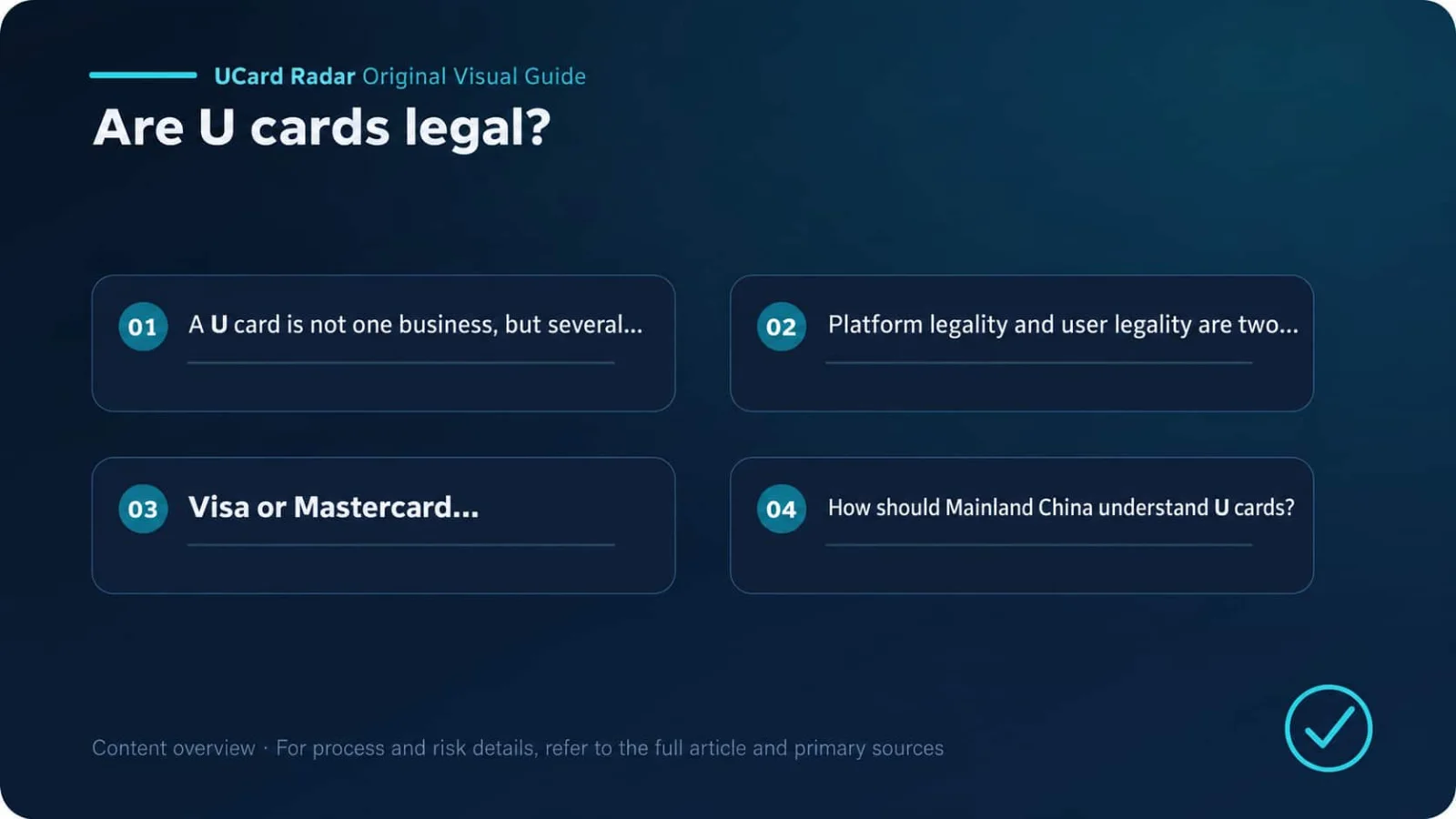
Original infographic: key points and decision process for determining whether U cards are legal
Sources and boundaries of conclusions
Primary verification: Notice on Further Preventing and Handling the Risks of Speculation in Virtual Currency Trading; Implementation of the new licensing regime for virtual asset trading platform operators; Regulations Governing Anti-Money Laundering and Countering the Financing of Terrorism for Virtual Asset Service Providers.
Whether a U card is legal must be assessed separately according to the user’s jurisdiction, the operating entity, the card-issuance and conversion chain, and the specific use of funds. The regulatory documents listed above support the jurisdiction-specific conclusions in this article and do not constitute individual legal advice.
Any case-specific conclusion involving criminal law, foreign exchange, taxation, or cross-border funds must be assessed on the facts with a locally licensed lawyer. This article does not treat a payment-network logo or overseas company registration as proof of compliance.