
Whether a U card is legal cannot be determined simply by checking whether the card bears the Visa or Mastercard logo. Nor does the fact that a platform allows users to open an account, top up, and spend normally mean that the entire service complies with local law.
Visa and Mastercard provide card payment networks. They handle authorization, clearing, and acceptance, but they do not certify that a U card platform is qualified to provide crypto custody, conversion, cross-border payments, or services to users in a particular region.
Even if the card itself is issued by a legitimate institution, several questions still need to be verified separately:
Who receives and holds the user’s USDT or USDC top-ups;
Through what channel crypto assets are converted into fiat currency;
Who the actual card issuer is;
Whether the platform allows residents of the user’s region to open accounts;
Whether the user must make tax or cross-border fund declarations.
Therefore, there is no single global answer to the question “Are U cards legal?”
In regions where individuals are allowed to hold and use crypto assets, obtaining a U card through a compliant service provider and using it for normal spending generally does not become illegal solely because a U card is used. But the risk is very different if the platform operates without licenses, the user uses a false identity or address to bypass regional restrictions, the source of the topped-up funds is questionable, or the card is used for money laundering, mule activities, cash-out schemes, tax evasion, or similar conduct.
In this article, a “U card” refers to a virtual or physical card funded with crypto assets such as USDT or USDC, where the platform or its partner converts those assets into fiat currency at the time of spending, and the payment is then settled through a bank card network.
Scope of Evidence and Limits of the Conclusions
Primary references: Notice on Further Preventing and Handling the Risks of Virtual Currency Trading and Speculation; rules on personal foreign exchange administration; lists of virtual asset trading platforms.
The verifiable facts in this article about differences in the regulation of U cards in Mainland China, Hong Kong, the EU, the UK, the US, Singapore, and Australia are based on the official or regulatory documents listed. Actual service status, fees, eligibility, and regional coverage should be confirmed from the issuer or platform at the time of application.
The regional summaries do not replace personal legal or tax advice. The same product must still be checked for its actual operating entity, card issuance qualifications, residency restrictions, and intended use. Any discussion of user experience, approval success rates, fee comparisons, or trend judgments not directly disclosed in those primary sources is analysis or inference and has not been officially confirmed by the relevant authorities for individual cases.
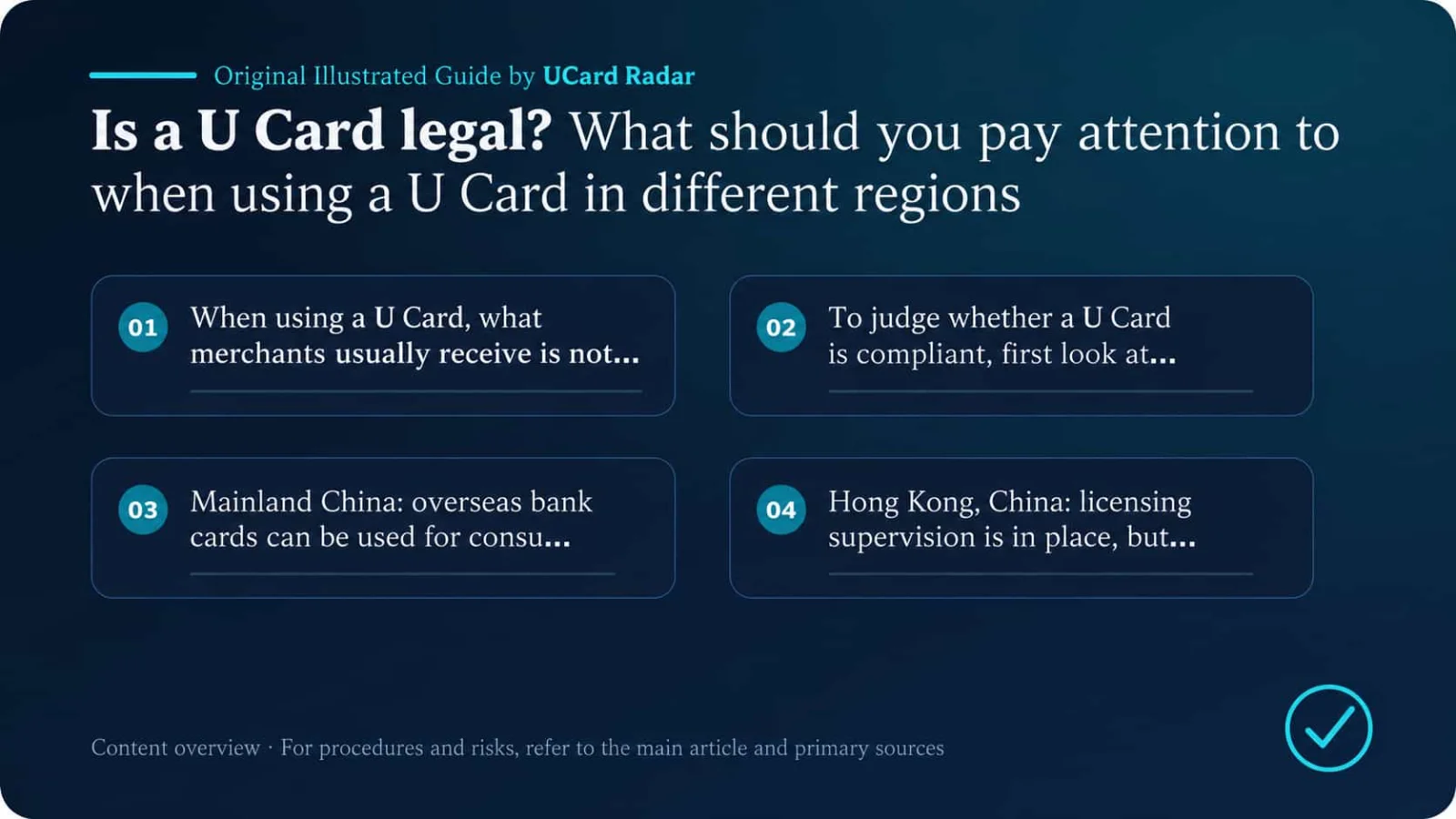
1. When You Use a U Card, the Merchant Usually Does Not Receive USDT
Most U cards do not transfer USDT directly to the merchant.
After the user pays, the platform deducts the amount from the user’s crypto balance or already-converted fiat balance, and the merchant receives US dollars, euros, or local currency through networks such as Visa or Mastercard. From the merchant’s perspective, this is usually just a standard card transaction.
However, several things may be happening behind that transaction at the same time:
The user purchases and transfers in USDT or USDC;
The platform receives, holds, or transfers the crypto assets;
The platform or its partner converts crypto assets into fiat currency;
The issuing institution provides a card account or prepaid balance;
The payment network completes authorization, acquiring, and clearing;
The user may incur tax, foreign exchange, or source-of-funds reporting obligations.
The fact that a card transaction goes through only shows that the payment system accepted the transaction. It does not prove that every step—from top-up to custody, conversion, and issuance—complies with the rules in the user’s jurisdiction.
2. To Judge Whether a U Card Is Compliant, Start with Four Questions
1. Is the service available to users in your region?
Different regions take very different approaches to crypto assets.
Some allow individuals to hold and trade crypto assets but require service providers to be licensed. Some restrict retail promotion and cross-border services. Others take a prohibitive approach to virtual-currency-related business.
The same U card may be available to residents of the European Economic Area while remaining unavailable to residents of Mainland China, the United States, or Singapore.
When platforms assess user eligibility, they usually check the user’s residential address, identity documents, tax residency, and KYC materials rather than only the login IP address. Even if a user can reach the onboarding page through a VPN, that does not mean the user is eligible to apply.
2. Who are the platform operator and the card issuer?
The U card brand seen by users often operates only the website or app and does not directly issue the card.
A single U card may involve all of the following at the same time:
The U card platform;
A crypto custody or conversion service provider;
An institution holding a payments or e-money license;
The bank that actually issues the card;
Card schemes such as Visa or Mastercard.
These parties bear different responsibilities. A Visa or Mastercard logo shown by the platform only indicates that the card is connected to the relevant payment network.
If a platform never discloses its corporate entity, issuing institution, user agreement, or service regions, or only shows a license image that cannot be verified, users should be especially cautious before applying.
3. Can the source of top-up funds be explained?
Completing KYC does not mean future top-ups will never be reviewed.
Frequently receiving transfers from unknown wallets, collecting funds on behalf of others, using a mixer, or topping up from addresses associated with fraud, gambling, money laundering, or other high-risk activity may trigger the platform’s anti-money-laundering controls.
The platform may ask the user to provide:
Exchange purchase records;
On-chain transfer records;
Proof of salary or business income;
Proof of wallet ownership;
An explanation of the purpose of the spending.
If the source of funds cannot be explained, the account may be restricted from topping up, the balance may be frozen, and in serious cases the account may be closed.
4. Does tax or cross-border reporting apply?
Some jurisdictions treat crypto assets as property. Using USDT or USDC to top up or spend may be regarded as a sale, exchange, or disposal of an asset.
Even if a U card is used only to buy daily necessities, the user may still need to record the acquisition cost of the crypto asset, the conversion price, the disposal value, and the fees.
A U card should not be treated as a tool to evade tax, foreign exchange regulation, or offshore account reporting. Whether reporting is required should be determined based on the user’s tax residency and local rules, not merely on where the card was issued.
3. Mainland China: A Foreign-Issued Bank Card May Be Spendable, but That Does Not Make the Funding Stage Compliant
Users in Mainland China should be especially cautious when using U cards.
The Notice on Further Preventing and Handling the Risks of Virtual Currency Trading and Speculation, jointly issued by the People’s Bank of China and other authorities, states that virtual currencies do not have the same legal status as legal tender, and that business activities related to virtual currencies are illegal financial activities. Overseas virtual currency exchanges that provide services to domestic residents over the internet are also brought within the relevant regulatory scope.
This notice should not be simplified into “holding USDT is automatically a crime for an individual,” but neither does it support the conclusion that individuals face no restrictions at all when using U cards.
A U card commonly involves stablecoin purchase, on-chain transfer, platform conversion, and cross-border settlement. Problems at any of these stages may lead to account freezes, source-of-funds reviews, or even more serious legal consequences.
At a minimum, users in Mainland China should note the following:
Do not use a U card to receive or send money for others, act as a money mule, cash out funds, or move funds for third parties;
Do not borrow another person’s identity, address, or overseas residency materials to open an account;
Do not use sham transactions, split transactions, or another person’s quota to evade foreign exchange rules;
Keep purchase records, transaction hashes, proof of source of funds, and proof of actual spending;
The fact that a platform allows access from a Mainland China IP address does not mean it is authorized to serve Mainland China residents.
China’s foreign exchange authority requires individuals purchasing foreign currency to have a genuine and lawful transaction basis and to make truthful declarations. False declarations, splitting foreign exchange purchases using another person’s quota, or using relevant funds for money laundering, gambling, tax evasion, or underground banking are all high-risk behaviors.
The fact that a foreign-issued Visa or Mastercard can be accepted by merchants in China or overseas does not eliminate the risks associated with stablecoin funding and cross-border fund arrangements at the earlier stage.
References: Notice on Further Preventing and Handling the Risks of Virtual Currency Trading and Speculation issued by the People’s Bank of China; personal foreign exchange policy guidance of the State Administration of Foreign Exchange.
4. Hong Kong, China: Licensed Regulation Applies, but Not All U Cards May Be Sold Legally
Hong Kong regulates virtual assets under a licensing regime.
Virtual asset trading platforms need authorization from the Securities and Futures Commission of Hong Kong. The SFC publishes lists of licensed platforms, applicants, and suspicious platforms.
It is important to distinguish between filing an application and actually obtaining a license. Even if a platform is licensed, that does not mean the regulator guarantees its operational condition, asset safety, or solvency.
The Hong Kong Stablecoins Ordinance took effect on August 1, 2025, introducing licensing requirements for activities such as issuing fiat-referenced stablecoins. But this does not mean that USDT or USDC products on the market are automatically recognized in Hong Kong, nor does it mean that all U cards may be marketed to Hong Kong residents.
Before applying, users in Hong Kong should verify:
Which company provides the virtual asset conversion or custody service;
Whether that company is subject to the relevant regulation;
Which bank or payment institution issues the card;
Whether the product terms clearly allow Hong Kong residents to apply;
Whether the platform is promoting “license application pending” as if it were already licensed;
Whether top-up, conversion, and spending create tax reporting obligations.
References: SFC list of virtual asset trading platforms; Hong Kong Monetary Authority regime for stablecoin issuers.
5. EU and EEA: MiCA Licensing and Payment Authorization Must Be Examined Separately
The EU Markets in Crypto-Assets Regulation (MiCA) creates a unified regulatory framework for crypto-asset issuers and crypto-asset service providers, covering authorization, disclosure, customer protection, and prudential requirements.
However, MiCA authorization mainly addresses crypto-asset services. A U card also involves bank card, e-money, or payment services. Relevant institutions may additionally need a payment institution license, e-money authorization, and compliance with anti-money-laundering rules.
Users in Europe should check the following:
Whether the crypto-asset service entity has authorization from the competent authority;
Whether the card issuer has payment or e-money authorization;
Whether the service may legally cover the member state in which the user resides;
Whether the user holds fiat balance or crypto assets held in custody by the platform;
How different types of balances would be treated if the platform fails.
Tax treatment cannot be summarized simply as “the EU has one single rule.” Member states do not handle holding periods, personal capital gains, and asset disposals in exactly the same way.
Since January 1, 2026, DAC8 has expanded tax transparency for crypto assets. Relevant service providers must collect reportable crypto-asset transaction information and member state tax authorities will exchange that information. It is unrealistic to assume that U card transactions are invisible to tax authorities.
References: European Commission explanation of MiCA; European Commission explanation of DAC8.
6. United Kingdom: Legal to Use, but Spending May Create Tax Records
The UK does not completely prohibit individuals from holding and using crypto assets, but crypto-asset service providers must comply with anti-money-laundering and financial promotion rules.
Crypto businesses that fall within the scope of UK anti-money-laundering regulation must register with the Financial Conduct Authority (FCA). Overseas firms marketing crypto services to UK consumers must also comply with the UK’s financial promotion regime.
FCA registration only means that a business meets certain registration requirements. It does not mean the UK government guarantees the platform’s safety, operating capacity, or solvency.
HM Revenue & Customs generally treats using crypto assets to purchase goods or services as a disposal of assets. If a U card automatically sells crypto assets when funds are topped up or spent, it may also generate taxable capital gains or losses that need to be recorded.
Users in the UK should keep records of acquisition cost, time of conversion, sterling value, and fees, rather than relying only on card statements.
References: FCA guidance on cryptoasset businesses; FCA financial promotion rules; UK government guidance on cryptoasset taxation.
7. United States: Rules Are Not Uniform Nationwide, and State-Level Eligibility Also Matters
The United States has not completely banned crypto cards, but the related business may be subject at the same time to federal anti-money-laundering rules, state money transmission licensing, banking regulation, and tax requirements.
A platform may be able to provide services in some US states without being able to operate in all of them.
Before applying, US users should confirm:
Who the actual issuing bank or licensed institution is;
Whether the user’s state is within the service area;
Whether the crypto conversion business has the applicable registration or license;
Whether fiat balances on the card are protected by FDIC insurance;
Whether the insurance covers fiat balances held at the bank or crypto assets held by the platform.
The fact that a partner bank is an FDIC member does not mean that every balance on the platform is insured. Crypto assets do not automatically become FDIC-insured simply because the platform works with a bank.
The Internal Revenue Service treats digital assets as property. Selling, exchanging, or using digital assets to buy goods and services may generate reportable gains or losses.
US users should ideally keep records of the time of each top-up and conversion, the quantity of assets, the US dollar value, acquisition cost, and fees. Ordinary card statements are generally not enough to calculate gains or losses on digital asset disposals.
Reference: IRS frequently asked questions on digital asset transactions.
8. Singapore: Licensed Services Are Allowed, but Retail Crypto Business Is Regulated Strictly
Singapore’s Payment Services Act licenses and regulates payment service providers, and digital payment token services also fall within the regulatory scope.
To judge whether a U card platform is compliant, it is not enough to see whether it has registered a company in Singapore. Company registration and financial licensing are two different things. It is also necessary to confirm whether its license covers the custody, conversion, transfer, or payment services currently being offered.
Users in Singapore should pay attention to:
Which entity provides the digital payment token service;
The specific business scope covered by the license;
Whether the product allows Singapore residents to apply;
Who holds the user’s funds in custody;
Which entity is responsible for complaints if a dispute arises.
For tax purposes, Singapore distinguishes between personal investment activity and digital token income arising from business or trading activity. There are also corresponding GST treatment rules when digital payment tokens are used to buy goods and services.
References: Monetary Authority of Singapore guidance on payment regulation; Inland Revenue Authority of Singapore guidance on digital payment tokens.
9. Australia: Funding a Debit Card with Crypto Assets May Trigger a Tax Event
Australia requires businesses that provide regulated virtual asset services to register with AUSTRAC and comply with anti-money-laundering and counter-terrorism-financing obligations.
The Australian Taxation Office has explicitly noted that using crypto assets to fund a gift card or debit card may trigger a capital gains tax event.
Certain personal-use assets may qualify for specific exemptions, but the conditions are detailed and should not be understood as meaning that all ordinary U card spending is automatically tax-free.
In addition to checking the platform and card issuer, Australian users should keep records of the purchase price of the crypto assets, the Australian dollar value at the time of top-up, and the related fees.
References: AUSTRAC guidance for virtual asset service providers; ATO guidance on tax treatment of crypto-funded debit cards.
10. Key Regional Differences When Using U Cards
Region | Regulatory Characteristics | Main Practical Caution |
|---|---|---|
Mainland China | Prohibitive approach to virtual-currency-related business | The fact that a foreign-issued bank card can be accepted does not make the stablecoin funding and conversion stages compliant |
Hong Kong, China | Licensed regulation of virtual assets | Verify the virtual asset service provider, stablecoin-related entity, and card issuer separately |
EU and EEA | MiCA operates alongside payment regulation | MiCA authorization does not replace payment or e-money authorization |
United Kingdom | Individuals may hold crypto, subject to AML and financial promotion rules | Spending crypto assets may constitute a taxable disposal |
United States | Federal and state-level rules coexist | Check state eligibility, issuing bank, and scope of balance insurance |
Singapore | Licensing regime with strong retail consumer protection focus | Review the exact business scope covered by the license; do not look only at company registration |
Australia | Virtual asset service providers are supervised by AUSTRAC | Funding a debit card with crypto assets may trigger capital gains tax |
11. What You Should Check Before Applying for a U Card
Identify all service entities
Check the user agreement, privacy policy, or card terms for the full company name, place of registration, crypto service entity, actual card issuer, and complaint channel.
If you cannot even identify the contracting party, it becomes difficult to know whom to pursue if something goes wrong with the funds.
Verify licenses on regulators’ official websites
Do not rely only on screenshots of licenses or marketing claims on the platform’s website.
A parent company, partner, or affiliated company holding a license does not mean that every service offered by the U card platform falls within that license. When verifying, compare the full company name, license number, business type, and service region.
Check geographic restrictions on account opening
Read clauses such as “Restricted Countries,” “Eligibility,” and “Supported Regions” carefully.
Using a VPN, fake address, or someone else’s identity documents to bypass regional restrictions may violate the user agreement. If a review is triggered, the platform may close the account and require the user to re-prove identity and source of funds.
Understand when crypto assets are converted
Some U cards convert USDT into fiat at the time of top-up. Some convert in real time for each purchase. Others require the user to convert manually.
The timing of conversion affects exchange rate, fees, balance type, and tax records. If a platform says only that it “supports spending with USDT” but does not explain the actual conversion mechanism, the information is still incomplete.
Confirm who holds the balance
“Issued in cooperation with a bank,” “funds are held at a partner bank,” and “user balances are covered by deposit insurance” are three different situations.
Cooperation with a bank does not mean that all user assets are directly held by that bank. Nor do crypto assets automatically receive deposit insurance simply because a partner bank exists.
Keep complete transaction records
It is advisable to retain:
KYC and account-opening documents;
Top-up addresses and on-chain transaction hashes;
Exchange purchase records;
Conversion rates and fees;
Card spending statements;
Records of refunds, chargebacks, and account freezes;
Proof of source of funds.
If you face account risk controls, tax reporting, or source-of-funds reviews, these materials are usually more useful than customer service chat logs.
A U card cannot be simply labeled as either “legal” or “illegal.” The final assessment depends on the rules in the user’s region, the qualifications of the platform and the card issuer, the source of the topped-up funds, and whether the user fulfills tax, foreign exchange, and reporting obligations.
For ordinary users, products with transparent service entities, clear issuing relationships, explicit support for the user’s actual place of residence, and exportable transaction records are relatively easier to assess from a risk perspective.
If a card can be obtained only by relying on a fake address, someone else’s identity, or concealed source of funds, it should not be treated as a low-risk option even if it appears to work for normal spending temporarily.