
Midjourney currently does not offer long-term free usage on the web. To use its main generation features, users need to purchase a Basic, Standard, Pro, or Mega plan. Midjourney free-trial information
For users without a suitable international bank card, virtual cards are a common payment option. Some users also want to convert USDT or USDC into card balance first and then use that balance to pay for the subscription.
However, having a Visa or Mastercard logo does not mean that a card will necessarily work with Midjourney.
Midjourney does not publish a whitelist of virtual card brands. It processes subscription payments through Stripe, and the checkout page generally accepts major credit and debit cards such as Visa, Mastercard, and American Express. In some regions, Apple Pay, Google Pay, Amazon Pay, Alipay, or Link may also appear, depending on what the user sees at checkout. PayPal is currently not supported. Midjourney payment-method information
What really determines whether a payment succeeds is whether the card can handle U.S. dollar online transactions and automatic renewals, whether the billing address is accurate, and whether Stripe, the merchant, and the card issuer allow the transaction.
No virtual card is currently officially recommended by Midjourney. The assessments below are based on publicly available information about each card’s online-payment capability, recurring billing, billing address, and verification features. They are not a ranking of success rates.
Card | Midjourney-specific information | Subscription capability | Recommendation |
|---|---|---|---|
Bybit Card | Not specifically named | Supports online transactions, billing address, and App verification | Test first |
MetaMask Card | Not specifically named | Explicitly supports recurring subscriptions | Test first |
KAST Card | Not specifically named | Explicitly supports SaaS and automatic renewals | Test first |
RedotPay Card | Not specifically named | Supports automatic charges for AI tools and similar services | Can be tested if card-issuance requirements are met |
Crypto.com Prepaid Card | Not specifically named | Can be used online and supports some subscriptions | Test cautiously |
One-time virtual card | None | Usually does not support renewals | Not suitable |
“Test first” only means that the product functionality is relatively complete. Whether payment actually succeeds still depends on the specific BIN, issuing region, card type, and payment risk controls at the time.
How Much Does Midjourney Cost?
Midjourney currently offers four personal plans:
Plan | Monthly price | Annual total | Effective monthly price with annual billing |
|---|---|---|---|
Basic | USD 10 | USD 96 | USD 8 |
Standard | USD 30 | USD 288 | USD 24 |
Pro | USD 60 | USD 576 | USD 48 |
Mega | USD 120 | USD 1,152 | USD 96 |
All plans renew automatically. Monthly plans are charged each month, while annual plans charge the full year upfront rather than splitting the cost into monthly installments. Midjourney plan comparison
The subscription page may sometimes default to annual billing. Users who only want to subscribe for one month should first switch to Monthly Billing and then select a plan. The “effective monthly price” shown on the page is only the annual fee divided by 12; it is not the amount that will actually be charged that month. Midjourney subscription information
Midjourney charges in U.S. dollars. If the virtual card is not denominated in USD, the card platform or card network will perform currency conversion, which may result in exchange-rate spread, foreign transaction fees, or cross-border charges. Midjourney settlement-currency information
Therefore, do not prepare exactly USD 10, USD 30, or USD 60 on the card. The checkout amount may also include taxes, FX costs, platform fees, and a small pre-authorization.
What Kind of Virtual Card Is Better for Midjourney?
First, check whether it supports international U.S. dollar online purchases.
Some virtual cards can only be used with domestic merchants, or have cross-border, card-not-present, or foreign-currency transactions disabled by default. Even if the card number, expiration date, and CVC are displayed normally, authorization may still fail on Stripe’s checkout page.
Second, check recurring billing.
Midjourney is an auto-renewing subscription. Ideally, the card should explicitly support Recurring Payment, Subscription Payment, Card-on-File, or Merchant-Initiated Transaction. One-time cards, cards that are destroyed after use, gift cards, and temporary cards with very short validity periods are not suitable for long-term subscriptions.
Third, check the billing address.
Midjourney requires billing details to match the issuer’s records. If the cardholder name, country, street, city, or postal code does not match, payment may fail. Midjourney payment-failure information
The billing address entered here should be the one recorded by the card platform. It is not the shipping address, and it does not necessarily have to be the user’s current residential address. Using a random U.S. address from the internet usually makes troubleshooting more difficult.
Fourth, check transaction verification.
Stripe checkout may trigger issuer verification, such as App confirmation, an SMS code, a one-time password, or 3-D Secure. Anonymous cards and third-party cards that cannot receive verification prompts may fail on the very first payment.
Long-term usability also matters. A card suitable for subscriptions should keep the same number for a long period, allow continued funding, and be able to receive refunds back to the original payment method if a subscription is canceled or a duplicate charge occurs.
Bybit Card: Relatively Complete Features, Suitable for a Small Initial Test
Bybit Card provides a card number, expiration date, and CVV, and can be used at online merchants that accept Mastercard. When a transaction requires additional verification, users can confirm it through biometric verification or a verification code in the Bybit App. Bybit Card payment information
Users can also view and configure the billing address in the card-management page and confirm the specific card program and card network they have received. Bybit Card management information
These features align reasonably well with Midjourney’s payment requirements: international online transactions, a long-term card number, a billing address, and App-based verification. Spending can be funded from fiat or supported crypto assets in the account.
Bybit’s subscription rewards program does not specifically list Midjourney, but it does include merchants such as ChatGPT Plus, Claude Pro, Netflix, Spotify, and TradingView, which shows that it is genuinely used for international subscription scenarios. Bybit Card rewards information
However, this should not be described as “Bybit officially supports Midjourney.” Bybit itself notes that merchants may reject transactions because of prepaid or virtual-card status, issuing country, IP location, or billing-address issues. Different regions may also receive different BINs under the same Bybit brand.
If a user has legitimately opened a Bybit Card with their own identity information, testing a monthly Midjourney plan first is reasonable. Buying another person’s verified account solely for Midjourney is not worthwhile.
MetaMask Card and KAST Card: Clearer Recurring-Subscription Support
MetaMask Card officially supports subscription merchants that accept Mastercard and allows users to view and manage Recurring Charges in the card-management interface. Public examples include Netflix, Amazon Prime, and Spotify. MetaMask Card information
The card number can remain active long term, and merchants can save the payment details. Spending can come from supported assets in the wallet, so users do not need to hold a large fiat balance for a long time just for subscriptions.
MetaMask does not specifically mention Midjourney. A more accurate description is that it provides the main capabilities required to pay for Midjourney, and users who already have the card can test it. Issuance regions, underlying card programs, and supported assets may still change.
KAST Card uses the Visa network. Its official materials explicitly mention online purchases, software subscriptions, SaaS tools, membership services, and recurring billing. As long as the card remains active and has sufficient balance, it can continue processing automatic renewals. KAST Card information
From a product-capability perspective, KAST fits Midjourney’s subscription model fairly well. The uncertainty lies in the specific card program: different countries and account tiers may correspond to different BINs, and Visa acceptance does not mean every KAST Card will be accepted by Stripe.
If the only purpose is to subscribe to Midjourney, check issuance fees, funding costs, and FX charges before applying. Sometimes the card works, but the total cost is not attractive.
RedotPay Card: Supports Automatic Charges for AI Tools, but Eligibility Comes First
RedotPay’s official information states that Netflix, Spotify, iCloud, cloud storage, AI tools, and other merchants that store card details can continue charging the card in later billing cycles. RedotPay payment information
This indicates that it supports card-on-file and recurring payments, giving it the basic functionality required for Midjourney subscriptions. Users can also view transactions, freeze the card, and manage balance in the App.
RedotPay does not promise that Midjourney will definitely work, and region and BIN can affect the result. Users should first confirm whether they are currently eligible to apply and should not buy so-called ready-made cards based on outdated tutorials.
Another easily overlooked point: freezing or deleting the card is not the same as canceling the subscription. If automatic renewal remains active in the Midjourney account, the merchant may continue attempting charges. An invalid card or insufficient balance only causes the renewal to fail; it does not replace a formal cancellation.
Crypto.com Prepaid Card: Can Be Tested, but Prepaid Status Is a Variable
Crypto.com offers virtual prepaid cards for online spending, and users can prepare spending balance from assets such as BTC, ETH, and USDC. Crypto.com USD prepaid-card information
Past Spotify and Netflix benefits from Crypto.com required users to set the Prepaid Card as the subscription payment method, showing that the card can process at least some recurring transactions. Crypto.com card-benefit information
The issue is that it is a prepaid card. Midjourney’s checkout page accepts major credit and debit cards, but whether a particular prepaid BIN passes depends on Stripe, Midjourney, and the issuing institution together.
Existing cardholders can test with a small amount. There is no need to apply for a high-tier Crypto.com Card solely for Midjourney.
It is especially important to distinguish between Prepaid Card and One-Time Card. Crypto.com One-Time Card can only be used once, and the official documentation clearly states that it is not suitable for repeated purchases or recurring subscriptions. Crypto.com One-Time Card information
Using a one-time card for Midjourney means that even if the initial authorization succeeds, the next month’s renewal cannot proceed normally. Buying additional GPU time or receiving refunds later may also become problematic.
Midjourney Virtual Card Payment Process
First, sign in to the Midjourney account you intend to subscribe with and open Manage Subscription. Check the current account and the linked Discord account to avoid purchasing a plan for the wrong account.
Next, choose monthly or annual billing. If you only want one month, confirm that the page has been switched to Monthly Billing. Annual billing charges USD 96, 288, 576, or 1,152 upfront. Do not mistake the effective monthly price for the actual amount due. Midjourney subscription information
When preparing the balance, use the final amount displayed on the Stripe checkout page and leave some extra room for tax, FX, and pre-authorization.
On the payment page, enter the card number, expiration date, CVC, cardholder name, billing country, address, postal code, and billing email. The billing address should match the information stored by the card platform. Midjourney payment-failure information
If an App prompt, SMS, or 3DS verification appears, complete it according to the instructions. During verification, do not repeatedly refresh the page, switch networks, or open several checkout windows at the same time.
After payment is completed, confirm at least three things:
The Midjourney account displays the new plan;
The billing email receives a receipt and invoice;
The card transaction’s final status is successful rather than Pending.
Midjourney states that after successful payment, the receipt and invoice are sent to the billing email entered at checkout. This email can be different from the Midjourney login email. Midjourney payment-failure information
Why Does Payment Still Fail Even When All Card Details Are Correct?
The most common mistake is accidentally choosing annual billing. The user only prepares enough balance for one month, while the page attempts to charge the full annual amount.
Incorrect billing address is also common. A mismatch in postal code, country, state, or cardholder name can trigger a decline. Using a random U.S. address is a common cause of failed payments.
Card permissions are another easily overlooked issue. Online payments, international transactions, U.S. dollar spending, or subscription charges may be disabled by default and need to be enabled manually in the issuer platform.
Sometimes both card information and balance are correct, but the issuer still declines the transaction. Possible reasons include prepaid-card classification, BIN risk, software-service merchant restrictions, or transaction limits. Midjourney recommends contacting the issuer to ask for the decline reason or trying another card. Midjourney payment-failure information
Stripe or merchant-side risk controls may also block the transaction before it reaches the issuer. If the virtual-card App contains no transaction record at all, the problem may not be the balance.
Another case is when the payment page reports failure but the card shows Pending. This is usually an incomplete or reversed pre-authorization and does not mean the subscription succeeded. The final result should be judged by whether the plan is active, whether a receipt was received, and whether the card transaction completed. Midjourney payment-failure information
How to Troubleshoot After a Payment Failure
Do not immediately retry multiple times. Repeated submissions on the same card within a short period may cause Stripe, Midjourney, or the issuer to tighten risk controls further.
First confirm which plan you are buying and whether monthly or annual billing is selected. Then recheck the card number, expiration date, CVC, name, and complete billing address.
In the card App, verify that U.S. dollar transactions, international online purchases, and recurring subscriptions are enabled. Also confirm available balance, per-transaction limit, daily limit, and monthly limit.
Then review the transaction history:
Declined: authorization reached the issuer; ask for the exact decline code;
Pending: wait for the status to update and do not pay again;
Reversed: authorization was canceled and funds are usually returned;
Completed: the card-side charge has completed; confirm whether the Midjourney plan is active;
No record at all: the request may have been blocked by Stripe or the merchant before entering the issuer’s system.
When contacting the card platform, ask directly whether it received a Midjourney transaction, what the decline code was, whether the card can process U.S. dollar software subscriptions, and whether merchants are allowed to initiate automatic charges later.
If the information and card settings are correct and the issuer cannot remove the restriction, changing cards is usually more effective than repeated attempts. Midjourney’s official troubleshooting guidance is broadly the same. Midjourney payment-failure information
Renewal, Replacing the Card, and Canceling the Subscription
All Midjourney personal plans renew automatically. If renewal fails, the plan may appear as Paused. Users can update the payment method, add a new card, or resubscribe in Manage Subscription. Midjourney paused-plan information
For long-term use of a virtual card, it is best to check card status and balance before the renewal date. Do not wait until the charge date to transfer stablecoins from on-chain sources; allow time for block confirmation, platform crediting, and currency conversion.
When changing cards, go to Manage Subscription, click Edit Billing, then add the new card in the Stripe billing portal and set it as the default payment method. Simply adding a new card without changing the default may cause the system to continue charging the old card. Midjourney payment-method editing information
To cancel, click Cancel Plan in Manage Subscription. Cancellation takes effect at the end of the current billing cycle, so the remaining usage period does not disappear immediately, and account history and generated images are not deleted because of the cancellation. Midjourney cancellation information
Freezing the card, deleting it, or intentionally leaving insufficient balance does not count as formal cancellation. The correct order is to turn off automatic renewal in Midjourney first and then deal with the virtual card.
Refunds Are Easier to Overlook Than the Initial Payment
Midjourney’s refund conditions are relatively strict. Under the current rules, a refund option may appear on the cancellation page only if the account has used less than 20 minutes of GPU time in total. The calculation includes Fast, Turbo, and Relax modes. If no refund option appears, the account generally does not meet the automatic-refund conditions. Midjourney refund information
Refunds may take up to 10 business days, depending on the bank or issuer.
Do not rush to close the card or payment-platform account before the refund is completed. Refunds are usually returned to the original payment card. If the original virtual card has already expired, whether the funds are automatically routed to a replacement card or account balance depends on the issuing platform.
Therefore, when choosing a subscription card, do not ask only “Can it make the payment?” Also ask whether there is a refund-handling mechanism after the card expires.
If you already have Bybit Card, MetaMask Card, or KAST Card, they can be tested first. Their documentation on online payments, long-term card numbers, transaction verification, or recurring subscriptions is relatively complete.
RedotPay Card is suitable for users who currently meet its issuance requirements. Crypto.com Prepaid Card can serve as an alternative for existing cardholders, but prepaid status adds uncertainty.
One-time virtual cards, cards without a real billing address, cards that cannot complete verification, and ready-made cards opened using another person’s identity are not suitable for long-term subscriptions such as Midjourney.
For the first purchase, monthly billing is safer than annual billing. Prepare only enough for one billing cycle, plus a small buffer for tax and pre-authorization. First confirm that payment, renewal, cancellation, and refund all work properly before considering switching to annual billing.
There is no permanently valid “Midjourney-only virtual card.” The useful criteria are whether the card can be legitimately obtained in the user’s region, whether it supports U.S. dollar online purchases and recurring charges, whether the billing address is real and usable, and whether the original card can receive refunds.
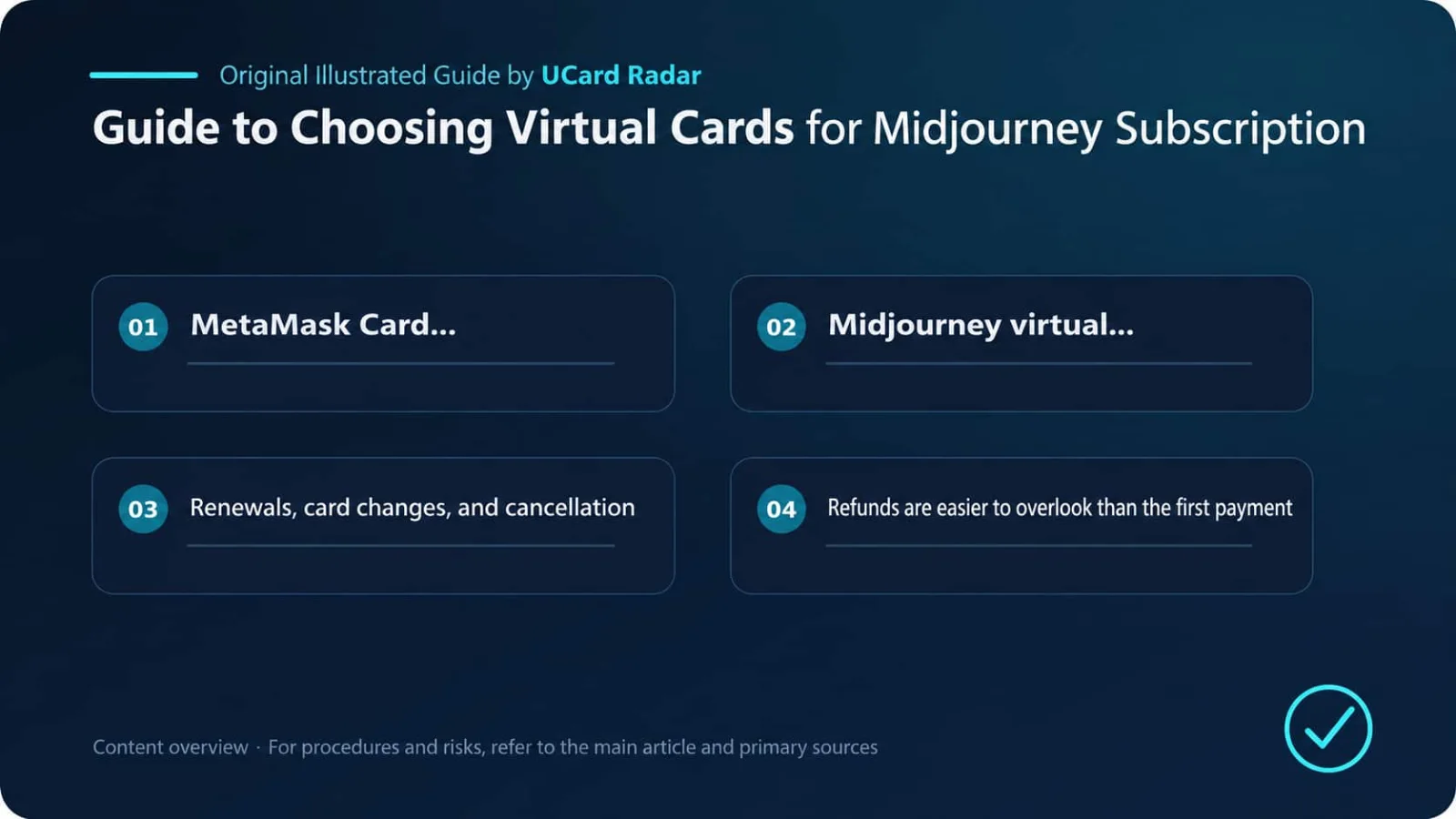
Sources and Scope of Conclusions
Primary-source verification: How to Subscribe; Editing Your Payment Information; Visa Core Rules and Visa Product and Service Rules.
The verifiable facts in this article regarding Midjourney subscriptions, billing information, and virtual-card payment flows are based on the cited official or regulatory documents. Actual service status, pricing, eligibility, and regional availability should be confirmed on the issuer’s or platform’s page at the time of application.
Different issuers, regions, account tiers, and merchant rules may produce different results. Experiences, success rates, fee comparisons, or trend assessments that are not directly disclosed in the primary sources above are analyses or inferences and have not been officially confirmed by the relevant institutions for individual cases.