
U cards (crypto payment cards) involve complex risks across multiple layers, including platforms, custody, stablecoins, and issuers. This article provides a detailed analysis of common risks and response strategies to help users use them more safely.
Article › Body
Yes, there are risks, and they do not come only from card fraud. U cards do solve some real-world problems. They may be used for overseas subscriptions, online services that local bank cards cannot cover, travel spending, and even everyday card payments. The problem is that a U card is not simply an ordinary bank card with a different top-up method. Users load digital assets such as USDT and USDC, but spending goes through the Visa or Mastercard network, with platforms, custodians, issuers, and payment processors in between.
A change at any layer can affect the final user experience.
So, whether a U card can be used depends on payment success rates; whether it is worth using long term depends on where funds are held, the issuing relationship, exit mechanisms, and account rules. These are two different questions and should not be confused.
1. What exactly is a U card, and why is its risk structure more complex?
What the market usually calls a U card generally refers to a crypto payment card, stablecoin card, or virtual card that is funded with digital assets such as USDT or USDC and then used for spending through the card network.
Visa refers to such products as stablecoin-linked cards, and Mastercard also has a Crypto Card Program. When a user pays, the merchant usually receives fiat settled through the card network rather than stablecoins directly.
This model can operate normally, but it involves more parties than a traditional bank card. A single U card may involve all of the following at the same time:
the operating platform that provides the website or app;
the wallet or custody institution that receives the stablecoins;
the settlement system responsible for asset conversion and balance bookkeeping;
the card infrastructure provider;
the bank or electronic money institution that actually issues the card;
the payment processor, card network, and merchant acquirer.
What users see is only a card number, a balance, and a top-up button, while multiple companies may be involved behind the scenes.
Being connected to Visa or Mastercard only means the card can transmit and process transactions through that network. Card networks usually do not bear the platform’s business losses, nor do they automatically compensate for stablecoin depreciation, custodial asset losses, or balance losses caused by platform failure.
2. Platform risk: the website still being online does not mean the funds are safe
Most users deal with the U card platform, not the issuing bank. Registration, KYC, top-ups, balance checks, and customer service are all handled through the platform front end.
But the platform may not hold an issuing license. Many platforms handle branding and user operations, while the card itself is issued by another institution. Once the relationship between the platform and the underlying partner is interrupted, the website may still be accessible while the card has already stopped working.
It may be unclear who is actually operating it
Some platforms disclose only the brand name, but not the full company name, registration jurisdiction, office address, or governing law for disputes. Users may realize only after depositing funds that they do not know who their contract is with, and that no formal complaint channel exists.
A relatively transparent platform should at least provide terms of service, a privacy policy, information about the operating entity, and card issuance details. If customer service exists only on Telegram or WhatsApp and no legal entity can be found on the website, it is not suitable for holding larger balances.
A platform may fail even without “running away with funds”
When a U card project stops operating, it is not always because the operator absconded with the money. Fraud losses, chargeback rates, card issuance costs, and compliance expenses can all crush a small platform.
If the underlying issuer or payment processor ends the partnership, the project may suddenly lose the ability to continue operating.
Such problems often have warning signs: declining payment success rates, slower deposits and withdrawals, customer support repeatedly replying with “system maintenance,” and increasingly frequent card replacement notices. One isolated event may not mean there is a problem, but several happening together should prompt caution.
The app balance may be only internal bookkeeping
A displayed balance of 100 USD may represent stablecoins in a custodial wallet, already converted fiat, prepaid funds under the card program, or simply an internal balance the platform promises to honor.
If the platform does not explain the fund structure, users cannot tell whether the displayed amount is backed by sufficient assets. An account that displays normally does not mean the platform can redeem everyone at once.
3. Custody risk: where is the money actually held?
Before using a U card, the key question is not how much the card-opening fee is, but who holds the funds after the top-up.
Properly regulated payment institutions usually separate customer funds from company operating funds. In principle, that means customer assets should not be directly used to repay the company’s ordinary debts even if the company runs into trouble.
In practice, it is not that simple. If a platform mixes user top-ups, agent funds, company income, and daily operating funds in the same wallet or account, then once the account is frozen or the platform enters insolvency proceedings, users may have difficulty proving which portion belongs to them.
The UK FCA requires payment institutions and electronic money institutions to adopt safeguarding measures for customer funds, and recent regulatory developments continue to focus on segregation, reconciliation, and insolvency return mechanisms. The fact that regulators keep refining these rules shows that customer fund protection is not solved simply by saying “bank-grade custody.”
A bank account does not automatically mean deposit insurance
When a platform says funds are held at a bank, users should continue asking: In whose name is the account? Are users the actual beneficial owners? Does it contain eligible bank deposits, or platform funds and proceeds from stablecoin conversion?
The U.S. Federal Deposit Insurance Corporation has made clear that FDIC insurance protects eligible deposits held at insured depository institutions; it does not protect crypto assets, nor does it compensate for losses caused by the business failure of a non-bank crypto company.
“Funds pass through a bank,” “customer funds are segregated,” and “deposit insurance applies” are not the same thing. When promotional pages blur these concepts together, users can easily overestimate the scope of protection.
4. Stablecoins themselves also create risk
USDT and USDC usually trade close to 1 USD, so many people treat them as digital dollars with no volatility. It is true that stablecoins aim to maintain a peg, but that target is not an unconditional guarantee.
Depegging and redemption
When the market questions the issuer, reserve assets, or redemption capacity, the price of a stablecoin may deviate from 1 USD. If a user tops up or converts funds at that moment, the resulting spendable balance may end up lower than expected.
In its recommendations on global stablecoin oversight, the Financial Stability Board emphasizes whether users can obtain clear and timely redemption. What the reserves consist of, who safeguards them, and whether ordinary users have direct redemption rights matter more than “the price has been stable most of the time.”
Addresses may be frozen
Some centralized stablecoin issuers can freeze specific on-chain addresses. If funds are linked to stolen assets, scams, sanctioned addresses, or other high-risk wallets, restrictions may follow.
This is not limited to users who actively participate in wrongdoing. Receiving funds from strangers, acting as an intermediary for top-ups, or accepting stablecoins of unclear origin may also trigger review because of unusual upstream fund flows.
Sending on the wrong network is hard to fix
The same stablecoin may exist on Ethereum, Tron, Solana, and other networks at the same time. A platform that supports USDT does not necessarily support every USDT network.
If the wrong network is chosen, the address is entered incorrectly, or a Memo is omitted, an on-chain transfer usually cannot be reversed. Some platforms may offer manual recovery, but the time and cost are uncertain. Testing with a small amount before sending a large deposit is the simplest safeguard.
5. Changes in the issuer can directly affect the life of the card
A U card platform usually cannot generate card numbers that work on the Visa or Mastercard network by itself. Real payment cards must be issued by a bank, an electronic money institution, or another qualified issuer.
The issuer is responsible for BIN, transaction authorization, spending limits, 3-D Secure, card freezes, and dispute handling. Once the platform’s cooperation with the issuer ends, common outcomes include the original card stopping payments, cards being replaced in bulk, or users being asked to deal with their balances within a limited time.
Existing subscriptions may also stop working, and Apple Pay and Google Pay may need to be set up again. Even users who have never violated any rules may be affected by a project-wide adjustment.
BIN risk should neither be exaggerated nor ignored
The first several digits of a payment card are BIN identification data, which can reflect the issuer, region, and card type.
If a BIN shows persistently high fraud or chargeback rates, issuers, processors, or merchants may raise the level of risk control, and ordinary users may encounter more verification and more declines.
But it is inaccurate to say that “if one person violates the rules once, the entire BIN is immediately blocked by the card network.” Whether broader restrictions are imposed depends on project fraud rates, chargeback rates, compliance issues, issuer policy, and merchant rules. BIN risk is real, but it is not a simple guilt-by-association mechanism.
6. KYC and compliance review may happen after funds are loaded
“No KYC” may sound convenient, but in actual use it can create greater uncertainty.
U cards connect both digital assets and card networks, so platforms usually need identity verification, sanctions screening, source-of-funds review, and suspicious transaction monitoring. FATF’s risk-based anti-money laundering standards and the Travel Rule also affect how virtual asset service providers collect and transmit transaction information.
The following situations are likely to trigger review:
a sudden increase in top-up amount;
clearly unusual transaction frequency or spending location;
long-term inconsistency among ID, phone number, IP address, and residential address;
using someone else’s identity or a purchased ready-made account;
multiple accounts sharing the same device;
stablecoins coming from a high-risk address;
inability to explain the source of funds.
Normal KYC does not mean a platform is unsafe. The more troublesome case is when a platform repeatedly claims before deposit that “no verification is required at all,” but after funds arrive it suddenly demands materials that are difficult to provide and then restricts withdrawals for a long time.
The risk of buying ready-made accounts is even more direct. The original verified person may recover the account through email, phone number, or identity verification, and during re-review the actual user cannot prove ownership either.
7. Payment failure does not necessarily mean the platform is in trouble
A successfully opened U card does not mean every merchant will accept it.
A payment goes through the issuer, payment processor, acquiring institution, and merchant risk controls. A card being classified as a virtual card or prepaid card, a billing address mismatch, a conflict between the issuing region and the account region, or unsupported recurring payments can all cause failure.
Hotels, car rentals, advertising platforms, and cloud services usually impose stricter requirements. Some merchants accept only credit cards, some reject foreign-issued cards, and some require higher preauthorization capacity.
EMV 3-D Secure helps reduce card-not-present fraud. During authentication, the merchant submits transaction and device information to the issuer, which decides whether SMS, app confirmation, or other verification is needed. Even if 3DS is completed, final authorization is not guaranteed.
An occasional payment failure is usually a compatibility issue or a real-time risk-control issue. But if many users simultaneously find that cards fail across all merchants, withdrawals are restricted, and support disappears, the situation is different.
8. Refunds, preauthorizations, and chargebacks are often more troublesome than payment itself
Smooth card opening and smooth spending only show that the first half of the chain works. The real test of a platform is refunds and dispute handling.
Refunds do not return immediately
After a merchant initiates a refund, the funds still have to pass through the acquirer, card network, payment processor, issuer, and U card platform. Delays in bookkeeping at any point affect the arrival time.
If the original card has already been canceled or replaced, refund handling becomes more complicated. Users need to confirm whether the platform can map a refund to the old card back to the new card or to the account balance.
Preauthorizations consume available balance
Hotels, car rentals, and self-service fuel stations usually place a preauthorization hold first, and the amount may be higher than the final charge. If the order later fails, the hold may still not be released immediately.
The app may still show a balance, but the amount truly available for spending has already been reduced. Repeating the payment under such circumstances may create multiple holds.
Chargeback rights vary by card
The dispute protections applicable to foreign crypto cards, prepaid cards, and traditional credit cards are not exactly the same. Seeing a Visa or Mastercard logo does not automatically mean the card has all the chargeback protections of a local bank credit card.
The card agreement should specify liability for unauthorized transactions, dispute deadlines, required evidence, investigation timelines, and fees. If the platform shuts down, there should also be a clear arrangement for who continues handling refunds and disputes.
9. Account and personal data leakage
Part of U card risk comes from the platform, and part comes from the user’s own email account, phone, and browser.
Fake websites, fake customer service, and malicious plugins are common entry points. If the card number, expiry date, CVC, and verification code are exposed together, an attacker may directly complete card-not-present transactions.
The ID documents and facial data submitted for KYC are equally sensitive. If they are stored by an unknown intermediary or a platform with weak security capability, the consequence is not only balance loss, but also identity misuse and targeted fraud.
At a minimum, daily use should include:
using a separate email address and different passwords;
enabling two-factor authentication and transaction notifications;
never sending the full card number or verification code to customer support;
never posting ID documents, facial data, or top-up receipts in group chats;
not installing apps, plugins, or configuration files from unknown sources;
disabling online payments or lowering limits when the card is not in use.
PCI DSS provides security requirements for institutions that handle payment card account data, but no compliance standard can keep passwords and verification codes safe on the user’s behalf.
10. What signals mean you should reduce your balance?
A single issue does not necessarily mean a platform is about to fail. But when the following occur together, it is not advisable to keep topping up.
No company details or formal terms can be found
The website has only a brand name, with no corporate entity, registered address, governing law, or complaint channel.
The issuer is not disclosed
The platform talks only about an “official Visa card” or an “international banking channel,” without saying who is responsible for card issuance and transaction authorization.
It promises all transactions will succeed
Claims such as “100% success at all merchants,” “never frozen,” “available to any country,” or “fully anonymous with unlimited limits” do not match how card payments actually work.
It asks you to transfer funds to a personal wallet
Proper top-ups are usually generated within the platform system and clearly show the asset and network. A customer service agent sending a personal wallet address on the fly is high risk.
You can top up, but exiting is difficult
The platform does not support withdrawals and does not explain how card cancellation refunds, refunds to the old card, or balance treatment after service termination work. Putting money in is easy, but there is no clear way out.
Frequent maintenance and repeated entity changes
Payment success rates keep falling, while the domain, app, customer service account, or company entity keeps changing. Users should promptly confirm whether their remaining balance can still be transferred out normally.
Fees are clearly inconsistent with the marketing
After a cheap card-opening price, you later discover top-up fees, conversion fees, cross-border fees, failed transaction fees, refund fees, and card closure fees. That suggests the platform did not fully disclose the real cost in advance.
11. How to judge whether a U card is worth using before applying
First check the operating entity and the issuing institution. If these two points are unclear, there is no need to rush into studying cashback or sign-up incentives.
Then clarify the status of funds after top-up:
whether the stablecoins remain in an on-chain wallet;
whether conversion happens in real time at the moment of spending;
whether the funds become fiat or electronic money balance after top-up;
whether the platform pools the funds into a single fund pool;
whether users can withdraw or close the card and recover the balance.
Do not look only at the card-opening fee. Top-up, conversion, cross-border, ATM, monthly, refund, failed transaction, and card closure fees may all affect the real cost.
For first use, do not start with a large amount. Complete a small closed-loop test first:
whether the deposit arrives normally;
whether ordinary online payments go through;
whether 3DS works properly;
whether merchant refunds come back;
whether the remaining balance can be withdrawn successfully;
whether customer support can locate specific transaction records.
A screenshot from someone else showing one successful payment proves only that that single payment succeeded. Only when top-up, spending, refunds, and withdrawal all work can you form a basic judgment about the platform’s real capabilities.
12. How to reduce the risks of using U cards
U cards are suitable for payments, not for long-term savings. Loading only what you need for near-term spending and not keeping large balances on the card for long periods is the most direct form of risk control.
Do not use purchased real-name accounts, and do not top up for strangers, make payments on behalf of strangers, or accept stablecoins from unclear sources. Many freezes are not caused by the spending behavior itself, but by identity, device, or source-of-funds issues that cannot be explained.
Records of top-ups, spending, refunds, withdrawals, and customer service communications should all be kept. If payment anomalies appear, first confirm the cause; if withdrawal delays, customer support disappearance, and changes in the underlying partnership occur at the same time, stop adding funds and reduce the balance as soon as possible.
High cashback, top-up rewards, and referral commissions can lower usage cost, but they should not be the reason to keep money in the system for a long time.
There are risks in using U cards, but the gap between platforms can be very large.
If the operating entity, issuing institution, and fund structure are all clear, the withdrawal and dispute rules are spelled out, and the platform can complete the full cycle of top-up, spending, refund, and withdrawal, such a product is more suitable as a day-to-day payment tool.
Conversely, if the platform entity is unclear, deposits are allowed but withdrawals are not, the structure depends on multiple layers of intermediaries, and “anonymous, unlimited, never frozen” is used as the main selling point, then the user is taking on more than mere payment-failure risk.
Before using the card, several practical questions should be answered: who holds the money, who issues the card, why the account may be frozen, where refunds go if the original card stops working, and how balances are recovered if the platform stops service.
If these questions are answered clearly, start with small amounts. If they are not, then do not leave large sums inside just because the card is cheap to open or offers high cashback.
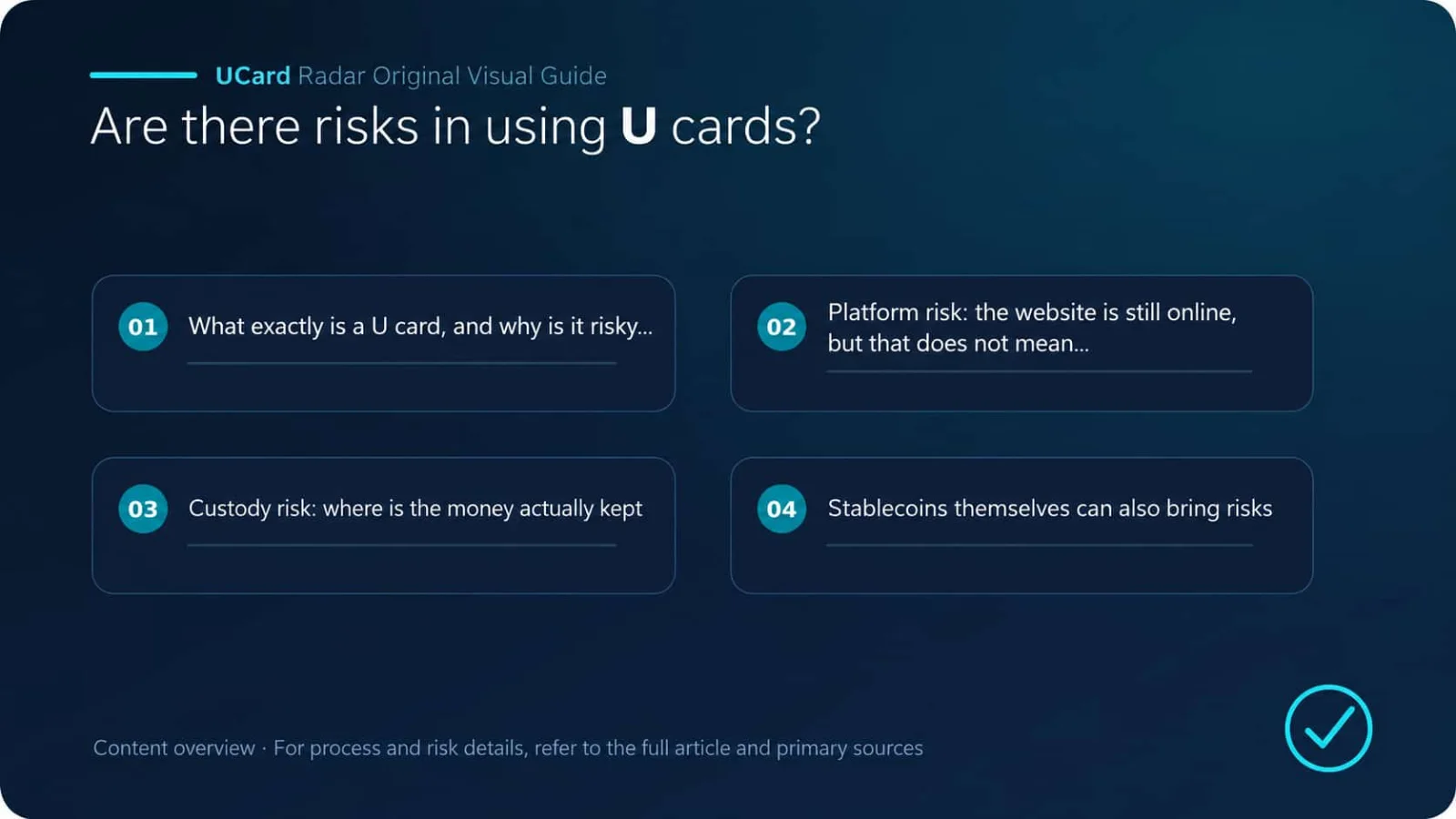
Original infographic: key points and decision process for whether there are risks in using U cards
Sources and boundary of conclusions
Primary verification: Visa Core Rules and Visa Product and Service Rules; What should I do if my prepaid card or PIN is lost or stolen, or I see unauthorized charges?; FATF Standards on Virtual Assets and VASPs.
The verifiable facts in this article regarding U-card funds, transaction authorization, and unauthorized-transaction risk are based on the listed official or regulatory documents. Actual service status, fees, eligibility, and geographic scope should be determined based on the issuer’s or platform’s pages at the time of application.
Different issuers, regions, account tiers, and merchant rules may produce different outcomes. User experience, success rates, fee comparisons, or trend judgments not directly disclosed by the above primary sources are analytical or inferential and have not been officially confirmed by the relevant institutions for individual cases.