
A few years ago, one of the most common marketing claims for crypto payment cards was “sign up and get a card instantly.”
Users entered an email address, uploaded a passport or identity document, completed facial verification and received a virtual card within minutes. Some smaller platforms even promoted “no KYC” as a core selling point in an attempt to differentiate themselves from exchange cards and traditional fintech accounts.
That model is now fading. By 2026, identity checks for mainstream crypto payment cards no longer stop at account opening. Platforms need to establish not only who the user is, but where the user lives, where the money comes from, which addresses on-chain assets have passed through, whether account activity matches the information originally declared, and whether the user continues to meet eligibility requirements in the card-issuing region.
Even a user who has already completed KYC may later be asked for additional documents when funding the account, requesting higher limits, applying for a physical card, receiving a large stablecoin transfer, frequently changing devices, or transferring funds to a self-custody wallet.
KYC is no longer simply an onboarding gate. It has become a risk-control mechanism spanning the entire lifecycle of the account.
Sources and Boundaries of the Conclusions
Primary-source verification: FATF Standards on Virtual Assets and VASPs; Spend Stablecoins with Gate Card; Coinbase Card - Debit card overview.
The verifiable facts in this article concerning 2026 changes to KYC, AML/CFT and regional eligibility rules for crypto payment cards are based on the official or regulatory sources listed above. Actual service availability, pricing, eligibility and geographic coverage should be confirmed on the issuer's or platform's page at the time of application.
Different issuers, jurisdictions, account tiers and merchant rules may produce different results. Any discussion of user experience, success rates, fee comparisons or trends not directly disclosed in the primary sources above should be treated as analysis or inference rather than an officially confirmed conclusion for a particular case.
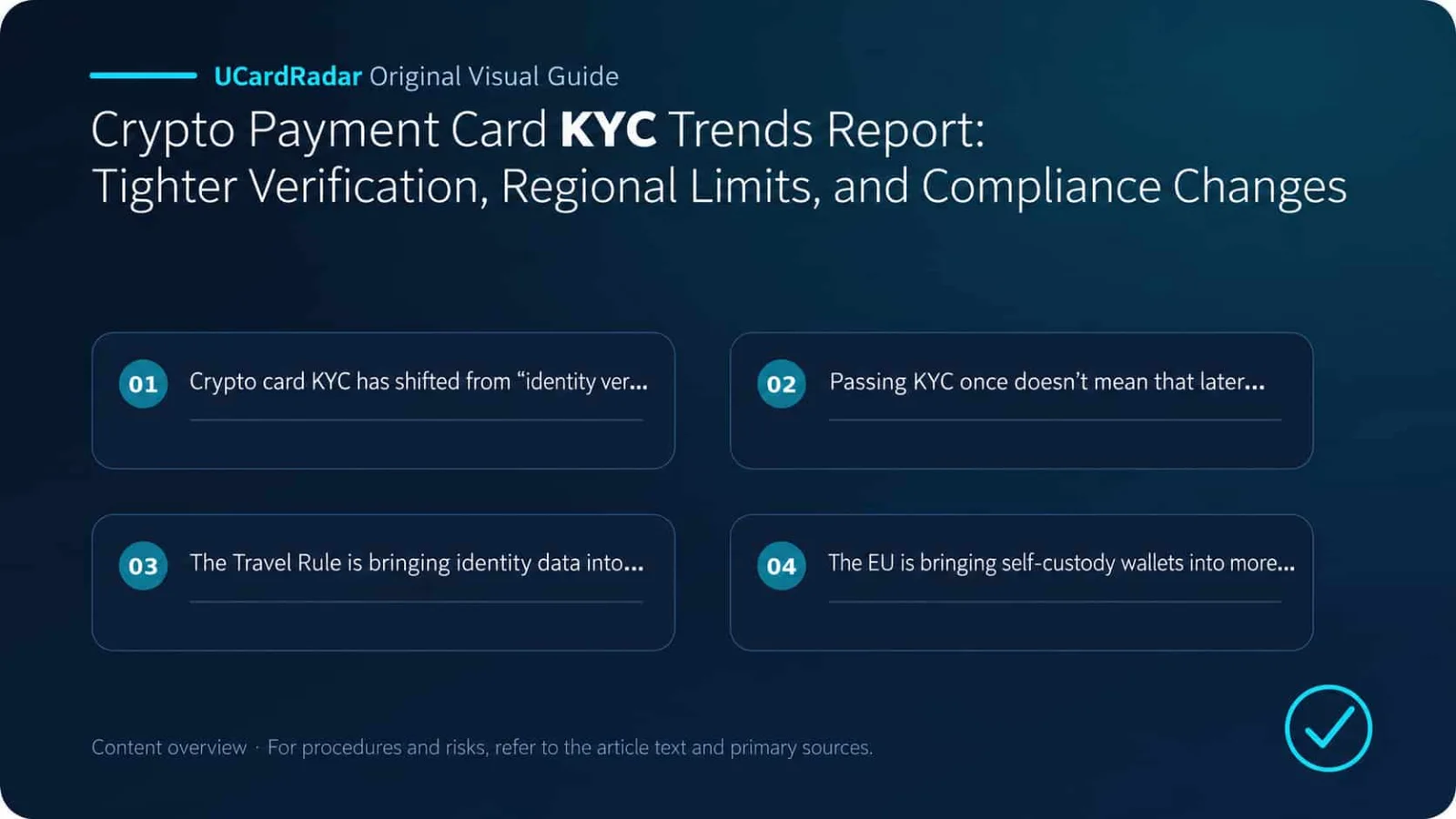
1. Crypto Card KYC Has Shifted From “Verifying Identity” to “Verifying the Entire Flow of Funds”
Traditional KYC mainly answered one question: is the applicant actually the person shown on the identity document?
Today, crypto payment card platforms commonly need to complete at least seven layers of checks.
Review Area | What the Platform Mainly Verifies |
|---|---|
Identity information | Name, date of birth, nationality and document number |
Biometrics | Face, liveness detection and whether the document holder is the applicant |
Residential address | Whether the user genuinely resides in a country or region supported for card issuance |
Sanctions and PEP screening | Whether the user appears on sanctions or law-enforcement lists or presents politically exposed person risk |
Source of funds | Whether deposits come from salary, business income, investment returns or third-party accounts |
On-chain fund flows | Whether assets have passed through mixers, hacker-linked addresses, scam addresses or sanctioned platforms |
Ongoing transaction monitoring | Whether actual behavior remains consistent with the purpose and income level declared at onboarding |
As a result, the complete review process for a crypto payment card now looks much more like opening and maintaining a bank account than buying an ordinary gift card.
Crypto.com publicly lists identity documents, proof of residential address, video verification and source-of-funds documentation among the materials that may be required. For larger crypto deposits, the platform may ask users to explain when and how the assets were obtained and provide bank statements, payslips, exchange records or other supporting evidence.
Wirex also states that users may be asked, during or after verification, to provide source-of-funds and source-of-wealth documentation. Accepted evidence can include payslips, tax returns, bank statements, exchange deposit and withdrawal records, and proof of investment or trading profits.
These requirements show that platforms no longer only need to know “who owns the account.” They also need to determine whether “the money in the account is consistent with that person's identity and economic profile.”
2. Passing KYC Once Does Not Mean There Will Be No Further Reviews
Many users still think of KYC as a one-time process: once approved, the account gains permanent eligibility.
In reality, licensed card issuers are subject to ongoing customer due diligence obligations. Expired documents, changes in risk level or significant shifts in transaction behavior can all trigger a fresh review.
Bybit has established a separate Enhanced Due Diligence, or EDD, process. When account activity or regulatory requirements call for deeper review, users may need to complete additional verification. Its latest personal verification framework also links higher-level identity checks with EDD procedures.
RedotPay likewise explains that users may be asked during the life of the account to provide personal declarations, source-of-funds information or source-of-wealth materials rather than having their identity checked only at initial registration.
Wirex states directly in its terms that users must cooperate with ongoing checks relating to identity, address, source of funds and other required information. The platform monitors account activity for AML, sanctions, fraud and security purposes.
Common triggers for re-verification include:
Identity documents approaching expiry or being replaced;
A change in country of residence;
Long-term inconsistency between login location and registered address;
Significant increases in deposit or withdrawal amounts;
Funds arriving from multiple unrelated wallets;
Funding through third-party bank cards or third-party accounts;
Requests for higher spending or withdrawal limits;
Frequent deposits, purchases and withdrawals within a short period;
Receiving large amounts that clearly do not match declared income;
High-value transfers involving self-custody wallets;
On-chain fund flows linked to high-risk addresses;
Unusual refunds, chargebacks or cash-like transactions.
None of these situations automatically means a user is involved in illegal activity. But the platform may need to reconfirm the purpose of the transactions and the origin of the funds.
For users, the important point is this: passing KYC marks the beginning of the account relationship, not the end of compliance review.
3. The Travel Rule Is Bringing Identity Information Into On-Chain Transfers
One of the main forces behind tighter crypto-platform verification is the gradual global implementation of the FATF Travel Rule.
The Travel Rule requires regulated virtual asset service providers to collect, retain and transmit necessary information about originators and beneficiaries when processing transfers. Its purpose is similar to payer-information rules in bank wire transfers: to make the movement of funds traceable.
In its 2025 implementation update, FATF said that 99 jurisdictions had adopted or were in the process of developing Travel Rule legislation. These jurisdictions represented roughly 98% of the world's significant virtual-asset market.
FATF also revised Recommendation 16 in 2025 to further harmonize information standards for cross-border payments. For relevant cross-border transfers above USD 1,000 or EUR 1,000, standard information includes name, address and date of birth. Ordinary credit-card, debit-card or prepaid-card purchases of goods and services can still be exempt from the full Travel Rule framework, but that exemption does not mean card funding, stablecoin transfers and wallet withdrawals are all exempt.
This distinction matters.
When a user pays a merchant with a crypto card, the transaction is generally treated as a card purchase. But before the card is used, moving USDT from an external wallet into the platform, or from the platform to another wallet, is a separate leg of the fund flow.
As a result, a platform may not ask for beneficiary details during an ordinary card purchase, but may ask during stablecoin deposits or withdrawals:
Whether the wallet belongs to the user;
Whether the funds came from a personal wallet or an exchange;
Who the sender or recipient is;
What the transfer is for;
How the assets were originally acquired.
Crypto payment cards bridge on-chain assets and bank-card infrastructure. That also means on-chain transfers and traditional financial compliance are increasingly entering the same review framework.
4. The EU Is Bringing Self-Custody Wallets Into a More Explicit Review Framework
The European Union is one of the clearest markets today when it comes to information requirements for crypto transfers.
The EU Transfer of Funds Regulation has applied to certain crypto-asset transfers since December 30, 2024. Where one side of a transaction involves an EU-based crypto-asset service provider, relevant information about both the originator and beneficiary must travel with the transfer.
The regulation does not prohibit self-custody wallets, but it requires service providers to identify transfers involving self-hosted addresses and take additional risk-based measures.
For transfers above EUR 1,000 from a platform account to a user's self-custody address, or from a self-custody address into a platform account, the provider must take appropriate steps to assess whether the address is actually owned or controlled by its customer.
Methods used to verify wallet control may include:
Completing a small verification transfer from the target wallet;
Signing a message;
Providing screenshots of the wallet interface;
Connecting the wallet and completing a technical verification;
Combining blockchain analytics with third-party data;
Asking the user to explain who owns the wallet and the relationship between the parties.
For transfers with missing information or elevated risk, EU service providers may choose, according to their internal risk procedures, to execute, return, reject or suspend the transaction. Unusual transfers involving self-hosted addresses may also trigger enhanced due diligence, including questions about the source of the assets, the destination address and the beneficial owner.
The impact on European crypto cards is direct.
In the past, a user might simply send USDC into a card account and start spending. Today, a platform may need not only to verify the user's identity, but also to establish which wallet the USDC came from and whether that wallet is controlled by the user.
MiCA addresses market access for crypto-asset service providers and stablecoins, while the Travel Rule addresses information traceability when funds move between platforms and wallets. Together, these frameworks make ambiguous account and fund structures increasingly difficult for European crypto-card products. Most MiCA provisions became applicable on December 30, 2024, while provisions relating to stablecoins began applying earlier, on June 30, 2024.
5. Regional Restrictions Are Moving From “Residency Checks” to Multi-Dimensional Screening
In the past, platforms often determined card eligibility mainly by looking at the user's country of residence.
Today, a growing number of platforms check several dimensions at the same time:
Nationality;
Legal residence;
Country that issued the identity document;
Current login location;
Country code of the mobile number;
Country that issued the proof of address;
Physical card delivery address;
Tax residence;
Country from which funds originate;
Nationality of the ultimate beneficial owner.
This means that even someone with an address in a supported country may not necessarily qualify.
For example, Bybit states in its business verification rules that restrictions can apply both to the place where a company is incorporated and to the nationality or residence of its ultimate beneficial owners.
Gnosis Pay requires applicants to be lawful residents of supported countries or regions. Applicants must submit a government-issued identity document and recent proof of address, with the address document issued in the country of residence. Its KYC system may also use internal and external risk data to make a final decision to reject higher-risk applications.
RedotPay manages citizenship restrictions separately from location-access restrictions. Some users may be unable to complete KYC because of nationality; even where an account already exists, accessing the service from a restricted location may trigger location controls.
As a result, the following approaches are becoming increasingly difficult to rely on over the long term:
Applying with a hotel or friend's address;
Using a virtual address instead of a genuine residence;
Using a VPN over the long term to disguise the actual country;
Using a phone number or identity document that does not match the real place of residence;
Applying through an overseas company without disclosing the actual controller;
Funding one's own card through another person's bank account or wallet.
Even if the account is initially approved, inconsistencies between later transaction behavior, device information and address documents may still lead to renewed review.
6. Singapore: Offshore Incorporation No Longer Means Global Operating Freedom
Singapore previously attracted a large number of crypto businesses to incorporate there, but regulatory boundaries have tightened noticeably since 2025.
From June 30, 2025, firms providing digital token services from Singapore—even where their main clients are overseas—must comply with new regulatory requirements for digital token service providers. The Monetary Authority of Singapore has stated that such businesses present elevated money-laundering risk and that licensing standards will be very strict.
Relevant service providers are expected to maintain AML and counter-terrorist-financing controls, identify customers, monitor transactions and prevent illicit funds from flowing through Singapore's financial system.
The impact on the crypto-card industry extends beyond Singapore-focused products.
In the past, some projects highlighted the existence of a “Singapore company” to create an image of regulatory legitimacy even though actual card issuance, custody and user services were located elsewhere. Today, company registration alone no longer demonstrates that a platform is authorized to provide digital-token or payment services to users globally.
Users need to verify:
What business the Singapore company actually performs;
Whether it holds the required licenses;
Who issues the card;
Which legal entity enters into the contract with the user;
Which institution holds customer funds;
Which jurisdiction handles disputes.
The place of incorporation, operational headquarters, card issuer location and user-facing contracting entity may all be different.
7. Hong Kong: Stablecoin Licensing Has Arrived, Alongside Higher AML Requirements
Hong Kong's regulatory regime for stablecoin issuers formally took effect on August 1, 2025. Issuing fiat-referenced stablecoins became a regulated activity, requiring the relevant institutions to obtain licenses and comply with reserve, risk-management, disclosure, audit and AML requirements.
The Hong Kong Monetary Authority also issued AML and counter-terrorist-financing guidance for licensed stablecoin issuers and stated that it would supervise the related risk-management systems of licensed institutions.
In April 2026, the Hong Kong Monetary Authority issued the first stablecoin-issuer licenses to Anchorpoint Financial and HSBC.
However, the introduction of stablecoin regulation in Hong Kong does not mean Hong Kong residents automatically qualify for every international crypto payment card.
Stablecoin issuance, virtual-asset trading platforms, e-wallets and payment cards are governed by different sets of rules. International card platforms also decide whether to serve Hong Kong users according to their own issuing arrangements, card-network requirements and global risk policies.
For example, Bybit still lists Hong Kong among excluded jurisdictions in its latest service restrictions.
This shows that “a jurisdiction developing its virtual-asset industry” and “an overseas platform issuing cards to residents of that jurisdiction” are not the same question.
Hong Kong may see more stablecoin accounts and payment products involving locally licensed institutions, but verification requirements are unlikely to become looser. If anything, issuers are likely to place greater emphasis on genuine identity, address, source of funds and the path through which stablecoins move.
8. United States: Crypto Cards Ultimately Still Sit Inside the Financial-Sector AML Framework
The United States does not have a single unified KYC regime designed specifically for “crypto payment cards.” However, institutions involved in exchanging or transmitting convertible virtual currency may be treated as money services businesses or money transmitters and therefore be subject to registration, AML, recordkeeping, monitoring and reporting obligations.
That means crypto cards offered to US users generally involve at least two layers of compliance:
One layer comes from the wallet, exchange or crypto-asset service provider, which reviews on-chain funds and crypto activity. The other comes from the bank or licensed card issuer, which is responsible for card accounts, sanctions screening, transaction monitoring and suspicious activity reporting.
The user may see a single app, but multiple institutions may be conducting separate reviews behind the scenes.
This also explains why US crypto-card users often encounter repeated verification. A platform may already have verified an identity document, while the partner bank may still independently require confirmation of name, Social Security number, address, tax information and intended use of funds.
Passing KYC on the crypto platform does not automatically mean the issuing bank must accept that user.
9. United Kingdom: Registration Also Means Ongoing Supervision
The UK's Financial Conduct Authority requires firms providing crypto-asset services covered by UK anti-money-laundering regulations to register with the FCA. The focus of registration is not merely whether the company exists, but also its AML systems, the fitness and propriety of management, and its operational controls.
For crypto payment cards, wallet and trading services may be provided by a crypto-asset firm, while the card and fiat account may be provided by an electronic money institution or another regulated financial institution.
As a result, UK users may face several layers of review at the same time:
KYC by the crypto platform;
Electronic-money account verification;
Card-issuer review;
Source-of-funds checks;
Ongoing sanctions and transaction monitoring.
The UK terms of Wirex provide a typical example of this structure. The platform requires identity and address verification and also reserves the right to ask users to explain their source of funds and provide other financial information.
A statement that a company is “registered in the UK” only means that it falls within a certain regulatory perimeter. It does not mean customer accounts cannot be restricted, nor does it replace the need to verify the actual issuer and the arrangements protecting customer funds.
10. “Low KYC” Is Turning Into Staged KYC
Crypto virtual cards marketed as “low KYC” still exist, but low KYC usually does not mean no identity verification.
A more common model is staged verification.
At registration, users may submit relatively little information and gain access to a low-limit virtual card. Once spending, deposits or withdrawals reach certain thresholds, the platform may then request additional identity documents, proof of address and source-of-funds information.
This approach can reduce drop-off during onboarding, but it does not eliminate later compliance obligations.
A common structure looks like this:
Account Stage | Possible Required Information |
|---|---|
Registration | Email, mobile number, name and date of birth |
Basic verification | Identity document and facial liveness check |
Card application | Residential address and proof of address |
Higher limits | Occupation, income and intended account use |
Large deposit | Source-of-funds evidence |
High-risk transaction | Source of wealth, wallet ownership and transaction explanation |
Business account | Company-registration documents, directors, shareholders and ultimate beneficial-owner information |
When a user sees “no proof of address required when opening the card,” it may simply mean that the verification process has not yet reached the next stage.
Truly no-KYC products generally face three problems.
First, they struggle to secure stable Visa or Mastercard issuing partnerships. Licensed issuers need to know who the ultimate cardholder is, and fully anonymous long-term bank-card accounts are difficult to reconcile with the existing financial regulatory framework.
Second, the identity check may simply be delayed until after the user has deposited money. Once the user's funds are already on the platform, receiving a request for additional verification puts the user in a much weaker position.
Third, the product may rely on short-term prepaid cards or multi-layer intermediary structures. The card may work temporarily, but refunds, balance redemption and account appeals may lack reliable protection.
For that reason, “no KYC” is not inherently an advantage. For users who need long-term card access, refunds or stored balances, it often implies greater operational and financial risk.
11. Why Source of Funds and Source of Wealth Are Becoming More Important
Source of funds and source of wealth are often confused.
Source of funds looks at where a particular transfer came from. For example, if a user sends USD 50,000 in USDC to a platform, the platform may ask whether that USDC came from salary savings, the sale of an asset, business income or investment gains on an exchange.
Source of wealth looks at how the user's overall wealth was accumulated. If a user routinely conducts high-value transactions, the platform may want to understand that person's occupation, business income, property sales, investment portfolio or inheritance history.
In the context of crypto payment cards, platforms pay particular attention to situations such as:
Large amounts transferred directly from external wallets;
Funds passing through multiple wallets and cross-chain bridges;
Deposit amounts that do not match declared income;
Funds arriving from third parties with no verified identity;
Assets that are quickly spent or withdrawn after arrival;
Users repeatedly funding different accounts;
Transaction histories that do not clearly establish when and at what cost assets were acquired;
Funds passing through privacy tools or high-risk services.
Crypto.com states that for larger crypto-asset deposits, users may be asked to explain how and when the assets were acquired. Wirex accepts exchange records, bank statements, payslips and tax documents as evidence of source of funds or source of wealth.
For users who expect to use crypto cards over the long term, it is increasingly important to retain:
Bank statements showing fiat funding;
Exchange purchase records;
On-chain transaction hashes;
Evidence of salary or business income;
Tax returns;
Asset-sale agreements;
Explanations of ownership relationships between wallets;
Records of early crypto holdings and investment gains.
Reconstructing a complete fund trail later is usually much harder than preserving records when the transactions occur.
12. Self-Custody Cards Will Not Eliminate KYC
Self-custody payment cards are often described as a freer alternative to exchange cards.
From the standpoint of asset control, there is some truth to that claim. Users may be able to keep stablecoins in their own smart accounts or on-chain wallets rather than leaving them for long periods on a centralized exchange.
But self-custody changes the custody model, not the rules governing card issuance.
Gnosis Pay requires users to complete identity verification and provide government-issued identification and proof of residential address. Card eligibility and issuing activities still involve licensed partners.
In the EU, transfers above EUR 1,000 between a self-custody wallet and a regulated platform may also trigger verification of wallet control.
The more accurate definition of a self-custody card is therefore:
Users can retain greater control over their assets, but when they use the bank-card network they still need to open an account under their real identity and remain subject to transaction monitoring.
“Self-custody” and “anonymous use” are not the same thing.
13. Chinese-Speaking Users Face Layered Restrictions, Not a Single Unified Policy
When discussing crypto cards, Chinese-speaking users often group Mainland China, Hong Kong, Macau and Taiwan together.
That approach is becoming increasingly inaccurate.
Platforms may make separate decisions based on nationality, residence, place of issue of the identity document and current access location. The same product might accept residents of Taiwan but reject residents of Mainland China; it might accept a Hong Kong identity document but not a Hong Kong residential address; or it may allow users in a jurisdiction to open a wallet account without making the card itself available.
As of 2026, Bybit lists Mainland China and Hong Kong among excluded service regions.
RedotPay, in its latest unsupported-region guidance, lists Mainland China among jurisdictions where users cannot complete KYC or use the service and separately applies location-access restrictions.
These policies can change with issuers, licensing arrangements and risk strategy, so old guides should not be relied on to determine current eligibility.
For Mainland Chinese users, the risks of using overseas addresses, VPNs or another person's information to bypass regional restrictions are increasing. Platforms may discover inconsistencies at login, funding, physical-card delivery or supplementary verification stages and restrict the account.
Hong Kong users likewise should not assume that the existence of a virtual-asset and stablecoin regulatory regime means every international card platform will accept applications from Hong Kong residents. Each platform still makes its own decision.
Macau and Taiwan need to be checked separately rather than inferred from a single “China region” label.
The most reliable approach is to check all of the following:
Whether the nationality is accepted;
Whether the current place of residence is accepted;
Whether the relevant identity document is supported;
Whether genuine proof of address can be provided;
Whether a physical card can legally be delivered;
Whether the login location is within a permitted region;
Whether the card program itself—not merely the platform account—is available.
14. Why Platforms Would Rather Reject Users Than Loosen Verification
The crypto-card market is growing quickly, but issuers also face concentrated risk.
If a platform becomes associated with large-scale money laundering, sanctions evasion, fraudulent funding or illegal cash-out activity, the consequences may extend far beyond a single brand. They can affect the issuing bank, program manager, BIN arrangement and card-network relationships.
Many crypto-card brands do not hold card-issuing licenses themselves. They rely on banks, electronic money institutions or card-issuing infrastructure companies.
If an underlying institution judges a market to be too risky, it may require the platform to:
Stop accepting new users from that region;
Re-verify existing users;
Reduce spending and withdrawal limits;
Add source-of-funds checks;
Block certain merchant categories;
Stop delivering physical cards;
Change the issuer or reissue cards;
Close accounts that cannot complete supplementary verification.
For a platform, losing some users in a high-risk jurisdiction is often easier to accept than losing the entire card program.
Regional restrictions therefore do not necessarily come from a direct government ban. They may instead originate with the issuing bank, card network, insurer or the platform's own internal risk model.
15. KYC Trends for the Second Half of 2026
Proof of Address Will Become a Standard Card-Application Requirement
Products that allow a user to obtain a global virtual card using only a passport are likely to keep disappearing. Issuers need to establish which service region the user actually belongs to and prevent cross-region onboarding through virtual addresses.
Crypto.com requires card applicants to provide a residential address; Gnosis Pay requires proof of address to be issued in the applicant's country of residence.
Dynamic Facial and Video Verification Will Replace Simple Selfies
Static selfies are easier to defeat with stolen images, deepfakes and document trading. Platforms are likely to rely more heavily on liveness movements, random instructions, video verification and device-risk detection.
In some security-verification processes, Crypto.com requires users to display an identity document, record front and side views of their face and say specified content together with the current date.
Source-of-Funds Reviews Will Expand From High-Balance Users to Users With Abnormal Behavior
In the future, source-of-funds requests will not necessarily be limited to users with large balances. Even relatively small amounts may trigger review if the transaction pattern is unusual, funds are linked to high-risk on-chain addresses or activity does not match account information.
Self-Custody Wallet Verification Will Become More Common
The EU has already established a relatively clear framework, while other markets are also implementing the Travel Rule. Wallet signatures, small verification transfers and wallet-ownership declarations may gradually become standard steps when funds move between exchanges, stablecoin accounts and crypto cards.
Nationality, Residence and Login Location Will Be Cross-Checked
Platforms will increasingly move beyond the country the user enters on a form. Conflicts among identity documents, address, IP, mobile number, device data and card-delivery location will become important risk signals.
Ultimate Beneficial-Owner Checks for Corporate Cards Will Intensify
A company's place of incorporation does not conceal the real controller. Corporate crypto-card programs will increasingly scrutinize directors, shareholders, ultimate beneficial owners, business model, customer base and intended use of funds.
Small No-KYC Card Providers Will Continue to Be Eliminated
Fully anonymous cards are difficult to keep connected to mainstream issuing infrastructure over the long term. Some products may move toward low-limit, disposable or purpose-specific prepaid cards, while others may introduce KYC after operating for a period of time or disappear altogether.
16. How Users Should Prepare
As KYC becomes stricter, the most realistic strategy is not to search for a platform that will never ask questions, but to reduce the risk of being unable to explain one's funds when supplementary review occurs.
Before applying, users should confirm:
Whether the product explicitly supports their nationality and place of residence;
Whether the card issuer and operating entity are disclosed;
Whether proof of address is required;
Whether the platform provides a withdrawal route and an account-appeal process;
Whether the terms permit re-verification and account freezes;
How remaining balances are returned after card termination.
During use, users should retain:
Identity documents and valid proof of address;
Fiat funding records;
Exchange purchase records;
Wallet transaction hashes;
Income and tax documentation;
Documents explaining the source of large assets;
Refund and merchant-dispute records.
Account behavior should also remain consistent:
Do not use another person's account to fund the card;
Do not hand the card to someone else for long-term use;
Do not frequently switch to false locations;
Do not fund the account from wallets whose source cannot be explained;
Do not keep balances in the account for long periods beyond normal spending needs;
When asked for supplementary review, confirm the official submission channel before sending documents.
The crypto payment card market is still expanding in 2026, but opening an account is becoming more difficult. This does not mean crypto payment cards are losing room to grow. It means the industry is beginning to operate inside the licensed financial system in a more meaningful way.
Visa and Mastercard networks require the real cardholder to be identifiable; issuing banks must perform customer due diligence; crypto platforms must review on-chain funds; and regulators increasingly require funds to remain traceable as they move between platforms and wallets.
What used to be a one-time identity check is turning into ongoing review of identity, address, source of funds, wallet ownership and transaction behavior.
For platforms, KYC determines whether they can preserve relationships with issuers, BIN sponsors and card networks. For users, KYC determines not only whether a card can be opened, but whether deposits will be credited, spending can continue, refunds will return and remaining balances can be withdrawn smoothly.
The crypto payment cards worth choosing in the future will not be those that promise never to check identity. They will be those with clear verification standards, transparent regional policies, reliable exit routes for funds and a normal appeal process when reviews are triggered.
Data cutoff: July 19, 2026