
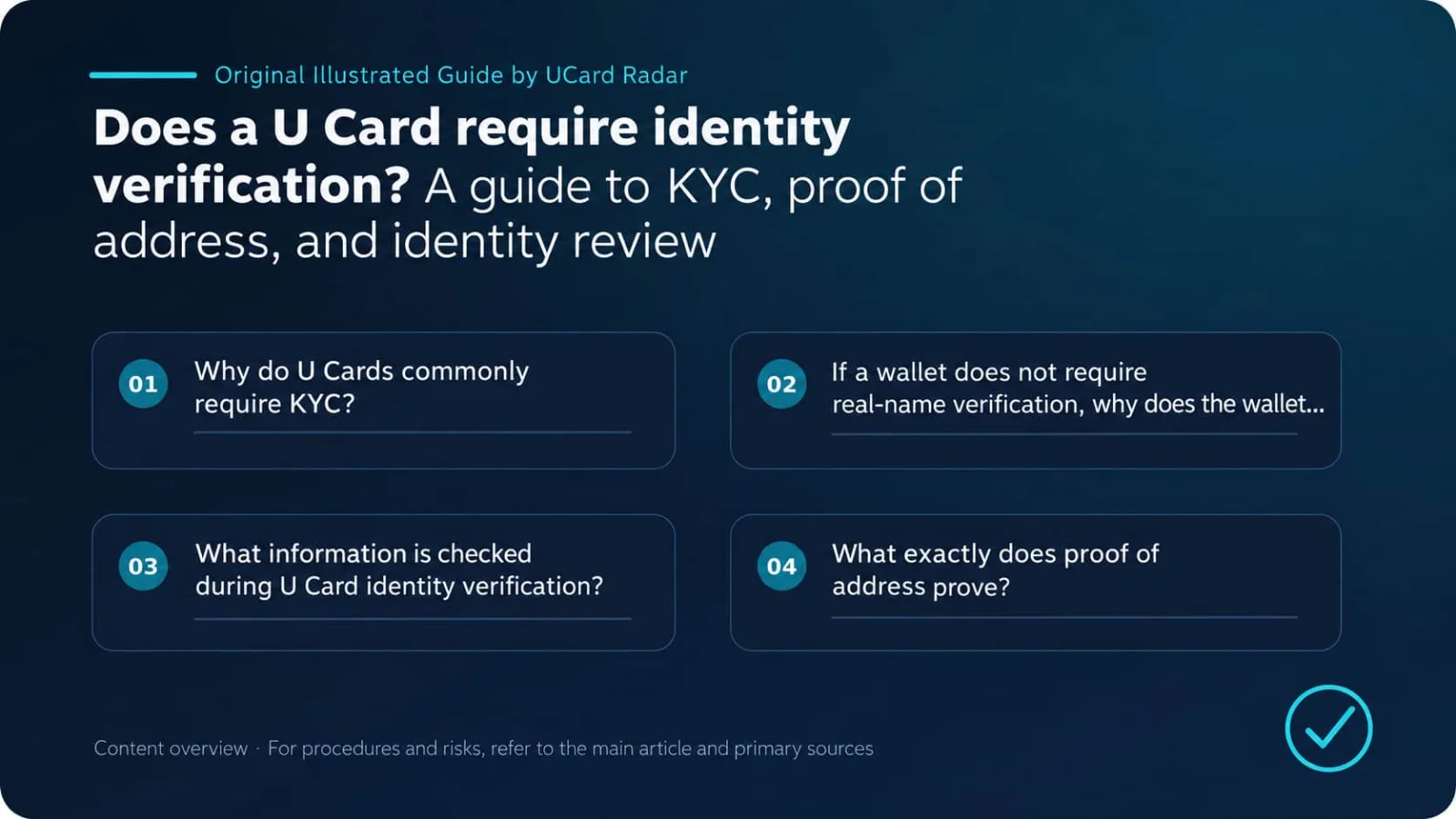
Do You Need Identity Verification to Apply for a U Card?
In most cases, yes.
U Cards that support ongoing funding, USDT or USDC conversion, and spending through Visa or Mastercard generally require users to complete KYC. Basic verification usually includes legal name, date of birth, nationality, place of residence, identity documents, and facial verification. Depending on the card type and account risk profile, the platform may also request proof of address, occupation, intended card use, and source of funds.
However, verification procedures vary by platform.
Some platforms initially verify only identity documents and facial biometrics, then request proof of address when the user applies for a physical card or raises account limits. Others ask about the source of funds when a user makes a first large deposit. Users who have already used a card normally for some time may also be asked to verify again after changing residence, making unusually large transactions, or receiving funds from a high-risk wallet.
KYC is therefore not a one-time procedure completed only when opening an account. As long as the account remains active, the platform may conduct additional reviews based on risk.
Scope of Sources and Conclusions
Primary-source verification: Updated Guidance for a Risk-Based Approach to Virtual Assets and VASPs; Cryptoassets: AML / CTF regime; Financial Services Register.
Verifiable statements in this article concerning U Card KYC, customer due diligence, the Travel Rule, and ongoing transaction monitoring are based on the listed official or regulatory documents. Actual service availability, pricing, eligibility, and geographic coverage should be confirmed on the issuer’s or platform’s current application pages.
Accepted identity documents, proof-of-address validity periods, and supported regions vary by platform and must be checked on the platform’s official website. Forged or borrowed documents must not be used. Experiences, approval rates, fee comparisons, or trend assessments not directly disclosed in the primary sources above are analysis or inference and have not been officially confirmed by the relevant institutions for individual cases.
1. Why Do U Cards Commonly Require KYC?
A U Card may look like an ordinary virtual or physical card, but the underlying service can involve crypto-asset custody, stablecoin funding, crypto-to-fiat conversion, prepaid balances, and card payments.
The platform must know who the user is, where the user lives, and where the funds come from. It must also determine whether it is legally permitted to provide services to that user.
The Financial Action Task Force (FATF) requires virtual asset service providers to conduct customer due diligence in accordance with applicable local laws and to obtain and verify customer identity information. Virtual asset transfers may also be subject to the Travel Rule, which can require service providers to collect, retain, or transmit certain information about originators and beneficiaries.
Platforms conduct KYC mainly to determine:
Whether the user is the person they claim to be;
Whether the user is located in a restricted or sanctioned jurisdiction;
Whether the account involves identity theft, bulk registrations, or multi-account abuse;
Whether the actual cardholder and the person controlling the funds are the same;
Which cards, currencies, limits, and features may be made available;
Whether funds can be traced if unusual funding, withdrawals, or spending occur.
Identity verification is only the first step. Platforms also consider residence, account purpose, and transaction activity when deciding whether to accept a user and which functions to enable.
2. If a Wallet Does Not Require Identity Verification, Why Does the Card Inside It?
This distinction is easy to misunderstand.
Self-custodial wallets such as MetaMask and Rabby generally do not require users to submit identity documents. A wallet helps users manage private keys and on-chain assets and does not necessarily open a financial account on their behalf.
Once a payment-card product is added, the nature of the service changes.
For example, an ordinary MetaMask wallet does not ask users by email or direct message to verify their identity. However, when applying for MetaMask Card, users need to register a card account, verify a mobile number, and complete KYC. Personal data and the card account are managed by partner service providers.
Relevant information can be found in MetaMask Card onboarding documentation and MetaMask identity-verification warnings.
To determine whether a wallet-linked card requires identity verification, check whether it opens a bank-card or prepaid-card account and whether it provides asset conversion, fiat funding, withdrawals, or cross-border payments.
A wallet not requiring KYC does not mean the payment card connected to it can be used anonymously.
3. What Information Is Checked During U Card Identity Verification?
Basic Personal Information
Users are typically asked to provide:
Legal name;
Date of birth;
Nationality;
Current country or region of residence;
Full residential address;
Mobile phone number and email address;
Tax residency or tax identification number where required.
The name must match the identity document. Omitting a middle name, reversing first and last names, using a different romanization, or entering a nickname can prevent automated matching.
Identity Documents
Common identity documents include passports, national identity cards, driving licences, residence permits, and residence cards.
Which documents are accepted depends on the user’s nationality, residence, and application jurisdiction. A platform accepting passports does not necessarily mean that it accepts national identity cards or driving licences issued by the same country.
Crypto.com’s published KYC requirements include a legal name, a government-issued identity document, and a selfie. In many regions, users may submit a passport, identity card, or driving licence, while U.S. residents may be subject to different documentation requirements.
Facial Verification and Liveness Detection
Facial verification may require users to take a selfie, blink, turn their head, read out numbers, or record a short video.
This helps the platform confirm that the person submitting the information is the legitimate document holder and detect photo replays, pre-recorded video, virtual cameras, or third-party impersonation.
A failed facial verification does not necessarily mean there is a problem with the person’s identity. Poor lighting, document glare, a blurry camera, masks or glasses, or another person appearing in the frame can interfere with verification.
Residential Address
Some platforms only require users to enter an address, while others require supporting documentation.
RedotPay’s published identity-verification process includes completing personal information, uploading an identity document, completing a facial scan, confirming the recognition result, providing a genuine residential address, and answering a short questionnaire. Additional documentation may also be requested depending on the account.
The address should be where the user actually lives. Freight-forwarding warehouses, hotels, purchased online addresses, and overseas residential addresses unrelated to the user are not suitable as KYC residential addresses.
Occupation, Account Purpose, and Source of Funds
Platforms may also ask about occupation, intended use of the card, expected monthly funding, anticipated spending, and sources of income.
If actual transactions are far higher than the income declared by the user, or if funds repeatedly arrive from many unfamiliar wallets, the platform may request bank statements, payslips, exchange records, tax documents, company records, or explanations of on-chain funds.
This more intensive review is generally known as Enhanced Due Diligence, or EDD. It does not necessarily take place during account opening and may instead be triggered by later activity.
4. What Does Proof of Address Actually Prove?
Proof of address is used to confirm where a user actually resides. It is different from nationality or the country that issued an identity document.
For example, a Chinese citizen legally residing in the United Kingdom on a long-term basis may use a Chinese passport as proof of identity and then submit a UK bank statement, utility bill, or government letter to show that they currently live in the UK.
Common proof-of-address documents include:
Utility bills for water, electricity, gas, or similar services;
Bank or credit-card statements;
Letters issued by government authorities;
Tax documents or formal proof of residence;
Fixed-line broadband or home telephone bills;
Formal tenancy agreements that meet the platform’s requirements.
A valid document normally needs to show the user’s name, full address, issuing institution, and document date. When uploading a screenshot or photograph, the full page and all four corners should generally remain visible.
Many platforms require documents issued within the previous three months, but this is not a universal rule.
Some published Coinbase and Bybit requirements specify proof of address dated within the previous three months. Crypto.com accepts documents issued within six months in many cases, although documents for the UK and Türkiye are generally required to be within three months.
For current requirements, refer to:
Coinbase proof-of-address guidance
Bybit individual KYC guidance
Crypto.com proof-of-address guidance
Before uploading, check the platform’s current help pages rather than applying standards from another service or an outdated tutorial.
5. What If You Do Not Have a Utility Bill in Your Own Name?
People who rent, live in dormitories, or live with family may not have utility bills in their own name.
First check whether the platform accepts alternatives such as:
A bank or credit-card statement in your own name;
An official letter sent by a government authority;
A tax document or certificate of residence;
A residence card or driving licence showing the current address;
A formal tenancy agreement that meets the required date criteria.
If a platform does not accept tenancy agreements, mobile-phone bills, or e-wallet screenshots, repeatedly uploading them will not increase the approval rate.
Do not alter the name or address on a bill or purchase “overseas proof of address” online. Forged documents can lead to permanent account closure and frozen funds. Where multiple platforms use the same identity-verification provider, suspicious documents may also affect verification on other services.
6. Proof of Address and Billing Address Are Not the Same
Proof of address is a KYC document used to confirm where a user actually resides. Bank statements, utility bills, and government documents fall into this category.
A billing address is the address registered to the payment-card account. When subscribing to overseas services such as ChatGPT, Claude, or Midjourney, a merchant may ask users to enter this address on the payment page for payment verification and anti-fraud checks.
The purposes of these addresses differ:
Address Type | Main Purpose |
|---|---|
KYC residential address | Identify the user’s actual residence and service eligibility |
Proof of address | Verify that the declared residential address is genuine |
Billing address | Used for payment-card verification |
Physical-card delivery address | Used to deliver the card |
A delivery address can sometimes be a forwarding warehouse, but a forwarding warehouse normally does not prove that the user lives there.
If a U Card platform does not provide a clear billing address, do not copy one from a BIN lookup website. A fabricated address may cause payment declines and may also conflict with the information used to open the account.
7. Why Does U Card KYC Fail?
Incorrect Name Entry
Missing a middle name, reversing first and last names, using a nickname, or using a romanization that differs from the machine-readable zone of the identity document can affect matching.
Identity-Document Photo Does Not Meet Requirements
A blurred photo, glare, cropped corners, a missing reverse side, a screen photo, or a scanned photocopy may all cause rejection.
Some platforms only accept live photos of the original document taken directly with a mobile phone camera.
Expired Document or Insufficient Remaining Validity
A document being valid today does not necessarily mean it meets the platform’s requirements. Some platforms also check how much validity remains.
RedotPay currently requires identity documents to have at least three months of validity remaining at the time of application.
Expired or Incomplete Proof of Address
A document that is too old, does not show the applicant’s name, lacks the full address, or consists only of a transaction screenshot can affect verification.
Information Spans Several Unexplained Jurisdictions
Using Chinese identity documents while providing an unrelated European address, repeatedly logging in from the United States while declaring residence in Asia, or using a phone number, identity document, and address from several unrelated countries may trigger additional review.
Occasional IP changes are not necessarily a problem, but persistent conflicts between devices, login locations, and KYC information can lead the platform to ask for an explanation.
Duplicate Account Registration
Many platforms allow each natural person to hold only one KYC-verified personal account.
Creating duplicate accounts, buying another person’s account, or using a family member’s documents may result in all related accounts being restricted.
Facial Verification Failure
Insufficient lighting, facial obstruction, significant differences between the identity photo and current appearance, another person appearing in the frame, or the use of a virtual camera can interfere with liveness detection.
Unexplained Funding
Even after initial KYC approval, large deposits, repeated transfers from unfamiliar wallets, or exposure to high-risk addresses can trigger account review.
Passing KYC only means the platform accepted the account-opening information at that time. It is not a permanent exemption from future review.
8. Mainland Chinese Users Need to Distinguish Different Types of “Support”
Whether a mainland Chinese user can obtain a U Card cannot be determined solely by whether the platform accepts a Chinese national ID card or passport.
The following situations mean different things:
The platform accepts identity documents issued by China;
The platform accepts Chinese citizens who reside abroad long term;
The platform allows residents of mainland China to open an account;
The platform can deliver a physical card to a mainland Chinese address;
The card can be used at merchants in mainland China.
For example, RedotPay’s published restricted-region list includes mainland China among the jurisdictions where users cannot register and complete KYC. Platform policies can change, so applicants should check the latest list rather than relying only on outdated guides or old screenshots from other users.
If a user genuinely resides abroad long term, they may follow the platform’s requirements and submit a passport, local residence permit, and genuine proof of address.
If a person does not actually reside overseas but completes verification by purchasing bills, borrowing an address, or forging residence documents, the problem may not surface when the card is first issued. It may appear later when the account is reviewed during a large deposit, withdrawal, refund, or compliance check.
A foreign mobile number or overseas IP address is not a substitute for genuine overseas residency.
9. Can “No-KYC U Cards” Be Used?
Some products do advertise no KYC, anonymous card issuance, or registration with only an email address, but they are not necessarily the same type of product.
Some are merely interfaces for non-custodial wallets and do not actually issue payment cards. Others are low-limit or one-time prepaid products. Some are provided by third-party agents and may in practice use a corporate master account, supplementary cards, or card accounts registered in someone else’s name.
A platform may also temporarily operate without full identity verification but later require KYC when limits are raised, funds are added or withdrawn, or the account undergoes a risk review.
“No KYC” does not automatically mean fraud. However, a card that claims to hold balances long term, support repeated funding and worldwide spending, while also promising complete anonymity, no limits, and no future review, does not align well with normal financial risk-control practices.
Common risks include:
The account is actually registered to another person or an intermediary;
The platform may require identity verification at any time;
Users may be unable to prove account ownership after password loss or unauthorized transactions;
An upstream issuer may suspend cards in bulk;
Frozen balances may have no effective appeal channel;
Users may not know who stores their identity or transaction data;
Refunds may be difficult after the card stops working.
If a seller provides an account that has already completed KYC under another person’s identity, that is not “no KYC.” It is using someone else’s identity. The user has no reliable control over the account or its funds.
10. How to Protect Yourself When Submitting KYC Information
Upload identity documents, proof of address, and facial data only through the platform’s official app or website.
Do not send a complete set of identity materials through Telegram, WhatsApp, WeChat groups, ordinary email, or so-called agent support.
KYC may require an identity document, facial verification, and proof of address, but it will never require a wallet seed phrase or private key. Anyone asking for a seed phrase, private key, or wallet password on the grounds of “account verification” should be treated as a scammer.
Other precautions include:
Submit only the documents explicitly requested on the page; do not voluntarily send full asset or bank-card screenshots;
Mask account numbers only if the platform expressly allows it and follow its instructions;
Do not alter names, addresses, dates, or issuing institutions;
After KYC approval, enable an authenticator app, Passkey, or another form of two-factor authentication;
Keep records of official submissions and verification results.
Identity details, addresses, asset information, and spending records may all be concentrated in one account. SMS codes alone generally provide insufficient protection.
11. Why Can You Be Reviewed Again After Completing KYC?
KYC does not remain valid forever simply because it was approved once.
Re-verification may be triggered when:
An identity document expires;
The user changes their name, address, or country of residence;
Login devices or usual login locations change materially;
Funding, withdrawals, or spending increase sharply;
Funds come from high-risk wallets or unfamiliar third parties;
The platform changes its card issuer;
Compliance policies or regulatory requirements change;
A long-inactive account is reactivated.
The UK Financial Conduct Authority’s guidance on customer due diligence states that financial institutions must not only identify and verify customers when establishing a relationship but also understand the purpose of the business relationship and conduct ongoing, risk-based monitoring while keeping customer information up to date.
Initial KYC approval only means the platform accepted the information submitted at that time. As long as the account remains in use, the platform may still request updated information or explanations of transactions.
12. Check These Items Before Submitting KYC
Before applying for a card, check:
Whether the platform supports your nationality and actual place of residence;
Whether your name and date of birth exactly match your identity document;
Whether the document is genuine, valid, and has sufficient remaining validity;
Whether document photos are clear, free of glare, and show all four corners;
Whether you are entering your genuine current residential address;
Whether proof of address falls within the platform’s required validity period;
Whether the document shows your name, address, date, and issuing institution;
Whether you retain records supporting your salary, crypto purchases, and on-chain transfers as sources of funds;
Whether you are submitting information only through official pages;
Whether two-factor authentication is enabled.
Do not use a VPN to falsify your residence, and do not buy another person’s account, overseas bills, or identity materials. False information may pass an initial review by chance but still cause problems during later compliance checks.
Most mainstream U Cards require identity verification.
The most common process involves entering personal information, uploading an identity document, and completing facial verification. Whether proof of address, occupation, and source-of-funds documents are required depends on the jurisdiction, card type, account tier, and subsequent transaction activity.
The key issue when preparing documents is consistency: the identity must be yours, the residence must be genuine, and the source of funds must be explainable.
If the platform does not support the user’s region, a false address, purchased bill, or borrowed identity may temporarily bypass an application page, but it will not solve later problems involving funding, withdrawals, or account reviews.
For long-term use, priority should be given to U Card products with clearly defined service regions, transparent verification rules, identifiable issuing relationships, and clear disclosure of who processes personal data. By comparison, “no KYC” and “instant card issuance” are not always advantages and may instead mean that the user bears greater risk.
Information verified through August 1, 2026. Platform KYC policies may change in response to regulatory requirements, issuer relationships, and risk-control rules. Applicants should check the latest official information before applying.