
“Is a U card safe?” is difficult to answer with a simple “safe” or “unsafe.”
Some people see the Visa or Mastercard logo on the card and assume a U card is no different from a normal bank card. Others, after experiencing card suspension, delayed withdrawals, or refunds that never arrive, conclude that all U cards are unreliable. Both views overlook the real structure behind a U card.
A U card is not a bank card with a unified issuance standard or unified protection for funds. In the Chinese market, “U card” is often used as a catch-all term for crypto payment cards that support top-ups or spending with stablecoins such as USDT and USDC. In reality, different platforms may rely on very different issuing institutions, fund accounts, and conversion arrangements.
Behind a single U card, there may be eight different types of participants:
Participant | Main Role |
|---|---|
Stablecoin issuer | Issues stablecoins such as USDT and USDC, manages reserves and redemption |
Custody or wallet platform | Holds the crypto assets topped up by users |
U card operating platform | Provides registration, top-ups, card management, and customer support |
Conversion service provider | Converts stablecoins or other crypto assets into fiat currency |
Issuing institution | Opens card accounts, generates card numbers, and handles authorizations |
Card program service provider | Provides card-issuing technology and program management |
Visa / Mastercard | Provides the card payment network and clearing rules |
Payment processor / acquirer | Connects the issuer, card network, and merchants |
So, to judge whether a U card is reliable, you need to look at at least four things: who holds the topped-up funds, whether the platform can process withdrawals normally, whether the issuing arrangement is real and stable, and where the user’s identity and transaction data will go.
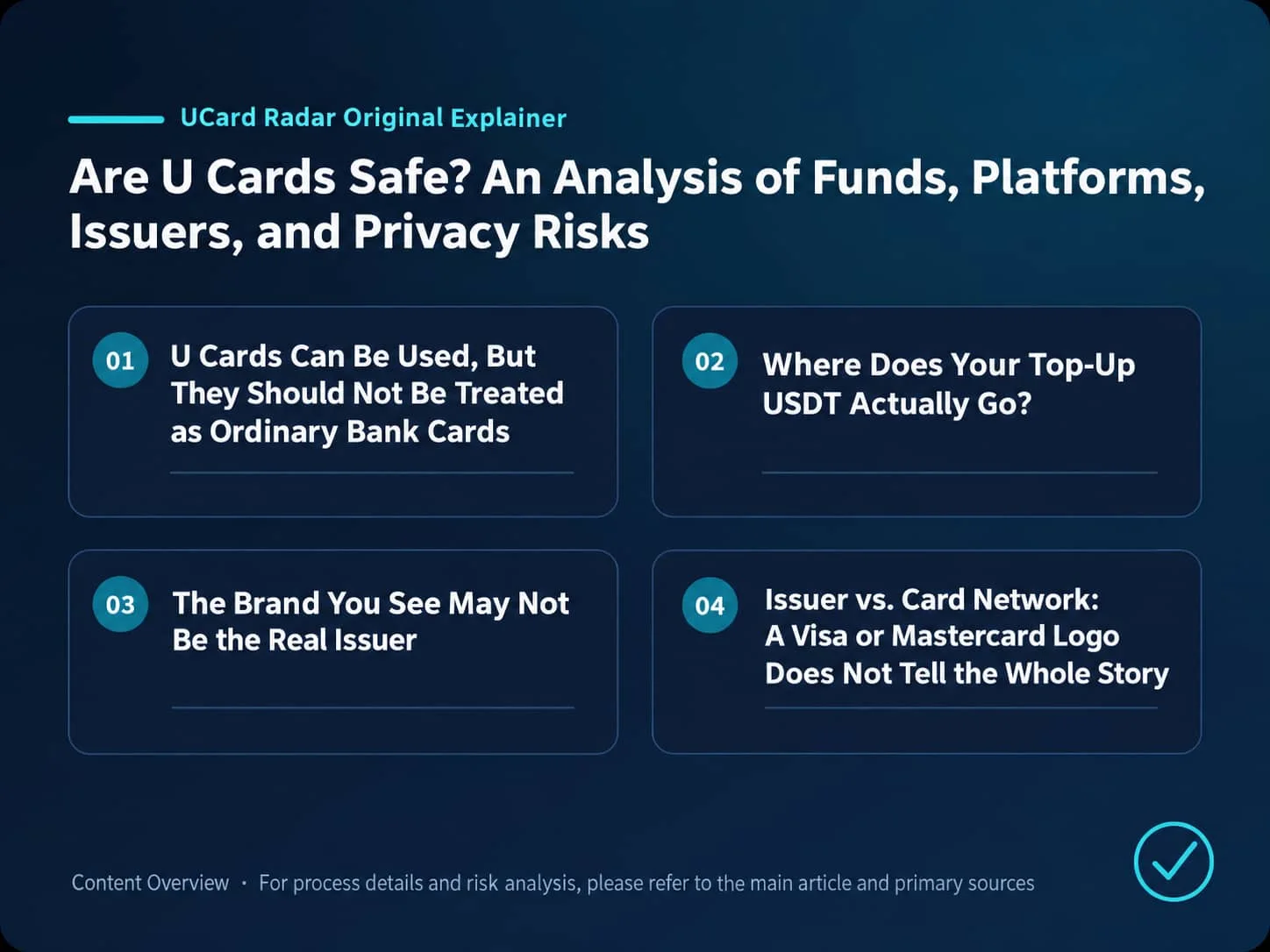
Scope of Evidence and Conclusions
Primary references: What should I do if my prepaid card or PIN is lost or stolen, or I see unauthorized charges? ; FATF Standards on Virtual Assets and VASPs ; Visa Core Rules and Visa Product and Service Rules.
The verifiable facts in this article about U card fund safety, account safety, and virtual-asset service risks are based on the official or regulatory materials listed above. Actual service status, fees, eligibility, and regional availability should be confirmed from the issuer or platform at the time of application.
Different issuers, regions, account tiers, and merchant rules may lead to different outcomes. Any user experience, success rate, fee comparison, or trend judgment not directly disclosed in the primary materials above should be treated as analysis or inference rather than an officially confirmed case conclusion.
1. U Cards Can Be Useful, but They Are Not Savings Accounts
A U card is essentially a payment tool that connects crypto assets to traditional card networks.
A user’s funds may come from USDT, USDC, BTC, or other digital assets, but merchants usually still receive fiat currencies such as USD or EUR. According to public descriptions from Visa and Mastercard regarding crypto-linked cards, the relevant digital assets are generally converted into fiat during the spending flow, while the merchant continues to get paid through the standard bank-card system.
A U card transaction actually spans two systems:
the front end: crypto top-up, custody, and conversion;
the back end: card authorization, clearing, and settlement.
Traditional bank cards mainly depend on banks and card networks. U cards add stablecoin issuers, wallets, crypto platforms, and conversion service providers to that structure. With more parties involved, it becomes harder to determine responsibility when something goes wrong.
So whether a U card is safe cannot be judged only by brand recognition, and certainly not only by whether the card shows a Visa or Mastercard logo. The real risk depends on how funds are held, how the issuance structure works, the operating strength of the platform, the compliance framework, and how the user uses the product.
2. Where Does the Topped-Up USDT Go?
When evaluating whether a U card is reliable, the first step is not testing whether it can be used for payment. The first step is understanding what happens to the USDT after you top up.
Broadly speaking, there are three fund models in the market.
1. Platform Custody
The user sends USDT to an address provided by the platform, and the platform shows a corresponding balance in the user’s internal account.
After the top-up is completed, the user usually no longer directly controls the private keys to those assets. The number shown in the app is only a record in the platform’s database of the user’s claim or balance, not an on-chain asset independently controlled by the user.
If the platform suffers a hot-wallet hack, private-key leakage, internal misuse, suspended withdrawals, or insufficient liquidity, users may be unable to recover their funds promptly. This risk is quite similar to keeping assets on a centralized exchange.
A blockchain explorer can prove that a top-up was sent to a certain address, but it cannot prove how the platform uses those assets afterward. The funds may be pooled, transferred to other wallets, exchanged, staked, or used for routine liquidity management.
Unless the platform publicly discloses a clear custody structure, asset-segregation arrangement, and verifiable reserve information, it is difficult for users to determine from a deposit address alone whether the funds are being fully preserved.
2. Converted First, Then Credited to the Card Account
Some U cards convert the received USDT into fiat currency such as USD or EUR first, and then credit the fiat balance to a prepaid-card account or e-money account.
In this model, what is actually used for card spending is fiat currency, not on-chain USDT.
The issue is that an “USD balance” shown on the account page does not necessarily mean the money is a bank deposit. Users still need to verify:
which company converts the stablecoins;
where the converted fiat funds are held;
whether customer funds are segregated from the platform’s operating funds;
what rights users have over the balance if the platform stops operating;
whether the balance is covered by local protection or insurance arrangements.
In the U.S. market, for example, the CFPB has noted that not all prepaid-card balances automatically receive deposit insurance. Whether protection applies depends on the specific product structure and cardholder agreement. Rules differ across regions, but the method of judgment is the same: focus on the legal nature of the funds, not only on the currency shown in the app.
3. Real-Time Conversion at the Time of Spending
Some crypto payment cards do not convert assets into fiat in advance. Instead, when the user makes a payment, the card sells the required amount of USDT, USDC, BTC, or other assets in real time.
This saves the user from manually selling crypto and topping up fiat, but it also introduces uncertainty in execution price and authorization timing. Users may encounter:
real-time conversion spreads;
insufficient market liquidity;
temporary interruption of conversion services;
a difference between the authorized amount and the final posted amount;
failed transactions temporarily locking up balance;
pre-authorizations that are released slowly.
“Zero card spending fees” does not mean zero cost. A platform can choose not to list a separate fee and instead embed its revenue in the conversion quote or trading spread.
When comparing such cards, the most effective method is not reading the marketing page but testing in practice: after topping up 100 USDT, how much usable value is actually available, and how much is ultimately deducted for a 100 USD purchase?
Stablecoins Are Not Bank Deposits Either
Stablecoins such as USDT and USDC aim to stay close to the value of the U.S. dollar, but they are not USD bank deposits.
The rights of stablecoin holders depend on the issuer, reserve assets, redemption rules, user eligibility, and the applicable jurisdiction. When users hold stablecoins through third-party wallets or trading platforms, they also take on the custody risk of those intermediaries.
In the U.S., for example, the FDIC has explained that payment stablecoins themselves are not bank deposits protected by deposit insurance. Even if an issuer keeps reserve assets in a bank, that does not automatically give stablecoin holders pass-through deposit insurance.
When using a U card, the user is therefore exposed to two layers of risk: one from the stablecoin itself, and another from the U card platform’s custody, conversion, and withdrawal arrangements.
3. The Brand You See May Not Be the Real Issuer
Users usually register through the U card brand’s website or app, but the company operating that brand may not be the actual card issuer.
A common structure is that the platform handles customer acquisition, KYC, top-ups, and support, while a bank or e-money institution issues the card, and other service providers handle payment processing. Users see one brand, but multiple companies may be involved behind the scenes.
This model is not unusual, and it does not by itself mean the platform is unreliable. The problem is that many platforms do not clearly explain the relationships among all the parties involved.
What Are the Warning Signs of a Platform Exit Scam or Failure?
Higher-risk platforms often share some common characteristics:
the official website does not show the full company name or registration jurisdiction;
the issuing institution is not disclosed;
there is no formal user agreement or cardholder agreement;
customer support exists only on Telegram, WhatsApp, or personal WeChat;
users are asked to top up to a personal wallet;
users are encouraged to store large amounts of USDT for a long time;
the platform uses high cashback or fixed-yield claims to attract deposits;
displayed licenses cannot be verified on a regulator’s website;
the domain, brand, card numbers, or issuing scheme changes frequently.
If the platform stops operating, users may lose more than the account balance. Transaction records, refund channels, support records, and complaint paths may disappear as well.
This is why users should not rely only on the balance shown in the app. Deposit hashes, transaction records, refund evidence, and user agreements should all be saved separately.
Even Without “Running Away,” a Platform May Suddenly Stop Cards
A U card becoming unusable does not necessarily mean the platform stole the money and disappeared. In many cases, the issue comes from the partnership chain:
the issuing institution ends the program;
the card network requires certain transactions to be paused;
a bank account is investigated or frozen;
the KYC or blockchain-analysis provider stops cooperating;
the stablecoin funding channel is closed;
a country is removed from the service scope;
the platform proactively adjusts or shuts down the card business.
In such cases, the platform’s website may still work and users may still be able to log in, but the card can no longer be authorized for transactions.
Having a License Does Not Mean Every Part of the Business Is Regulated
Some platforms emphasize that they hold a payment license, a virtual-asset license, or a financial-services authorization. A license is certainly better than having no information at all, but you still need to check which company holds it and what activities it covers.
If one subsidiary within a group has a license, that does not mean all group websites, wallets, cards, and stablecoin balances are supervised in the same way. The entity with which the user signs the contract may also be different from the entity highlighted on the marketing page.
When checking a license, compare the following:
the legal name of the licensed company;
the regulatory authority that issued the license;
the license number and current status;
the activities the company is allowed to conduct;
the contracting entity in the user agreement;
whether the product is available in the user’s region;
whether card issuance and stablecoin custody fall within the license scope.
If those details do not line up, a screenshot of a license has limited value.
4. Issuer and Card Network: Does a Visa or Mastercard Logo Make It Safe?
Visa and Mastercard mainly provide the payment network, clearing rules, and brand licensing. They do not directly operate every U card platform, and they do not automatically guarantee the USDT balance held on a platform simply because the card uses their network.
A U card usually involves three roles that are easy to confuse:
Role | Responsible For |
|---|---|
U card platform | User registration, crypto top-ups, product operations, and customer support |
Issuing institution | Creating card accounts, issuing card numbers, authorization, and account management |
Visa or Mastercard | Providing the bank-card payment network and clearing rules |
A Visa or Mastercard logo on the card mainly indicates that the card connects to that payment network. It does not prove the platform cannot fail, and it does not prove that the stablecoins held by the platform are bank deposits.
The Issuing Institution May Suspend the Entire Program
Issuers continuously assess fraud rate, chargeback rate, source of funds, KYC quality, sanctions risk, and user complaints for partner programs.
If a program sees a large amount of fraud, abusive chargebacks, or high-risk funds, the entire batch of cards may be restricted—even if a particular user has never violated any rule. The issuer may not evaluate every cardholder individually. Instead, it may directly lower limits, pause transactions, or terminate the entire program.
This kind of “program-level risk” is one of the major differences between U cards and ordinary personal bank accounts.
BIN Affects Merchant Acceptance
The first digits of a card identify the issuer, card program, and card type. These digits are often called the BIN or IIN.
Merchants and payment service providers may decide whether to accept a transaction based on information such as:
issuing country;
prepaid, debit, or credit;
business card or personal card;
whether 3-D Secure is supported;
the merchant’s own anti-fraud policy.
So a U card working for normal online shopping does not mean it will necessarily work for hotel pre-authorizations, car-rental deposits, ad accounts, cloud servers, or long-term subscriptions.
Some merchants reject foreign cards, prepaid cards, or certain BINs. That does not necessarily mean the balance is insufficient; it may simply mean the card attributes do not fit the merchant’s rules.
Refunds Are More Likely Than Payments to Run Into Problems
Card refunds usually return through the original transaction path.
If the card has already been closed, the issuing program has ended, the account has been frozen, or the platform is offline when a refund is processed, the funds may fail to return to the original account. Even if the refund can ultimately be handled, the platform and issuer may need to intervene manually.
Hotels, airlines, car rentals, and cross-border e-commerce often have long refund cycles. For large prepayments that the user cannot afford to lose, relying on only one relatively new U card is not advisable.
5. Compliance Risk: On-Chain Funds Can Be Traced
Blockchain addresses can be created without using a real name, but on-chain transactions are usually public.
After a user tops up a U card platform with USDT, the platform may use blockchain-analysis tools to review the fund trail, including whether the funds have interacted with:
sanctioned addresses;
stolen-coin or scam-related addresses;
ransomware funds;
mixing services;
high-risk trading platforms;
gambling or illicit markets;
other flagged sources of funds.
Even if the user did not personally engage in illegal activity, they may still trigger a review because they received assets from a complex or risky source.
A Freeze Is Not the Same as Confiscation, but the Timeline Is Hard to Predict
If a platform detects suspicious funds, it may suspend top-ups, withdrawals, and card use, and ask the user for additional identity documents, proof of source of funds, or explanations of on-chain transactions.
A freeze is usually a risk-control measure, not a final confiscation. But how long it lasts, what documents are needed, and whether access will ultimately be restored depend on platform policy, issuer requirements, and local law.
For users, the real problem is often not doing one more KYC review, but dealing with a platform that has no clear appeal process and customer support that cannot explain who froze the funds or who has the authority to unlock them.
“Permanent No-KYC” Is Not a Reliable Selling Point
Legitimate payment accounts usually require user identification. Requirements differ by region for prepaid cards, e-money accounts, and crypto-asset services, but fully anonymous, unlimited, and long-term use does not fit the risk-management logic of most regulated card-issuing systems.
The FATF Travel Rule also requires relevant virtual-asset service providers and financial institutions to obtain, retain, and transmit originator and beneficiary information in qualifying transfers.
A so-called “no-KYC U card” may only mean full verification is not required at the beginning, and it may also involve problems such as:
restricted limits and functions;
cards issued using another person’s identity or a company account;
unstable or non-standard card-issuing channels;
inability to prove account ownership after a risk-control trigger;
the project being terminated at any time.
Not uploading identity documents at registration does not mean the account will never require verification later.
6. Privacy Risk: A U Card May Link On-Chain Addresses to Real Identity
Many users believe that topping up with USDT protects privacy better than a bank transfer. In reality, that is not always the case.
Once KYC is completed, the platform may simultaneously hold:
name, identity documents, and facial data;
phone number, email, and residential address;
login IP and device information;
deposit and withdrawal addresses;
card spending records;
merchant names, transaction amounts, and spending locations.
When a user tops up a real-name U card platform from a personal wallet, that wallet address may become linked to the user’s real identity. Since blockchain records are public, the platform or its analytics partners may continue tracing the past and future fund flows of that address.
What was originally just a string of characters may, once it enters a real-name payment platform, become connected to a user’s name, identity documents, and spending record. This does not necessarily mean the platform will abuse the data, but the technical ability to make such connections clearly exists.
Data Does Not Stay Only on the U Card Platform
A U card transaction may pass through a KYC provider, a blockchain-analysis firm, a custody wallet, the issuing institution, a payment processor, the card network, the merchant, and the acquirer.
Different participants each process part of the data and may each retain transaction and risk-control records. Visa’s global privacy notice states that a payment network may process data such as the card number, transaction time, location, amount, and merchant, while issuers, merchants, and other participants apply their own privacy policies.
So a single homepage statement like “we protect user privacy” is far from enough. Users should also review the cardholder agreement, issuer privacy notice, KYC service-provider disclosures, and cross-border data-transfer clauses.
Once KYC Information Leaks, It Is Hard to Fix
A leaked password can be changed. Identity documents and facial information cannot easily be replaced.
If a platform has weak security, the passport, ID card, facial video, and proof of address submitted by the user may be used for identity fraud, social engineering, targeted scams, or forged verification.
If the operating entity, privacy policy, and data processors cannot be clearly confirmed, users should avoid submitting highly sensitive identity materials. In particular, they should not send unencrypted ID photos or hand-held ID videos through private chat accounts.
7. Fraudulent Charges, Held Funds, and Refund Risk
A virtual card not having a plastic form does not mean it cannot be compromised.
If an attacker obtains the card number, expiry date, CVV, billing address, and SMS or email verification code, they may be able to attempt online payments. Common leak channels include phishing websites, malicious browser extensions, screenshot leaks, merchant database breaches, hacked email accounts, and remotely controlled devices.
Risk reduction is not complicated:
do not send screenshots showing the full card number in chat apps;
enable two-factor authentication and real-time transaction alerts;
use a dedicated email address and strong password for the U card;
freeze the card when not in use;
set per-transaction and daily spending limits;
separate subscription cards from everyday spending cards;
stop the card immediately and preserve evidence if suspicious transactions occur.
In some regions, eligible prepaid cards may receive certain protections for unauthorized transactions and error resolution. For example, some registered prepaid accounts in the U.S. may qualify for relevant error-resolution protections.
However, consumer-protection rules from one country cannot simply be applied to all offshore U cards. Final rights still depend on the issuing jurisdiction, product type, cardholder agreement, and where the user is located.
8. How Can You Judge Whether a U Card Is Relatively Reliable?
No single indicator can prove that a U card is absolutely safe, but the following checks can eliminate some higher-risk products.
Identify the Operating Entity
At a minimum, the official website should disclose the full company name, registration jurisdiction, user agreement, and a formal complaint channel.
If the brand name, website name, and contracting company in the agreement are completely different, you need to confirm how they are related. A product that has only social-media accounts, but no disclosed company entity or agreement, is not suitable for holding a large balance.
Find the Real Issuing Institution
Key points to verify:
name of the issuing institution;
whether it is Visa or Mastercard;
whether the card is prepaid, debit, or credit;
issuing country of the card;
cardholder agreement;
who manages the card balance;
who handles refunds and disputes.
A product that shows only a card mockup and a card-opening page, but no issuer identity or cardholder agreement, cannot be regarded as clearly reliable in origin.
Verify Licenses Instead of Looking at Screenshots
Check the regulator’s official website for the company name, license number, current validity, and scope of permission.
Also confirm whether the contracting company named in the user agreement is the same licensed entity. A license covering crypto-asset conversion does not necessarily cover card balances; a payment license also does not mean all stablecoin-related business offered by the platform is regulated in the same way.
Read the Fund Terms and Exit Terms
The most important parts of the user agreement are not the marketing descriptions but issues such as:
who owns the assets after top-up;
whether user funds are segregated;
withdrawal fees and limits;
conditions for freezing the account;
how balances are handled if the platform terminates service;
how refunds are processed after a card is closed;
how the stablecoin conversion price is determined;
where disputes must be resolved.
If those issues are not clearly stated, the user cannot really know what legal rights they acquire after topping up.
Do One Complete Small-Amount Test
Do not test only top-up and spending. A proper test should include at least:
a small top-up;
a small purchase;
one failed transaction;
one merchant refund;
one stablecoin withdrawal;
one customer-support inquiry.
Being able to top up, open the card, and spend only proves the front half of the chain works. How smoothly refunds and withdrawals work is a better reflection of the platform’s fund-handling ability.
9. Which Risk Signals Should Be Taken Seriously?
If you notice the following, reduce your balance and reassess the platform:
the official site no longer discloses the issuing institution;
the platform frequently changes card numbers or BINs;
many users simultaneously report payment failures;
withdrawal times become significantly longer;
customer service repeatedly responds only with “system maintenance”;
the community disables comments or forbids discussion of withdrawals;
the platform suddenly raises KYC requirements without an appeal process;
refunds take a long time to arrive;
top-up addresses or receiving entities change frequently;
the user agreement or fee page is removed;
the platform starts encouraging users to lock balances for high yields;
top-ups can only be sent to personal wallets;
the platform cannot explain who is holding customer funds.
One warning sign alone does not necessarily mean a shutdown is imminent. But if payment failures, withdrawal delays, customer-support disappearance, and information deletion occur together, chasing cashback or promotions no longer makes sense. The priority should be reducing the balance and preserving transaction evidence.
10. How Can Ordinary Users Reduce U Card Risk?
The most practical principle is to treat a U card as a transactional payment account, not as a place to store money.
Top Up Only As Needed
Only top up the amount you expect to spend in the near term. Even if the platform is operating normally, there is no need to keep a large USDT or fiat balance there long term just to save one blockchain transaction fee.
Separate Use Cases
Subscriptions, travel, large purchases, and business expenses should ideally not all be concentrated on one card. If one card is frozen or stopped, you should still have an alternative payment method.
Keep Necessary Evidence
It is advisable to save:
on-chain top-up hashes;
spending and refund records;
the user agreement and cardholder agreement;
fee pages;
customer-support communication records;
KYC submission time and outcome.
If a refund or account dispute arises, these materials may be the only evidence the user independently retains.
Use a Dedicated Payment Wallet
You can use a separate on-chain wallet to top up the U card, so you do not directly expose the full transaction history of your long-term asset wallet.
This does not make you anonymous. The platform still knows the relationship between the payment wallet and the verified account. But it can reduce the direct connection between your main asset address and your everyday spending, and it also helps you control each top-up amount.
Watch for Changes in Issuance and Rules
U card products typically change faster than traditional bank cards. Users need to monitor the issuing institution, supported regions, fees, withdrawal status, BIN, and user agreement on a regular basis.
If a platform changes its issuer without explaining how old-card refunds, balance migration, and dispute handling will work, users should first reduce the account balance and then decide whether to continue using it.
Conclusion
U cards can solve the problem of spending crypto assets in daily life, but their risks do not come only from the card itself.
A card may connect normally to the Visa or Mastercard network while the stablecoin balance held on the platform does not enjoy the same protection. The issuing institution may be real, while the platform’s crypto-asset business may not fall under the same regulatory framework. A successful card payment also does not guarantee that refunds and withdrawals will still work smoothly if the card is suspended later.
When assessing risk, it helps to divide the issue into four layers:
Risk Layer | Questions to Confirm |
|---|---|
Funds | Where the USDT goes after top-up, whether it is converted into fiat, and what legal nature the balance has |
Platform | Who operates it, who handles custody and withdrawals, and how to exit if the service stops |
Issuance | Who actually issues the card, what type of card it is, and who handles refunds and disputes |
Privacy | What identity, device, on-chain, and spending data the platform collects, and with whom the data is shared |
A Visa or Mastercard logo only means the card uses the corresponding payment network. It does not provide a comprehensive guarantee for the stablecoin balance held on the platform, the safety of custody, or the platform’s operating ability.
Ordinary users do not need to look for a U card that claims to be “absolutely safe,” because that kind of promise is itself not credible. A more realistic approach is to choose products with complete information disclosure, start with a small test, top up only as needed, keep transaction records, and maintain a backup payment option that can be switched to at any time.