
The fact that a U card can be topped up and used today does not mean the funds inside it are truly safe. Many people judge a U card by three things: whether the card shows a Visa or Mastercard logo, whether other people online have successfully used it, and whether they themselves can pay with it normally. Those signals only show that the card is currently usable. They do not answer several more important questions: who holds the funds after top-up, who issues the card, and whether the remaining balance can still be recovered if the platform shuts down or a partnership breaks.
What the market usually calls a U card is a crypto payment card, stablecoin card, or virtual card funded with stablecoins such as USDT or USDC and then used through the Visa or Mastercard network. It is rarely a product independently provided by one bank from beginning to end. The platform operator, asset custodian, stablecoin issuer, card infrastructure provider, issuing bank, payment processor, and card network may all be involved at the same time. Once there are many layers, the risk is no longer just “will the platform run away with the money?” Termination by the issuer, problems with the stablecoin, lack of customer fund segregation, tighter KYC reviews, or BIN restrictions can all affect both the card and the balance.
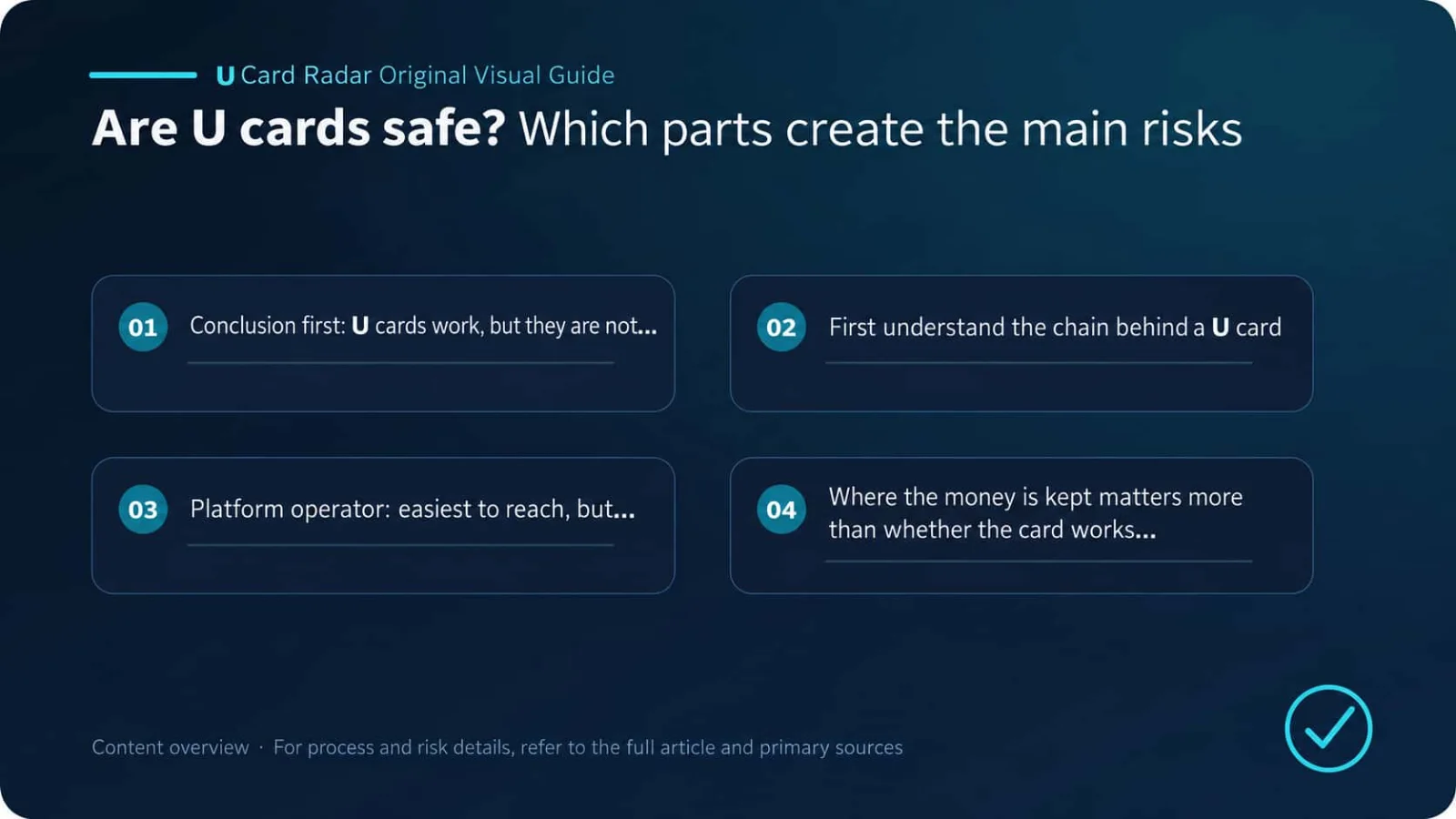
1. The Bottom Line First: U Cards Can Be Useful, but They Are Not a Bank Account
U cards are not inherently unsafe. If a platform clearly identifies its operator, uses a real underlying issuer, discloses how funds are handled, and clearly states its limitations, it can be used as a tool for cross-border spending and subscription payments.
The problem is that products all called “U cards” may have completely different underlying structures. Some platforms work directly with licensed issuers, some plug into card infrastructure providers, and some products are resold through multiple layers of agents. The user interface may look similar, but the level of fund safety and the ability to resolve disputes can differ greatly.
Visa refers to such products as stablecoin-linked cards, and Mastercard also has a Crypto Card Program. When a purchase happens, the merchant normally receives fiat settled through the card network, not USDT or USDC. That shows stablecoins can connect to traditional card rails, but it does not mean every platform displaying a Visa or Mastercard logo has gone through the same level of review.
Card networks are responsible for the transaction network and program rules. They normally do not absorb the operating losses of a U-card platform. If the platform goes bankrupt, custodial assets are stolen, or the stablecoins a user loaded cannot be redeemed, the presence of a Visa or Mastercard logo does not automatically entitle the user to compensation.
2. First Understand the Chain Behind a U Card
A U-card transaction roughly follows this path: the user tops up stablecoins → the platform or custodian receives the assets → the assets are converted or recorded as card balance → the issuer approves the transaction → the payment processor and card network pass the authorization → the merchant acquirer settles the payment.
At least two relationships here are easy to misunderstand.
First, the platform used by the customer is not necessarily the card issuer. The platform may handle the app, top-up interface, and customer service, while the actual card number may be issued by a different bank or electronic money institution.
Second, the balance shown in the app is not necessarily a bank account balance. It may be an internal platform ledger entry, an entitlement to funds in a custodial account, or stablecoins waiting to be converted. A display showing 100 USD does not mean there is a 100-dollar bank account in the user’s own name protected by deposit insurance.
To judge safety, do not ask only “which card is it?” Also ask who is responsible for the platform, custody, and issuance.
3. The Platform Operator: Easiest to Reach, Easiest to Misread
Registration, KYC, top-up, balance checking, and customer support all happen through the platform. Because the platform is the most visible layer, many people assume it controls the whole card program.
In reality, some platforms are only the brand and operating front end. They may still keep the website online after an underlying partner stops cooperating, while no longer being able to approve card transactions.
Opaque operating entity
A common feature of higher-risk platforms is that they show only a brand name, not the full legal name of the operating company, its place of registration, or the governing law. The website may have a polished card page, while support exists only on Telegram or WhatsApp. Before applying, users should at least be able to find:
the operating company and its registration jurisdiction;
the terms of service and privacy policy;
the card issuer or program manager;
the governing law and complaint channels for disputes;
the rules for handling balances after account closure.
If a platform repeatedly advertises “available worldwide” or “anonymous card issuance” while refusing to say who is actually providing the service, the risk is already obvious.
Customer funds may be mixed
A user’s USDT top-up may go into a platform omnibus wallet, or it may be handed to a third-party custodian. The biggest red flag is when customer assets and the company’s operating funds are pooled together. If the platform later suffers losses, a run on withdrawals, account freezes, or debt disputes, user assets inside the pool can be difficult to identify separately. The balance in the app may still display normally, but that is only a database record. It does not prove the platform has enough assets to repay all users at any time.
A platform can shut down without “running away”
A U-card program may stop operating even if the founder did not abscond with the money. High chargeback rates, increasing fraud losses, rising issuance costs, excessive compliance costs, or the exit of a core partner can all make the business unsustainable. These problems usually do not appear overnight. A common pattern is that top-ups or withdrawals become slower, customer support becomes vague, some transactions start failing, then the platform pauses service citing “system upgrades” or “card maintenance,” and eventually moves into card replacement, user offboarding, or insolvency.
4. Where the Money Is Held Matters More Than Whether the Card Can Be Swiped
Platforms often use phrases such as “bank-grade custody” or “customer fund segregation” to suggest safety. Those phrases have legal meaning, and they should not be judged only from marketing pages.
Custody is not the same as deposit insurance
If a platform keeps fiat funds in a bank, that does not mean each user directly enjoys bank deposit insurance. The U.S. Federal Deposit Insurance Corporation has clearly explained that FDIC insurance covers eligible bank deposits held at insured depository institutions. It does not protect crypto assets, and it does not backstop the business failure of non-bank crypto companies. A fintech platform partnering with an insured bank does not automatically become an insured depository institution itself.
Electronic money institutions in the UK and Europe are generally required to safeguard customer funds, for example by placing them in segregated accounts or protecting them through insurance or comparable arrangements. But electronic money is not the same as an ordinary bank deposit. The UK FCA has also warned that customer funds held by payment institutions and e-money institutions are not directly protected by the FSCS deposit protection scheme.
“A platform says it is safe,” “the law requires segregation,” and “bank deposit insurance” are three different things. When marketing mixes them together, users can easily overestimate the level of protection.
Segregation can still fail in practice
A formal safeguarding system does not mean execution is flawless. Reconciliation gaps, non-compliant account naming, mixing client funds with company funds, or inconsistent records between the platform and the custodian may only become visible in insolvency. Even if assets are eventually returned, the liquidator may still need to verify users’ identities and balances and resolve expenses and disputes, which can take a long time. Past FCA reviews of non-bank payment firms have also found that some customer safeguarding arrangements still needed improvement. Regulation can reduce some risk, but it cannot reduce risk to zero.
5. Stablecoins Are Not “Digital Dollar Deposits”
Most U cards are funded with USDT or USDC. Their price is usually close to one U.S. dollar and they may feel like dollars in use, but their legal structure, reserve arrangements, and redemption mechanics are different from bank deposits.
Depegging and redemption risk
A stablecoin aims to maintain its peg; it does not guarantee that it will trade at exactly one dollar at every time and in every market. If the market questions reserve quality, custody arrangements, or the issuer’s redemption capacity, the price may deviate from the peg. The Financial Stability Board and the International Monetary Fund have both discussed stablecoin reserve quality, liquidity, and the risk of large-scale redemptions. If many users redeem at once, the issuer may need to sell reserve assets, which can intensify market stress.
The issuer remains a source of risk
When deciding which stablecoin to use for top-up, users should look at what the reserves consist of, who holds them, whether disclosures are made regularly, and whether ordinary users can redeem directly with the issuer. Minimum redemption thresholds, suspension clauses, and address-freezing powers also affect users’ practical rights. A U-card platform functioning normally does not mean the stablecoin layer cannot fail.
On-chain transfers are hard to reverse
If a user chooses the wrong network, enters the wrong address, or forgets to include a memo when topping up, the transfer generally cannot be canceled the way a bank transfer sometimes can. Even if the platform is willing to help, it may not have the technical ability to recover the funds. In addition, deposit addresses may change, and some smart-contract tokens may not be supported by the platform. If funds pass through sanctioned addresses, stolen-fund addresses, or other high-risk wallets, compliance review may be triggered. Testing with a small amount before sending a large top-up is more useful than reading ten “deposit success” anecdotes.
6. The Issuer Determines Whether the Card Can Continue to Function
A U-card platform cannot create Visa or Mastercard card numbers by itself. Payment cards must be issued by a bank, an electronic money institution, or another entity that meets the card network’s rules.
The issuer is responsible for the BIN, the card’s attributes, transaction authorization, limits, 3-D Secure, freezes, and dispute handling. Once the underlying issuing partnership ends, even the best-looking front end cannot preserve the existing card. After a cooperation ends, users may face:
the original card no longer working or no longer renewing;
suspension of new card issuance;
mass replacement of card numbers and expiry dates;
Apple Pay or Google Pay links breaking;
a requirement to move out the balance within a limited time.
Such adjustments are not necessarily tied to the behavior of a specific customer. Overall fraud rates, chargeback levels, regulatory risk, or commercial economics that fail to meet the issuer’s standards can all lead to termination.
BINs affect merchant acceptance
A BIN can reveal the card network, issuing region, product category, and card type. Merchants or payment gateways may use that information to identify credit cards, debit cards, prepaid cards, business cards, and virtual cards. So a card that works on a normal e-commerce site may still fail for ads, cloud services, hotel deposits, or car rentals. If the merchant does not accept prepaid cards, virtual cards, or foreign-issued cards, a sufficient balance still will not help.
7. Card Networks and Payment Processors Also Run Risk Controls
Visa and Mastercard provide the payment rails; they are not guarantees of the platform’s business. Mastercard has noted in materials about crypto card programs that such programs require anti-money-laundering checks, sanctions screening, and ongoing fraud monitoring.
A U-card transaction often passes through more than one layer of risk control. Large numbers of cards opened in a short period, multiple accounts sharing the same device, high-frequency small-value test transactions, frequent IP changes, or rapid spending across multiple countries may all trigger restrictions. Large volumes of failed transactions and chargebacks can also damage the program and, in serious cases, affect other users under the same BIN.
Sometimes platform support can see only “Do not honor” or “Generic decline” without knowing which layer actually rejected the payment. This is one reason U-card problems can be difficult to troubleshoot: the user talks to the platform, but the decision maker may be a different company.
8. KYC Is Not the Only Risk; Inconsistent Rules Are the Real Headache
Some U cards market themselves as “no KYC,” but for long-term use, higher limits, and withdrawals, complete absence of identity verification is unrealistic. FATF requires virtual asset service providers to take risk-based anti-money-laundering measures. As the Travel Rule is implemented more broadly, identity and fund information from both sides of a transaction may need to be collected, stored, or transmitted.
Common review scenarios include:
only basic information is collected at sign-up, but full KYC is required for withdrawals or larger top-ups;
the user is asked for exchange records, on-chain source-of-funds evidence, or proof of income;
the issuing jurisdiction of the ID or the user’s place of residence is outside the service scope;
the IP address, phone number, residential address, and ID information remain inconsistent over time;
funds have passed through addresses flagged as high risk;
the user relies on another person’s identity or a bought account.
Reasonable KYC is not itself a danger signal. The bigger concern is when a platform intentionally downplays verification requirements before top-up and then imposes conditions that are almost impossible to satisfy after the money has arrived. Bought accounts are particularly risky. If control of the account, the legal identity, and the device environment do not match, the balance can easily be frozen once re-verification is requested.
9. The Issuer May Approve the Transaction, but the Merchant Can Still Reject It
Merchants and acquiring institutions have their own risk systems. They may check the issuing country, account region, IP address, billing address, postal code, card type, 3DS capability, and past failed transactions. EMV 3-D Secure is designed to reduce card-not-present fraud, but whether authentication is triggered, which method is used, and whether the payment is ultimately approved all depend on the issuer, the merchant, and the specific transaction context.
As a result, a user may have money on the card and a normal card status, yet still fail to pay at a given website without that necessarily meaning the platform is malfunctioning. The merchant may not accept virtual cards or prepaid cards, or it may consider the account region inconsistent with the card region. Frequently changing IPs and randomly entering foreign addresses usually only create more inconsistencies.
10. Pre-Authorizations, Refunds, and Chargebacks Are Another Layer of Risk After the Card Is Issued
Many users focus only on getting the card and topping it up. They discover how different the after-sales support can be only once a dispute happens.
Pre-authorizations lock up balance
Hotels, car rental companies, self-service fuel stations, and some subscription merchants may place a pre-authorization hold first. The held amount may be higher than the final charge and may also include tax, deposits, tips, or room for exchange-rate movements. Even if the underlying order fails, the hold may not be released immediately. The app may show a balance of 100 USD while only 40 USD is actually spendable.
Refunds pass through many parties
After a merchant initiates a refund, the funds still have to pass through the acquirer, card network, payment processor, issuer, and U-card platform. If the original card has been closed, the card number has been replaced, or the platform’s internal ledger mapping is wrong, the arrival of the refund may be delayed.
Do not assume dispute protection exists
Consumer protections differ across jurisdictions, card types, and issuing entities. The U.S. CFPB notes that some registered prepaid cards can obtain protections for error resolution and unauthorized transactions, but those rules cannot simply be applied to all offshore U cards and anonymous virtual cards. Before using a card, users should review the card agreement for unauthorized transaction liability, dispute windows, chargeback conditions, investigation timelines, provisional credits, and fees. If a platform has no dispute rules at all, or handles everything only through private chat on social media, the user will be in a weak position when something goes wrong.
11. Fraud Often Starts With the User’s Own Account
Even if the platform and issuer are both functioning normally, the card may still be abused because of phishing or account compromise. Common entry points include fake official websites, fake support, malicious browser extensions, remote-control software, email compromise, and SIM swapping. Once the card number, expiry date, CVC, and SMS verification code are all exposed, an attacker may be able to complete a card-not-present payment.
PCI DSS requires organizations that handle payment account data to adopt corresponding technical and operational protections, but users also need to manage their own information carefully:
do not send screenshots of the full card number to customer support;
do not share ID documents or top-up receipts in group chats;
do not give SMS verification codes to anyone;
do not install unknown apps, extensions, or configuration profiles;
use different passwords for email, the U-card platform, and exchanges;
when not in use, disable online payments or lower spending limits.
Platforms that support instant freeze, transaction alerts, separate spending limits, and virtual card resets make it easier to control losses when something abnormal happens.
12. A KYC Data Leak Can Be More Troublesome Than Losing the Balance on the Card
Applying for a U card usually requires identity documents, a face photo, a phone number, an email address, and a residential address, and sometimes even documents proving income or source of funds. If the platform’s data security is weak, the consequences go beyond card fraud. Leaked identity documents and facial data may be used for account opening, targeted scams, or identity misuse, and unlike passwords, such information cannot simply be changed whenever needed.
At a minimum, the privacy policy should explain who performs KYC, where the data is stored, which issuing or compliance service providers the data is shared with, how long it is retained, and how users will be notified if a breach happens. Users should not submit identity documents and face scans through unidentified agents. An agent is a sales channel, not necessarily a platform employee, and may not be subject to formal data access controls.
13. If You See These Signs, Do Not Rush to Top Up
One sign alone is not enough to conclude that a platform is unsafe. But if several appear together, users should reduce their exposure.
No visible operating company
The website provides no full company name, registered address, terms, or complaint channels, and support exists only on Telegram or WhatsApp.
No clear disclosure of the issuer
The platform repeatedly uses phrases such as “official Visa card” or “bank-grade channel” but does not disclose the issuing institution or the program manager.
Promises of guaranteed success
Claims such as “any country can open,” “never blocked,” “works with all merchants,” or “100% success paying for ChatGPT” are not things a legitimate payment product can guarantee. Transactions remain subject to geography, BIN, 3DS, merchant policy, and real-time risk controls.
Encouraging purchased accounts
An account opened under another person’s identity leaves almost no room to resolve problems once re-verification is required.
Top-up only, but no smooth exit
Crypto-only top-up is not automatically a problem. But if the platform also does not support withdrawals, does not publish refund rules, and does not explain its custody structure, users may have little control after sending funds in.
Fees buried deep
The card opening fee may look low, while top-up fees, conversion fees, cross-border fees, failed-transaction fees, refund fees, and card closure fees appear only later.
Frequent domain and brand changes
If a platform repeatedly changes its website, app, support accounts, or legal entity in a short period, it may be trying to distance itself from complaints, regulatory issues, or historical records.
Asking users to send funds to a personal wallet
A legitimate platform will usually assign a deposit address within its own system and show the network, token, and arrival rules. If support sends a personal wallet address ad hoc, the risk is high.
14. How to Judge Whether a U Card Is Relatively Reliable Before Applying
First verify the operating entity, then verify the issuer. If neither is clear, there is little point in continuing to research the fee structure or rewards. Then confirm the fund structure: after top-up, do the funds remain in stablecoins, or are they converted into fiat or an internal platform balance? Are withdrawals supported? Will withdrawal trigger extra KYC? If the platform closes, how are unused balances returned?
The card agreement also matters. The goal is not to memorize dozens of pages, but to find the following:
supported countries and ID jurisdictions;
prohibited merchant categories;
per-transaction, daily, and monthly limits;
rules for subscriptions, ATM use, and pre-authorizations;
handling of refunds, chargebacks, and unauthorized transactions;
freezing and account closure conditions;
balance handling after card closure.
Finally, run a small closed-loop test. Top up a small amount, complete an ordinary purchase, then test a refund and a withdrawal. Whether 3DS works properly and whether support can locate the authorization record tell more than social-media screenshots. A single successful payment proves only that one payment succeeded. Only when top-up, spending, refund, and withdrawal all work can a user claim basic familiarity with the platform.
15. How to Keep the Risk Within a Tolerable Range
U cards are suitable for payments, not for storing money long term. The simplest approach is to top up according to short-term spending needs and avoid keeping large balances on the card. Account security should also be handled separately. Use a dedicated email address and a strong password for the U-card account, and enable two-factor authentication, login alerts, and transaction notifications. Do not top up for others, pay on behalf of others, or receive funds of unclear origin, and do not lend the card to other people.
Keep records of top-ups, payments, refunds, withdrawals, and communication with support. If the underlying issuer, terms, pricing, or service regions change, decide promptly whether the balance should be moved out. High cashback and top-up rewards may look attractive, but they should not be the reason for keeping money on the platform long term. The higher the incentive, the more important it is to understand how the platform can afford it.
16. What Is the Hardest U-Card Risk to Handle?
Card fraud usually has visible transactions and relatively clear freeze and dispute procedures. More troublesome are failures in the underlying partnerships and fund structure. For example, customer funds may not have been properly segregated, the custodian may suffer a security incident, the stablecoin may face redemption pressure, the issuer may terminate the program, compliance review may freeze a whole batch of accounts, or the platform may collapse without being able to verify user balances. In those cases, changing the card number does not help, and support may not even have the authority to solve the issue.
That is why U-card safety cannot be judged only by asking whether the card “still works.” More useful questions are:
Who operates the platform?
Who holds custody of user assets?
Who issues the card?
How are customer funds segregated?
If the card stops working or the platform shuts down, through what process is the remaining balance returned?
No U card can guarantee that nothing will ever go wrong. What ordinary users can do is control balances, use their real identity, avoid opaque platforms, and make sure they always have other payment methods available. If a U card is treated as a payment tool, it can solve many cross-border spending needs. If it is treated as a bank account for storing large assets over the long term, the risk profile is completely different.
Scope of Sources and Conclusions
Primary-source verification: What should I do if my prepaid card or PIN is lost or stolen, or I see unauthorized charges? ; FATF Standards on Virtual Assets and VASPs ; Visa Core Rules and Visa Product and Service Rules.
The verifiable facts in this article about U-card account security, card programs, and risks in virtual asset services are based on the official or regulatory documents listed above. Actual service status, fees, eligibility, and geographic scope should be confirmed on the issuer’s or platform’s page at the time of application.
Different issuers, regions, account tiers, and merchant rules may lead to different outcomes. User experiences, success rates, fee comparisons, or trend judgments not directly disclosed in the primary sources above are analytical or inferential and have not been officially confirmed by the relevant institutions for individual cases.