
U Cards and regular bank cards can look very similar: both have a card number, expiration date, and CVC. Some can also be linked to Apple Pay or Google Pay, or used directly over the Visa or Mastercard network.
The main differences are behind the card.
A conventional bank debit card is generally linked directly to a bank account. When a payment is made, funds are deducted from the account balance. A credit card, by contrast, uses a line of credit provided by the issuing bank, which the cardholder repays later.
A U Card adds an extra layer of crypto-asset processing. Users first deposit assets such as USDT or USDC. The platform converts them into a fiat balance, and payments are then completed through a card issued by a partner institution. Some products convert funds when they are deposited, while others settle the conversion only when a transaction occurs. Therefore, seeing “Visa Debit” on a card does not mean the underlying account structure is the same as that of a traditional bank debit card. To determine what type of product a card really is, you need to look at the source of funds, the nature of the account, the actual issuer, and the cardholder agreement.
Scope of Sources and Conclusions
Primary-source verification: How are prepaid cards, debit cards, and credit cards different?; Prepaid Cards and Deposit Insurance Coverage; Fact Sheet: What the Public Needs to Know About FDIC Deposit Insurance and Crypto Companies.
For verifiable facts in this article concerning the account characteristics and fund protection of U Cards, prepaid cards, bank debit cards, and credit cards, the listed official or regulatory documents take precedence. Actual service availability, pricing, eligibility, and geographic coverage should be confirmed on the issuer’s or platform’s current pages at the time of application.
Different issuers, regions, account tiers, and merchant rules may produce different outcomes. User experience, success rates, fee comparisons, or trend assessments that are not directly disclosed in the primary sources above should be treated as analysis or inference and have not been officially confirmed by the relevant institutions for individual cases.
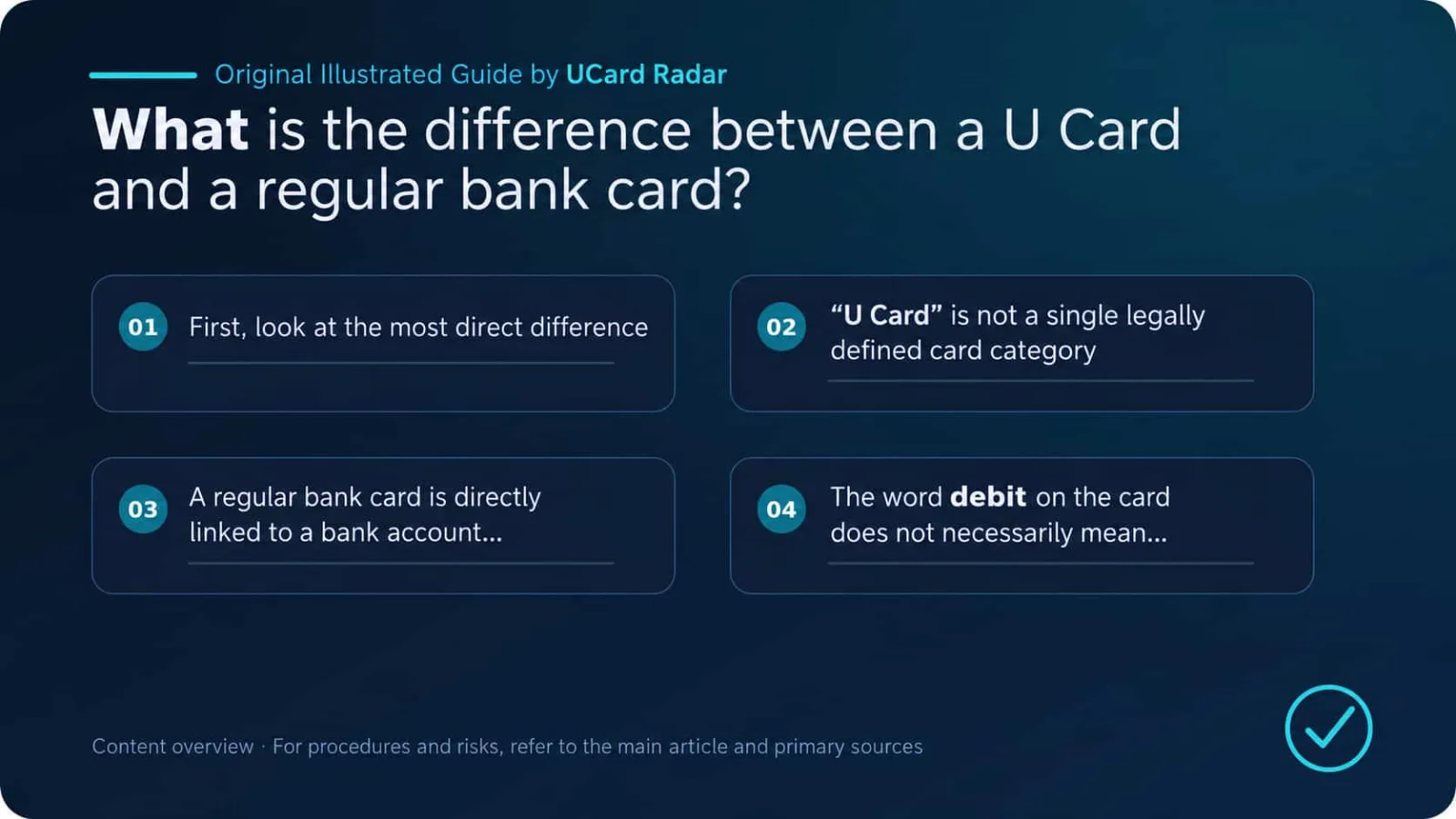
1. Start With the Most Direct Differences
Comparison | U Card or Crypto Payment Card | Regular Bank Debit Card | Bank Credit Card |
|---|---|---|---|
Source of funds | USDT, USDC, other crypto assets, or preloaded fiat | Balance in the user's own bank account | Credit line provided by the bank |
Result after payment | Platform balance is reduced or corresponding crypto assets are sold | Bank account balance is directly reduced | An amount due is added to the credit card bill |
Common issuing structure | Platform, payment institution, and issuer may jointly provide the service | Issued directly by a bank | Issued by a bank or licensed credit institution |
Type on the card network | May be debit, prepaid, or another program type | Usually debit | Credit |
Whether funds are needed in advance | Usually requires a deposit or assets available for settlement | Sufficient available balance is required | No pre-funding required, but subject to the credit limit |
Common fees | Card issuance, deposits, conversion, FX markup, monthly fees, and cash withdrawal fees | Account management, cross-border transactions, ATM, or FX fees | Annual fees, interest, late fees, and cross-border transaction fees |
Protection of funds | Depends on the custodian, payment institution, bank-account structure, and jurisdiction | Eligible bank deposits are generally covered by the local protection regime | Unused credit is not a customer deposit |
Asset-price risk | May include stablecoin, crypto-asset, and conversion risk | Primarily account-currency and bank risk | Primarily debt, interest, and repayment risk |
Service stability | Affected by the platform, issuing partnership, and crypto-business compliance | Usually provided continuously by the bank | Affected by bank credit decisions and account status |
Better-suited uses | Spending crypto assets, some cross-border payments, and overseas subscriptions | Salary, savings, transfers, and everyday payments | Deferred payment, credit history, and certain purchase protections |
The U.S. Consumer Financial Protection Bureau draws a straightforward distinction among three traditional card types: prepaid cards spend money previously loaded into the card account; debit cards spend money held in a bank or credit-union account; and credit cards involve borrowing money to make purchases. CFPB: differences between prepaid cards, debit cards, and credit cards.
Many U Cards are structurally closer to reloadable prepaid cards. The key difference is that the source of the loaded funds may be crypto assets, with conversion and custody added in between.
2. “U Card” Is Not a Uniform Legal Card Category
“U Card” is a common term in the Chinese-speaking crypto-payment market. It generally refers to a payment card that can be funded or settled using assets such as USDT or USDC.
It is not a card tier uniformly defined by Visa or Mastercard, nor is it a regulatory category recognized consistently across jurisdictions.
U Cards on the market generally fall into three structural models.
Custodial top-up model
The user first transfers USDT or USDC into a platform wallet, and the platform records the crypto balance. Conversion is then completed by the platform when the user applies for the card, funds the card account, or makes a payment. This model is convenient, but the user assumes platform-custody and withdrawal risks. Once crypto is deposited on the platform, the user typically no longer controls the private keys.Fiat or e-money balance model
Crypto assets are sold after deposit, and the user sees a balance denominated in dollars, euros, or another form of fiat or electronic money. Card transactions directly reduce that balance. In this model, it is important to determine whether the fiat balance is managed by a bank, an electronic-money institution, or an ordinary company. A “USD balance” is only a user-interface representation and does not automatically mean the funds constitute a bank deposit.Wallet-linked or real-time settlement model
Assets normally remain in the user’s wallet and are converted at the time of payment through smart-contract authorization, a settlement service, or the platform. Users often retain more control over their assets, but they still face smart-contract permission risks, conversion-liquidity risk, and payment-settlement risk.
All three structures may be marketed as U Cards, even though the risks lie in very different places. Comparing only issuance fees and cashback can easily obscure the most important issue: the account structure.
3. Regular Bank Cards Connect Directly to Bank Accounts; U Cards Usually Add a Platform Layer
A USD 50 purchase makes the difference easier to understand.
With a bank debit card, the merchant requests authorization for USD 50. The bank confirms that the account has sufficient funds, approves the transaction, and ultimately deducts USD 50 from the bank account.
With a credit card, the issuing bank first extends USD 50 of credit. The transaction appears on the credit card statement, and the cardholder repays it later.
With a U Card, the process may instead look like this:
The user deposits USDT. The platform or a partner institution converts it into U.S. dollars, and the dollar balance is then used through the issuer to authorize the USD 50 payment.
Some products sell the corresponding crypto assets only when the transaction occurs.
The merchant normally receives fiat currency, not USDT. From the merchant’s perspective, the payment is still a conventional card-network transaction. The crypto conversion takes place between the user, the platform, and the card-issuing infrastructure.
4. A “Debit” Label Does Not Mean the Card Is Linked to a Traditional Bank Account
Visa describes debit and prepaid cards as follows: Visa Debit typically connects to a conventional bank checking account, with purchases deducted directly from the account; Visa Prepaid uses a stored-value balance funded in advance. Visa: Debit cards · Visa: Prepaid cards.
In practice, however, card-program structures can be more complicated. Some U Cards may appear as “debit” on the card itself or in BIN data while being funded through an e-money account, payment account, or a ledger maintained by a partner institution.
In this context, “debit” describes the payment type within the card network. It does not necessarily mean that the user has an individual deposit account at a traditional bank.
Four items are useful to check:
The actual issuer named in the cardholder agreement;
Whether the card is debit, prepaid, or credit;
Whether the balance represents a bank deposit, electronic money, or a liability of the platform;
Who returns the balance if the platform stops operating.
If a platform only says “issued by an international bank” or “global Visa access” without identifying the issuer or linking to the relevant agreement, the legal nature of the card account remains unclear.
5. Fund Protection Works Differently
A conventional bank debit card connects to a bank account. If the account, bank, and deposit type meet the requirements of the applicable local regime, the deposit can generally fall within the relevant protection framework.
In the United States, for example, the FDIC protects eligible deposits at insured banks and calculates coverage according to the depositor, the bank, and the account ownership category. FDIC: Deposit Insurance.
Whether a U Card balance receives similar protection depends on where the underlying funds are ultimately held.
If the money is managed by a payment institution or an electronic-money institution, a common approach is segregation or safeguarding of customer funds rather than bank deposit insurance.
The UK Financial Conduct Authority explicitly states that funds held by payment and electronic-money institutions are not directly protected by the FSCS. Those institutions must instead protect customer funds under safeguarding rules. If the institution fails, repayment may still be delayed or subject to shortfalls. FCA: safeguarding rules for customer funds held by payment institutions.
If the underlying card funds are held at an insured depository bank and the requirements for pass-through deposit insurance are met, some prepaid-card balances may qualify for protection. However, the words “partner bank” alone are not enough to establish this.
FDIC guidance on prepaid cards likewise requires specific registration and underlying-deposit conditions to be satisfied. FDIC: Prepaid Cards and Deposit Insurance.
USDT, USDC, and other crypto assets held in a platform account generally cannot simply be treated as bank deposits. Even if the platform also provides a payment card, that does not mean all crypto assets on the platform fall within a deposit-insurance regime.
6. U Cards Add Several Additional Layers of Risk
With a conventional bank debit card, the main parties are usually the customer, the bank, the merchant, and the card network. U Cards often add a platform, crypto custodian, conversion provider, and program manager.
As the number of parties increases, risks are distributed across more points:
The platform may suspend deposits, withdrawals, or currency conversion;
A custodial wallet may be frozen, hacked, or affected by internal-management problems;
A stablecoin may depeg, be frozen, or face issuer-related risk;
The issuing institution may terminate its partnership with the platform;
Users in certain jurisdictions may suddenly lose eligibility;
Card spending may continue while crypto funding has already been disabled;
The platform and the issuer may shift responsibility for refunds or dispute handling to each other.
This does not mean regular bank cards are risk-free. Bank accounts may also be frozen because of anti-money-laundering reviews, unusual transactions, unauthorized use, or legal orders.
The difference is that the regulatory relationships, complaint channels, and legal nature of traditional bank accounts are usually easier to identify.
7. Fee Structures Can Be Very Different
Fees for regular debit cards are usually concentrated around account management, ATMs, cross-border transactions, and foreign-exchange conversion. Credit cards may additionally involve annual fees, interest, and late-payment charges.
U Cards often divide fees into more categories:
Card issuance fee;
Crypto deposit fee;
USDT or USDC conversion fee;
Fiat FX markup;
Monthly or account-management fee;
ATM withdrawal fee;
Refund, failed-transaction, or account-closure fee;
On-chain withdrawal and network fees.
The CFPB notes that prepaid cards may charge activation, maintenance, transaction, and other fees, with the actual cost depending on the specific card and how it is used. CFPB: common prepaid-card fees.
When comparing a U Card with a bank card, a statement such as “the card only costs USD 5 to open” is not meaningful by itself.
A better approach is to calculate the total cost under a fixed scenario: deposit 500 USDT, spend USD 100, and then withdraw the remaining funds. Add the losses or fees incurred at every stage—deposit, conversion, spending, and withdrawal—to determine the card’s true cost.
8. Payment Success Depends on More Than the Card-Network Logo
If two cards operate on the same card network, both may work at many of the same merchants, but their acceptance will not necessarily be identical.
Merchants can impose restrictions based on card type, BIN, issuing region, and business category. Some websites do not accept prepaid cards, single-use virtual cards, or cards issued in certain regions. Hotels, rental-car companies, and fuel stations may also require higher preauthorization amounts.
A U Card that lacks 3D Secure or recurring-payment support may also fail more often for subscriptions.
Regular bank cards can also be declined, but the issuing bank is usually able to provide a decline code more quickly. U Card users may sometimes need to contact the platform’s customer support first, which then asks the issuing partner for further information.
“Visa supported” means the card is connected to the Visa network. It does not mean every Visa merchant must accept it, nor does it mean its payment success rate is identical to that of a Visa card issued directly by a bank.
9. Refund and Fraud-Dispute Handling May Differ
Both U Cards and regular bank cards may process reversals, refunds, and disputes through the card network, but the actual experience depends on the issuer, card type, and cardholder agreement.
When unauthorized transactions occur on a conventional bank card, the user generally files a complaint directly with the bank or credit-card issuer.
With U Cards, the customer-support entry point is usually the platform, while the institution handling the case in the background may be different. If the platform has already suspended the card program, changed issuers, or closed the account, how a refund returned to the original card is credited depends on whether the platform can still identify the transaction and post the money back to the user’s balance.
Before using a U Card, it is useful to confirm:
Whether chargebacks or transaction disputes are supported;
What documentation is required for a dispute;
How refunds to a closed or cancelled card are handled;
The processing period and applicable fees;
Which legal entity should be contacted if the platform ceases operations.
Using Visa or Mastercard does not automatically provide the full set of consumer protections associated with a particular bank’s credit card. The applicable rights depend on local law, the issuing agreement, and the type of transaction.
10. KYC and Account-Freezing Rules Also Differ
Traditional bank-card accounts are usually opened after the bank itself completes identity verification.
With a U Card, the platform, crypto-asset service provider, and issuing institution may each conduct separate checks. Users can therefore face two or even multiple rounds of KYC.
The platform may also request information about the source of crypto assets, on-chain transaction history, and wallet ownership. Receiving USDT from a high-risk address, funding an account on behalf of another person, frequent currency conversion, or transaction patterns that do not match the account profile may trigger additional review.
“No KYC” may appear convenient, but it is not necessarily more reliable for long-term use. Without sufficient identity information, a cardholder may find it difficult to prove account ownership if the card is lost, the account is compromised, or the platform offboards the user.
11. Can a U Card Replace a Regular Bank Card?
In most cases, completely replacing a regular bank card is not advisable.
Regular bank accounts and cards are generally more suitable for salary payments, savings, everyday transfers, utility payments, and situations that require a stable long-term banking relationship.
A U Card is better viewed as a supplementary tool for converting legitimately held crypto assets into everyday spending power or for handling certain cross-border payments and overseas subscriptions.
Use Case | More Suitable Choice | Reason |
|---|---|---|
Salary and long-term savings | Regular bank account and debit card | Clearer account relationship, with more complete deposit protection and complaint channels |
Everyday domestic payments | Regular bank card | Usually lower cost and shorter deposit/refund chain |
Small purchases using legitimately held crypto | U Card | Reduces the steps of manually selling crypto and transferring funds to a bank |
Overseas software subscriptions | Depends on the card | Issuing region, 3DS, recurring-payment support, and merchant restrictions all matter |
Hotels, car rentals, and large preauthorizations | Regular credit card is usually more suitable | Credit limits and preauthorization handling are generally more mature |
Long-term storage of large amounts of USDT | Not recommended on a U Card platform | Custody, platform, stablecoin, and freezing risks can accumulate |
A more prudent approach is to fund the card according to near-term spending needs and top it up again after the balance is used. Cashback or yield should not be a reason to treat a U Card account as a long-term store of funds.
12. Frequently Asked Questions
Is a U Card a bank card?
Some U Cards are indeed issued by banks or licensed institutions and operate on the Visa or Mastercard network. However, “U Card” itself is not a uniform legal category of bank card.
Whether a specific card is debit, prepaid, or another type should be determined from the BIN and cardholder agreement.
Is the U.S. dollar balance in a U Card account a bank deposit?
Not necessarily.
It may represent electronic money, a payment-account balance, an internal platform ledger balance, or spending power created after crypto assets are sold. Only when the funds are clearly held at a bank and the account structure and protection conditions meet the applicable requirements may they be treated under the relevant deposit-protection regime.
If both a U Card and a bank debit card say “Visa Debit,” are they the same?
Not necessarily.
The card-network product label may be identical while the underlying source of funds, account characteristics, managing institution, and protection mechanisms are different.
Does a U Card send USDT directly to the merchant?
In most card-payment scenarios, the merchant receives settlement in fiat currency.
Crypto assets such as USDT are converted by the platform or its partners during funding or at the time of payment. The exact timing depends on the product terms.
What are the advantages of a U Card?
The main advantage is that it allows crypto holders to use their assets more conveniently for everyday purchases and certain cross-border payments.
It reduces the need to manually sell crypto, withdraw funds to a bank, and then spend them. At the same time, however, it introduces additional platform, custody, and currency-conversion layers.
The biggest difference between a U Card and a regular bank card is not the appearance of the card or whether it uses Visa or Mastercard. The important questions are where the balance comes from, who holds it, and who is responsible when something goes wrong.
A regular debit card usually connects directly to a bank account, while a credit card connects to a credit line provided by a bank. A U Card usually involves crypto funding, custody, and conversion before payment is ultimately completed through a partner issuer.
Those additional steps create convenience, but they also add fees and risks.
For salary, savings, and long-term money management, a regular bank account generally remains more suitable. A U Card can be useful for small purchases and specific cross-border payments, but it is better treated as a payment tool rather than a place to store large amounts of assets.