
In mainland China, holding or using a U Card issued overseas does not automatically mean that a person is acting illegally or committing a crime. However, this also does not mean that a U Card is a “lawful and compliant crypto payment tool” in mainland China. Regulatory assessment usually does not stop at the product name of the card, but instead looks through to the following facts:
who issued the card, and whether real-name verification and KYC were genuinely completed;
where the USDT came from, and whether the source of funds can be explained;
whether virtual currency was used to complete a value conversion between RMB and foreign currency;
whether the activity was genuine personal spending, or collecting money, paying on behalf of others, settlement, or cash-out services for others;
whether the amount, frequency, counterparties, and spending scenarios were unusual;
whether the person knew or should have known that the funds were connected to fraud, gambling, underground banking, or other illegal or criminal activity.
On February 6, 2026, the People’s Bank of China and seven other authorities issued Yinfɑ [2026] No. 42, clarifying that virtual currencies such as Bitcoin, Ether, and Tether do not have legal tender status and should not and cannot circulate in the market as currency; domestic virtual-currency exchange, trading intermediation, pricing, and related financial product businesses are illegal financial activities. The document also expressly states that Yinfɑ [2021] No. 237 issued in 2021 is repealed at the same time. Therefore, analysis of U Card risks should use the current Yinfɑ [2026] No. 42 as the primary policy basis, rather than continuing to treat the 2021 rules as current law.
Eight departments acting in concert to strengthen regulation and curb risks related to virtual currencies and similar activities. What is virtual currency? What business activities related to virtual currencies are covered?
Scope of Sources and Conclusions
Primary verification sources: Notice on Further Preventing and Handling the Risks of Virtual Currency Trading and Speculation; Measures for the Administration of Individual Foreign Exchange; Updated Guidance for a Risk-Based Approach to Virtual Assets and VASPs.
The verifiable facts in this article concerning virtual currency, foreign exchange, anti-money-laundering, and identity-related risks associated with U Cards in mainland China are based on the listed official or regulatory documents. Actual service status, fees, eligibility, and regional coverage should be determined by the issuer’s or platform’s page at the time of application.
This article only explains the public regulatory boundaries and does not constitute legal advice for any specific transaction, source of funds, or criminal-risk issue. Any experience, success-rate observations, fee comparisons, or trend judgments not directly disclosed in the above primary materials are analysis or inference and have not been officially confirmed by the relevant authorities for specific cases.
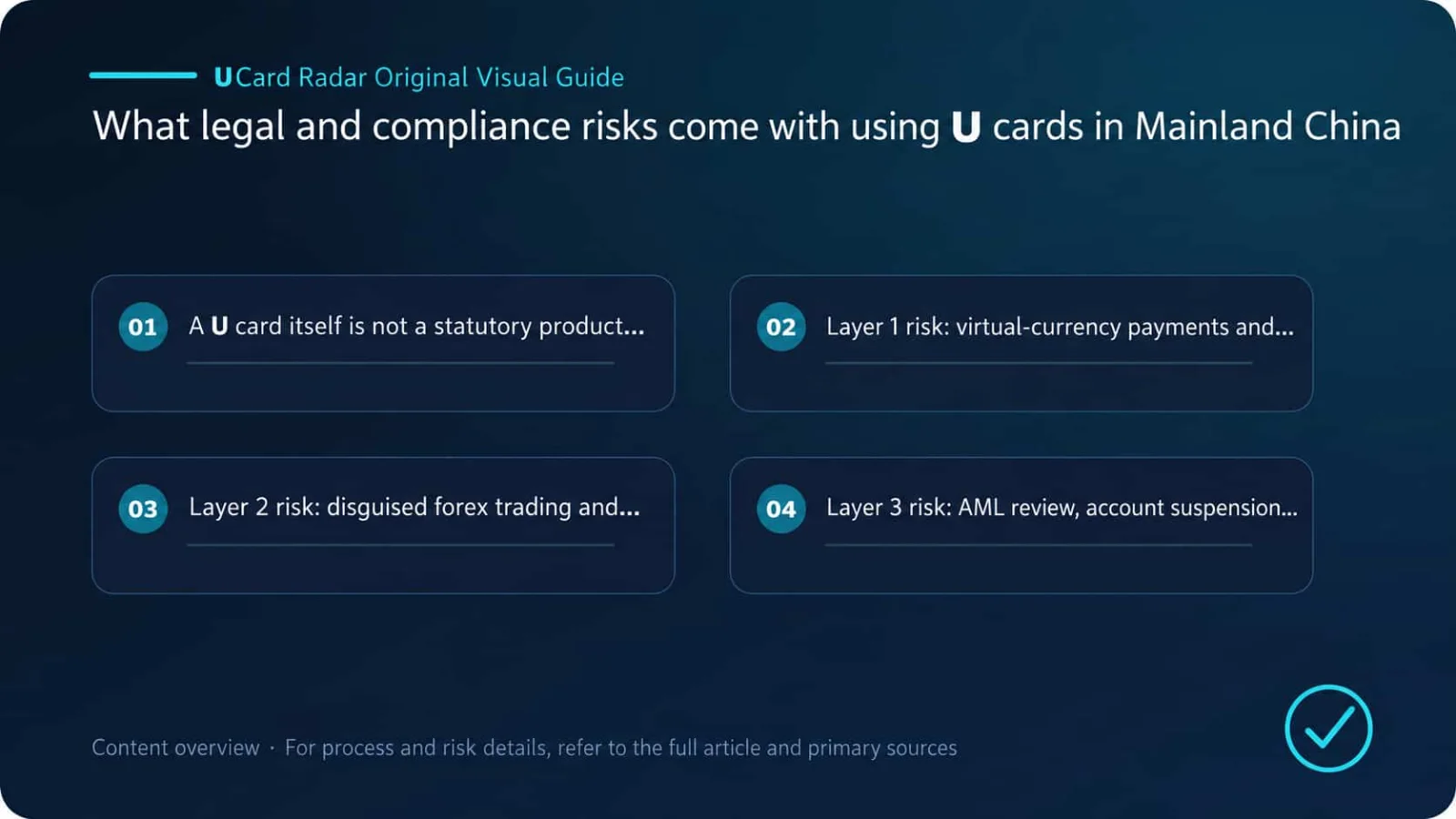
I. A U Card Is Not a Statutory Product Category
“U Card” is a market nickname. It usually refers to a card that can be topped up with virtual assets such as USDT and then used for spending or cash withdrawal through card networks such as Visa and Mastercard. The actual structure may differ completely:
The user transfers USDT to the issuing platform, which converts it into fiat currency and credits a prepaid-card balance;
At the time of spending, the platform sells the virtual asset in real time and settles the payment in fiat currency;
What the user actually holds is only an overseas payment account, and the so-called “card” is just an attached spending tool;
Some products do not clearly disclose the issuing bank, licensed entity, or custodial arrangement for user funds.
Therefore, there is no simple answer such as “all U Cards are legal” or “all U Cards are illegal.” Being licensed overseas and functioning normally for card payments does not mean that every service provided to residents of mainland China complies with mainland Chinese regulatory requirements.
II. First Layer of Risk: Virtual-Currency Payments and Domestic Business Prohibitions
The most direct effects of Yinfɑ [2026] No. 42 on U Cards include:
USDT is explicitly classified as a virtual currency and does not have the same legal status as fiat currency;
domestic businesses involving exchange between fiat and virtual currency, exchange between virtual currencies, transaction matching, and related financial-product businesses are all strictly prohibited;
overseas entities and individuals may not illegally provide virtual-currency-related services to domestic entities in any form;
domestic financial institutions and non-bank payment institutions may not provide account opening, transfer, clearing, settlement, or similar services for virtual-currency-related business;
domestic entities and individuals that know or should know that an overseas entity is illegally providing such services to domestic parties, but still assist it, may be held liable;
if relevant investment behavior violates public order and good morals, the civil legal act may be invalid and the losses must be borne by the participants themselves.
This means that even if a U Card platform is established overseas, if it continuously markets to mainland Chinese users and provides USDT exchange and card-payment services, there is still a policy risk that it may be regarded as providing virtual-currency-related services to domestic entities. For ordinary users, a single genuine small-value consumption transaction should not be mechanically equated with “operating a virtual-currency business,” but users also cannot treat overseas registration, an overseas BIN, or the availability of an app download as official approval.
Another practical issue is civil relief. If a platform ceases operations, refuses withdrawals, freezes balances, or suffers fraudulent card use, and the transaction structure itself is closely connected with a prohibited virtual-currency business, users may face difficulties in recovering losses through domestic litigation, including issues relating to contract validity, obtaining evidence, and overseas enforcement.
III. Second Layer of Risk: Disguised Foreign-Exchange Trading and Cross-Border “Matching”
What is most easily overlooked with U Cards is not the act of swiping the card itself, but the value conversion that takes place before the card is used.
For example, a user pays RMB domestically to obtain USDT, then tops up an overseas U Card with the USDT, and then spends it with overseas merchants, withdraws cash from an ATM, or transfers it to others. If the substance of the overall arrangement is to transfer the value of domestic RMB overseas—especially where there are fixed counterparties, bilateral bookkeeping, service fees, frequent large transactions, or services provided for others—it may trigger risks involving illegal foreign-exchange trading, evasion of foreign-exchange controls, or underground banking.
The State Administration of Foreign Exchange and the Supreme People’s Procuratorate have publicly explained that although cross-border “matching” does not appear to involve one single fund transfer crossing the border directly, an arrangement in which RMB is paid domestically and foreign currency is paid overseas may still in substance constitute disguised foreign-exchange trading. Using virtual currency as an intermediary to indirectly convert value between foreign exchange and RMB is an important link in the chain of illegal foreign-exchange trading. In serious circumstances, it may constitute the crime of illegal business operations. Legitimate exchange between domestic and foreign currency should be conducted through banks or approved individual foreign-exchange institutions and should have a genuine and lawful transactional basis. See the Q&A released by SAFE and the Supreme People’s Procuratorate.
It is important to distinguish that an individual using a card in his or her own name to purchase real goods or services does not automatically constitute the crime of illegal business operations. Criminal liability still requires a case-by-case judgment based on concrete evidence such as whether the conduct is business-like, the amount, frequency, profits, subjective knowledge, and source of funds. But “helping others convert RMB into U, then using the card to spend or withdraw cash and charging a service fee” is clearly riskier than occasional personal consumption.
IV. Third Layer of Risk: AML Review, Payment Blocking, and Account Freezes
The revised Anti-Money Laundering Law came into force on January 1, 2025. It requires financial institutions to conduct customer due diligence, preserve identity and transaction records, identify beneficial owners, and report large or suspicious transactions. See the Anti-Money Laundering Law of the People’s Republic of China published by the National Financial Regulatory Administration.
Ordinary cardholders are not financial institutions and do not automatically assume institutional AML obligations merely by using a U Card, but they are affected by these measures. The following transaction patterns are especially likely to trigger review, payment delay, restrictions, or account freezes:
top-up funds coming from multiple strangers or many dispersed accounts;
buying USDT and then quickly topping up, swiping, withdrawing, or transferring out;
transaction amounts that do not match the user’s occupation, income, or historical spending profile;
frequent purchases of gift cards, electronics, gambling-related services, or other high-risk goods;
multiple people sharing one card, or batch account opening from the same device or address;
funds passing through OTC dealers, “running-score” platforms, underground banks, or addresses linked to criminal cases;
inability to provide salary records, business income proof, contracts, on-chain records, and consumption receipts.
The judicial interpretation on money laundering released by the “Two Highs” in 2024 emphasized that “knowing” should be determined by considering facts such as the source of funds, method of transaction, account abnormalities, the actor’s professional background, and the relationship with upstream criminals. This shows that risk assessment is not based solely on whether “USDT was received,” but on whether the user knew or should have known that the funds were abnormal, and whether the user engaged in transfer, conversion, or concealment. See the Supreme People’s Court press conference on the judicial interpretation of money laundering offenses.
V. Fourth Layer of Risk: Paying on Behalf of Others, “Running Scores,” and Renting or Lending Accounts
Letting others use a U Card opened in your own real name is much riskier than personal spending. Common high-risk conduct includes:
renting out or selling U Cards, accounts, verification codes, phones, or login environments;
topping up for strangers, receiving U, swiping cards, or withdrawing cash for them;
pooling multiple people’s funds under the pretext of “paying for ChatGPT, advertising fees, or server fees”;
knowingly helping transfer funds despite obviously abnormal pricing or commissions;
using another person’s identity to open a card, or providing real-name verification for batch card opening.
Article 31 of the Anti-Telecom and Online Fraud Law prohibits the illegal sale, lease, or lending of bank accounts, payment accounts, and similar resources, and also prohibits providing real-name verification assistance, impersonating identities, or fabricating agency relationships to open accounts. Violations may result in confiscation of illegal gains, fines, detention, and, where a crime is constituted, criminal liability. See the full text of the law published by the Supreme People’s Procuratorate.
If the relevant accounts are used for fraud, online gambling, or transferring criminal proceeds, the conduct may further involve the crime of assisting information-network criminal activities, concealing or disguising criminal proceeds, money laundering, or even complicity in the upstream offense. The 2025 opinion of the “Two Highs and One Ministry” on assistance-information-network-crime cases further requires a determination based on factors such as the number of accounts, capital flow, abnormal transactions, and subjective knowledge. See the explanation of the “Opinion on Assisting Information Network Crime” released by the Supreme People’s Court.
“I was only helping a friend pay once” is not an absolute safe harbor. A real counterparty, a clear purpose, a reasonable amount, and no fee are very different, in terms of risk, from making payments over a long period for unspecified persons, charging commissions, and being unable to explain the source of funds.
VI. Fifth Layer of Risk: False KYC, Proof of Address, and Identity Misappropriation
Some U Cards restrict applications from residents of mainland China, so the market has developed services such as “overseas address packaging,” “passing KYC on your behalf,” or “buying ready-made accounts.” Such practices involve at least three layers of risk:
Contract risk: submitting false nationality, residence, tax-residency status, or source-of-funds information to the issuer usually violates the user agreement, and the platform may freeze the account, terminate service, or refuse refunds;
Identity and account risk: using another person’s identity document, proof of address, or facial verification may involve identity misappropriation, infringement of personal information, or unlawful account opening;
Follow-up explanation risk: where the name, billing address, login region, device, and source of funds do not match, manual review is more likely to be triggered, and the user will find it harder to prove ownership of the account and funds.
The compliant approach is to apply only with your own genuine information and confirm whether the issuer accepts residents of mainland China. If the platform does not support mainland Chinese residents, it is not advisable to bypass the restriction by forging an address, borrowing another person’s identity, or remotely controlling another device.
VII. Risk-Level Reference Table
Usage Pattern | Approximate Risk | Main Issues |
|---|---|---|
Card opened in the user’s own real name, lawful source of funds, and used only for occasional genuine small-value personal consumption | Lower, but not zero | Platform business legality, virtual-currency policy, account freeze, and relief risks |
Purchasing USDT from an unknown OTC seller and topping up for immediate spending | Medium to high | Unclear source of funds, fraud-linked funds, suspicious transactions, and payment-blocking risk |
Long-term purchase of USDT with RMB and use of overseas spending or cash withdrawal to transfer value | High | Disguised FX conversion, cross-border value transfer, and foreign-exchange compliance risk |
Batch payments on behalf of relatives, friends, or clients for commissions | High | Business-like payment settlement, illegal financial activity, and assisting-crime risk |
Renting out or selling U Cards, or providing others with accounts, verification codes, or real-name verification | Very high | Possible exposure under the Anti-Telecom and Online Fraud Law, assisting-crime offenses, and other related crimes |
Using a fake address, fake documents, another person’s identity, or buying a ready-made account | High | Platform breach, identity misuse, account freeze, and loss of funds |
Receiving USDT from an unknown source and cashing out, buying highly liquid goods, or transferring to others | Very high | Money laundering, concealing criminal proceeds, and exposure to fraud or gambling fund-chain risks |
Risk levels are only general judgments, not law-enforcement or judicial conclusions. A single high-risk transaction may trigger an investigation, and multiple low-value transactions may also be reviewed together if the pattern is unusual.
VIII. Compliance Suggestions for Using U Cards in Mainland China
Verify the issuing entity first, rather than looking only at the card-network logo
Confirm the name of the issuing bank or licensed institution, place of registration, regulatory license, card type, who safeguards user funds, and whether residents of mainland China are in the permitted region. A Visa or Mastercard logo only means the card may access that network; it does not mean the card platform itself is licensed by regulators in mainland China.Use only your own identity, your own account, and your own device
Do not buy ready-made accounts, do not borrow another person’s proof of address or face verification, and do not hand your account, card, verification codes, or device to others.Keep complete evidence of the source of funds
At a minimum, keep income proof, bank statements, coin-purchase orders, counterparty information, on-chain hashes, top-up records, card statements, invoices, or merchant orders. The evidence chain should be able to answer: “Where did the money come from, why was it converted into U, and what was ultimately purchased?”Avoid OTC transactions with unclear sources
Transfers from strangers, pricing clearly deviating from the market, requests to split orders, designated multiple recipient accounts, or promises of “no risk control” should all be treated as high-risk signals. Even if you did not commit fraud yourself, receiving case-related funds may still lead to payment blocking, account freezes, and investigation.Do not collect or disburse funds for unspecified third parties
Do not turn a U Card into a tool for merchant acquiring, settlement, “running-score” services, or foreign-exchange conversion. In particular, do not, for commissions, top up, swipe cards, purchase gift cards, or withdraw cash for unfamiliar clients.Control the balance and do not treat a U Card as a deposit account
Many U Cards are not bank deposits and may not be covered by deposit insurance. If the issuance chain spans multiple jurisdictions, the cost of recovery after platform insolvency, disappearance, or freezes can be very high. It is safer to keep only the balance needed for short-term spending.Do not fabricate explanatory materials if a freeze occurs
Stop transferring additional funds immediately, preserve notices, account flows, on-chain records, and communication records, and explain truthfully as required by the platform or law-enforcement authorities. Do not delete chats, create backdated contracts, or ask others to make false proof-of-funds materials. If the amount is large or you have already received notice from public security, procuratorate, or court authorities, consult a Chinese lawyer familiar with virtual assets, foreign exchange, and criminal compliance as soon as possible.
IX. Frequently Asked Questions
Is swiping a U Card in mainland China itself illegal?
Not necessarily. Real-name use by the cardholder, lawful funds, and genuine consumption are different in nature from operating exchange services, cross-border matching, payment facilitation, renting out accounts, or handling criminal proceeds. However, because U Cards are often linked to virtual-currency exchange and overseas payment services, users still bear policy, foreign-exchange, AML, platform-freeze, and civil-relief risks.
Can a U Card be used to pay for ChatGPT, cloud services, or overseas software subscriptions?
Purchasing genuine and lawful services is generally lower risk than cash-out behavior or settling for others, but it does not eliminate upstream issues involving coin purchases, foreign-exchange conversion, KYC, and platform access restrictions. Users must also comply with the merchant’s regional, account, and payment terms, and should not use such payments to circumvent explicit service restrictions.
Does the annual RMB 100,000 overseas ATM withdrawal limit apply to U Cards?
The SAFE rule limiting each person’s overseas cash withdrawal to the equivalent of RMB 100,000 per year applies to domestic bank cards used abroad. That limit cannot simply be transplanted to U Cards issued by overseas institutions, but this does not mean that overseas ATM withdrawals are free of limits or compliance risk. They may still be affected by the rules of the place of issuance, card-platform limits, and mainland China’s virtual-currency, foreign-exchange, and anti-money-laundering rules. See SAFE’s notice on regulating large overseas cash withdrawals via bank cards.
If I only use overseas platforms and do not use domestic banks, is it safe?
No. Regulators and courts will look at the actual controller, source of funds, relationship between domestic and overseas accounts, on-chain path, consumption purpose, and whether services are being provided to domestic parties. Yinfɑ [2026] No. 42 also explicitly establishes cross-department data analysis, online monitoring, fund monitoring, and risk-information-sharing mechanisms.
Conclusion
The core issue in using U Cards in mainland China is not simply “whether the card can be swiped,” but whether the entire funding chain is lawful, genuine, and explainable.
For ordinary users, the relatively controllable boundary is: using one’s real identity, lawful personal funds, a clear purpose, occasional consumption, not collecting or paying on behalf of others, not cashing out, not bypassing regional restrictions, and keeping complete records. Once behaviors such as foreign-exchange conversion for others, charging commissions, batch payment services, renting out accounts, false KYC, unclear sources of funds, or assisting cross-border transfer of value appear, the risk can quickly escalate from platform risk control to administrative or even criminal liability.
The final judgment must be based on the specific card product, fund path, transaction amount and frequency, counterparties, and the user’s subjective knowledge. For large-scale, long-term, or business-like use, one should not rely solely on internet experience, but should obtain targeted legal and tax advice before engaging in transactions.
Key Reference Materials
People’s Bank of China and seven other authorities: Notice on Further Preventing and Handling Risks Related to Virtual Currencies (Yinfɑ [2026] No. 42)
State Administration of Foreign Exchange and the Supreme People’s Procuratorate: Punish Foreign-Exchange Violations According to Law and Prevent Financial Risks
National Financial Regulatory Administration: Anti-Money Laundering Law of the People’s Republic of China
Supreme People’s Court and Supreme People’s Procuratorate: Press conference on the interpretation concerning application of law in money-laundering criminal cases
Supreme People’s Procuratorate: Anti-Telecom and Online Fraud Law of the People’s Republic of China
Supreme People’s Court: Opinion of the “Two Highs and One Ministry” on issues relating to criminal cases involving assistance in information-network criminal activities
State Administration of Foreign Exchange: Notice on Regulating Large Overseas Cash Withdrawals by Bank Cards