
USDT can be held and transferred in an on-chain wallet or bought and sold on an exchange. But supermarkets, hotels, and most e-commerce platforms will not simply give you a USDT wallet address for payment. To use USDT for everyday purchases, an additional conversion and settlement layer is usually required.
That is the problem USDT payment cards are designed to solve.
They connect a USDT balance or crypto wallet to card networks such as Visa and Mastercard. When the user pays by card, the platform deducts or reserves the corresponding amount of USDT based on the transaction value, then converts those assets into fiat currency that the merchant can accept. From the merchant’s perspective, it is still a normal card transaction, and the merchant does not need to hold USDT.
Visa explains in its documentation on crypto-linked cards that digital assets are converted into local fiat currency at the point of sale, while merchants continue to receive funds through Visa’s existing settlement process. Mastercard’s Crypto Card Program follows a similar approach: crypto assets are generally converted into fiat before entering the card network, although stablecoin settlement is supported in certain markets.
So a more accurate way to understand “spending USDT with a card” is this: you use USDT to fund a payment card, while conversion and settlement are handled in the background by the card platform, issuer, and payment partners.
Sources and Scope of Conclusions
Primary-source verification: Legal; Transparency; Crypto-linked cards.
Verifiable statements in this article concerning conversion, settlement, fees, and asset risks associated with USDT payment cards are based on the official or regulatory materials cited. Actual service availability, pricing, eligibility, and geographic coverage should be verified on the issuer’s or platform’s pages at the time of application.
Different issuers, regions, account tiers, and merchant rules may produce different outcomes. User experiences, success rates, fee comparisons, or trend assessments that are not directly disclosed by the primary sources above are analytical observations or inferences and have not been officially confirmed by the relevant institutions for individual cases.
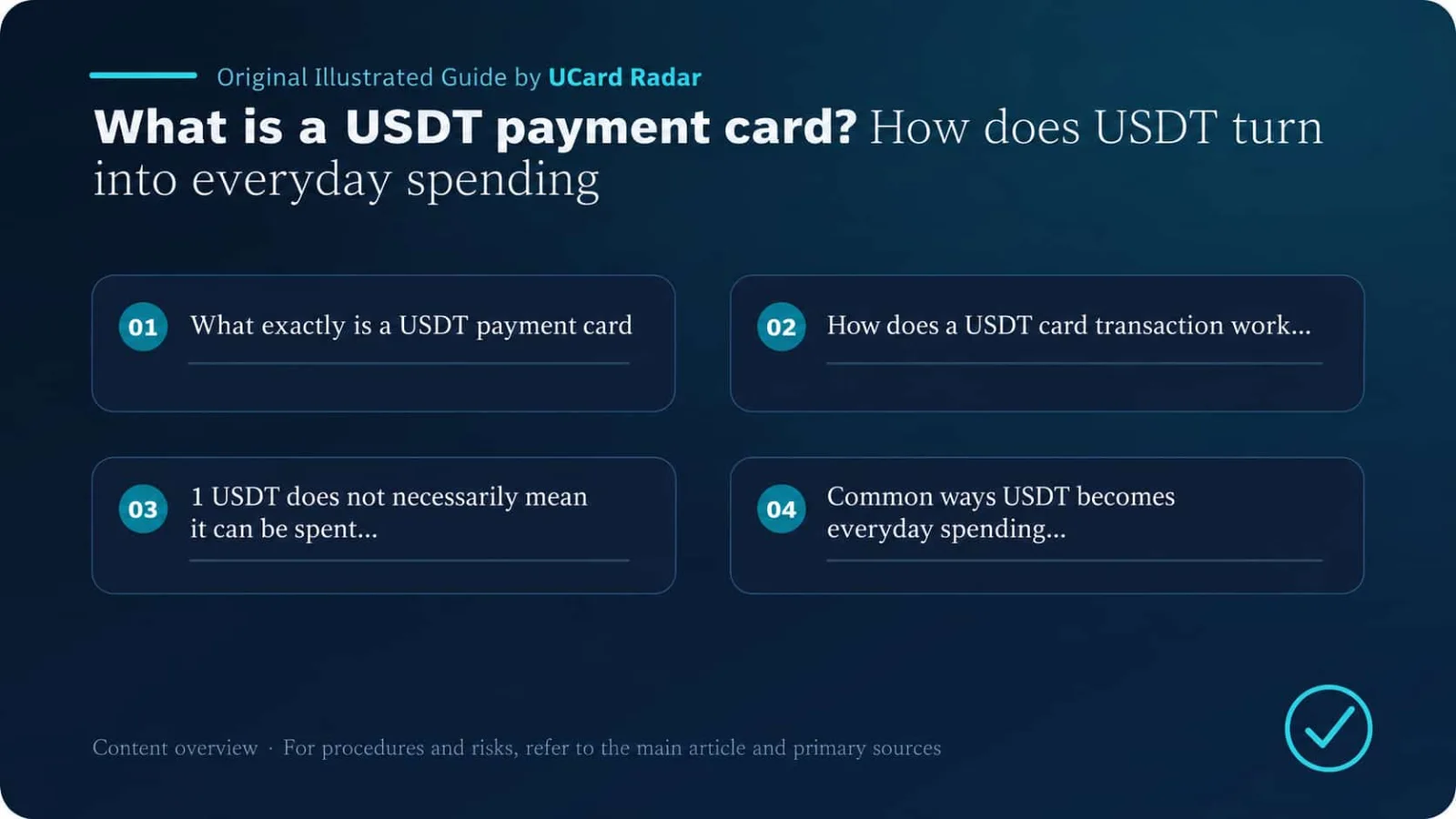
What Exactly Is a USDT Payment Card?
USDT payment cards are often referred to as U Cards, stablecoin cards, or crypto payment cards. They generally come in virtual and physical forms, and their card numbers are usually issued through the Visa or Mastercard ecosystem. Depending on the program and region, they may be used for online purchases, in-store payments, or linked to mobile wallets. Whether they support ATM withdrawals, overseas subscription services, Apple Pay, or Google Pay depends on the specific card program and jurisdiction.
These cards are not bank cards issued directly by Tether.
USDT is issued by Tether, while payment cards are usually provided jointly by crypto platforms, card program operators, licensed financial institutions, and payment processors. The platform name printed on a card is not necessarily the legal card issuer. Before using a card, users should at minimum identify the issuer, card network, custodian of funds, and the entity responsible for handling disputes.
From a funding-structure perspective, USDT payment cards on the market generally fall into three models.
Card model | Where the USDT is held | How payment is processed | Main issue |
|---|---|---|---|
Custodial balance model | USDT is first deposited into a platform account | The platform deducts USDT at authorization or converts it into fiat in advance | Convenient, but users assume platform custody and account-freeze risk |
Fiat pre-conversion model | Deposited USDT is first sold for USD, EUR, or another fiat currency | Card purchases are deducted directly from the fiat card balance | Settlement is straightforward, but it is not true real-time USDT spending |
Self-custody linked model | Funds remain in the user’s own on-chain wallet | Funds are authorized or deducted through a smart contract and converted at payment | Lower long-term custody risk, but greater dependence on networks, contracts, and authorization mechanisms |
The first two models are currently more common. Self-custody models are also in real-world use. MetaMask Card, for example, states that assets remain in the user’s wallet until payment, and its supported assets include USDT. However, these cards still require identity verification, and supported countries, networks, and tokens can change. The official MetaMask Card documentation shows that availability is restricted both by geography and by blockchain network.
How a USDT Card Transaction Is Completed
Consider an in-store purchase priced in local currency. After the user taps or swipes the card at checkout, the merchant does not send a transaction request to the USDT blockchain. The transaction still follows the normal card authorization process.
First, the merchant sends the transaction amount to its acquiring institution. If an item costs €100, the payment request enters the card network as a €100 transaction.
The issuer or card program then checks the card’s status, available balance, per-transaction limits, merchant category, and risk-control results. If the account is in good standing, the platform calculates how much USDT must be deducted at the current conversion rate and reserves that amount.
Some platforms sell the USDT at that moment. Others already maintain fiat settlement funds and simply deduct the user’s USDT on their internal ledger. Visa explains that stablecoin-linked card program managers can verify a user’s balance through an API or smart contract, reserve the required stablecoin amount, and then convert funds as needed for settlement. Visa also notes that both models currently exist: the traditional model in which stablecoins are converted into fiat before settlement with Visa, and an emerging model in which certain issuing members settle with Visa using supported stablecoins.
Once the transaction is authorized, the merchant receives payment as with an ordinary card transaction. One process described by Visa and Bridge deducts the required amount from the user’s stablecoin balance, converts it into fiat, and allows the local merchant to receive payment in local currency. The Visa and Bridge announcement provides this settlement example.
From the user’s perspective, the entire process may take only a few seconds. In the background, however, two separate systems are involved: a stablecoin wallet or platform account on one side, and the long-established card authorization and clearing network on the other.
1 USDT Does Not Necessarily Mean $1 of Spending Power
Tether designed USD₮ to track the US dollar. Under the Tether Terms of Service, eligible verified customers may acquire or redeem USD₮ from Tether at a price of 1 USD₮ per US dollar, subject to applicable fees.
Ordinary cardholders generally do not redeem directly with Tether. Instead, conversion takes place through the card platform, an exchange, or a liquidity provider. The final amount deducted can therefore be affected by market prices, conversion spreads, and card fees. If the purchase is denominated in a currency other than the US dollar, an additional foreign-exchange conversion is involved.
For example, if an item costs €100, the platform may first calculate the fiat value using the USD/EUR exchange rate and then determine the USDT deduction using its actual USDT/USD quote. In pre-authorization situations such as hotels, car rentals, or fuel stations, the system may also temporarily reserve an amount greater than the final bill.
Having exactly the “equivalent amount” in the account therefore provides little safety margin. Holding only 100 USDT on the card does not guarantee that a $100 transaction will be approved. Taxes, conversion spreads, pre-authorizations, and short-term exchange-rate fluctuations can all reduce the available balance below the amount requested by the merchant.
Three Common Ways to Turn USDT Into Everyday Spending
Use a USDT Payment Card
This is the method that most closely resembles using a conventional bank card. Users deposit USDT into the card platform or connect the card to a supported crypto wallet, then pay online or in stores.
The main advantage is that merchants do not need to support cryptocurrency directly. Acceptance generally follows the card network and the issuer’s program. The limitations are equally practical: users usually need to complete KYC, and transactions can be affected by issuing region, merchant category, spending limits, and risk controls. Platforms may also charge conversion or cross-border fees.
“Accepted at Visa or Mastercard merchants” does not mean every transaction will succeed. Gambling, crypto-asset purchases, transfers, financial services, some subscription payments, and cash-like transactions often face additional restrictions. Some cards are limited to online purchases, while others do not support ATM withdrawals.
Pay the Merchant Directly in USDT
If a merchant explicitly accepts USDT, users can scan a wallet address or QR code and transfer funds directly from their wallet. No card network is required, and the merchant receives USDT.
Before sending funds, the token and blockchain network must match exactly. USDT exists on multiple blockchains, and the fact that both sides call the asset “USDT” does not mean the recipient supports every network. If the wrong address or network is selected, a confirmed transfer generally cannot be charged back like a card payment.
This method is suitable for merchants or individuals already equipped to receive stablecoins, but it is still uncommon among ordinary physical retailers. Network fees, confirmation times, and the merchant’s own compliance requirements must also be considered separately.
Convert to Fiat First, Then Use a Conventional Bank Card
A third approach is to use a locally permitted and compliant exchange or another legitimate off-ramp to sell USDT for US dollars, euros, or local currency, then withdraw the funds to the user’s own bank account.
This adds a withdrawal step and is slower than paying directly with a card, but the movement of funds is easier to reconcile and users can continue using their existing bank cards. It is often more appropriate for large amounts, situations requiring formal statements, or cases where proof of source of funds is important.
There is no absolute hierarchy among these three methods. Convenience matters more for small everyday purchases; direct on-chain payment is more suitable when both parties are familiar with cryptocurrency; and converting to fiat first makes account management and documentation of fund flows easier.
What Fees Can a USDT Payment Card Generate?
USDT payment cards rarely involve only one fee. Some platforms advertise “zero card transaction fees,” but this often means only one specific fee has been waived. It does not mean deposits, conversions, cross-border payments, and cash withdrawals are all free.
Fee item | When it occurs | What is easy to overlook |
|---|---|---|
On-chain transfer fee | When USDT is sent to the card platform | Fees vary significantly by network, and a native token may also be required for Gas |
Deposit or crediting fee | When the platform receives USDT | Some platforms charge nothing, while others charge a percentage or fixed amount |
Conversion spread | When USDT is converted to fiat | It may not appear as a separate fee and can instead be embedded in an unfavorable exchange rate |
Card transaction fee | On each card purchase | It may apply only in certain regions, currencies, or merchant categories |
Foreign-exchange fee | When the card’s settlement currency differs from the merchant’s currency | The card platform may add a fee on top of the card network’s exchange rate |
ATM fee | When cash is withdrawn with a physical card | Platform fees, ATM operator fees, and exchange-rate differences may all apply |
Chargeback or refund fee | When a transaction fails, is disputed, or refunded | Whether a fee applies and which currency is returned depends on the card terms |
Issuance, monthly, or inactivity fee | When issuing, holding, or not using the card for an extended period | Infrequent users can easily overlook these fixed costs |
When comparing cards, do not look only at the issuance price and the advertised “spending fee.” A more useful test is to model your actual use case: deposit 100 USDT, make a foreign-currency purchase, and see how much the account balance actually falls; then consider how much would return if the transaction were refunded.
Refunds Usually Do Not Return the Original Amount of USDT
Card refunds take place within the card clearing system. Merchants generally refund in the original transaction currency. After the card platform receives the refund, it may credit the user with fiat or convert the refunded amount back into USDT at the rate available when the refund is received.
This means that even if the fiat refund is exactly equal to the original fiat transaction, the amount of USDT ultimately returned to the user can differ. Conversion rates, foreign-exchange movements, and refund fees can all affect the result.
A refund is also not an on-chain reversal. After the merchant issues the refund, the funds must still pass through the acquirer, card network, and issuer. Settlement time therefore depends on the entire card-processing chain. Users should keep order details, refund receipts, and card transaction records. If funds do not arrive for an extended period, first ask the merchant for the refund reference number and then contact the card platform.
The Risks of USDT Payment Cards Go Beyond the Token Price
USDT usually trades close to one US dollar, but holding USDT and handing funds over to a card platform involve two distinct layers of risk.
Tether’s terms state that USD₮ is not legal tender and is not covered by insurance provided by Tether or protections such as FDIC or SIPC coverage. Once a card platform receives USDT, whether the funds remain in USDT, are converted into fiat, or are segregated after conversion depends on the specific arrangements between the platform and its issuing institution.
Custodial cards require users to transfer assets to an address controlled by the platform. If withdrawals are suspended, a card program is terminated, or an account becomes subject to a compliance investigation, users may temporarily lose access to their balance. Self-custody cards reduce long-term custodial exposure but still involve smart-contract authorization, wallet-security risks, and changes in supported networks.
USDT itself may also be subject to address freezes. Tether’s current terms reserve the right to freeze relevant tokens or terminate services when legally required, in connection with sanctions, or where its terms are violated. Card platforms additionally conduct their own anti-money-laundering checks, sanctions screening, and transaction monitoring. USDT of unclear origin, unusually frequent deposit-and-spend activity, third-party payments, or cash-out behavior can all trigger review.
This is also why buying pre-verified accounts, borrowing another person’s identity, or providing a false address may appear convenient but creates substantial risk. If additional KYC or source-of-funds verification is later required, the person using the account may be unable to prove legitimate control over the card and its balance.
What to Check When Choosing a USDT Payment Card
Start with the issuing entity. A platform should identify the bank, electronic-money institution, or licensed issuer responsible for the card rather than merely displaying a Visa or Mastercard logo. Card networks provide payment infrastructure; they do not guarantee an unidentified platform.
Next, examine the flow of funds. After USDT is deposited, does it remain USDT or is it immediately converted into fiat? Who holds the funds? If the card is suspended or closed, can the remaining balance be withdrawn to the user’s own wallet or bank account? These questions are more important than a claim that the card “works in many countries.”
The fee schedule and restrictions should also be read in full, particularly foreign-exchange fees, ATM fees, refunds, chargebacks, inactivity fees, per-transaction limits, and daily limits. If merchant-category restrictions are not publicly disclosed, users should at least request written clarification from customer support.
Finally, verify the supported blockchain networks. A platform saying it “supports USDT” does not mean that every USDT network, including TRON, Ethereum, and Solana, is supported. The network and deposit address shown on the funding page must be checked character by character. For a first deposit, use a small test amount.
If a platform does not disclose its actual issuer, sells cards only through private communities, asks users to purchase accounts verified in someone else’s name, or promises that payments will work in every region and at every merchant without exception, it is unsuitable for holding significant balances.
Frequently Asked Questions
Do USDT payment cards require identity verification?
Legitimate card programs generally do. Issuing payment cards involves identity verification, anti-money-laundering controls, and sanctions screening. Mastercard’s crypto card program materials explicitly refer to AML, KYC, sanctions screening, and ongoing transaction monitoring. Self-custody products such as MetaMask Card also require users to complete identity and compliance checks. Claims of a “completely KYC-free Visa card” should therefore be examined carefully, particularly the legal issuer and account ownership.
Will merchants know that I am paying with USDT?
Usually not. From the merchant’s perspective, it is an ordinary card transaction, and the merchant receives local fiat currency or another settlement asset arranged by the card program. The card platform and associated financial institutions, however, can see the card account, conversions, and transaction records.
Can a USDT payment card be linked to Alipay, WeChat, Apple Pay, or Google Pay?
It depends on the BIN, issuing region, and the rules of the wallet service. A platform claiming support for a particular mobile wallet does not mean every country or every account can add the card. Successful linking also does not guarantee that subsequent transactions will never be rejected by risk controls.
Can I withdraw cash from an ATM using a USDT payment card?
Only physical cards with ATM functionality can be used for this purpose. Cash withdrawals usually have lower limits and higher fees, and some ATMs charge additional operator fees. Virtual cards generally cannot be used for ATM withdrawals.
Is a USDT payment card suitable for storing a large balance long term?
Usually not. A payment card is primarily a spending tool, not a long-term savings vehicle. Leaving a large amount of USDT on a custodial card platform means simultaneously accepting stablecoin risk, platform-custody risk, card-program risk, and account-freeze risk. Funding the card according to near-term spending needs and topping it up when necessary makes those risks easier to control.
What a USDT Payment Card Actually Provides
A USDT payment card does not make every merchant start accepting USDT. Instead, it acts as a translation layer: the user holds or spends stablecoins on one side, while the merchant continues using familiar card and fiat-settlement infrastructure on the other.
For users, the main convenience is avoiding the need to manually sell USDT, withdraw it to a bank, and then make a payment each time. The trade-off is the addition of a card platform, conversion provider, and issuer, bringing additional fees, KYC requirements, and account-freeze risks.
For occasional spending, using a card with clear rules and keeping the account balance controlled may be sufficient. For long-term or high-value use, priority should be given to verifying the issuer, custody model, exit channels, and complete fee schedule rather than simply asking whether the card can be used for purchases.
References
Stablecoins and USDT
Card Networks and Settlement Mechanisms
Visa: Stablecoin-linked cards and money movement
Visa and Bridge stablecoin-linked card announcement
Self-Custody Payment Card Examples
MetaMask Card official introduction
MetaMask and Mastercard US card program announcement