
Argentinians have a growing range of options for spending USDT or USDC on everyday purchases. But choosing a crypto payment card still raises practical questions. Can you apply using Argentine identity documents? Can you spend stablecoins directly? What exchange rate applies when you pay? And how much extra will an international transaction cost?
Lemon, Binance, Ripio, belo, and Nexo are five products worth comparing in Argentina in 2026. All allow users to fund everyday spending with digital assets, but they differ substantially in their intended use, how funds are accessed, and transaction costs.
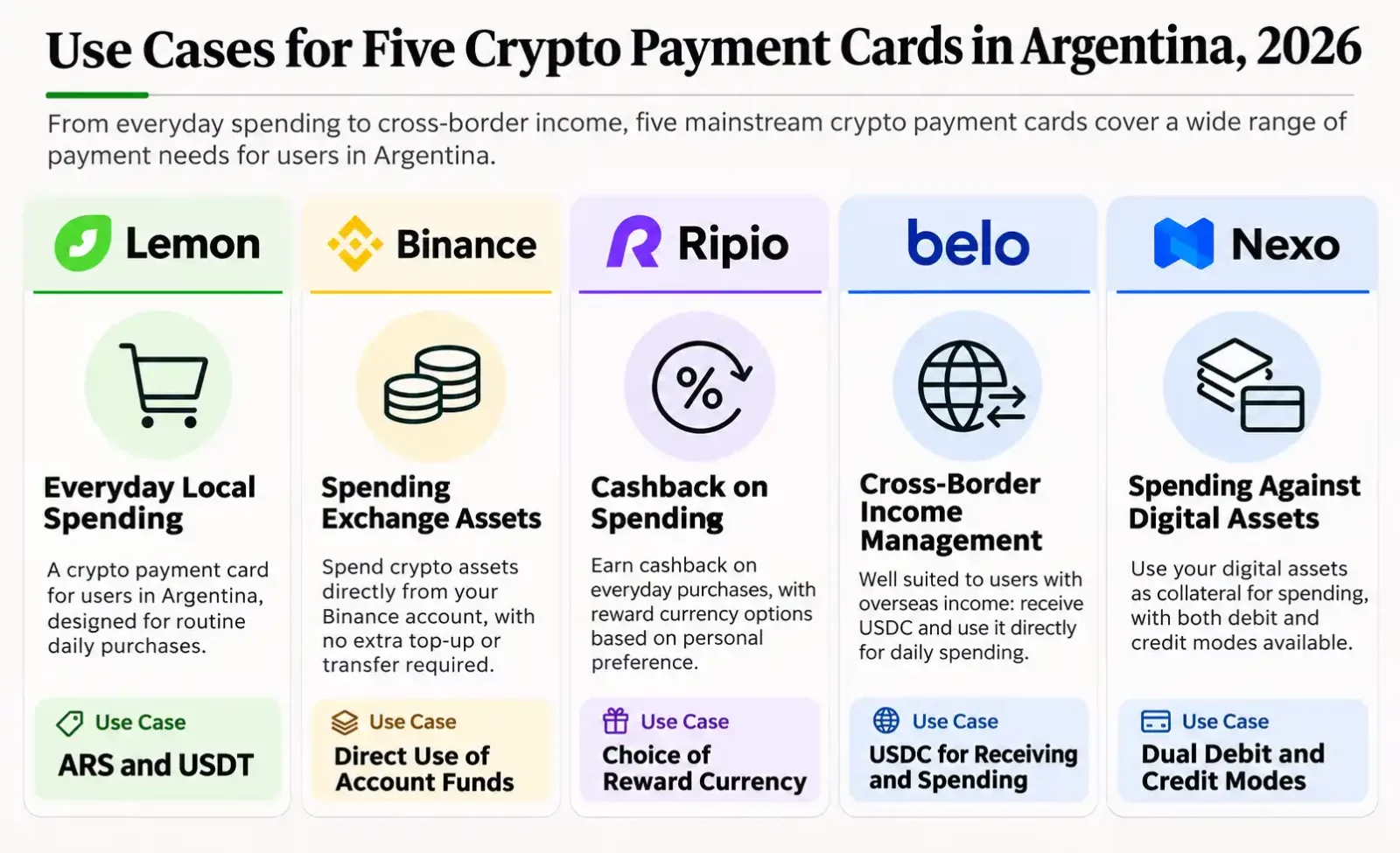
Lemon combines stablecoins with local Argentine payment methods, making it a practical choice for everyday purchases. Binance Card lets customers spend funds held in their exchange accounts. Ripio appeals to consumers with crypto cashback rewards. belo brings cross-border payments, multicurrency balances, and card spending into one service. Nexo offers digital asset-backed credit, allowing customers to access spending power without immediately selling their holdings.
For Argentine residents, cashback rates are only part of the decision. The convenience of local payments, the cost of converting digital assets, and the way international transactions are settled often matter more than the advertised rewards.
Key Differences Between the Five Cards
Product | Main Payment Methods | Standard Rewards and Key Conditions | Best-Suited Use Cases |
|---|---|---|---|
Lemon Card (Visa) | ARS and crypto assets; QR payments also supported | 2% BTC cashback on crypto-funded card purchases, with a 0.5% conversion fee; 0.25% BTC cashback on ARS purchases; monthly cashback cap of 30,000 ARS | Everyday local spending and purchases funded with existing USDT |
Binance Card Argentina (Mastercard) | Eligible crypto assets and ARS held in a Binance account | Tiered 1.5%–3% BTC cashback on crypto-funded purchases, with a 0.9% conversion fee; no cashback on ARS-funded purchases | Argentine consumers who already hold crypto on Binance |
Ripio Card (Visa) | ARS and eligible crypto assets | 2% cashback on crypto-funded purchases, with a 0.5% card transaction fee; 0.5% cashback on ARS purchases; monthly cashback cap of 50,000 ARS | Users who prefer USDT rewards or want better returns on ARS spending |
belo Mastercard | Multicurrency account balances | No single fixed cashback rate for card purchases; certain international transactions carry minimum fees | Cross-border income, USDC receipts, and spending |
Nexo Card (Mastercard) | Debit spending and digital asset-backed credit | Both modes offer rewards in Argentina, depending on loyalty tier and reward currency | USD payments and users with an existing need for collateralized borrowing |
All cashback figures are subject to eligible transaction requirements and applicable limits.
Lemon Card: A Well-Rounded Choice for Everyday Life in Argentina
Lemon Card is a Visa prepaid card that supports crypto-funded payments. It comes in virtual and physical versions, with no issuance, delivery, or maintenance fees.
Its strongest advantage is its close integration with Argentina's local payment system. Users can hold ARS alongside digital assets such as USDT in their Lemon accounts, then choose which balance to spend.
For example, someone shopping at a supermarket in Buenos Aires can pay directly in pesos by selecting their ARS balance. If they select USDT instead, Lemon converts the required digital assets into ARS when the transaction takes place. The merchant still receives a conventional card payment and does not need to accept cryptocurrency.
The 0.5% Conversion Cost Behind 2% Cashback
Under Lemon's official rules, effective September 1, 2026, eligible card purchases funded with ARS earn 0.25% cashback in BTC, while purchases funded with cryptocurrency earn 2% BTC cashback.
However, when cryptocurrency is used to fund an ARS transaction, the platform automatically sells the necessary digital assets and charges a 0.5% conversion fee.
Consider an eligible purchase worth the equivalent of $100 that qualifies for 2% cashback:
The customer receives approximately $2 worth of BTC cashback.
The crypto conversion fee is approximately $0.50.
Excluding other costs, the net benefit is approximately $1.50.
This calculation excludes the cost of acquiring the USDT and the actual conversion rate. If the customer originally bought the stablecoins at an unfavorable price, the final benefit will be smaller.
Lemon also supports QR payments, which are widely used in Argentina, but QR transactions have different cashback rules from card purchases. Eligible QR payments funded with cryptocurrency earn 1% cashback, compared with 2% for card spending.
For international purchases, Lemon offers another useful feature. According to its 2026 product information, eligible foreign-currency transactions funded with USDt can be processed in U.S. dollars without being subject to Argentina's associated 30% advance income-tax collection. These transactions do not earn BTC cashback. Eligibility depends on the specific transaction and the tax rules in force.
For Argentine residents who want to manage stablecoins and household spending in the same app, Lemon covers a broad range of needs, including local purchases, QR payments, virtual and physical cards, and foreign-currency spending.
Its main weakness is the cashback rate on ARS purchases. For customers who primarily spend pesos and rarely need to convert stablecoins, a 0.25% reward offers limited value. Other cards may provide a better direct return.
Official sources: Lemon Card | Current cashback rates and monthly limits | QR payment cashback | Crypto conversion fees | Foreign-currency settlement
Binance Card: Spend Exchange Balances Directly, but Watch International Fees
Binance launched Binance Card for the Argentine market in June 2026, using the Mastercard payment network.
For customers who already hold digital assets on Binance, the most immediate benefit is being able to spend without first transferring funds off the exchange and into another wallet.
According to Binance, Argentine residents who have completed KYC can apply using valid Argentine identity documents, a passport, or residence documents. The virtual card can be used once approved, while a physical card can be requested separately.
Standard cashback is determined by the total value of eligible transactions settled during each calendar month, with the applicable rate applied retroactively to qualifying purchases made that month:
Monthly Eligible Spending | BTC Cashback | Cap |
|---|---|---|
Below 148,000 ARS | 1.5% | No separate monthly cap specified in the rules |
148,000 to less than 1,480,000 ARS | 2% | No separate monthly cap specified in the rules |
1,480,000 ARS or more | 3% | Maximum monthly cashback of 148,000 ARS |
Once spending reaches a higher tier, the new cashback rate applies retroactively to eligible purchases made during that month. Rewards are generally settled the following month.
Binance also offers a limited-time 3% cashback promotion for a first purchase with the physical card, ending December 31. This promotion follows separate rules from the standard tiered rewards program, so the two percentages cannot simply be added together.
More important than the cashback tiers, however, is Binance Card's fee structure.
The official fee schedule for the Argentine card includes:
Cryptocurrency conversion fee: 0.9%;
Foreign exchange conversion fee: 6%–7%;
Annual fee: 0 ARS;
Standard physical card issuance fee: $10, waived for the first card through December 31, 2026.
If a customer uses USDT to fund an eligible ARS purchase in Argentina at the 2% cashback tier, the theoretical net reward is approximately 1.1% of the purchase amount after deducting the 0.9% crypto conversion fee.
International spending is a different proposition. If a transaction incurs a 6% foreign exchange fee, even the maximum 3% cashback rate would not offset that charge.
Binance Card is better suited to customers who already manage their digital assets on Binance and primarily spend within Argentina. Spending directly from an exchange account eliminates the need for transfers between platforms, but that convenience does not overcome the cost disadvantage in certain transaction scenarios.
For international travel, USD subscriptions, or cross-border purchases, the actual cost of foreign-currency settlement deserves more attention than the advertised cashback rate.
Official sources: Argentina Card overview | Cashback tiers and excluded transactions | Fees and limits
Ripio Card: Competitive 2% Cashback on Crypto Spending
Ripio is an established participant in Argentina's domestic crypto asset services market. Its Visa-network Ripio Card is available as a virtual card or physical prepaid card and supports purchases funded with ARS or eligible cryptocurrencies.
Compared with Lemon, Ripio's standard cashback structure is more attractive for ordinary consumers, particularly those paying directly in ARS.
According to Ripio's official 2026 product information, crypto-funded purchases earn a standard 2% cashback reward, payable in USDT, BTC, or ETH at the customer's choice. Purchases funded with ARS earn 0.5%.
New cardholders can also qualify for promotional cashback of 4% on crypto-funded purchases and 1% on ARS purchases during their first 30 days, subject to the promotion's conditions. Rewards are capped, however.
Total cashback is limited to 50,000 ARS per calendar month. Digital wallet top-ups, certain financial transactions, taxes, and other restricted transaction categories are excluded.
Why Ripio's 2% Cashback Is Not a 2% Net Return
When a Ripio Card purchase is funded with digital assets, the platform sells the amount of cryptocurrency needed to complete the transaction, converts the proceeds into ARS, and uses those funds for the card purchase.
Under its terms of service, the conversion uses Ripio's prevailing selling price for the digital asset, together with the applicable sale fee.
As a result, a 2% cashback rate does not mean the customer earns a 2% net return. The outcome depends on the asset's selling price, platform fees, and the cost the customer originally incurred to acquire the crypto.
One scenario deserves particular attention: a customer who starts with ARS, buys USDT specifically to earn crypto-spending cashback, then uses Ripio Card to sell that USDT back into ARS at the point of purchase.
This strategy incurs costs on both sides of the conversion. If the combined buy and sell spreads are substantial, much of the cashback advantage disappears.
The calculation is different for customers who receive income directly in USDT. Because their funds are already held in stablecoins, they do not need to make an additional USDT purchase solely to qualify for cashback. That makes the cost structure simpler.
Ripio has another worthwhile advantage: customers can choose which crypto asset they receive as a reward.
Someone who wants to accumulate stablecoins without increasing their exposure to BTC price volatility can select USDT cashback. Compared with cards that pay rewards exclusively in BTC, that flexibility has practical value for day-to-day money management.
For frequent or high-volume spenders, though, the monthly cashback cap of 50,000 ARS limits the potential return. Once the cap is reached, additional purchases do not generate additional rewards.
Ripio Card suits customers who already use the Ripio wallet and want to accumulate USDT, BTC, or ETH through everyday spending. Its standard 0.5% cashback on ARS purchases is also worth considering for people who predominantly spend pesos.
Customers who regularly move funds between exchanges, or buy USDT specifically to earn higher cashback, should calculate the full conversion cost before deciding whether the card is worthwhile.
Official sources: Ripio Card | Card fees and limits | Cashback terms and exclusions | Tax treatment of international purchases
belo Mastercard: Less About Cashback, More About Spending Income Earned Abroad
For freelancers, remote workers, and digital service providers living in Argentina but earning income from the United States or other countries, the hardest part often comes before making a purchase.
Receiving international payments, converting that income into a usable balance, and spending it locally can be more complicated than finding a card with a higher cashback rate.
belo is designed around these needs.
According to its 2026 official documentation, Argentine customers can receive certain international transfers through belo. Depending on the service used, the incoming funds may be converted into or credited as balances such as USDC. Users can also hold ARS and other digital assets supported by the platform.
belo Mastercard is an Argentine-issued Mastercard prepaid card available in virtual and physical formats. Cardholders can set the order in which different currency balances are used, with transactions processed according to the applicable rules.
Consider an Argentine freelance designer working for an overseas client. After receiving USDC through an eligible payment channel, they can use that balance for everyday purchases without manually withdrawing the funds to a conventional bank account each time.
This does not mean the card sends USDC directly over a blockchain to the merchant. Card transactions still involve the applicable currency conversion and fiat settlement processes.
Official sources: belo Mastercard | Card fees | Spending limits | Receiving funds from Deel | Receiving funds from Payoneer
Nexo Card: Spend Without Selling Crypto, but Collateralized Credit Is Not a Cashback Strategy
On July 8, 2026, Nexo officially launched Nexo Card in Argentina, offering residents two payment options: debit spending and credit backed by digital asset collateral.
Its most significant difference from a conventional prepaid card is that customers can access spending power without immediately selling part of their crypto holdings.
In Debit Mode, customers spend eligible digital asset balances held in their accounts, with the underlying assets handled according to the product's rules.
Credit Mode allows customers to pledge eligible digital assets, such as BTC or ETH, as collateral for a spending credit line.
Consider a long-term BTC holder who believes the current market price is unfavorable for selling. They could pledge some BTC as collateral and use Nexo Card to fund purchases without liquidating their holdings when the transactions occur.
Provided the loan is repaid as required and the collateral continues to meet the platform's risk requirements, the customer may be able to retain their original BTC position.
This arrangement can appeal to long-term crypto holders who need short-term liquidity. It also means that ordinary card spending becomes linked to a collateralized loan.
The Risks of Spending While Retaining BTC Exposure
Nexo has advertised annualized credit rates starting as low as 1.9% in Argentina. However, these rates are subject to specific conditions and are not available to every customer.
The more significant concern is volatility in the collateral's market value.
If BTC falls sharply after being pledged, the loan-to-value ratio (LTV) may rise rapidly. Once the platform's risk thresholds are reached, the customer may need to provide additional collateral, repay part of the loan, or face the sale of pledged assets.
Credit Mode may avoid an immediate BTC sale, but it does not eliminate market risk. The customer takes on debt and must continue monitoring the value of their collateral.
For someone who primarily uses stablecoins to cover everyday expenses, this borrowing arrangement is unnecessary. It is better suited to customers who understand collateralized lending and can manage both borrowing costs and crypto price volatility.
Cashback Depends on Reward Currency and Loyalty Tier
According to Nexo's official information for Argentina, standard cashback can reach:
Credit Mode: 2%;
Debit Mode: 1%.
These maximum rates require the relevant loyalty tier and reward conditions, typically including the selection of NEXO tokens as the reward currency. Customers choosing BTC cashback receive a lower rate than the highest NEXO-token reward tier.
Nexo has also offered limited-time promotions for new customers, but temporary incentives should not be used to judge long-term card returns. For example, a double-cashback promotion that ended in October 2026 should not be included in calculations of standard rewards for November.
Beyond cashback, the Argentine version of Nexo Card supports local ARS payments and USD spending. Nexo has described arrangements under which certain USD settlement methods can avoid the 30% advance tax collection associated with ARS conversion.
This may appeal to customers who frequently spend in U.S. dollars and hold substantial digital asset balances. The tax treatment, however, depends on the transaction structure; it does not mean every international purchase is exempt from the relevant taxes.
Nexo Card is best suited to customers with an established digital asset portfolio who want flexibility in managing both spending and holdings. Its debit and credit options offer more ways to access funds, but interest charges, collateral management, and potential liquidation risks make Credit Mode more complicated than an ordinary stablecoin-funded prepaid card.
Someone who simply wants to use USDT to pay for groceries has little reason to assume additional borrowing risk for a collateralized credit feature.
Official sources: Nexo Card Argentina | Argentina launch announcement | Debit Mode in Argentina
Spending $1,000 in USDT: Which Card Has Lower Known Costs?
A cashback percentage is not the same as an actual return. The price at which a platform sells digital assets, its conversion fees, and the rules governing rewards all affect the final cost of a purchase.
Assume a customer already holds USDT and needs to make eligible ARS purchases worth the equivalent of $1,000 in Argentina. Using publicly disclosed standard cashback rates and conversion charges, the comparison looks like this:
Product | Theoretical Cashback | Disclosed Conversion Costs | Assessment of Net Benefit |
|---|---|---|---|
Lemon Card | $20 worth of BTC | Approximately $5 | Approximately $15 |
Binance Card (2% tier) | $20 worth of BTC | Approximately $9 | Approximately $11 |
Ripio Card | $20 worth of crypto assets | Based on the platform's actual selling fees and prices | Cannot be determined from the cashback rate alone |
belo Mastercard | No uniform fixed cashback rate for this comparison | Depends on the debited currency, exchange rate, and transaction rules | Better assessed alongside the cost of receiving funds |
Nexo Card | Up to 1% debit cashback, subject to eligibility | Depends on the specific assets and conversion method | Requires checking loyalty eligibility and actual transaction costs |
These figures are illustrative calculations under specific assumptions. They exclude the original cost of acquiring USDT, exchange rate spreads, taxes, cashback caps, and subsequent price movements in reward assets such as BTC.
In this example, Lemon's disclosed conversion fee is lower than Binance's, and its theoretical cashback benefit after known costs is higher. The practical choice also depends on where the customer's funds are already held.
One strategy is particularly difficult to justify: repeatedly buying USDT with ARS solely to earn cashback, then selling the USDT back into ARS through a card purchase. This adds costs and spreads on both sides of the transaction, potentially consuming most of the rewards.
For customers who already hold stablecoins, the priority is finding an inexpensive way to spend those assets. For customers who hold only ARS, the first question is whether adding a crypto purchase and sale makes financial sense at all.
How to Choose a Crypto Payment Card in Argentina in 2026
Your Situation | My Preferred Options | What You Can Rule Out First |
|---|---|---|
You already hold USDT and mainly spend in Argentina | Lemon or Ripio; compare where your funds are held, conversion quotes, and reward currencies | Nexo Credit Mode if you have no specific borrowing need |
Most of your USDT is on Binance and your monthly spending is high | Binance Card; confirm whether you can consistently qualify for the 3% tier | Expecting crypto-spending cashback when paying entirely in ARS |
You earn only ARS and occasionally use a card for local purchases | Ripio's ARS cashback; consider Lemon if QR payments also matter | Buying and reselling USDT purely to earn cashback |
You receive international income through Deel, Payoneer, or similar services | belo; calculate total costs for your actual payment channel | Judging a cross-border account solely by card cashback |
You regularly pay USD subscriptions or international bills | Nexo's USD settlement or Lemon's USDt-funded foreign-currency payments; also compare Ripio | Using Binance Card Argentina without comparing FX fees |
You hold BTC, need to borrow, and can manage LTV | Nexo Credit Mode | Treating collateralized borrowing like ordinary stablecoin debit spending |
Argentine consumers use stablecoins for different reasons. Some want to preserve purchasing power in foreign currency; others depend on income from abroad. Some simply want fewer steps between their digital assets and everyday payments. Those needs determine the value of each product. When choosing a crypto payment card, the central question is how much it costs to move funds from the account to a completed purchase. A card is worth keeping over the long term only if it provides reliable everyday payments at a reasonable cost.