
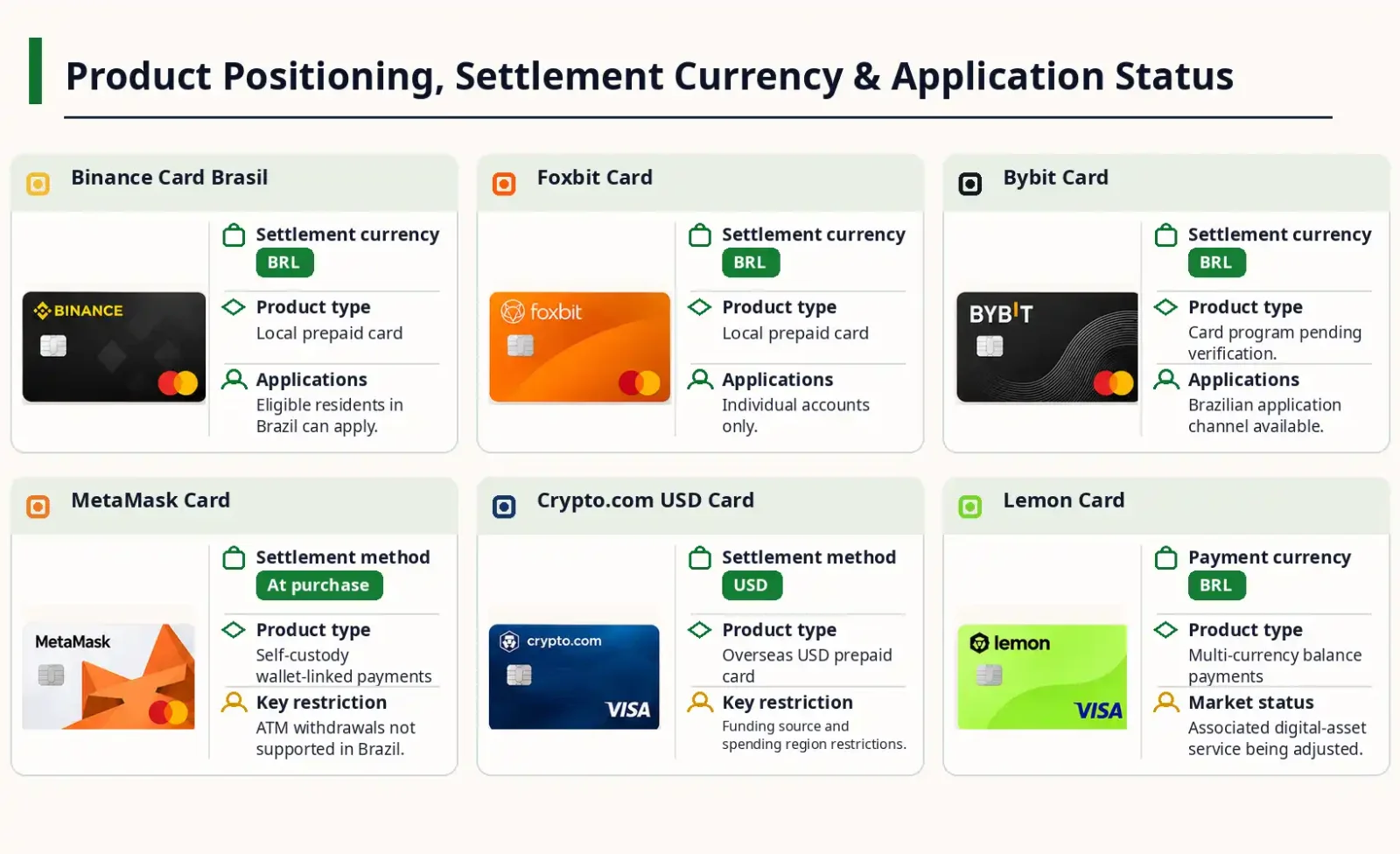
Brazilian residents can currently apply for, or obtain official information about, several crypto payment cards, including Binance Card Brasil, Foxbit Card, Bybit Card, MetaMask Card, Crypto.com USD Card, and Lemon Card. However, eligibility requirements, funding arrangements, and permitted uses differ considerably across these six products.
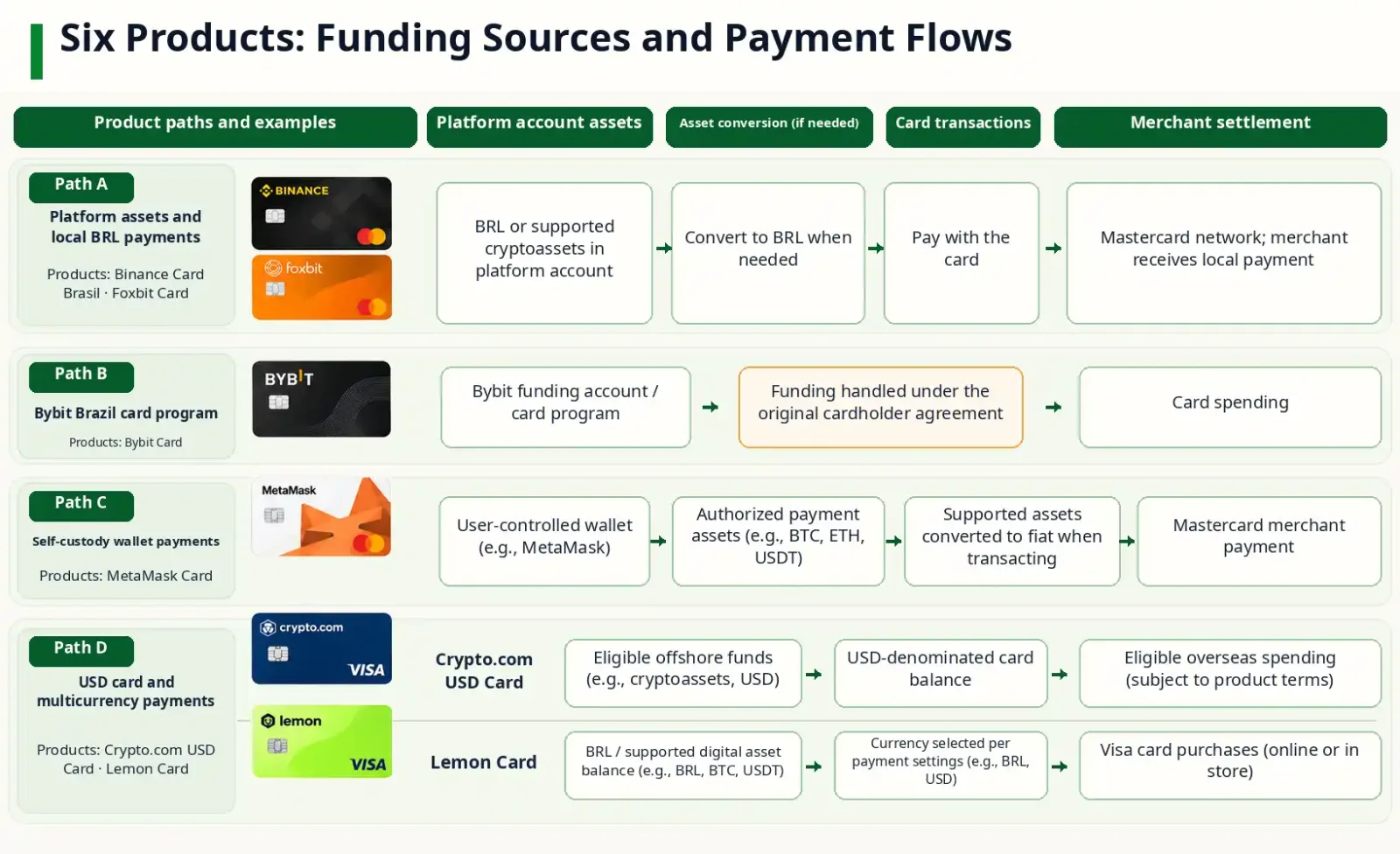
For everyday spending in Brazilian reais (BRL), Binance Card Brasil and Foxbit Card are the most relevant starting points. Both offer locally arranged prepaid cards that allow crypto assets to be converted into BRL for payments. Those who prefer to spend directly from a self-custody wallet may consider MetaMask Card, while users seeking a card for overseas spending in U.S. dollars can explore Crypto.com USD Card.
Bybit Card has an application process for Brazilian residents. Lemon Card has also entered the Brazilian market, but its associated digital asset services are scheduled to undergo changes before November 15, 2026. The card's subsequent operating arrangements have not yet been clarified.
1. Which Crypto Payment Cards Are Currently Available to Brazilian Residents?
As of November 5, 2026, the publicly disclosed application and operating status of the six products is as follows.
Product | Card network and type | Settlement currency | Availability in Brazil and key restrictions |
|---|---|---|---|
Binance Card Brasil | Mastercard prepaid card | BRL | Applications open; Brazilian residency and KYC requirements apply |
Foxbit Card | Mastercard prepaid card | BRL | Applications open; personal accounts only |
Bybit Card | Visa / Mastercard; conflicting official documentation | BRL | Application process available; applicable card program remains to be confirmed |
MetaMask Card | Mastercard debit card | Converted at the time of payment | Virtual card available in Brazil; physical card eligibility unconfirmed |
Crypto.com USD Card | USD-denominated Visa prepaid card | USD | Application process available; restrictions apply to overseas funds and spending |
Lemon Card | Visa virtual card | BRL payments | Launched in Brazil; associated digital asset services are undergoing changes |
These availability assessments are based on the residency requirements published by the providers.
It is important to distinguish cardholder eligibility from merchant acceptance. A card being accepted by merchants in Brazil does not mean Brazilian residents can apply for it. Similarly, the availability of a physical card in another country does not necessarily extend to Brazilian users.
2. Which Cards Are Worth Comparing for Different Spending Needs?
Spending need | Main candidates | Key limitations to consider |
|---|---|---|
Everyday BRL spending in Brazil | Binance, Foxbit | Crypto conversion costs and account verification |
Spending USDT, BTC, or other crypto assets | Binance, Foxbit, Bybit | Funding account requirements and conversion fees; Bybit's card program requires verification |
Payments from a self-custody wallet | MetaMask | Supported networks and tokens, conversion costs, and ATM restrictions |
Overseas spending in USD | Crypto.com USD | Requirements for overseas funding sources and spending locations |
Visa virtual card with digital-dollar cashback | Lemon | Changes to digital asset services and balance management |
ATM cash withdrawals | Binance, Foxbit, Bybit, Crypto.com | Physical card eligibility, fees, withdrawal limits, and regional restrictions |
For everyday BRL purchases, both Binance and Foxbit allow merchants to receive payments through standard Mastercard transactions. Their main differences lie in how crypto assets are converted, how accounts are managed, and how fees are charged. Foxbit charges no BRL card transaction fee, but crypto-funded purchases still require conversion at market prices. Binance explicitly lists a 0.9% crypto conversion fee.
MetaMask Card may appeal to users who want to spend assets held in their own wallets. However, ATM withdrawals are not currently available to its Brazilian cardholders.
Crypto.com USD Card operates differently from the locally arranged BRL cards. It is issued by an overseas entity and intended for qualifying overseas spending funded through eligible sources. It should not be treated as an ordinary domestic payment card in Brazil.
For Bybit and Lemon, the main questions concern which cardholder agreement applies to a current application and whether the associated payment and digital asset services will remain available.
3. Eligibility, Fees, and Key Restrictions for Six Cards
1. Binance Card Brasil: A Locally Issued BRL Prepaid Card
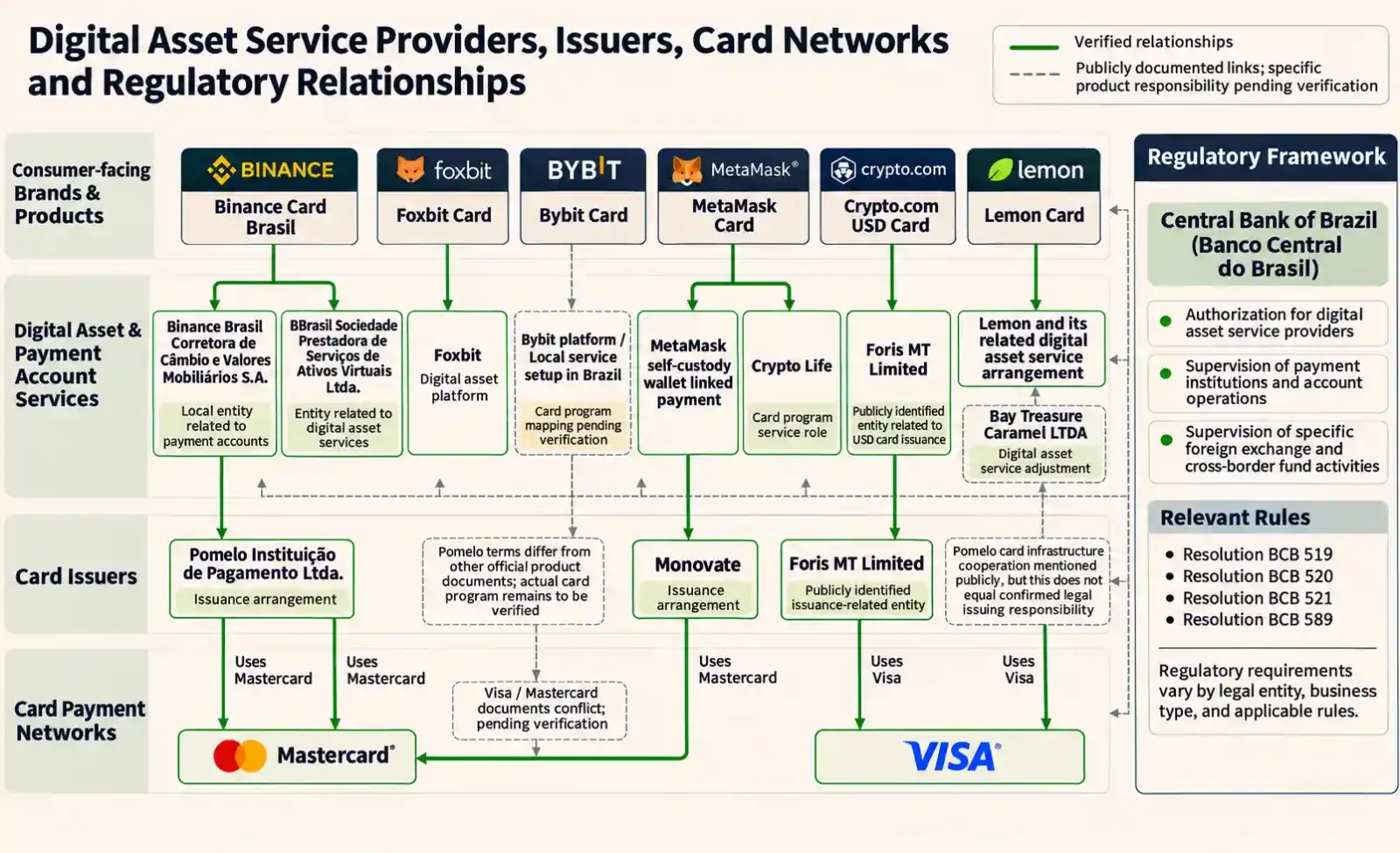
Binance launched Binance Card Brasil in Brazil on October 1, 2025. The card is issued by Pomelo Instituição de Pagamento Ltda., a payment institution regulated by the Central Bank of Brazil that provides card services under a Mastercard license.
The card is available to residents of Brazil who have completed Binance's identity verification process. Applications require a CPF tax identification number, personal income information, a residential address, and identity documents. The accepted documents listed by Binance include RG/RNE, CNH, a valid passport, and a residence permit, subject to requirements concerning where the documents were issued.
Brazilian citizenship or possession of a CPF alone does not guarantee eligibility. Brazilian citizens living abroad on a long-term basis must still meet the applicable residency and identity verification requirements.
Funding Sources and Fees
Binance Card Brasil settles transactions in BRL. Users can specify the order in which crypto assets held in their Funding or Spot accounts are used for payments. The required amount is converted when a purchase is made.
Supported assets include USDT, USDC, FDUSD, BNB, BTC, ETH, SOL, ADA, LINK, and XRP. The card supports online and in-store Mastercard transactions, as well as Apple Pay and Google Pay.
Item | Fee or condition |
|---|---|
Annual fee and virtual card issuance | 0 BRL |
First physical card issuance | 0 BRL |
Minimum assets required to apply for a physical card | Equivalent of 10 USDT |
Crypto conversion fee | 0.9% |
Foreign currency transaction exchange-rate fee | 1%–2% |
ATM withdrawals | First 2 withdrawals per month free; 1.5 USD per withdrawal thereafter |
Physical card cancellation within the first year | 30 BRL |
Physical card cancellation after one year | 0 BRL |
In addition to the fixed conversion fee, a transaction may incur exchange-rate spreads, third-party charges, and applicable IOF taxes. The published fee schedule should not be interpreted as the final all-inclusive transaction cost.
Spending and ATM Withdrawal Limits
Virtual and physical cards share the same limits, which are determined by the cardholder's KYC tier.
Limit | KYC 1 | KYC 2 | KYC 3 |
|---|---|---|---|
Daily spending | R$25,000 | R$25,000 | R$25,000 |
Monthly spending | R$50,000 | R$50,000 | R$150,000 |
Annual spending | R$200,000 | R$450,000 | R$600,000 |
Daily ATM withdrawals | R$3,000 | R$5,000 | R$7,000 |
Monthly ATM withdrawals | R$25,000 | R$25,000 | R$50,000 |
All three tiers have an annual ATM withdrawal limit of R$200,000, with a maximum of three withdrawals per day and 30 per month.
Binance also offers tiered cashback. Under the rules published effective June 1, 2026, monthly spending below R$500 earns 1.5% cashback. Spending of R$500–5,000 earns 2%, while spending of R$5,000 or more earns 3%. The highest tier has a monthly cashback cap of R$500.
Cashback applies only to eligible transactions. Purchases funded from BRL balances are excluded. Once a higher tier is reached, its cashback rate may be applied retroactively to qualifying purchases made earlier that month.
Changes to Local Operating Entities
In October 2026, Binance restructured its Brazilian operations. Starting October 29, eligible users of BRL services were required to complete Brazilian identity verification and open a local payment account.
The changes involve two entities:
Binance Brasil Corretora de Câmbio e Valores Mobiliários S.A.: Responsible for local payment accounts.
BBrasil Sociedade Prestadora de Serviços de Ativos Virtuais Ltda.: Responsible for the associated digital asset services.
Neither entity is the card issuer, Pomelo.
The restructuring does not change the published card limits. However, users need to review the separate terms governing their exchange accounts, local payment accounts, and payment cards. Completing verification for one account does not necessarily eliminate additional requirements for related services.
2. Foxbit Card: No BRL Transaction Fee, but Conversion Prices Determine the Real Cost
Foxbit Card is a Mastercard prepaid card offered by Foxbit, a Brazilian digital asset platform.
The product is available only to individual users. Applicants must register a Foxbit account and complete identity verification. Business accounts are not included in the currently published eligibility criteria.
Users can choose BRL, BTC, ETH, USDT, XRP, or ADA as their payment asset. When a purchase is funded with cryptocurrency, Foxbit sells the corresponding assets at market prices, while the merchant receives a standard Mastercard payment.
The product supports a physical card, online and contactless payments, Apple Pay, and Google Pay.
Fees and Cashback
Item | Published terms |
|---|---|
Issuance, annual, and monthly fees | R$0 |
BRL transaction fee | 0% |
Crypto asset conversion | Executed at the market selling price |
Domestic ATM withdrawal | R$6.90 |
International transactions | 6%, including IOF and exchange-rate charges |
Foxbit does not publish a single fixed conversion rate applicable to every crypto asset. Execution prices depend on market conditions and liquidity at the time of the transaction. A zero BRL transaction fee does not mean that purchases funded with USDT or BTC are free of conversion costs.
Cashback is calculated according to the amount spent in cryptocurrency on each transaction.
Crypto spending per transaction | Cashback rate |
|---|---|
Below R$999.99 | 0% |
R$1,000–2,999.99 | 0.5% |
Above R$3,000 | 1% |
Cashback is paid in the same cryptocurrency used for the purchase. Transactions funded from BRL balances do not qualify.
Account Limits Are Not Card Spending Limits
Foxbit has not published standardized daily or monthly card spending limits applicable to all cardholders.
Its exchange accounts have separate funding limits. Simplified accounts are subject to a monthly BRL deposit and withdrawal limit of R$5,000. Following verification, BRL deposit and withdrawal limits may increase to R$75,000 and R$300,000, respectively.
These are deposit and withdrawal limits for exchange accounts, not the actual spending limits of Foxbit Card.
On the regulatory side, Foxbit states on its website that its digital asset services business is applying for authorization from the Central Bank of Brazil.
3. Bybit Card: An Application Process Is Available in Brazil
Bybit has published card application requirements for Brazilian residents. Applicants must select Brazil as their country of residence, provide a Brazilian residential address, and complete identity verification.
The local verification process collects information including CPF, nationality, income, occupation, mother's name, politically exposed person (PEP) declarations, and confirmation of the lawful origin of funds. Some applicants must also complete facial recognition checks.
Virtual card applications are generally reviewed within minutes, although exceptional cases may take up to seven business days. Physical cards must be requested after virtual card approval, subject to the applicable rollout phases in Brazil.
Visa Prepaid Card or Mastercard Postpaid Card?
Three official Bybit documents currently describe different card arrangements.
Official document | Description relevant to Brazil |
|---|---|
Bybit Card General FAQ | Visa prepaid card; transactions are not processed as credit card purchases |
Bybit–Pomelo Card Terms | Mastercard postpaid card issued by Pomelo |
Bybit Brazil fee schedule | Mastercard exchange rates are used for foreign currency transactions |
The General FAQ and Pomelo terms differ not only in card network but also in funding arrangements. The postpaid card structure involves partner-backed Spending Power and associated repayment arrangements.
These documents correspond to different product programs, issuance batches, or updated versions.
Bybit's published fee schedule can serve as a reference for the Brazilian market.
Published Fees and Limits for Brazil
Item | Fee |
|---|---|
Virtual and physical card issuance | 0 |
Annual fee | 0 |
Crypto conversion fee | 0.9% |
Foreign currency transaction fee | 1.5% |
FX authorization buffer | 1% |
ATM withdrawals | First R$550 per month free; 2% on amounts above that threshold |
The 0.9% conversion fee applies to transactions funded with non-fiat assets held in the Funding Account. Conversion is calculated using Bybit One-Click Sell quotes, with a minimum conversion amount of R$10.
The 1% FX authorization buffer is an additional amount that may be temporarily held during transaction authorization. Any excess is released after settlement.
Limit | Brazil |
|---|---|
Daily spending | R$27,500 |
Monthly spending | R$137,500 |
Annual spending | R$550,000 |
Daily ATM withdrawals | R$5,500 |
Monthly ATM withdrawals | R$27,500 |
Annual ATM withdrawals | R$275,000 |
Daily / monthly / annual ATM withdrawal count | 10 / 300 / 2,500 |
Virtual and physical cards share spending limits. Bybit officially lists Brazil among the regions supporting Apple Pay and Google Pay.
Additional Requirements Following Brazil Account Migration
On September 24, 2026, Bybit began migrating eligible Brazilian users to a local entity. From October 22, the process also required liveness checks and payment account opening. After October 29, the relevant BRL fiat services became available only to eligible users who had completed these requirements.
Bybit also requires that each CPF be associated with no more than one verified Bybit account.
For new applicants, local account eligibility and card application eligibility must be assessed separately. The three most important points to verify are the actual legal card issuer, the applicable card network, and the fee schedule governing the relevant cardholder agreement.
4. MetaMask Card: Self-Custody Wallet Payments, but No ATM Access in Brazil
MetaMask Card does not require users to deposit all the assets intended for spending into a centralized exchange account in advance.
Cardholders can retain supported assets in their own MetaMask wallets and configure payment tokens, spending authorizations, and payment priorities. At the time of purchase, the card's payment mechanism converts the required digital assets into fiat currency to complete the transaction.
This is a wallet-linked debit card model, not an anonymous payment service exempt from identity verification.
Brazil is included in MetaMask's official list of supported countries. Residents can apply for a virtual card.
According to MetaMask's official information, Crypto Life provides card program services, Monovate is the issuer, and Mastercard supplies the payment network.
Supported Assets and Fees
MetaMask Card supports multiple blockchain networks, including Linea, Base, Solana, and Monad. Public product documentation lists assets such as USDC, USDT, mUSD, wETH, EURe, and GBPe. Support varies by network, however, and not every listed asset should be assumed available to Brazilian users.
The main fees and limits for the Free virtual card are:
Item | Fee or limit |
|---|---|
Annual and maintenance fees | 0 USD |
Eligible token approvals | 0 |
Conversion fee for certain stablecoins | 0.5% |
Conversion fee for other crypto assets, such as wETH | 0.875% |
Cross-border fee | 1% |
Maximum spending per transaction | 10,000 USD |
Daily spending limit | 15,000 USD |
Whether a stablecoin conversion fee applies depends on the token's denomination, the cardholder's country, and the merchant's location. Brazilian users spending USD-denominated stablecoins on BRL purchases are subject to the relevant conversion fee.
The cross-border fee shown in MetaMask's fee schedule is distinct from the FAQ's statement that there is no additional Mastercard exchange-rate markup. Transactions may also incur small blockchain network gas fees.
ATM access is subject to an explicit geographic restriction. MetaMask currently offers ATM withdrawals only to cardholders in the United States. Brazilian residents can apply for a virtual card but cannot use it to withdraw cash locally.
5. Crypto.com USD Card: Issued Overseas and Distinct from the Former BRL Card
Crypto.com's original Brazilian BRL Card was discontinued on April 30, 2025. The newer product offered to Brazilian residents is the USD-Denominated Crypto.com Prepaid Visa Card, which holds its card balance in U.S. dollars.
The card is issued and marketed by Foris MT Limited, a company registered in Malta. It is not a continuation of the former locally denominated Brazilian BRL prepaid card.
Crypto.com highlights the following restrictions:
The issuing entity is located outside Brazil.
The card is intended for spending outside Brazil.
Card funding must come from qualifying foreign exchange transactions or funds held by the user overseas.
These conditions make it unsuitable as a standard BRL card for everyday domestic purchases in Brazil.
Fees and Use of Funds
Crypto.com states that qualifying USD Card debit purchases are not subject to IOF and do not incur additional debit purchase fees. This treatment applies only to the relevant card transactions. It does not cover every stage of foreign currency purchases, card top-ups, or digital asset conversions.
The fee information applicable to residents of Brazil and certain other Latin American markets includes the following charges:
Item | Fee |
|---|---|
Midnight physical card issuance | 5.99 USD |
Ruby physical card issuance | 29.99 USD, depending on Level Up conditions |
Credit or debit card top-ups | 1% |
ATM withdrawals above the free allowance | 2% |
Account closure fee | 55 USD |
Inactivity fee after 12 consecutive months without active financial activity | 6 USD/month |
Monthly free ATM withdrawal allowances vary by card tier: 180 USD for Midnight, 360 USD for Ruby, 720 USD for Jade/Indigo, and 900 USD for Icy/Rose and Obsidian.
Non-USD purchases are also subject to tier-based pricing.
Tier | Non-USD purchase fee |
|---|---|
Midnight | 2% |
Ruby | First 500 USD per month free; 2% thereafter |
Jade / Indigo | First 1,000 USD per month free; 2% thereafter |
Other tiers | Listed as free of charge in the available fee information |
According to the relevant fee documentation, these non-USD transaction charges apply from October 2026.
Spending and Top-Up Limits
Item | Published limit |
|---|---|
Daily POS spending | 4,400 USD |
Monthly POS spending | No uniform limit specified |
Annual POS spending | 268,000 USD |
Maximum card balance | 22,000 USD |
Daily and monthly top-ups | 22,000 USD each |
Annual top-ups | 264,000 USD |
Top-up limits, card balance limits, and POS spending limits apply to different activities.
The card has a defined use case for individuals with qualifying overseas funds who primarily spend in USD or make payments while traveling internationally. For users who depend on locally held BRL funds, the first issue is whether they can fund the card in accordance with the applicable rules.
6. Lemon Card: Visa Virtual Card Launched in Brazil, With Changes Pending to Associated Digital Asset Services
On August 10, 2026, card infrastructure provider Pomelo announced a partnership with Lemon to expand the Visa Lemon Card into Brazil.
The Brazilian product is a virtual card that supports purchases at online and physical merchants accepting Visa through Apple Pay and Google Pay.
Lemon's Brazilian help documentation lists payment balances in BRL, USDS, USDT, BTC, ETH, and USDC.
Users can select a primary payment currency and a backup currency. If the primary balance is insufficient, the system can charge the entire transaction to the backup currency. It does not combine the two balances to fund a single purchase.
For example, suppose a user has R$700 in BRL and a backup USDC balance worth R$3,500. For a R$3,000 purchase, the system can use USDC to cover the full amount rather than deducting R$700 first and funding the difference with USDC.
Cashback and Spending Restrictions
Payment method | Cashback rate |
|---|---|
Fiat balance payments | 0.5% |
Digital-dollar or crypto asset payments | 1% |
Cashback is paid in digital dollars.
Lemon's Brazilian help center explicitly states that the card can be used for purchases but does not currently support ATM withdrawals.
Lemon's Brazilian legal disclosures state that Bay Treasure Caramel LTDA will cease providing its digital asset services in Brazil before November 15, 2026. The company has decided not to apply for authorization as a digital asset service provider from the Central Bank of Brazil.
The announcement confirms a change to digital asset services operated by a specific legal entity. It does not establish that the Visa Lemon Card itself has been discontinued in its entirety.
4. Comparing Fees and Spending Limits Across the Six Cards
The six cards use substantially different pricing structures. The figures below identify the main charges and should not simply be added together to estimate the total cost of an individual transaction.
Product | Annual fee | Crypto asset conversion | Foreign currency or cross-border charges | ATM |
|---|---|---|---|---|
Binance | 0 | 0.9% | 1%–2%, potentially plus IOF | First 2 withdrawals per month free |
Foxbit | 0 | Executed at the market selling price | 6%, including IOF and exchange-rate charges | R$6.90 per withdrawal |
Bybit | 0 | 0.9% | Published at 1.5%; card program requires verification | 2% on monthly withdrawals exceeding the R$550 free allowance |
MetaMask | 0 | 0.5%–0.875%, depending on asset and conditions | 1% cross-border fee for the Free card | Not supported in Brazil |
Crypto.com USD | Depends on card tier and applicable charges | Depends on funding and conversion arrangements | Depends on card tier | 2% above the free allowance |
Lemon | Not fully disclosed | Not fully disclosed | Not fully disclosed | Not supported |
Foxbit's published 6% international transaction charge already includes IOF and exchange-rate fees; those components should not be added again. Bybit's 1% FX authorization buffer is a temporary hold, not a final transaction fee. Crypto.com's No IOF statement applies only to the specific debit transactions covered by its terms.
The principal spending limits are:
Product | Daily spending | Monthly spending | Annual spending |
|---|---|---|---|
Binance | R$25,000 | R$50,000–150,000 | R$200,000–600,000 |
Foxbit | No uniform limit published | No uniform limit published | No uniform limit published |
Bybit | R$27,500 | R$137,500 | R$550,000 |
MetaMask | 15,000 USD | No uniform limit specified | No uniform limit specified |
Crypto.com USD | 4,400 USD | No uniform limit specified | 268,000 USD |
Lemon | Subject to available account balance and applicable conditions | No uniform limit published | No uniform limit published |
MetaMask also imposes a maximum of 10,000 USD per transaction. Binance's monthly and annual limits depend on the cardholder's KYC tier.
Foxbit and Lemon have not published uniform card spending limits.
5. Regulatory Changes in Brazil and Card Program Risks
In November 2025, the Central Bank of Brazil published Resolutions BCB 519, 520, and 521. The relevant rules began taking effect in February 2026, followed by further amendments during the year, particularly to certain provisions of Resolution 520.
Regulation | Relevance to crypto payment cards |
|---|---|
Resolution BCB 519 | Authorization procedures and transitional arrangements for digital asset service providers |
Resolution BCB 520 | Establishment, operation, and regulatory supervision of digital asset service providers |
Resolution BCB 521 | Application of foreign exchange and international capital rules to certain digital asset activities |
Resolution 519 addresses authorization procedures for digital asset service providers, while Resolution 520 establishes operating requirements for the relevant entities. Resolution 589 introduced further amendments to Resolution 520. Some provisions apply from October 1, 2026, while others are scheduled to take effect on January 1, 2027.
One change with more immediate implications for market participants concerns amended Article 91. From November 6, 2026, certain financial and payment institutions regulated by the Central Bank of Brazil are generally prohibited from conducting or facilitating specified digital asset market activities with unauthorized digital asset service entities, except where regulations expressly permit otherwise.
This does not mean that every institution operating under transitional authorization arrangements immediately loses the right to conduct business. The actual scope depends on authorization status, transitional provisions, and the specific transaction arrangements involved.
Resolution 521 addresses certain digital asset transactions and cross-border transfers, including transfers of assets between customers of qualifying digital asset service providers and issuers of payment cards or other international payment instruments, subject to the applicable conditions.
For cardholders, the practical implications of these regulatory changes are concentrated in three areas.
The first is the authorization and operational continuity of digital asset service providers. Foxbit has disclosed that it is seeking authorization, while a legal entity associated with Lemon has explicitly decided to discontinue the relevant digital asset services.
The second is the structure of funding and accounts. Binance and Bybit have adjusted their Brazilian operations. Exchange accounts, payment accounts, digital asset conversion services, and card issuance may be handled by different legal entities.
The third concerns responsibility for customer funds when services cease. Lemon's planned changes demonstrate that card programs and digital asset services may change independently. Even where the card itself has not been discontinued, the ability to top up, convert assets, or access balances may still be affected.
For overseas-issued products such as MetaMask Card and Crypto.com USD Card, eligibility to apply as a Brazilian resident does not remove applicable local identity verification, tax, or source-of-funds obligations.
6. What Should Applicants Verify Before Applying?
Before submitting an application or transferring digital assets, review the following:
Residency eligibility: Confirm Brazilian address requirements, CPF status, accepted document issuing jurisdictions, and the applicable KYC tier.
Actual card issuer: Check the legal issuer, card network, and card classification in the cardholder agreement, particularly for Bybit's Brazilian card program.
True spending costs: Review crypto asset selling quotes, fixed conversion fees, exchange-rate spreads, cross-border charges, and applicable taxes.
Card features: Verify whether virtual and physical cards are separately available, whether physical delivery is supported, and whether ATM withdrawals and local mobile wallets are available.
Personal spending limits: Check the limits shown in the card account itself. Exchange deposit and withdrawal limits are not substitutes for card spending limits.
Balances and service continuity: Retain agreements and transaction records, and review procedures for account closure, refunds, fund withdrawals, and service migration. Lemon users should pay particular attention to arrangements after mid-November.
7. Sources
Binance
Binance Card Brasil — Cashback Rules.
Binance Brazil — Changes to Local Operations in 2026.
Foxbit
Bybit
Bybit Card — Brazilian Application Process.
Bybit — Notice of Brazilian User Migration to a Local Entity.
MetaMask
Crypto.com
Crypto.com — Fees and Limits for Brazil and Certain Latin American Markets.
Lemon
Lemon — Backup Payment Currency Information for Brazil.
Lemon — ATM Withdrawal Information.
Central Bank of Brazil
Sources reviewed on November 5, 2026.