
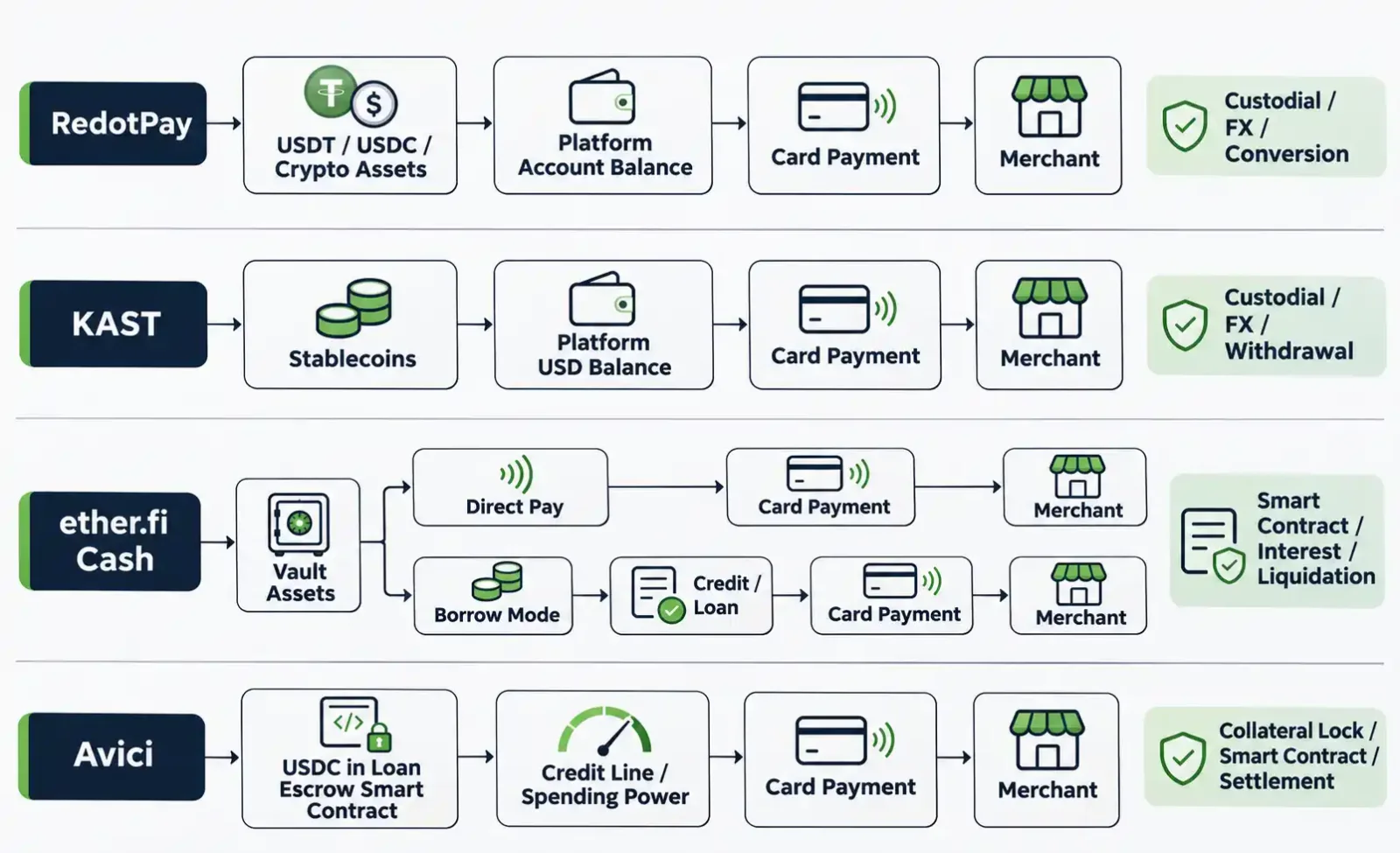
For UAE residents choosing a crypto payment card, the first question is not how much cashback it offers, but whether they qualify for the card at all. Based on currently available official policies, the four products examined here are not interchangeable payment instruments. RedotPay and KAST primarily let users spend digital assets or stablecoin balances held in platform accounts. ether.fi Cash supports both direct payments and borrowing against collateral. Avici, meanwhile, uses USDC held in smart contracts to establish a card credit limit.
1. First, Check the Eligibility Rules for UAE Residents
Product | Basis for UAE Resident Eligibility | Evidence Assessment | Physical Card Availability |
|---|---|---|---|
ether.fi Cash | UAE explicitly appears on the official list of supported countries | Explicitly supported | UAE is included in the delivery area |
Avici Card | UAE appears on the official list of supported regions for personal cards | Explicitly supported | Delivery to a specific address requires confirmation |
RedotPay Card | UAE is absent from both card issuance and delivery restriction lists | Indirect evidence of support | UAE is not listed as a prohibited delivery destination |
KAST Card | Global marketing and the platform's product information reference the UAE | Indirect evidence of support | Delivery to the UAE has not been verified |
The assessments are based on ether.fi's supported countries, Avici's supported regions, RedotPay's issuance restrictions and delivery restrictions, and KAST's country availability guidance. This comparison concerns eligibility for individual accounts.
2. How Do the Four Cards Actually Differ?
RedotPay: Relatively Clear Eligibility Rules, but Percentage-Based Fees Can Add Up on AED Spending
RedotPay allows users to deposit supported assets, including USDT and USDC, into a platform account and spend through a virtual or physical card. Its main advantage is not the lowest fees, but relatively detailed disclosures of application restrictions and basic charges. The August 2026 card issuance restriction list does not include the UAE. Nor does the physical card delivery restriction list. Together, these provide an indirect basis for UAE residents to consider applying.
According to the official card issuance fees, a virtual card costs $10, while a physical card costs $100. For someone primarily shopping online, the virtual card offers a lower-cost starting point. The higher upfront expense of a physical card makes more sense when in-person card use or ATM withdrawals are necessary.
Transaction fees matter more over time. Transactions in a currency different from the card's billing currency incur a 1.2% fee, while digital asset conversions carry a 1% charge. For USD-denominated cards, ATM withdrawals are charged 2% on the first $10,000 withdrawn each month and 3% on amounts above that threshold. Using a USD-denominated card at an AED merchant therefore creates a clear foreign-currency cost. If the payment also triggers a conversion from USDT into funds used for settlement, a separate conversion charge may apply. These fees cover different stages of the transaction.
RedotPay's funding structure also determines its risk profile. Users deposit assets into a platform account rather than retaining direct control of their private keys at all times. Account risk controls, crypto withdrawal channels, card program suspensions, and dispute-related refunds all depend on the relevant service providers. RedotPay is suited to users who want to spend stablecoin balances directly and are comfortable paying the associated conversion costs.
ether.fi Cash: Spend Existing Assets or Borrow Against Collateral
The official ether.fi country list explicitly includes the United Arab Emirates and confirms support for physical card delivery.
Cash cannot be classified simply as a prepaid card. According to the official explanation of its payment modes, Direct Pay uses eligible stablecoins or other supported assets held in a Vault to fund purchases. Spending reduces the relevant balance directly, without creating interest-bearing debt. Borrow Mode, by contrast, uses assets as collateral to automatically finance purchases through borrowing. Users do not have to sell their holdings first, but interest continues to accrue on the loan. If collateral value falls and the loan-to-value ratio (LTV) rises, users may face the need to add funds, repay debt, or have collateral liquidated. ether.fi describes its Vault as a smart contract account, not an ordinary bank demand deposit.
The two modes serve fundamentally different purposes. UAE residents who simply want to spend USDC or USDT they already own can use Direct Pay without taking on new debt. Those seeking spending liquidity while retaining their holdings have more reason to examine Borrow Mode's interest rates, LTV requirements, liquidation thresholds, and refund procedures. One particularly important detail: ether.fi states that refunds under Borrow Mode are returned to the Vault first and do not automatically repay the outstanding loan.
As for pricing, the card limits and fees documentation states that Core generally includes one free virtual card, while a physical card costs $50. The UAE is not included in the listed regional exceptions to virtual card pricing, although the final application price remains subject to what the account interface displays. For AED transactions involving currency conversion, the official additional FX markup is 0.5% for Core, 0.25% for Luxe, and 0% for Pinnacle and VIP. These charges are applied on top of the underlying exchange rate.
On the strength of its UAE eligibility documentation and published fees, ether.fi Cash deserves priority in any comparison. For everyday spending, Direct Pay should be evaluated first rather than treating the borrowing feature as free credit.
Avici: Smart Contract Collateral Does Not Eliminate Custody or Credit Risk
Avici's documentation on personal card availability explicitly includes the UAE. What distinguishes its Secured Credit Card from a conventional card is that the funds backing spending are held in a USDC collateral contract governed by executable rules.
The official technical documentation describes the process as follows: users deposit USDC into a Loan Escrow smart contract, and the card account receives a corresponding USD spending limit. When a purchase is made, the available limit decreases, and the USDC associated with the purchase is subsequently processed through the contract according to the settlement arrangements. Avici states that the user's wallet retains control over the contract, while service providers can process the relevant funds only in accordance with proof of spending and the contract's rules. This differs materially from transferring all assets into a pooled, platform-custodied account and converting them into a fiat balance in advance.
However, self-custody does not mean collateral can always be withdrawn freely. Unsettled transactions occupy part of the available limit, while the contract and transaction-proof mechanisms also affect how much can be withdrawn. The arrangement includes payment obligations, insufficient-collateral provisions, and liquidation procedures. Smart contract vulnerabilities, misconfigured permissions, and cross-chain operations introduce additional risks. Avici applicants must also complete identity verification through Sumsub. Control over on-chain funds does not replace the card issuer's KYC requirements.
The current fees page lists the following charges: $15 for the first Platinum virtual card and $10 for each additional card; $30 for a Signature virtual card in the first year and $20 annually thereafter; $50 for a Platinum physical card; and $75 for a Signature physical card, followed by a $20 annual fee from the second year.
Avici's value lies in its contract-based control structure, not greater convenience than an ordinary payment card. Users familiar with wallet permissions and collateral settlement may find it worth examining. Those opening a card solely for groceries, subscriptions, or online shopping generally have little reason to introduce an additional smart contract and credit relationship.
KAST: Convenient Stablecoin Funding, but Rewards and Paid Membership Need Scrutiny
KAST connects stablecoin funds to Visa spending through a platform account. Its official card page lists support for stablecoins such as USDT and USDC, along with virtual cards, physical cards, and mobile wallet payments. Stablecoin deposits appear as USD balances. The fee schedule states that eligible stablecoin deposits are credited at a 1:1 ratio to USD, with no platform funding fee. Blockchain network fees associated with transfers are separate. Conversion costs for deposits made using non-stablecoin assets vary by asset.
KAST's official country availability help page does not publish a complete list of supported countries. Instead, it directs prospective users to check whether their country appears in the registration dropdown menu.
Spending in AED is not free of currency costs. The official fee schedule updated on November 10 specifies an FX fee of 0.5%–1.75% for non-USD card transactions, depending on residence, transaction location, and card program. Non-USD transactions below $25 incur an additional $0.10, while a transaction declined for insufficient funds carries a $0.50 charge. Transferring a USD balance to an AED bank account involves a separate AED payout fee of $3 plus 1%. That is not the same as the FX fee on card purchases. Blockchain withdrawal fees may also apply when transferring funds out of the account.
KAST currently publishes the following membership prices and cashback limits:
Tier | Annual Fee | USD Cashback on Eligible Spending | Monthly Spending Eligible for Cashback |
|---|---|---|---|
Standard | $0 | 1.5% | $2,000 |
Premium | $1,000 | 2% | $10,000 |
Private | $10,000 | 3% | $40,000 |
These are caps on spending eligible for rewards, not the cards' actual spending limits. ATM transactions, cash equivalents, certain financial services, government payments, and other excluded merchant categories do not qualify for cashback. Refunds can also affect rewards. USD cashback is subject to unlocking and redemption procedures; it is not necessarily cash available for immediate withdrawal when a purchase is made. The rewards program terms set out these restrictions.
KAST Points should not be valued as USD cashback. KAST has explicitly announced that points earning will end on November 30, 2026. Its transition announcement indicates that eligible points are expected to convert into non-tradable KAST Pioneer Units (KPU) in December, while some users will receive spending vouchers instead. KPU are not equivalent to cash, shares, or tradable tokens, and their specific benefits and redemption conditions have not yet been fully established.
Premium offers a cashback rate just 0.5 percentage points higher than free Standard, although its monthly eligible spending cap is considerably larger. Assume that a user maintains the same level of eligible spending for 12 consecutive months, receives all applicable cash rewards, and incurs no other fees or benefits. At $5,000 in monthly spending, Standard earns $360 a year, while Premium delivers only $200 after its annual fee, leaving the user $160 worse off. At $6,000 per month, Premium yields $440 after its annual fee, $80 more than Standard. The break-even point is approximately $5,667 in eligible monthly spending. Even at Premium's maximum cashback-eligible spending of $10,000 per month, the additional annual benefit over Standard is only $1,040 after the membership fee. That figure is still before AED foreign-exchange costs.
For most residents with modest everyday spending, KAST's free tier is more sensible than a paid plan. With UAE individual eligibility still unverified, paying a $1,000 annual fee in anticipation of cashback is particularly difficult to justify.
3. Comparing Actual Costs and Asset Risks on the Same Basis
Product | Virtual Card or Entry-Level Fixed Cost | Asset Conversion Cost | Main Cost of AED Card Purchases | Fund Control and Key Limitations |
|---|---|---|---|---|
RedotPay | $10 virtual card; $100 physical card | 1% when a digital asset conversion is triggered | 1.2% foreign-currency fee | Platform-custodied account; conversion and withdrawal costs |
ether.fi Cash | Core generally includes one free virtual card; $50 physical card | Direct Pay depends on supported assets and settlement exchange rates | Additional 0.5% FX markup for Core; lower for higher tiers | Vault assets; interest and liquidation exposure under Borrow Mode |
Avici | $15 for the first Platinum virtual card | USDC collateral and contract-based settlement; additional on-chain costs | Fees page indicates 0.4%–1%; terms stated 1% at the time, and the applicable rate requires clarification | Contract-based collateral; transaction proofs, liquidation, and credit obligations |
KAST | No annual fee for Standard; $2 virtual card fee in some regions | 0% platform fee for eligible stablecoin deposits; separate charges for other assets | 0.5%–1.75% FX fee on non-USD transactions, plus small-transaction surcharges | Platform account balance; rewards restrictions and unverified UAE eligibility |
Consider a resident spending the equivalent of $3,000 per month in AED. Excluding differences in underlying exchange rates, promotional discounts, and additional on-chain costs, RedotPay's 1.2% foreign-currency fee alone amounts to $36 per month. If every payment also triggers a separate 1% digital asset conversion, that would add roughly $30 on the same transaction base. ether.fi Core's additional 0.5% FX markup amounts to $15 per month. Based on its published range, KAST's FX fees would be $15–$52.50 per month, before accounting for any cashback the transactions actually qualify for. Avici's currently published fee information is not fully consistent, so it cannot be placed in a definitive cost ranking.
RedotPay's virtual card costs just $10, but that does not necessarily make it suitable for repeated, high-value AED purchases. KAST may offer cashback, but the outcome depends on whether the merchant category qualifies and where the applicable fee falls within its published range. Frequent AED spenders should also watch for dynamic currency conversion (DCC) at checkout. Allowing a merchant to convert the charge into USD often introduces a separate markup from the merchant or acquiring provider, which should not be confused with the card platform's fee.
Costs are only part of the comparison. Platform accounts, Vaults, and collateral contracts create different responsibilities and exposures. With platform-custodied balances, users need to consider account freezes, withdrawal rights, and their position if a provider fails. Smart contract holdings introduce permission, vulnerability, and liquidation risks. Credit-based spending also creates obligations to repay outstanding debt.
4. How Do UAE Residency and Regulation Affect Card Selection?
A substantial share of UAE residents are foreign nationals. An Emirates ID establishes residency, but it does not override restrictions based on passport nationality. A person holding both UAE residency documentation and a foreign passport may be assessed against separate eligibility requirements in a card issuer's systems. Tourist visa holders cannot automatically assume that policies for "UAE residents" apply to them. Applications may also involve residential address checks, liveness verification, and source-of-funds reviews. Avici explicitly uses Sumsub for identity verification, while ether.fi, RedotPay, and KAST each have their own account and card approval requirements.
Local regulatory status cannot be determined from a brand's licenses alone. The Central Bank of the UAE's Payment Token Services Regulation establishes relevant licensing or registration frameworks for payment token issuance, conversion, custody, and transfer. It also restricts merchants from directly accepting certain virtual assets as payment. A consumer transferring USDT directly to a merchant follows a different commercial and payment process from using a Visa card funded by digital assets, where the card network and acquiring infrastructure handle merchant settlement.
Three entities also need to be distinguished: the company operating the crypto asset account, the institution actually issuing the payment card, and the entity holding or executing transactions involving customer funds. KAST describes itself as a fintech company rather than a bank, with accounts, cards, and custody services provided through partners. Avici's wallet control arrangements likewise differ from the transaction responsibilities of its partner card issuer. Rights relating to account freezes, refunds, and balance redemption ultimately depend on the applicable agreements and custody relationships, not the Visa logo printed on a card.
5. Which Card Should You Choose?
Start with products that have explicit UAE eligibility policies, giving ether.fi Cash and Avici priority in the comparison. ether.fi's Direct Pay is closer to spending existing stablecoin holdings on everyday purchases. Avici is more suitable for users who deliberately want USDC-backed smart contract collateral and understand the authorization and settlement mechanisms involved. Residents unfamiliar with DeFi should not put Avici first simply because it promotes self-custody.
For users who primarily hold USDT or USDC and want to establish a virtual card spending channel quickly, RedotPay is a reasonable candidate. The $10 issuance fee is straightforward, but sustained AED spending requires accounting for the 1.2% foreign-currency fee and any conditionally triggered asset conversion charges. Estimating annual costs from actual monthly spending is more useful than choosing a card solely for its low upfront price.
For users interested in cashback, KAST's free Standard tier deserves attention before considering Premium. Under the assumptions used here, Premium needs approximately $5,667 in sustained eligible spending each month merely to break even against Standard on cash rewards. With points earning ending in late November, anticipated points benefits are not a sound reason to pay an annual membership fee today.
Information current as of November 11, 2026. This article examines official policies and published fee documentation.