
You use a crypto payment card to make a purchase, but the merchant never ships your order. You cancel a subscription and continue to be charged. Or an unfamiliar transaction suddenly appears on your account. In these situations, cardholders may have another option beyond requesting a merchant refund: filing a payment dispute through the card network, provided the transaction qualifies.
A crypto card may fund purchases by converting digital assets such as USDT or USDC, but merchant payments are still processed through the Visa or Mastercard network. Paying with crypto does not eliminate your right to dispute an eligible card transaction. However, chargeback protections do not extend to platform account balances, on-chain transfers, or every type of crypto asset loss.
Whether funds can be recovered depends on the payment channel, whether the transaction has been posted, and where the problem occurred.
1. Identify the Problem Before Requesting a Refund or Filing a Dispute
When you notice an unexpected charge, check the transaction status before deciding what action to take.
Transaction issue | Recommended first step | What to verify |
|---|---|---|
Goods not received or services not provided | Contact the merchant; dispute if necessary | Delivery terms and fulfillment records |
Goods not as described | Request a return or refund | Product description, actual delivery, and return evidence |
Merchant promised a refund that has not arrived | Obtain refund confirmation and ask the issuer to trace it | Whether the refund was actually initiated |
Two charges for the same order | Check both transaction statuses | Whether both charges have posted |
Unauthorized transaction | Freeze the card and notify the issuer immediately | Possible card fraud or account compromise |
Pending transaction reducing available funds | Check the authorization status | Whether the funds are only temporarily held |
A Pending Transaction Is Not Necessarily a Completed Charge
Hotels, car rental companies, and gas stations commonly use preauthorizations.
For example, a hotel charges $150 for a room and places an additional $100 authorization hold for a deposit. The cardholder's available balance temporarily decreases by $250, but the hotel has not necessarily completed two separate charges.
An authorization hold temporarily reserves funds. Once the transaction is completed, an authorization that is no longer needed can be reversed or released when it expires.
Visa's authorization and reversal processing guidance notes that mismatches between authorization details and final clearing information can prolong holds on cardholder funds.
If two similar transactions appear, first determine whether both have posted. For an authorization that has not cleared, ask the merchant to investigate or reverse it before filing a duplicate-charge dispute.
Refunds, Authorization Reversals, and Chargebacks: What's the Difference?
These processes involve different parties and payment flows.
Merchant refund (Refund): The merchant initiates the return of funds following a return, order cancellation, or similar event. The money is sent back to the cardholder's account through the payment system.
Authorization reversal: An authorization is canceled before clearing is completed, releasing the reserved available balance. This does not necessarily generate a separate refund transaction.
Payment dispute (Dispute) and chargeback: The cardholder disputes a transaction with the card issuer. After reviewing the claim, the issuer may initiate a chargeback against the merchant's acquiring institution under the applicable card network rules.
Filing a dispute does not guarantee a refund. The merchant may submit evidence that it fulfilled its obligations, and the case must be assessed under the applicable rules.
For ordinary disputes involving authorized purchases, contacting the merchant first is generally appropriate. Suspected fraud should be reported to the issuer immediately.
For Unauthorized Charges, Secure Your Account Immediately
If you discover a transaction you clearly did not authorize, freeze the card, notify the issuer, and review your account password, signed-in devices, and multifactor authentication settings.
An unfamiliar merchant name may belong to a payment processor handling a subscription you recognize. Checking your transaction history can clarify this, but it should not delay reporting suspected fraud.
Visa's Zero Liability Policy provides liability protection for qualifying unauthorized transactions. Exceptions apply to certain commercial cards, anonymous prepaid cards, and transactions not processed over the Visa network. Actual liability also depends on the card agreement and applicable law.
A Visa or Mastercard logo on a crypto card does not automatically give the cardholder every statutory protection available to traditional bank credit card users.
2. Which Crypto Card Transactions Qualify for Chargebacks?
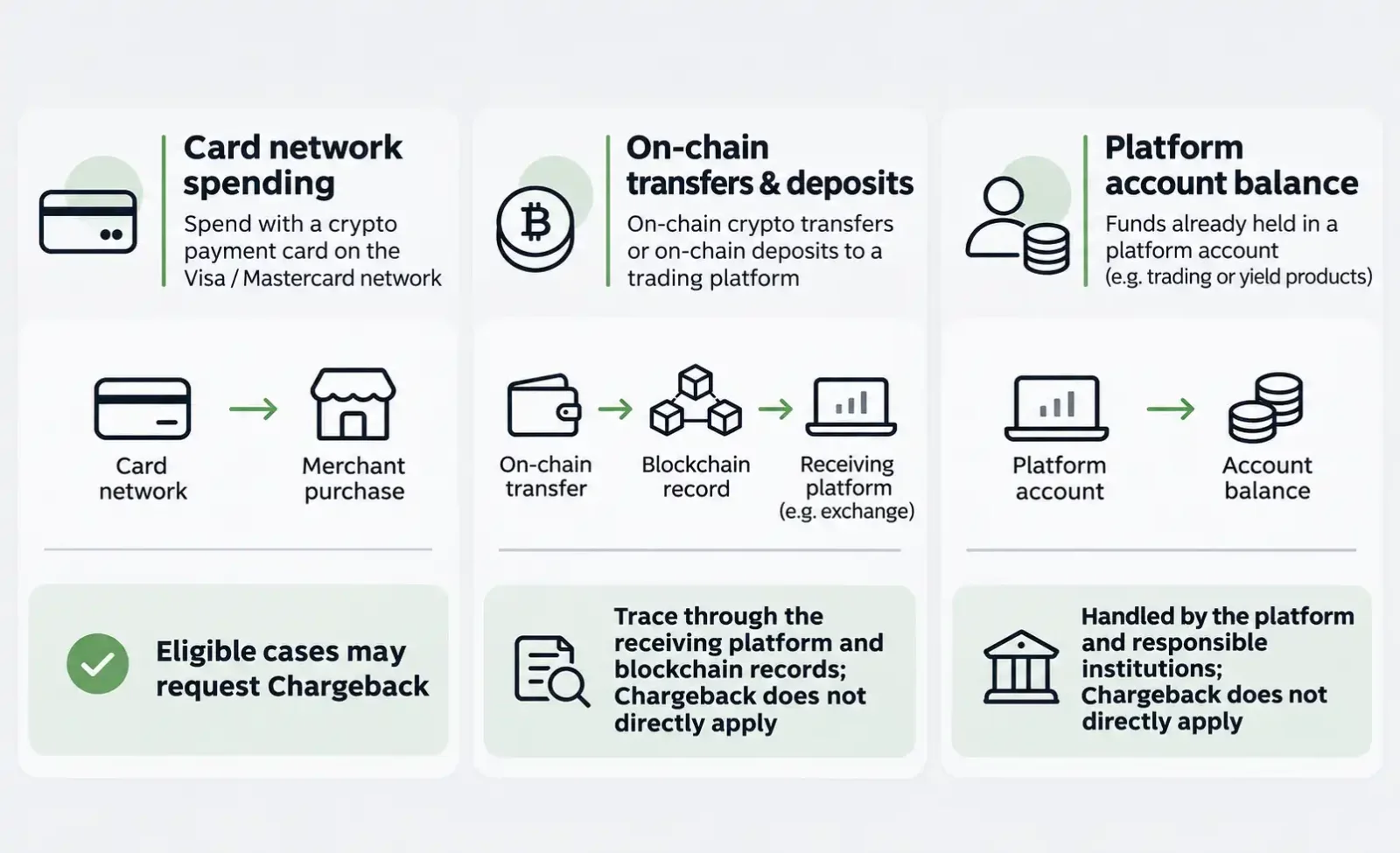
Crypto cards involve three distinct types of funds and transactions: card purchases, on-chain transfers, and balances held within a platform. Each follows a different dispute resolution process.
Purchases Processed Through Card Networks
When a crypto card purchase or subscription payment is processed through Visa, Mastercard, or another card network, circumstances such as goods not received, services not provided, duplicate charges, and unauthorized transactions may qualify as grounds for a dispute.
Even if the payment was funded by the platform automatically selling crypto assets, dispute eligibility is assessed based on the underlying card transaction.
Cardholders file claims with their issuer, which reviews the dispute under the applicable rules and communicates with the merchant's acquirer through the card network. Visa and Mastercard do not issue refunds directly to individual cardholders.
Mastercard's consumer support information specifically directs cardholders to their issuing institutions for transaction disputes.
On-Chain Transfers and Platform Deposits
Suppose a user transfers 500 USDT from a personal wallet to a crypto card platform. The blockchain confirms the transaction, but the platform fails to credit the deposit correctly.
This is an on-chain transfer or platform deposit dispute, not a conventional card purchase dispute.
The user should retain the transaction hash, asset type, blockchain network, receiving address, and deposit records, then contact the platform that received the assets. A transfer sent directly from a crypto wallet cannot be charged back through Visa or Mastercard.
The situation differs if the user purchased crypto with a payment card. Because the original payment traveled through the card network, dispute eligibility must be assessed according to the transaction's nature and the applicable rules. The merchant's on-chain delivery records may also serve as evidence of fulfillment.
Platform Balances Are Not Covered by Card Chargeback Protections
Consider a user holding 2,000 USDC on a platform and using only part of that balance for card purchases.
Those card purchases may qualify for disputes under the relevant rules. The unspent platform balance, however, is governed by the account agreement and the arrangements for custody of the assets.
Withdrawal restrictions, platform insolvency, lost private keys, or smart contract vulnerabilities do not automatically create card chargeback rights.
3. What Evidence Matters for Missing Orders, Subscription Charges, and Duplicate Payments?
An effective dispute is not about collecting as many screenshots as possible. The evidence needs to establish that the merchant failed to meet a relevant obligation or that the transaction was processed incorrectly.
Goods Not Received: Document the Delivery Agreement and What Actually Happened
Suppose a cardholder uses a crypto debit card to buy a $180 item. The merchant promises to ship within seven days but provides no valid tracking information and does not respond to refund requests.
The cardholder should preserve the order details, expected delivery date, payment record, and correspondence with the merchant. If attempts to resolve the issue fail, the next step is to contact the issuer.
Visa's Core Rules and Product and Service Rules (October 2026 edition) identifies Merchandise/Services Not Received as dispute condition 13.1.
A screenshot of the charge proves that a payment occurred; it does not prove that the merchant failed to deliver. The delivery terms, shipment tracking, and both parties' responses are more relevant.
The merchant also has the right to provide proof of delivery. An order that was never shipped, delivered to the wrong address, delivered late, or lost after confirmed receipt presents different facts. The dispute reason should reflect what actually occurred.
Goods Not as Described: Compare the Promise With the Delivery
A customer orders a new electronic device but receives a used one. Another purchases software that lacks a core feature explicitly promised by the merchant. Such circumstances may support a dispute for goods or services not as described.
Relevant evidence includes the product description at the time of purchase, service terms, the item actually received, inspection results, and communications concerning a return.
Simply being dissatisfied does not establish a breach by the merchant. The review will consider previously disclosed limitations, applicable return conditions, and whether the cardholder followed the required return procedures.
Charges After Cancellation: Verify When the Cancellation Took Effect
Crypto cards are often used to pay for SaaS products, AI tools, and streaming subscriptions.
For subscription disputes, the key questions are whether cancellation was completed, when it became effective, and which billing period the disputed charge covers.
If the customer canceled according to the agreed terms but was still charged an amount that should not have been collected, the cancellation confirmation email, service expiration date, and billing records may support a dispute.
Stopping use of a service is not the same as canceling a subscription. A valid automatic renewal does not become an unauthorized transaction simply because the customer forgot to cancel.
Duplicate Charges: Rule Out Authorization Holds First
Two $100 entries for the same order do not necessarily mean that the merchant charged twice.
If one is an authorization hold and the other is the final cleared transaction, first verify whether the original authorization is awaiting release.
If both charges have posted and relate to the same order, there are grounds to investigate a possible duplicate payment.
Amount discrepancies also require checking taxes, shipping, currency conversion, and additional merchant fees. Legitimate differences should not be incorrectly reported as billing errors.
4. How to File a Dispute, Track a Refund, and Verify the Outcome
Find the Correct Institution
The company operating a crypto card brand may not be the institution that actually issues the card. Cardholders should consult the official app, transaction details, Cardholder Agreement, or help center to identify the appropriate dispute channel.
Some products publish specific procedures:
Crypto.com Prepaid Card: According to its official dispute guidance, users can select a transaction from their transaction history and choose "Report an Issue" to submit the dispute reason and supporting documentation.
Coinbase Card debit card: Its official support guidance recommends contacting the merchant first for authorized transactions. If the matter remains unresolved or involves an unauthorized transaction, cardholders can contact card support.
These are product-specific procedures, not an industry-wide standard.
Submit Evidence and Track the Refund
A dispute submission should include the transaction date, amount, currency, merchant name, order number, and evidence relevant to the claim.
For goods-related disputes, prioritize delivery and return records. For subscription disputes, provide cancellation confirmation. For unauthorized transactions, document when the activity was discovered, when the card was frozen, and when the issuer was notified.
If a merchant promised a refund but the money has not arrived, request refund confirmation and tracking details such as the ARN (Acquirer Reference Number), then ask the issuer to investigate.
Stripe's refund processing guidance states that card refunds it processes generally take 5–10 business days to appear in a cardholder's account. Some refunds reverse the original charge rather than appearing as a separate credit. This is not a universal refund timeline for all cards.
Do not request a second recovery through a chargeback after receiving a full refund. If a refund is still processing, accurately disclose that status to the issuer.
Always submit evidence through official, secure channels. Never provide a full card number, CVV, password, verification code, or wallet recovery phrase through an unfamiliar email address or form.
An Open Dispute Is Not a Successful Chargeback
After receiving a claim, the issuer reviews the dispute reason and supporting evidence. Cases that meet the applicable criteria proceed through the relevant process.
"Dispute Submitted" or "Case Opened" means the claim was submitted or a case was created. Neither status confirms that a chargeback has been completed.
The merchant may submit rebuttal evidence through its acquirer, and the issuer may request additional documentation.
Some card programs or applicable laws allow a provisional credit during the investigation. Crypto.com's prepaid card dispute guidance, for example, discusses temporary adjustments while a case is under review. If the dispute is ultimately unsuccessful, a provisional credit can be reversed.
Cardholders should retain their case number, monitor requests for additional evidence, and meet response deadlines. A temporary credit should not be mistaken for a final refund.
5. Chargeback Deadlines and Crypto Refund Exchange Rate Differences
The 120-Day Period Is Not Universal
Card disputes may be subject to card network procedural deadlines, the issuer's own filing requirements, and applicable local laws.
Under Visa's October 2026 rules, disputes involving merchandise or services not received may be subject to a 120-calendar-day period measured from the transaction processing date or expected delivery date, along with other restrictions in specified circumstances.
Crypto.com's prepaid card dispute guidance lists a 120-day filing window following the relevant transaction or ATM withdrawal, with dispute processing generally expected to take 30–45 days. These are published procedures for that particular product and should not be assumed to apply to other cards.
Statutory notification deadlines may also apply.
For example, the U.S. Consumer Financial Protection Bureau (CFPB) explains that, for disputes covered by federal credit card billing error rules, consumers generally must send written notice within 60 calendar days after the statement containing the error was mailed. Unauthorized electronic fund transfers involving debit cards are subject to different rules.
See the CFPB's credit card dispute guidance and Electronic Fund Transfer regulations.
Repeated promises of a refund from a merchant are one of the easiest ways for a cardholder to miss the formal dispute deadline.
As soon as a dispute arises, confirm the filing deadline, when the clock starts, and the appropriate claims channel for the specific card. Do not wait indefinitely for the merchant to respond.
A Refund Does Not Necessarily Restore the Original Amount of Crypto
A crypto card may convert digital assets into fiat currency when the card is funded or automatically sell crypto assets at the time of purchase.
Suppose a $100 purchase was funded by converting crypto assets. Even if a subsequent dispute succeeds and the issuer adjusts the transaction by $100, the cardholder is not necessarily entitled to receive the same quantity of crypto originally spent.
The refund may be credited to a fiat-denominated card account or converted again under the platform's rules. With non-stablecoin assets, cross-currency transactions, or products that charge conversion fees, the quantity and market value of the assets ultimately returned may differ from the original expenditure.
To assess the refund, compare the original transaction amount, billing currency, conversion records, and the actual method of reimbursement.
6. What If the Dispute Is Rejected?
A chargeback may be rejected because the evidence is insufficient, the claim was filed too late, the dispute reason does not qualify under the rules, or the merchant submitted persuasive rebuttal evidence.
After receiving a decision, ask the issuer to explain the rejection and obtain the case outcome and any available summary of the evidence.
If important documentation was omitted, the merchant's evidence contains a clear contradiction, or the original dispute reason was incorrect, ask whether additional evidence, reconsideration, or a further stage of review is available. Eligibility and deadlines are governed by the applicable rules and laws.
For services provided by regulated financial institutions, customers may also file formal complaints with the institution actually responsible and pursue financial ombudsman or regulatory complaint channels available in their jurisdiction. Contract breaches and disputes over assets held in custody by a platform may also have legal remedies separate from the card dispute process.
Chargebacks cannot be used to undo legitimate purchases. If goods were delivered or services properly used, reporting an authorized transaction as fraud merely because the price later fell, the customer regretted the purchase, or an investment lost value may constitute an improper dispute. Account restrictions, fees, or other consequences may follow.
When a crypto card transaction goes wrong, the priority is to identify where the funds are and which institution is responsible. For authorization holds, investigate the authorization status. For merchant nonperformance, preserve evidence and dispute promptly. For fraud, secure the account immediately. For inaccessible platform funds or missing on-chain deposits, investigate the relevant asset and account obligations.
Identifying the payment channel, valid dispute reason, and responsible party is what turns a recoverable payment problem into a case that can actually move forward, rather than a complaint stalled by repeated submissions to the wrong institution.