
A crypto payment card bearing the Visa or Mastercard logo may involve several legally independent companies. A user might apply for a card through a platform, deposit USDT or USDC, and then use the card for purchases. Yet the company operating the app is not necessarily the financial institution that issues the card, nor does it necessarily hold the digital assets or funds deposited by the user.
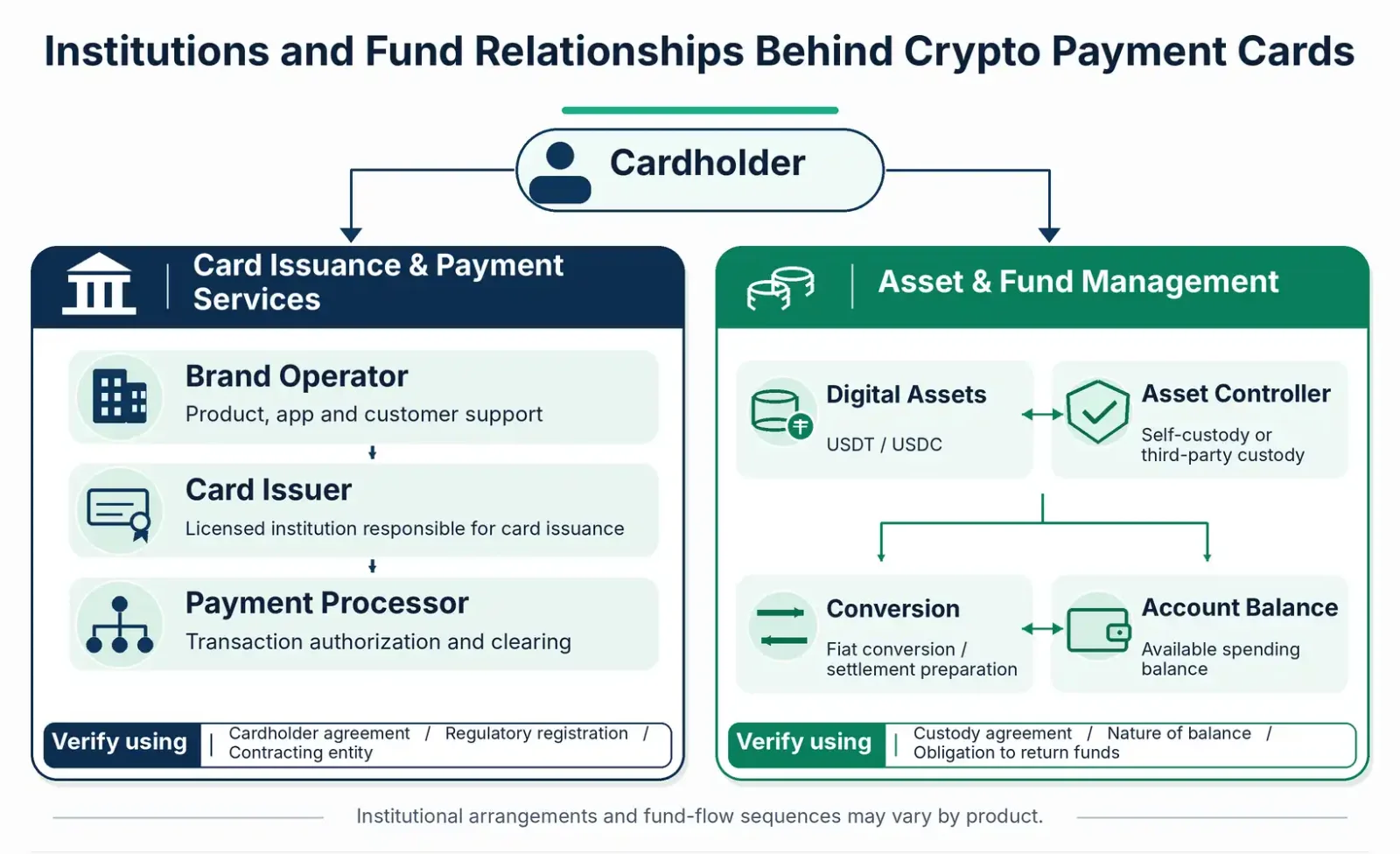
Some crypto card brands handle product design, customer support, and user acquisition. A licensed financial institution issues the cards, a specialized processor handles transaction authorization and clearing, and digital assets may be held on an exchange, with a custodian, or in the user's own onchain wallet.
These distinctions may be hard to notice when everyday payments work as expected. But if an account is frozen, withdrawals are restricted, an issuing partnership ends, or a platform shuts down, users need to know which company they have contracted with for financial services, who processes their card transactions, who controls their assets, and where they can seek recourse.
Investigating a crypto card requires more than checking the brand's reputation, its support for the Visa network, or the regulatory licenses displayed on its website. A more reliable approach is to trace the cardholder agreement, regulatory registrations, and movement of funds to identify the legal entity responsible at each stage.
1. Identify the Legal Entities Behind the Card
With a debit card issued by a traditional bank, the bank brand, card issuer, and deposit account provider are often the same institution. The allocation of responsibilities is relatively straightforward.
Crypto payment cards can have more complex business arrangements. Products offered by nonbank fintech companies, in particular, often rely on several institutions to provide card issuance and funds-related services.
A crypto payment card offered by a nonbank brand typically involves the following roles:
Entity or role | Primary responsibilities | What to verify |
|---|---|---|
Brand operator | App, product design, customer acquisition, and support | Registered company name; whether it directly enters into financial services contracts |
Card Issuer | Issues cards and provides payment services under the applicable agreement | Legal issuing entity, regulatory reference number, and applicable jurisdictions |
BIN Sponsor | Provides the BIN and payment network access arrangements for the card program | Which entity assumes issuing and network-related responsibilities |
Program Manager | Operates and coordinates the card program | Its specific contractual obligations to cardholders |
Issuer Processor | Authorization, transaction processing, and card systems | Whether its role is limited to technical services |
Asset custodian or account provider | Manages digital assets, electronic money, or fiat currency balances | Asset control, repayment or return obligations, and funds protection mechanisms |
Visa identifies BIN Sponsors, Issuer Processors, and Program Managers as distinct roles in its partner type descriptions.
One company may perform several roles, and a brand may work with different partners in different countries. A card offered under the same brand in Europe and another region may have different issuers or funding arrangements.
The most common source of confusion is the distinction between the card issuer and the asset custodian.
The issuer is responsible for issuing the card and providing the associated payment services. The crypto assets a user deposits to fund that card, however, may be held by an entirely different company.
2. Trace the Cardholder Agreement to the Regulatory Register
The most direct evidence of a card issuer's identity is usually the Cardholder Agreement.
For cards offered by nonbank brands, this agreement may not carry the brand's name. It may instead be issued by a partner bank, electronic money institution, or another legally authorized issuing entity.
Users can look for the following documents and terms on the platform's website, during the card application process, or in the app's legal documents section:
Cardholder Agreement or Card Terms;
Terms and Conditions;
Issued by, Card Issuer;
Electronic Money Terms;
Card Program Terms;
Safeguarding or Custody Disclosure.
Start with the name of the issuing entity on the first page of the agreement or in its legal disclosures. Verify its full legal name, registered address, regulatory reference number, and whether it operates the card program available to users in the relevant country or region.
Once the legal entity has been identified, check the regulator's original records:
United Kingdom: Use the FCA Firm Checker or Financial Services Register to search by legal name or Firm Reference Number (FRN). Review the firm's authorization status, permitted activities, regulatory history, and any restrictions. Authorization as an electronic money institution and registration for anti-money laundering purposes in the cryptoasset sector are separate statuses. The latter does not establish permission to issue cards or accept bank deposits.
European Economic Area: Start with the EBA register of payment and electronic money institutions, then verify the original record with the relevant national authority. The status of a crypto-asset service provider (CASP) under the EU's MiCA framework should be checked through the ESMA MiCA resources and relevant national registers. CASP authorization is a separate regulatory matter from card issuance and electronic money licensing.
United States: If the agreement names a bank, use the FDIC's BankFind Suite to verify the bank's identity and deposit insurance status. The cardholder agreement must also confirm that the bank actually provides services for the product in question.
Checking a regulatory register is only part of the investigation. Three further questions matter: Is the registered entity the same legal entity named in the contract? Does its authorization cover the relevant activities? Is the product offered to residents of the user's jurisdiction? A license held by a group affiliate, an authorization obtained in the past, or the availability of a product in another market does not answer these questions.
If no cardholder agreement applicable to the user's jurisdiction can be found, the issuer's identity and the contractual basis for the card remain significant information gaps.
3. Gnosis Pay: Investigating Issuing Authority, Regulatory Records, and Onchain Assets Separately
Gnosis Pay's original consumer card program provides a useful example of clearly divided institutional responsibilities.
According to a formal notice published by Gnosis Pay on September 21, 2026, its original consumer cards were issued by entities associated with Monavate. Gnosis Pay acted as the technology service provider and program manager.
More specifically:
Cardholders in the United Kingdom and other applicable non-EEA jurisdictions were served by Monavate Ltd, registered with the UK's Financial Conduct Authority (FCA) under reference number 901097.
Cardholders in the European Economic Area were served by UAB Monavate, regulated by the Bank of Lithuania under authorization number LB002139.
Gnosis Pay provided the card management platform and related services through its own application and partner integrations.
These institutional relationships are not assumptions based on website branding. They were disclosed by Gnosis Pay in the contractual arrangements described in its formal card closure notice.
Primary source: Gnosis Pay formal notice dated September 21, 2026
The regulatory status of both Monavate entities can also be checked against official records.
UAB Monavate appears in the Bank of Lithuania's official register as an electronic money institution, with authorization number LB002139 and a license effective date of March 31, 2022.
Monavate Ltd in the United Kingdom can be checked through the FCA's Financial Services Register using reference number 901097. The company's website also discloses its legal entity and regulatory information.
What makes this case particularly instructive is the relationship between card issuance and control over onchain assets.
The original Gnosis Pay cards were linked to users' Safe smart contract accounts on Gnosis Chain. According to the official notice, users retained control of the assets in their Safe accounts. Neither Gnosis Pay nor Monavate held users' signing keys enabling them to move those assets at will.
Some users could also receive euro transfers through separate electronic money and IBAN services provided by Monerium. Monerium fulfilled a different service role from that of the card issuer.
The arrangement can therefore be separated into four components:
Gnosis Pay: Branding, technology services, and card program management;
Monavate: Card issuance and payment services in the relevant jurisdictions;
The user's Safe: Control over onchain assets;
Monerium: Related euro electronic money and IBAN services.
In September 2026, Gnosis Pay announced the phased closure of its original consumer card services. Under the official arrangements available as of November 2026, the original Gnosis Pay cards were scheduled to stop working on December 20, 2026, at 23:59 UTC. Most functions of its web app, apart from withdrawals, were also scheduled to be discontinued.
The closure of the original card program, however, would not automatically remove users' control over assets held in their Safe accounts. Cardholders could continue managing those onchain assets using compatible Safe tools.
Refunds for past transactions, disputes, and complaints relating to the original cards would continue to be handled under the original issuing agreements and applicable procedures. Users moving to a new partner card program would need to accept new cardholder terms.
Primary source: Gnosis Pay services remaining available after closure
The Gnosis Pay case demonstrates that a brand, card issuer, and asset controller may have separate responsibilities. Identifying each relationship makes it possible to assess which services are affected when a card program changes and which assets remain under the user's control.
4. Verify Asset Custody, Conversion, and Obligations to Return Funds
Investigating custody requires more than asking where the money is stored. With crypto payment cards, deposited assets and spendable balances may exist within different account structures, governed by different contracts and protection mechanisms.
A statement that funds are "managed by a regulated institution" is not enough. Users also need to establish what type of asset they hold, how it is safeguarded or held in custody, and what happens to it between funding the account and making a purchase.
Platform Custody: Start With the Digital Asset Account Agreement
Some crypto payment cards require users to deposit USDT, USDC, or other crypto assets with the platform before those assets are converted, under the platform's rules, into a balance available for card spending.
The deposited digital assets may be held in the platform's own wallets or placed with a third-party custodian. The card issuer may administer the spending account and payment transactions without directly holding the crypto assets before conversion.
Review the digital asset account agreement to establish whether the platform holds assets in custody, whether it may appoint sub-custodians, and what kind of claim users have to their assets if the platform experiences financial difficulties.
If the agreement permits the platform to use, lend, or otherwise reallocate customer assets under certain conditions, the financial risks associated with those provisions also need to be assessed.
Another critical question is when conversion occurs. Are tokens converted immediately after deposit, or sold only when a card transaction is authorized or settled? Who bears custody risk before conversion, and who has the obligation to redeem or return the balance afterward? A balance displayed in US dollars establishes the app's denomination, not the legal existence of a US dollar bank deposit.
Electronic Money Balances: Check the Issuer and Safeguarding Arrangements
In the United Kingdom and certain European markets, fintech card accounts may be provided through electronic money institutions.
Such institutions are generally subject to applicable customer funds safeguarding requirements. These may include separating relevant customer funds from the institution's own funds and using legally permitted safeguarding methods.
The UK's FCA guidance for payment and electronic money institutions explains these obligations. Additional rules effective May 7, 2026 strengthened reconciliation, recordkeeping, and oversight arrangements. Monavate's official legal disclosures also state that its UK card account balances are safeguarded under electronic money rules rather than covered by the UK's Financial Services Compensation Scheme (FSCS) for bank deposits.
When reviewing electronic money arrangements, examine the account terms governing redemption times, fees, account freezes, and payment refusal. Check whether safeguarding accounts are opened in the issuer's own name. Even if the underlying funds are deposited with a bank, electronic money holders may have no direct deposit contract with that bank. The right to redeem electronic money and the arrangements for safeguarding customer funds are related but legally distinct issues.
Self-Custody Wallets: Check Signing Rights and Other Smart Contract Controls
For crypto payment cards connected to self-custody wallets or smart contract accounts, users may retain the private keys or signing authority needed to control their assets.
This structure can reduce reliance on centralized platform custody. But self-custody does not mean every operation can be performed independently by the user. Smart contract permissions and payment authorization mechanisms still need to be examined.
Key questions include:
Who can sign transactions that transfer assets?
Does spending require granting a specific smart contract permission to use tokens?
Can spending allowances be changed or revoked?
Does the smart contract have upgrade, pause, administrative, or other privileged functions?
If the card service is terminated, can users still withdraw their assets independently through standard wallet tools?
A platform's use of the term "Self-Custody" does not answer these questions.
It is also important to distinguish assets held in a self-custody wallet from funds already committed to payment or conversion processes. Even with complete control over their own wallets, users may still depend on external service providers during conversion, transaction settlement, or refunds.
Collateralized Products: Examine Loans and Collateral Separately
Some crypto credit cards and collateral-backed payment products allow users to obtain spending limits by pledging crypto assets as collateral.
In these arrangements, card payment services and collateral custody may be provided by different institutions.
Users need to establish who controls the collateral, who is party to the loan agreement, whether mandatory liquidation conditions apply, and what happens to the loan and collateral arrangements if the card account is disabled.
The regulatory status of the card-issuing bank does not establish equivalent protection for pledged crypto assets. Card issuance and digital asset-backed lending involve different contractual obligations and risks and must be investigated separately.
5. What BIN Data and Regulatory Licenses Can Actually Establish
A BIN (Bank Identification Number) can provide clues about issuance arrangements, geographic coverage, and product characteristics. Both six-digit and eight-digit BINs remain in use across the industry, and account-range information may offer additional specificity. Visa's BIN Attribute Sharing Service explains that different account ranges may exist within a single BIN and that BINs may also be shared. Public lookup databases are not always up to date. The first six digits of a card number cannot reliably establish the complete issuing agreement applicable to a particular cardholder, much less identify the custodian holding their USDT.
A regulatory license establishes an institution's regulatory status, but the scope of protection depends on the license type, the nature of the account, and the applicable law.
Assessing protection for funds associated with a crypto payment card requires three separate questions.
What is the institution authorized to do? It may be a bank, electronic money institution, payment institution, or crypto-asset service provider. Each authorization permits different activities.
What asset does the user actually hold? It may be a bank deposit, electronic money, digital assets held in a platform account, or onchain tokens controlled directly by the user.
What mechanisms apply if something goes wrong? Depending on the arrangement, they may include deposit insurance, safeguarding of customer funds, contractual claims, asset recovery, card dispute procedures, or other legal remedies.
These distinctions determine the rights users may assert if an institution encounters financial difficulties, an account is frozen, or card services are discontinued.
A platform's claim that it "partners with a licensed bank" does not mean all assets held on that platform are covered by bank deposit insurance. Similarly, operational problems at a licensed institution do not necessarily affect every associated customer's assets in the same way.
The central question is which part of the service the institution is legally responsible for, and whether that responsibility extends to the specific product and funds used by the cardholder.
6. When Records Conflict, Decide Based on the Missing Evidence
During an investigation, a platform's website footer may name one issuer, the cardholder agreement another company, and a public BIN lookup service a third.
That does not necessarily mean the platform has provided false information. The website may refer to card programs in different countries, the regulated entities may belong to the same corporate group, or the public database may not yet reflect an update.
If the discrepancy cannot be explained by a valid agreement, the platform should be asked to clarify it.
When the identities of the responsible entities remain unclear, ask the platform five questions:
What is the full legal name of the institution that issues the card available in my country?
What is its regulatory reference number, and which cardholder agreement do users sign?
Who holds and controls deposited USDT or USDC before it is converted into a card balance?
What is the legal nature of the balance held for card spending, and what customer funds safeguarding or other protection mechanisms apply?
If the issuing partnership ends, who remains responsible for past transaction refunds, account balances, and outstanding transactions?
If the only response is "We work with licensed banks worldwide," without identifying the issuer and funding arrangements applicable to the user, it does not establish who bears responsibility.
Before depositing funds, an ordinary user should be able to answer at least three questions:
Which legal entity actually issues my card?
Who controls, holds, or is obligated to return my deposited digital assets and spendable card balance, respectively?
If my account is frozen, a refund is disputed, or the card program ends, which contract governs my claim and which institution should I approach?
If these questions can be answered, the user has the essential information needed to understand the basic funding relationships and contractual rights.
If even the actual issuer cannot be identified, or the platform cannot explain the account arrangements governing customer funds, the reliability of its long-term funding arrangements remains in doubt, even if the card currently works for everyday purchases.