
A restaurant bill in the United States may come to $80, yet a crypto payment card could temporarily have $96 of its available balance tied up. In another scenario, the card initially shows an $80 payment, but the final transaction amount changes to $92 a day or two later.
Both situations can look like an overcharge, but they have different explanations. The first may involve the card issuer reserving additional funds for a potential tip. The second may result from the restaurant adding a tip approved by the customer to the final settlement amount.
These mechanisms also apply to ordinary Visa and Mastercard transactions. Crypto cards can make them more confusing because some products rely on prepaid balances, while funding may involve stablecoin deposits, asset conversions, or other steps. A restaurant transaction that has not yet settled can therefore affect the cardholder's ability to make subsequent purchases.
1. Why Does an $80 Restaurant Bill Show Up as $92 or $96?
Some full-service restaurants in the United States still use a checkout process in which customers pay with a card before writing in the tip.
After the meal, the restaurant requests authorization for the bill amount and gives the customer a receipt on which to enter a tip. The merchant subsequently adds that tip to the final transaction amount. This is why the initial payment notification may differ from the final charge.
An alternative is to determine the tip before payment. The customer selects a tip on a mobile point-of-sale (POS) terminal at the table or at the counter, confirms the total including the tip, and the restaurant then requests authorization from the card issuer.
Visa describes both approaches in its 2025 Transaction Acceptance Device Guide. Under one approach, a qualifying tip is added after the initial authorization. Under the other, the total including the tip is established before authorization is requested.
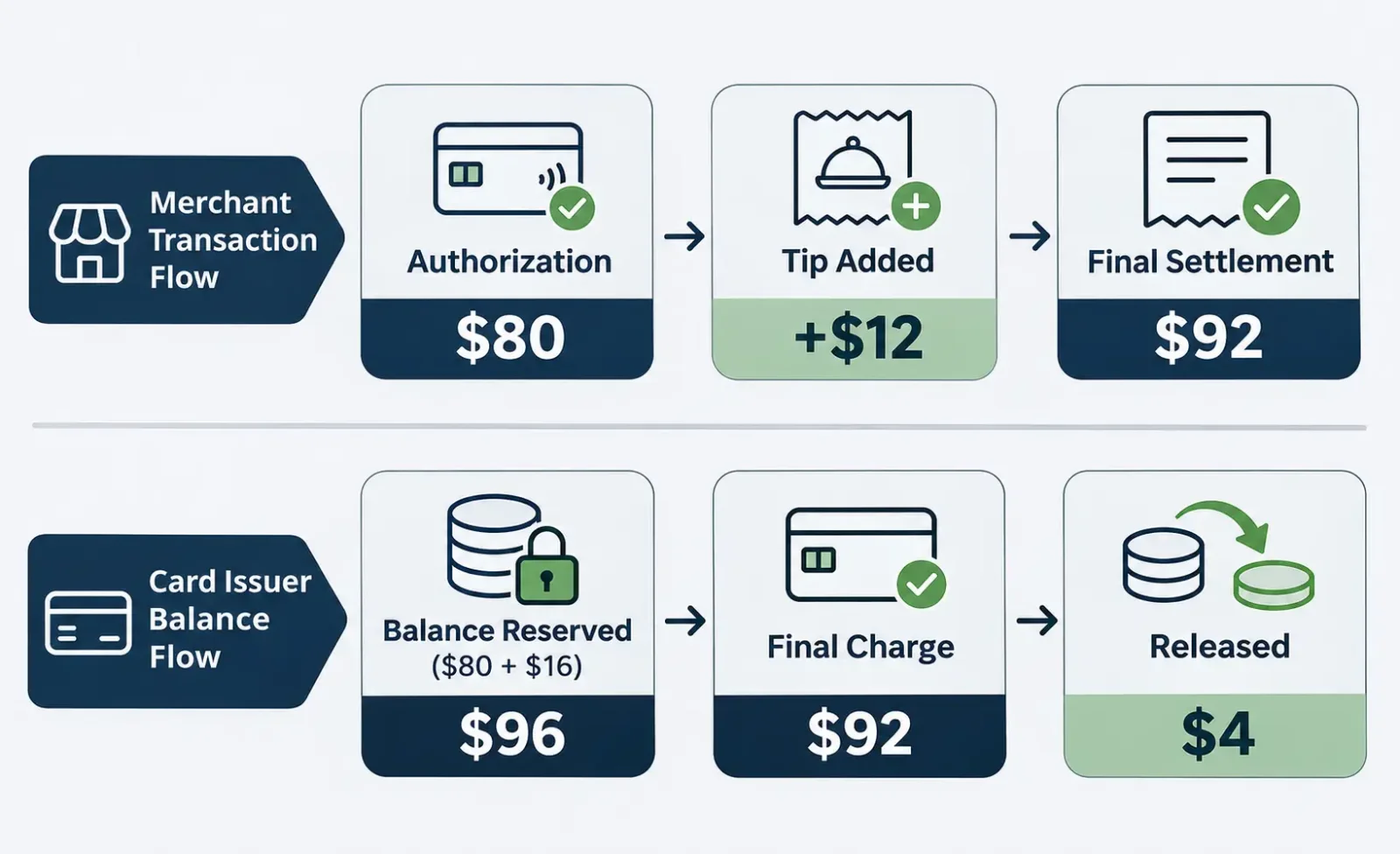
Consider a customer whose restaurant bill is $80 and who subsequently adds a $12 tip. Assume the issuer also reserves an additional 20% of the meal amount in available funds to cover a potential tip:
Transaction stage | Amount | What it means |
|---|---|---|
Meal and included taxes | $80 | Amount initially submitted by the merchant for authorization |
Additional balance reserved by the issuer (assumed 20%) | $16 | Funds reserved for a potential tip |
Available balance potentially tied up during authorization | $96 | Temporarily unavailable; not the amount actually charged |
Tip confirmed by the customer | $12 | Added to the final transaction amount |
Merchant's final settlement amount | $92 | Meal and tip combined |
Excess reserved balance | $4 | Should become available again after normal processing |
In this example, $96 is the amount temporarily tied up, while $92 is the amount ultimately owed. The extra $4 should be released as the transaction settles and the issuer updates the available balance.
The authorized amount, the temporary reduction in available balance, and the final settlement amount are three separate figures that must be checked independently.
Card network rules also underwent a notable change in 2026.
Under the Visa Core Rules and Visa Product and Service Rules, effective February 21, 2026, the permitted difference between authorization and clearing amounts can be as high as 30% for specified US restaurant merchant categories. These include MCC 5811 (Caterers), MCC 5812 (Eating Places and Restaurants), and MCC 5814 (Fast Food Restaurants). Exceptions apply to certain transactions, including some authorization types.
The Mastercard Transaction Processing Rules likewise permit qualifying US transactions to have a tip added after authorization, up to 30% of the authorized amount.
The 30% figure is a transaction-processing tolerance that applies under specified conditions, not a universal tipping rate or fee.
2. Why Can a Crypto Card Be Declined When There Is Enough Money for the Bill?
One practical consequence of reserving funds for restaurant tips is that a prepaid card may have enough available balance to cover the meal but not enough to obtain authorization for the transaction.
If the issuer requires additional funds to be held for a potential tip and the card's available balance cannot cover that requirement, authorization may be declined. From the cardholder's perspective, the balance exceeds the amount on the bill, yet the payment still fails.
This is not a rule unique to crypto cards. However, prepaid cards generally do not provide an additional credit line to draw upon, making temporary balance holds particularly disruptive.
In its prepaid card guidance updated July 20, 2026, Crypto.com explicitly notes that certain restaurants and service merchants may temporarily hold more than the bill amount to account for potential tips. It recommends that customers using the Crypto.com Prepaid Card at restaurants have an available balance at least 20% higher than the bill.
Crypto.com also explains that merchants and the platform may place preauthorizations exceeding the actual purchase amount. Funds held in excess of the final settlement amount are released once the transaction is completed.
The source of spendable funds also differs fundamentally across card products. Prepaid cards mainly draw on the balance loaded onto the card. Debit cards depend on available funds in the linked account, while credit cards generally depend on remaining credit and the issuer's authorization requirements.
Crypto cards funded with stablecoins such as USDT or USDC introduce another consideration: the status of the underlying funds.
Holding enough stablecoins on a platform does not necessarily mean those assets are available for card authorization. A deposit may still be awaiting confirmation or an internal transfer. Some products require assets to be converted and moved into a card account first; others support conversion at the point of purchase or crypto-backed lending arrangements.
When a payment fails, cardholders should therefore check not only the displayed card balance but also whether the funds have reached a state recognized as available under the card program.
For frequent international travelers, transparency about preauthorization policies matters more in practice than simply comparing card issuance or top-up fees. If a card provider does not clearly explain how much extra balance restaurant transactions may reserve, how those holds appear, and when the funds become available again, users cannot reliably determine how much money they need to keep on the card.
That is a question of product transparency, not a problem with a restaurant following ordinary card authorization rules.
3. How Do Physical Cards, Mobile Wallets, and Online Orders Differ?
The payment method can determine when a tip enters the authorized amount and whether a merchant can adjust the transaction after authorization.
In the traditional signed-receipt process, customers may authorize the meal amount first and write in a tip afterward. The merchant then adjusts the settlement amount in accordance with applicable rules.
With a mobile POS terminal at the table, customers can usually choose a tip before confirming payment. The terminal displays the meal price, taxes, and tip, and the merchant requests authorization for the total approved by the customer.
Contactless payments made through Apple Pay or Google Wallet involve different methods of cardholder verification and payment credential processing. Whether a tip can be adjusted after authorization depends on the card network rules and the transaction type.
For example, Mastercard's 2026 US rules explicitly distinguish between types of transactions involving US-issued Mastercard cards. Some must include the tip in the authorization request, while qualifying others allow a tip to be added afterward. The procedure used for traditional signed receipts does not apply to every contactless transaction.
This helps explain why the same restaurant may handle tips differently for signed receipts and contactless payments.
Online food orders introduce their own variations.
If a delivery platform or restaurant app requires the customer to select a tip before submitting an order, that amount can generally be included directly in the authorization. If the app permits tip adjustments after the order is completed, processing may instead involve an additional authorization, a subsequent charge, or another method supported by the platform.
The same crypto card may therefore produce different authorization and settlement records when used at a restaurant counter, at a tableside terminal, or for an online order. Those differences often reflect the transaction type and the merchant's payment system rather than the underlying mechanics of paying with crypto assets.
4. How Can You Tell a Normal Hold From an Incorrect Charge?
When the amounts do not match, the most effective first step is to check the transaction status and compare it with the restaurant receipt.
Card apps commonly use statuses such as Pending, Authorized, Posted, or Settled. The terminology varies by platform, but the statuses broadly distinguish transactions that are still undergoing authorization processing from those that have been formally posted.
Pending or Authorized generally indicates an authorization record that has not yet been finally posted. Posted or Settled generally means the transaction has reached the formal posting or settlement stage.
If the original authorization is still visible alongside a final posted transaction, first establish whether both records relate to the same purchase. Two amounts appearing on the screen at the same time do not, by themselves, justify adding them together and treating the result as a duplicate charge.
To determine whether more money has actually been taken, check whether the available balance has been restored.
An authorization hold temporarily makes funds unavailable. Once the merchant submits the final transaction, the issuer adjusts the balance according to the settlement outcome. The original authorization may also need to be matched, reversed, or allowed to expire before the remaining hold is fully released.
This typically does not appear as a separate refund.
A refund returns funds from a charge that has already occurred and is initiated by the merchant. Releasing an authorization hold, by contrast, frees funds that were not finally debited or no longer need to be reserved. The two processes can produce different transaction records and take different amounts of time.
If the transaction has posted and the amount really exceeds what the customer approved, the next step is to examine the individual charges on the receipt.
US restaurant bills may include taxes, a Service Charge, a Gratuity, and an additional tip entered voluntarily by the customer.
These labels must be interpreted in light of how the charges are applied. A mandatory service charge added by the restaurant is not the same as a tip voluntarily entered by the customer. Even if the receipt uses the word Gratuity, check whether the amount was added automatically and whether the customer could choose or modify it. Restaurants that already impose a service charge may also provide a separate field for an optional tip.
Cross-border payments require another distinction: differences caused by currency conversion.
For example, if a restaurant charges in euros but the card account is denominated in US dollars, the final displayed amount may reflect movements in the card network exchange rate, foreign transaction fees charged by the issuer, or costs associated with converting crypto assets.
First verify the meal and tip actually charged by the merchant against the receipt in the original currency. Then review foreign exchange and asset conversion costs separately using the card's transaction details and fee schedule. Combining these two sources of differences can easily create the mistaken impression that the restaurant added an excessive tip.
If the final amount still cannot be explained, the cardholder should retain the complete receipt, signed tip slip or terminal confirmation, and screenshots of the card transaction. The merchant can first be asked to verify the settlement amount it actually submitted. If there is a duplicate posting, an unauthorized tip increase, or another unresolved discrepancy, the cardholder can then raise a transaction dispute with the issuer or card platform.
If an authorization hold remains outstanding for an unusually long time, contact the issuer directly to check the transaction's status rather than waiting for the merchant to issue a refund that does not actually exist.
For crypto cards, the ability to distinguish authorizations, reserved balances, final postings, and currency conversions in transaction records is an important measure of product reliability. The fact that temporarily reserved funds eventually become available again does not eliminate the problems caused by insufficient available balance during authorization, declined transactions, or unclear records.
Ultimately, deciding whether a restaurant has genuinely overcharged a cardholder comes down to three figures: the amount the customer actually agreed to pay, the balance temporarily reserved during authorization, and the amount the merchant ultimately submitted for clearing.