
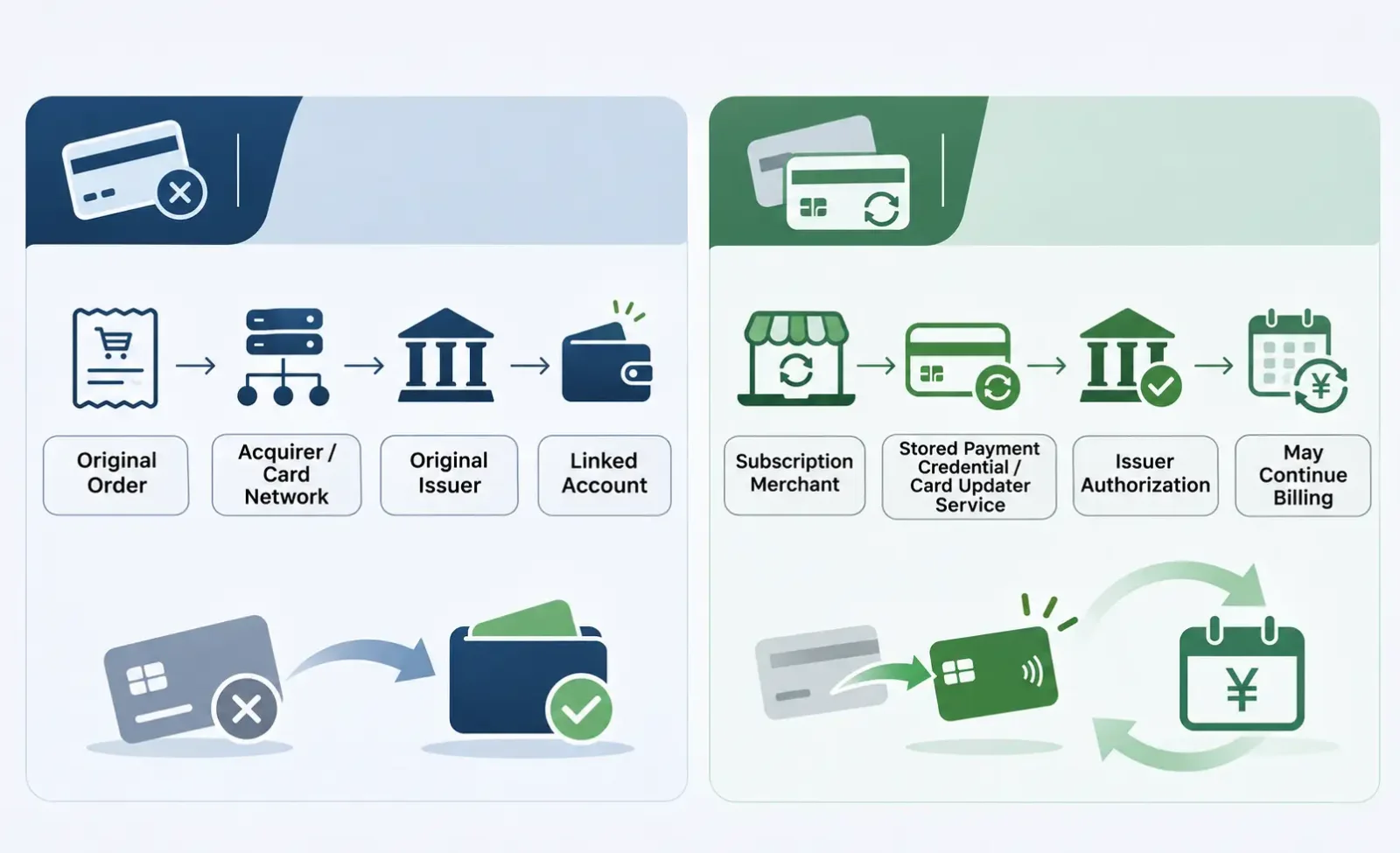
When a crypto payment card expires or is replaced, cardholders generally have two immediate concerns: Can they still receive refunds for earlier purchases? And can a card previously saved with ChatGPT, Netflix, or another subscription service continue to be charged?
The answers depend on different processes. Refunds are largely governed by the original transaction records, the issuing account, and the issuer's processing rules. Subscription renewals depend on stored payment credentials, account updater services, and authorization of subsequent transactions.
When a card expires or is routinely reissued, refunds for past transactions may still reach the cardholder's account even after the old card number becomes invalid. Subscription payments may also continue, as some merchants can obtain updated card details automatically. The more consequential risks arise when an account is closed, the card issuer changes, or an entire card program is terminated. Such changes can disrupt the handling of historical transactions.
1. Can Refunds Still Arrive After a Card Expires or Is Replaced?
Routine expiration or reissuance generally does not create a major obstacle to receiving refunds. A card's Primary Account Number (PAN), expiration date, or status can change without erasing its transaction history. The issuer can still process refunds by matching the original transaction to the associated account.
Not all card replacements are alike. A routine renewal may only update the expiration date, while replacement following a loss report may also involve a new card number. In both situations, the original issuer typically remains responsible for managing historical transactions. Closing the entire platform account or moving from one issuer to another is different: it can change both account continuity and the party responsible for processing transactions.
Ordinarily, the merchant should refund the original purchase through its acquirer and the card network to the issuer that processed the initial payment. The cardholder does not need to supply a new card number. For example, if a hotel reservation paid for with an old card is canceled, the first step should be to ask the hotel to refund the original payment. Requesting a refund to a different card may instead run into merchant fraud controls or payment processor restrictions.
Stripe's official guidance explains that when a refund is sent to an expired or canceled card, the bank will usually route it to the replacement card. If no replacement exists, the funds may be credited directly to the associated bank account. If the bank cannot process the refund, it is returned to Stripe.
The Coinbase Card troubleshooting guide similarly states that refunds to an old card are generally transferred automatically to the replacement. If the original payment method has been closed or the account details do not match, the cardholder may need to provide merchant refund documentation to customer support.
Both providers' explanations point to the same fundamental question: Can the issuer identify the original transaction and correctly link the refund to an account the cardholder can still access?
It is also important to distinguish where a refund is directed from how it appears in the account. Card refunds are generally matched to the original payment, so the merchant does not need the new PAN. Whether the refund subsequently appears under the replacement card, an associated balance, or funds awaiting a claim depends on the issuer's accounting arrangements.
The critical distinction is between a card becoming invalid and the underlying account being terminated. Routine renewal and replacement after loss often preserve the same account or a traceable relationship between accounts. When voluntarily canceling a card, however, cardholders should establish whether only the card is being closed or the associated funds account is also being terminated. In the latter case, even if the original issuer receives the refund, additional steps may be necessary to claim or withdraw the money.
2. Why Hasn't the Refund Arrived If the Merchant Says It's Complete?
A merchant dashboard showing "Refund Completed" does not mean the money has reached the cardholder's account. Merchant confirmation, submission through the acquiring side, and receipt and posting by the issuer are separate stages. If the old card is closed or account details no longer match, further account reconciliation or manual review may be required.
Adyen's documentation on referenced refunds explains that accepting a refund request and completing its processing are not simultaneous. For transactions that support refund authorization, an issuer may decline authorization because the card has expired, the account number is invalid, or the account is closed. Adyen says it will still attempt to process the refund even if authorization is declined.
Payment status labels can also be misleading. "Refund initiated" may simply mean the merchant's system has accepted the request. Even when a payment processor reports successful processing, the final credit may not yet have been posted to the cardholder's account. If the issuer cannot locate the credit, the merchant should be asked whether the refund was returned. An order screenshot alone is not evidence that the money has been lost.
Before tracing a payment, establish whether the merchant issued a refund or merely released a preauthorization. Hotels and car rental companies often place holds on payments that have not yet been settled. Canceling the authorization releases the held amount without creating a separate refund credit. Only the return of funds from a settled transaction needs to be traced through the original card refund process. Releasing a frozen balance within a platform account is not the same as a refund through a card network.
If the merchant has actually issued a refund, first obtain the original transaction date, amount, currency, refund date, and supporting documentation. Where available, also request the Acquirer Reference Number (ARN) or another tracking reference issued by the payment processor. If the merchant cannot provide an ARN, the processor's transaction ID, refund receipt, or order number can be submitted first. The original issuer can then confirm which details are sufficient to locate the refund. ARNs are relevant only to refund flows in which such a reference is available.
Next, contact the original card issuer or its designated card support provider. Supply the last four digits of the old card and the supporting records, and ask whether the refund was received, returned, or referred for manual handling.
Coinbase Card's help documentation gives 5–10 business days as a reference timeframe for many refunds, although actual processing times vary by merchant and payment network. Once the provider's stated timeframe has passed, follow up using the refund documentation and ARN, if available. If the issuer confirms that the refund was returned, request written confirmation and ask the merchant to investigate the original refund before deciding whether to issue it again. Do not repeatedly request new refunds while the money's whereabouts remain unclear. Never disclose a CVV, password, or crypto wallet private key to an unverified support representative.
3. Can ChatGPT, Netflix, and Other Subscriptions Keep Charging a Replaced Card?
Yes, recurring charges may continue. Replacing a card is not the same as canceling a subscription. After a customer initially authorizes a subscription, the merchant stores payment credentials. Subsequent eligible recurring charges may be submitted as Merchant-Initiated Transactions (MITs), without requiring the customer to enter a card number or complete authentication each time.
MIT describes how a merchant initiates subsequent charges under an existing authorization. It does not give merchants an unlimited right to keep charging. Whether a subscription remains active and whether renewal authorization has been withdrawn are matters between the customer and the merchant. How banks and card networks process the payment is a separate issue. Card updater services address payment failures caused by outdated credentials; they do not determine whether a subscription should continue.
After a card is replaced, previously stored payment details may remain usable through card network account updater services. Visa Account Updater (VAU) enables participating institutions to update card numbers, expiration dates, and certain account status information. Mastercard Automatic Billing Updater (ABU) likewise provides updated payment information to participating acquirers and merchants. If the issuer, acquiring side, and merchant all support the relevant service, a subscription may continue without the customer manually updating the card details.
There is another possibility: a merchant submits a transaction using previously stored, expired card details, and the issuer still approves it. Stripe's official guidance confirms that such payments can sometimes succeed, with the authorization decision resting with the issuer. Conversely, even after credentials have been updated automatically, renewal may fail because of insufficient funds, transaction limits, geographic restrictions, or merchant category controls.
Card change | Effect on existing subscriptions |
|---|---|
Expiration date updated only | Details may update automatically; critical subscriptions should still be checked |
Card number changed or card replaced after loss | Old credentials may still be approved or may be declined; check the merchant's billing records |
Issuer or card program changed | Do not assume account updater services will transfer credentials across programs; update manually |
Associated account permanently closed | Future payments may fail; arrange another payment method |
Account updater services are not enabled by default for every card. Coverage depends on the specific issuing program, whether the merchant participates, and whether the stored credentials have actually been updated. This can be particularly difficult to establish for some third-party-issued virtual and prepaid cards. A card's brand and Visa or Mastercard logo alone do not establish participation. For services that must remain operational, checking actual billing results is more useful than relying on the theoretical availability of network updater technology.
For entertainment subscriptions such as Netflix, a failed renewal is generally a service-access issue. The consequences can be more serious for cloud services, developer tools, and enterprise software, where missed payments may lead to restricted functionality or suspension. Users who depend on ChatGPT, Claude, cloud servers, or other business tools should check upcoming billing dates, invoice status, and backup payment methods rather than relying on VAU or ABU to preserve service continuity.
To stop a subscription, cancel it formally through the merchant account and retain confirmation. Disabling an old card does not establish that payment authorization has been terminated. If unauthorized charges continue, investigate them with the merchant and issuer and use the applicable dispute procedures.
Apple Pay and Google Wallet introduce a separate consideration: device-based payment tokens, which are managed independently of the payment credentials merchants store for subscriptions. Some tokens remain usable after card replacement; others require the card to be added again. Crypto.com's Apple Wallet guide explicitly instructs users to add their Prepaid Card to Apple Wallet again after the card is reissued, replaced, or upgraded.
4. What Happens to Balances and Refunded Crypto Assets After Card Replacement?
Conventional bank debit cards are typically linked to bank accounts. Crypto payment cards, however, may draw on prepaid platform balances, stablecoin funding accounts, exchange-held asset balances, or other funding arrangements.
As a result, what happens to the balance after card replacement deserves more attention than the card number itself.
For a platform-funded prepaid card, an existing balance may remain available under the product's terms if both the old and new cards are linked to the same continuing funding account. If the card program is being migrated, cardholders need to establish how the old balance will be transferred, whether refunds can still be received, and whether remaining funds can be withdrawn.
For products that convert crypto assets only when a purchase is made, refunds may involve asset valuation and a further conversion.
Suppose a customer uses a crypto asset to make a purchase worth $100, and the merchant later approves a $100 refund. Whether the customer ultimately receives a U.S. dollar balance, USDC, or another crypto asset depends on the product's funding and refund rules.
Even when the refunded fiat amount is identical to the original transaction amount, the corresponding quantity of crypto assets may change because of the conversion date and applicable exchange rate.
Purchases funded through collateralized loans or credit lines are handled differently again. A refund may first offset the recorded purchase, reduce the outstanding amount owed, or restore available credit.
These distinctions have little to do with whether Visa or Mastercard appears on the card. What determines how a refund is reflected is the product's underlying funding structure, account relationships, and cardholder agreement.
A card program migration warrants greater scrutiny than routine card replacement.
When a card expires normally, an account system capable of identifying the original cardholder and historical transactions usually remains in place. If an entire card program ends, that continuity may be broken.
Consider a crypto payment card brand that ends its relationship with its original issuer and launches a new product issued by another institution or in another jurisdiction. Even if the brand name remains unchanged, the new card account may not be able to receive refunds on transactions made with the old card.
Three parties' responsibilities need to be established separately.
Original card issuer: Will it continue handling historical transactions, refunds, and disputes? When does the original cardholder agreement terminate? Through which channels can users still inquire about earlier transactions?
Platform operator: Will existing balances be transferred? Will transaction inquiries and withdrawals remain available for old card accounts? How will unsettled funds be handled?
New card issuer: Is there a formal migration arrangement between the old and new accounts? Can the new card receive historical refunds? Must users apply again or complete identity verification?
A platform's statement that it has "upgraded its card issuing services" does not answer these questions. Brand continuity does not guarantee account continuity, nor does it mean a new issuer automatically assumes responsibility for every historical transaction on the old card.
Card program termination notices are especially important for users with unfulfilled orders, hotel deposits, rental car preauthorizations, or pending refunds. Preserve original transaction records, merchant confirmations, and platform announcements, and establish the deadlines and dispute channels for historical transactions as early as possible.
If the original issuer has exited and the new card does not take over the old account, a refund may still encounter problems involving fund claims, account closure, or coordination between institutions, even if it has been processed through the payment network.
This goes beyond ordinary card expiration management. Ownership of funds, processing responsibilities, and dispute deadlines must be assessed under the original cardholder agreement and the relevant jurisdiction.
5. What Should Cardholders Prioritize Before and After Replacement?
For routine card renewal, the safest sequence is to activate the new card, verify the available balance, expiration date, and payment status, and then review the payment details stored by important merchants.
For orders awaiting refunds, there is generally no need to ask a merchant to change the destination card simply because the old card has expired. Keep the original transaction records and refund tracking details, and confirm that the original issuing account can still receive refunds for historical transactions.
Critical subscriptions require more active management. Automatic account updates can reduce payment disruption after card replacement, but they do not cover every merchant. If the new card involves a different issuer, jurisdiction, or account infrastructure, it is better to treat the change as a full payment-method migration.
If the card is being replaced because of fraudulent use or exposed payment information, review previous merchant authorizations and the security settings of associated accounts. Revoke payment authorizations that are no longer needed, and ask the issuer how stored credentials linked to the old card and subsequent transactions will be handled.
If the platform is about to terminate the original card program, the priorities should change. First establish what will happen to existing balances and pending refunds, then consider applying for a new card and migrating subscriptions. When funds or disputed transactions remain unresolved, the fact that a new card has been issued is not sufficient evidence that responsibility for the old account has been properly transferred.