
A personal crypto card can pay for software subscriptions, cloud servers, and international business travel. But using one regularly for company expenses raises questions about account ownership, cardholder agreements, and financial management.
For a small business run by a single owner, the two types of cards may feel much the same. The differences become more significant when several people need access to company funds. Who can authorize payments? How are permissions revoked when an employee leaves? Who is responsible for subscription charges? Can transaction records feed directly into the company's accounts? Each requires a clear policy.
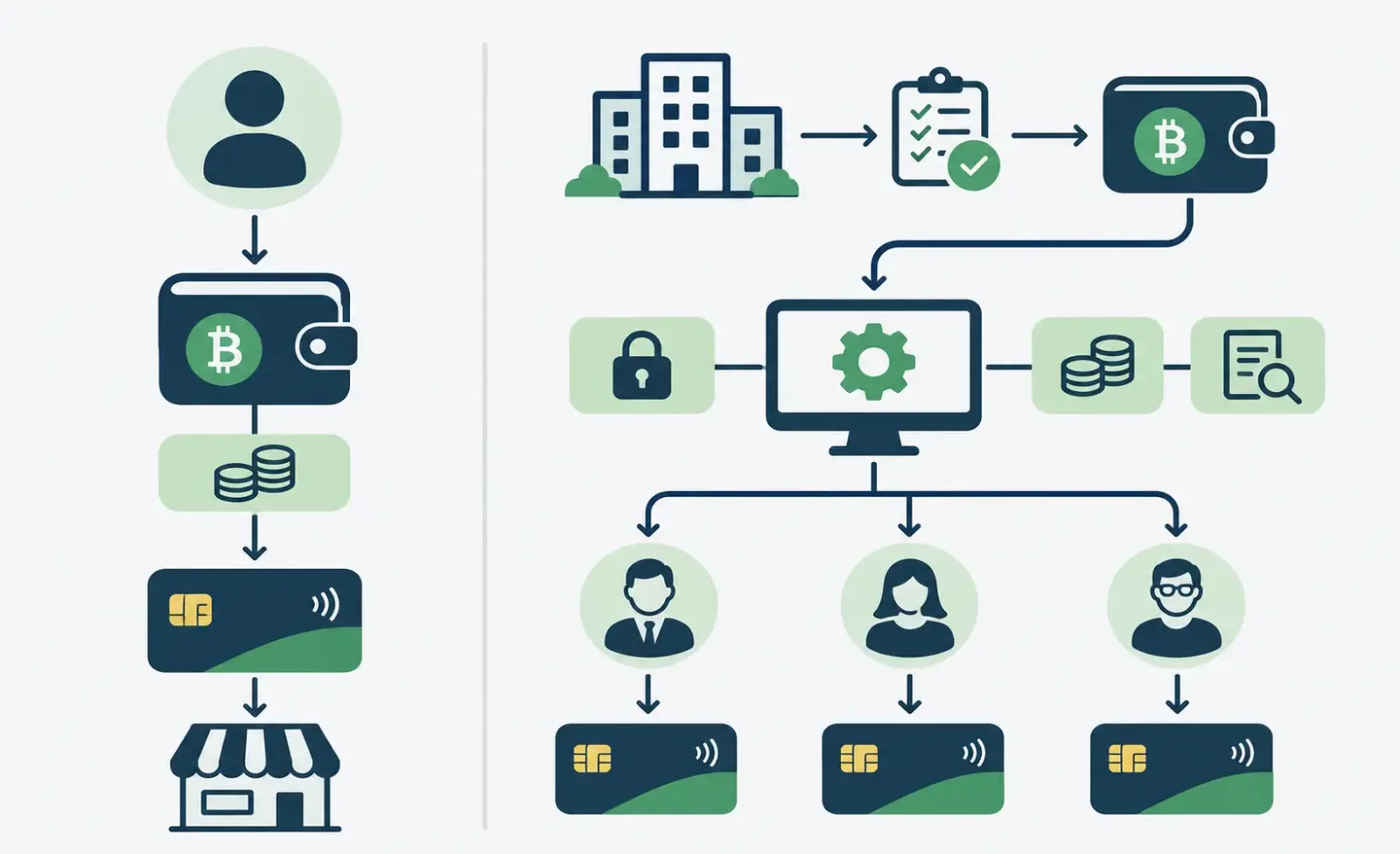
The main differences between a Personal Crypto Card and a Business Crypto Card concern the legal entity that holds the account, identity verification, control over funds, and financial management. Whether a particular card is a debit, prepaid, or credit product depends on its underlying funding structure and contractual arrangements.
1. A Personal Card May Work for Business Payments, but Commercial Use Must Be Permitted
Personal crypto cards are generally issued to individuals. After completing identity verification, cardholders may be able to spend fiat currency, digital assets, or an available credit line, depending on the product's funding structure.
A merchant's willingness to accept a payment, however, is not the same as the card issuer permitting that use.
For example, the Crypto.com US Prepaid Card Cardholder Agreement expressly limits the card to personal use and excludes business purposes. The US terms for the Coinbase One Card similarly restrict the card to personal, family, and household use, rather than business use.
These restrictions apply to the respective products, not to every personal crypto card. They nevertheless illustrate an important distinction: successfully paying for AWS, Google Workspace, or another business service does not mean the issuer permits the cardholder to use the card routinely for company expenses.
For a freelancer, occasionally buying work-related software with a personal card and recording the expense may be relatively straightforward. The situation becomes more complicated when a company routinely relies on employees' personal cards for advertising, servers, procurement, and travel.
The account belongs to the individual, and the payment history remains in that person's name. If the employee leaves, the card is frozen, or the account undergoes another review, the company may not have the authority to resolve the matter directly. Refunds, subscription renewals, and payment disputes may also be affected.
Businesses should therefore review the specific cardholder agreement to establish whether commercial use is allowed, whether an account can be opened in the company's name, and who is responsible for invoices, refunds, and payments.
2. Business Card Verification Covers the Company and the People Behind It
Applications for personal crypto cards primarily involve KYC (Know Your Customer). This typically includes checking the applicant's identity documents, residential address, and identity authenticity, along with source-of-funds checks where required.
Business cards also require KYB (Know Your Business) verification.
KYB focuses on the business as a legal entity. In addition to registration documents, issuers need to understand what the company actually does, its ownership and control structure, and who is authorized to manage its account.
According to Reap's business verification requirements, updated in September 2026, required documents may include a certificate of incorporation, constitutional documents, ownership structure, and information about directors and ultimate beneficial owners (UBOs). Individuals acting on the company's behalf must also provide proof of identity and authorization. The precise requirements vary by jurisdiction of incorporation and business type.
The main verification differences are:
Verification Requirement | Personal Crypto Card | Business Crypto Card |
|---|---|---|
Applicant | Individual | Company or another eligible business entity |
Primary checks | KYC | KYB, plus KYC for relevant individuals |
Identity documents | National ID, passport, or other accepted identification | Corporate registration documents and identification of directors and beneficial owners |
Address verification | Personal residential address | Registered business address, operating address, and addresses of relevant individuals |
Source of funds | Personal income, assets, or transaction history | Business revenue, source of funds, and evidence of business activities |
Authorization checks | Primarily verification of the cardholder's identity | Verification of the authority of account representatives, administrators, and authorized users |
Jurisdictions differ in their beneficial ownership thresholds, definitions of effective control, and due diligence requirements. Some companies may face additional scrutiny because of their industry, ownership structure, or risk rating.
Web3 companies operating across borders should prepare particularly carefully. When incorporation, actual operations, management personnel, and stablecoin funding sources are spread across different countries, the review is often more complex than opening a personal card account domestically.
Completing KYB does not necessarily eliminate the need for individual checks. Authorized cardholders may still have to complete identity verification, and administrators, finance personnel, and ordinary employees may face different requirements.
3. A Business Card Is Not Necessarily Funded by the Company's Stablecoin Balance
Two business crypto cards may both support USDT or USDC while relying on fundamentally different funding arrangements.
Common models include preloading a balance with fiat currency or stablecoins and deducting spending from available funds; pledging stablecoins as collateral for a card credit line; or using a separate corporate credit facility and repaying the outstanding amount according to a billing cycle.
Stablecoin-backed credit warrants particular attention.
Consider Reap. According to its official Business Account documentation, updated November 3, 2026, Reap offers a collateral-backed Visa business credit card supporting US dollars and Hong Kong dollars. Companies can pledge USDC or USDT to establish a credit line. The published ratio of collateral value to credit limit is 1:1.
Depositing stablecoins in this arrangement is not simply a prepaid card top-up. The assets secure a credit facility.
Suppose a company deposits USDC worth $10,000 with Reap as collateral, receives a $10,000 credit line under the published ratio, and then pays $2,000 for software services.
That purchase creates an outstanding credit card balance. It does not immediately deduct $2,000 from the pledged collateral.
Under Reap's business card instructions, companies must settle outstanding balances monthly, either through bank transfers or by using collateral assets. Repayment with collateral reduces the credit limit accordingly. The available procedures also depend on account balances and applicable terms.
The company's finance team therefore needs to track pledged collateral, the credit limit, card transactions, and actual repayments separately. Depositing collateral should not be treated as equivalent to incurring a business expense.
This example describes Reap's publicly documented collateral-backed credit arrangement. It does not imply that all business crypto cards follow the same model.
For prepaid products, the main accounting considerations are balances, funding transactions, and asset conversions. Collateral-backed credit products also introduce corporate credit liabilities, pledged assets, and repayment records. Whether other credit products charge interest or financing fees depends on their individual contracts; those terms should not be assumed to apply to Reap.
Businesses should establish who holds the collateral, whether it can be withdrawn, how it would be handled following a default, and what contractual rights the company retains if the platform ceases operations.
These questions determine how much practical control a company has over its funds. Transaction fees and cashback rates matter, but they do not capture the full impact of capital being tied up, custody risk, and credit arrangements.
4. Managing Employee Permissions and Payment Liability
For companies regularly purchasing software, cloud services, and advertising, making a payment is seldom the difficult part. Managing who among the staff is allowed to spend company funds is where business cards offer capabilities that personal cards struggle to replace.
Consider a cross-border internet company with eight employees. Its technical staff purchase development tools and cloud services, its marketing team buys advertising, and its operations staff handle routine expenses.
If everyone uses one virtual card in the founder's name, some payments may go through, but individual spending responsibility becomes difficult to establish. Sharing the same card credentials among several people increases the risk of exposure. When a subscription continues charging the card, identifying the responsible employee may be difficult. Replacing that card could also disrupt several departments at once.
A company can separate these permissions through individual employee cards, spending limits, and merchant category restrictions. The technical team might have a dedicated card for cloud services, while marketing uses a separate advertising card. When an employee leaves, the relevant card permissions can be revoked.
None of these capabilities is exclusive to crypto business cards.
Visa's business virtual card solutions and Mastercard's business payment controls both position spending controls as an important part of commercial payments. Whether a particular program supports merchant category restrictions, spending limits, or authorized-user management depends on the issuer and card program.
For crypto business cards, employee permissions must also work alongside stablecoin accounts, collateral-backed credit lines, and corporate accounting. When several employees share a company credit line, the business needs to control spending on each card while monitoring the account's total outstanding balance and use of pledged assets.
Spending authority can be delegated to employees. Accountability for the account and its funds cannot be left undefined.
Issuing a card in the company's name does not automatically mean the company alone bears every transaction loss or debt.
Traditional corporate card programs may impose sole payment liability on the business, place some or all liability on employees, or allocate responsibility between them under contractual terms. Crypto business cards likewise need to be assessed under their specific agreements.
For credit cards in particular, companies must establish who is legally obligated to repay the debt, whether employees are merely authorized cardholders, and how collateral may be used to satisfy outstanding obligations. Prepaid and debit cards do not have the same credit structure, but responsibility for unauthorized transactions, excess charges, and account disputes still needs to be defined.
Can an administrator immediately deactivate a departing employee's card? What happens to existing preauthorizations, subscription renewals, and refunds? If an employee exceeds the approved budget, what contractual provisions determine liability?
These questions should be answered before the account is opened.
Not every business crypto card offers a complete set of approval workflows, budget controls, and expense categorization features. Some products support only company accounts and multiple cards, leaving advanced approvals or accounting integrations to third-party software. Buyers should verify the functionality actually available rather than relying on claims of "enterprise-grade management."
5. What Financial Records Are Needed for Stablecoin-Funded Business Expenses?
Crypto cards provide a means of payment and asset conversion, but businesses must still account for their transactions under applicable accounting rules.
Suppose a company holds USDC and uses its business card to pay an overseas software vendor. Its finance team needs to identify the supplier, purpose of purchase, original invoice amount, payment currency, changes in stablecoin holdings, and associated fees.
If the card operates on credit, the company must also distinguish the date of purchase from statement recognition and actual repayment.
This information is often spread across merchant records, the business card platform, and stablecoin accounts. A card transaction statement alone may not provide a complete accounting record.
Financial Record | Primary Purpose |
|---|---|
Merchant invoice or payment receipt | Verify what was purchased, the expense purpose, and the parties to the transaction |
Card transaction statement | Reconcile authorized amounts, final posted amounts, and transaction dates |
Stablecoin funding and conversion records | Trace the source of funds, conversion amounts, and associated fees |
Business card account or credit statement | Reconcile available credit, amounts payable, and repayments |
Employee or project attribution | Identify cost centers, budgets, and approval responsibilities |
When a business funds its account with stablecoins, it is especially important to preserve the connection between on-chain transaction records and the platform's account statements.
Blockchain confirmation establishes the status of a transfer on the relevant blockchain. It does not replace merchant invoices, card purchase records, or other supporting documentation. Even if a merchant ultimately receives US dollars, the company's earlier digital asset conversions or disposals may create separate accounting and tax obligations.
In practice, the ability to reconcile financial data is more valuable than the number of supported currencies.
If a company processes numerous subscriptions, international purchases, and employee expenses each month, but its card platform provides only transactions with no information about the underlying business purpose, finance staff must still match invoices, payers, and cost centers individually.
A business crypto card's ability to produce complete, reconcilable financial records says more about its practical value than the number of stablecoins it supports.
If a company handles large volumes of recurring subscriptions, cross-border purchases, and employee spending each month, yet can download only a transaction statement with no business-level attribution, its finance team will still spend considerable time organizing and reconciling the data. The card may have processed the payments without meaningfully improving expense management.
6. Should a Business Use a Personal Card or Apply for a Business Card?
For a sole operator paying only a handful of subscriptions each month, the additional KYB requirements and account administration costs of a business card may not be justified. A practical first step is to check whether the personal card's agreement permits business spending and whether the company can properly maintain expense documentation, reimbursement records, and tax records.
When a company needs multiple people to make payments, purchases services regularly, or centrally manages international business spending, a corporate account with individual cardholder permissions becomes more valuable.
I recommend assessing four areas before choosing a card:
First, account eligibility and legal liability. Confirm that the company's place of incorporation, operating location, industry, and relevant personnel meet the eligibility criteria. Establish the legal relationships among the issuer, account holder, and party responsible for payment.
Second, funding and debt structure. Determine whether the card uses a prepaid balance, a stablecoin-collateralized credit line, or an independent corporate credit facility. Clarify the rules for custody, repayment, asset withdrawals, and default.
Third, permissions and financial management. Check whether employee cards, budget controls, payment approvals, merchant restrictions, transaction records, and reconciliation capabilities meet the company's operational needs.
Fourth, fees and additional features. Once the first three requirements are satisfied, compare card issuance fees, transaction charges, foreign exchange costs, financing costs, cashback, and other benefits. Also assess geographic availability and conditions for long-term use.
Personal and business crypto cards may run on the same Visa or Mastercard payment networks and offer similar everyday payment experiences. What businesses need to manage, however, extends beyond individual transactions to the funds behind them, employee authority, and financial records.