
A crypto payment card has an available balance of $80, and its holder only wants to buy $30 worth of gas. Yet the payment is declined at the pump. A similar problem can occur at public EV charging stations: a charging session may cost just over $10, while the card temporarily has several dozen dollars tied up in an authorization hold.
Crypto payment cards can be used for fuel purchases and EV charging, but whether a transaction succeeds depends on the merchant's payment acceptance methods, issuer restrictions, and the funds available when authorization is requested. Support for the Visa or Mastercard network does not guarantee that every transaction will be approved.
The problem often comes down to the difference between the final purchase amount and the amount requested for payment authorization. Gas stations and charging networks may require preauthorization before service begins, making crypto prepaid cards with limited balances particularly vulnerable to declines.
1. Can Crypto Payment Cards Be Used at Gas Stations and EV Chargers?
Gas stations and public charging networks generally accept payments through the card payment system. If the merchant accepts the card and the issuer does not restrict the transaction, a crypto payment card can be used much like a conventional debit or prepaid card.
However, the payment channel also matters.
A gas station's automated fuel dispenser and its cashier terminal may follow different authorization procedures. EV charging payments are even more varied. An operator's app, a charger-mounted card reader, a mobile wallet, and guest checkout may involve different payment service providers and verification requirements.
For example, EVgo notes in its official instructions that support for mobile wallets such as Apple Pay and Google Pay is limited at certain locations. Even when a card has been successfully added to a mobile wallet, it may not work at an on-site terminal.
Some charging equipment has a contactless reader intended specifically for the operator's RFID membership cards, rather than bank-issued payment cards. EVgo makes this distinction clear in its guide to paying by card at a charging station.
A card network logo alone is therefore not enough to determine whether a card will work for fuel or charging. The decisive factors are how the merchant initiates the payment, whether the issuer permits the authorization, and how much available funding the card has at that moment.
2. Why Do Gas Stations Request Preauthorization for More Than the Fuel Cost?
There is an important difference between paying at an automated gas pump and checking out at a supermarket: when the card is first presented at the pump, the merchant generally does not know the final purchase amount.
A supermarket cashier can request authorization for a $30 purchase immediately. An automated fuel dispenser, by contrast, must establish that the card can support the transaction before allowing the driver to start fueling.
Some pumps therefore request an initial authorization for an amount expected to cover the fuel purchase.
Consider a prepaid card with an available balance of $80. The driver plans to purchase $30 worth of gas, but the pump first requests authorization for $100. If the issuer requires sufficient available funds to cover the full authorization, the transaction will be declined.
It is the initial $100 authorization that fails, not the eventual $30 fuel purchase.
In its 2018 payment acceptance guidance for U.S. retail petroleum merchants, Visa describes the authorization, transaction completion, and clearing processes used at automated fuel dispensers. The document also explains that pumps can use different authorization methods. No single preauthorization amount should be treated as a universal requirement across gas stations.
Crypto.com's prepaid card fees and limits guidance provides a more concrete example. It states that some gas stations may preauthorize approximately $50 to $150 and suggests paying at the cashier to avoid the larger hold that may be required at the pump.
That advice is particularly useful for holders of crypto prepaid cards with limited balances.
Where a gas station allows prepayment of a specified amount at the cashier, a driver can pay $30 directly without first satisfying the pump's larger authorization request. The cashier transaction still requires issuer approval, but it generally gives the cardholder more control over the amount of funds committed.
An Authorization Amount Is Not the Final Charge
Suppose a prepaid card initially has $160 available. A gas pump places a $100 preauthorization hold, temporarily reducing the available balance to $60.
After fueling, the actual purchase comes to $45. Once the merchant submits the final transaction amount and the issuer completes the relevant processing and releases the unused authorization hold, the card should have $115 remaining.
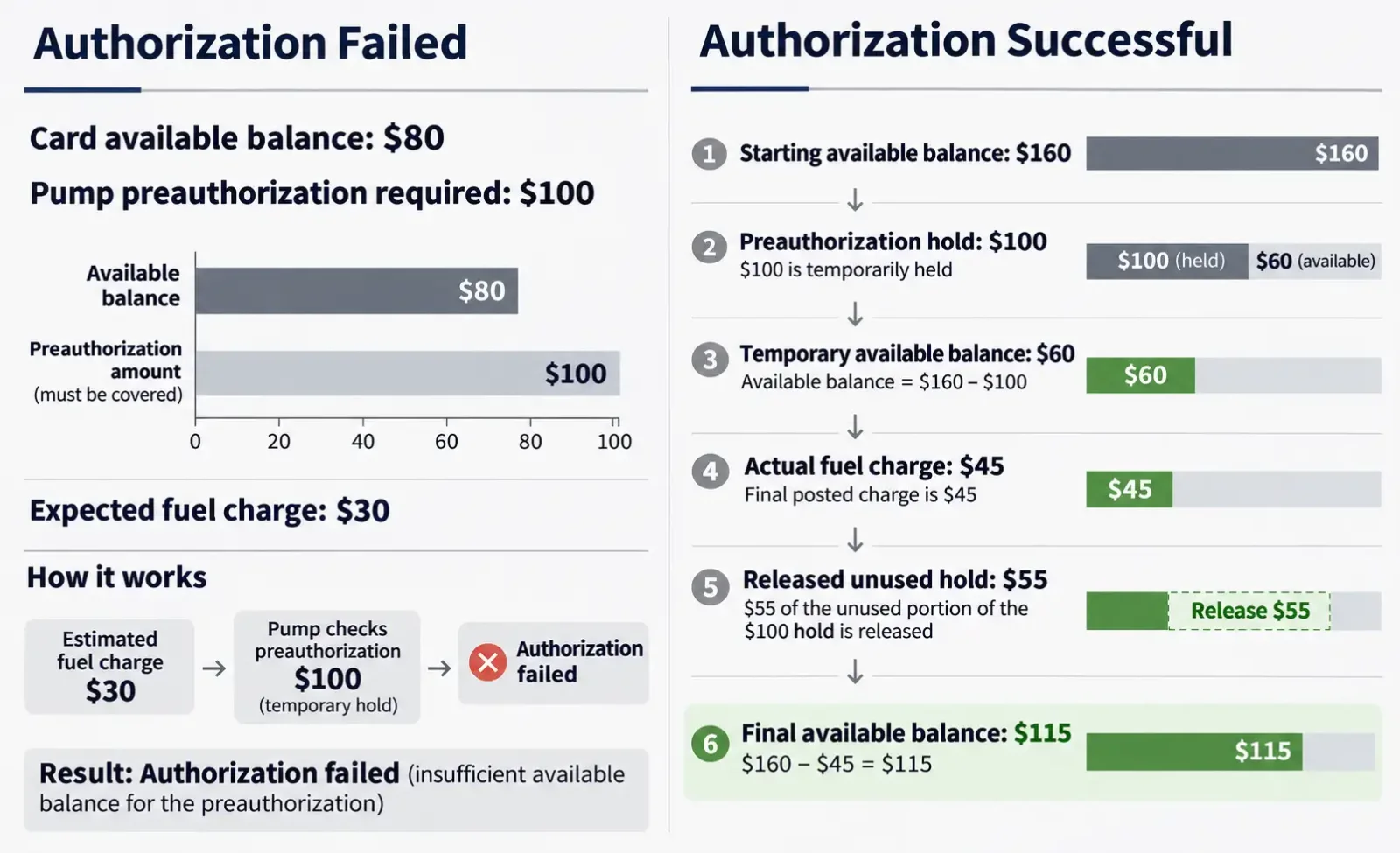
Three distinct stages are involved:
Preauthorization: The merchant requests payment approval. The issuer may temporarily place a hold on funds or available credit.
Final posting: The merchant submits the actual transaction amount, and the issuer formally records the purchase on the cardholder's account.
Authorization release or reversal: The portion of the original authorization that is no longer required is released.
Releasing an authorization hold is not the same as issuing a refund. A refund relates to a transaction that has already posted. Releasing an ordinary preauthorization hold does not require the full authorized amount to be charged first and the difference refunded afterward.
A card app may temporarily display both the original authorization and the final purchase. As long as the original authorization is still marked Pending, the two entries should not automatically be treated as duplicate charges.
3. How Does Preauthorization Work Differently for EV Charging?
Public EV charging also requires payment capability to be verified before service begins, but authorization rules vary considerably across operators.
Charging costs depend on energy consumption, session duration, local pricing, and any applicable idle fees, congestion fees, or other surcharges. Operators generally cannot determine the final amount when a charging session starts.
Suppose a charging station requires a $50 preauthorization, but the actual session costs just $18. The cardholder may initially see a pending authorization for $50, followed by a final charge of $18 after the session. The remaining $32 is an authorization hold that needs to be released, not an additional service fee.
ChargePoint explicitly distinguishes temporary authorizations from final charges in its explanation of preauthorization holds.
Authorization amounts differ substantially among charging networks. Even within the same network, the applicable rules may depend on the payment method.
ChargePoint: Account Payments and On-Site Payments Have Different Rules
According to ChargePoint's U.S. help documentation updated July 10, 2026, the preauthorization amounts for charging sessions started through a ChargePoint account are:
AC charging: $25.
DC charging: $50.
See ChargePoint's account-based preauthorization guidance.
For sessions started without a ChargePoint account, the company's official materials describe two different amounts.
Its non-account charging guidance, updated July 10, 2026, specifies a $50 preauthorization. However, its guidance on EMV contactless card payments, updated June 16, 2026, explicitly states that starting a session with an EMV contactless payment card results in a fixed $75 authorization hold.
ChargePoint does not fully explain how these two policies apply in relation to one another. It would therefore be incorrect to assume that every non-account transaction uses the same hold amount. Before paying, drivers should check the terminal they intend to use and ChargePoint's latest published requirements.
Tesla: Different Hold Amounts for App Payments and Guest Checkout
In its Supercharging guidance for non-Tesla vehicles, Tesla states that, for applicable non-Tesla charging transactions denominated in U.S. or Canadian dollars, starting a session with a payment method in the Tesla app results in a temporary authorization of $20. Guest checkout carries a $40 authorization.
These amounts apply to the non-Tesla vehicle payment scenarios described by Tesla, not to every Supercharging transaction.
Electrify America: App Payments and Card Payments at the Station Must Be Distinguished
Electrify America's U.S. official payment FAQ describes two separate arrangements.
When a session is started and paid for through an app account, a temporary $20 authorization is placed. Longer sessions may trigger an additional $20 authorization.
Drivers who pay directly at the station with a bank card as guests are instead subject to a temporary $50 authorization.
Changing payment channels within the same charging network can therefore change the available balance required to start a session.
Additional authorizations also mean that one charging session can generate multiple pending entries. Looking only at the card transaction list can make the amount actually spent appear larger than it is.
EVgo: Published Maximums Differ Across Official Documents
EVgo's preauthorization guidance, updated July 6, 2026, states that when paying at a charging station's bank card reader, the payment service provider may initiate a temporary authorization of up to $60.
However, its guide to credit card payments at the station, updated in October 2025, still lists a maximum of $100 and notes that the amount depends on the charging equipment.
The two official documents do not fully explain the conditions behind this discrepancy. Neither figure should therefore be presented as a universal maximum for all EVgo locations. EVgo also warns that debit and prepaid cards may be declined if their available balances cannot cover the authorization amount.
For drivers planning to use several charging stations in succession, unreleased authorization holds can sometimes have a greater effect on the next payment than the charging costs already incurred.
4. Why Is Available Balance Particularly Important for Crypto Payment Cards?
Preauthorization is not unique to crypto payment cards. Conventional debit, prepaid, and credit cards can also have funds or credit capacity tied up by authorization holds.
The difference is that crypto payment cards may draw their spending funds from different types of accounts, sometimes involving conversion between digital assets and fiat currency.
Pre-Funded Crypto Prepaid Cards
These cards generally require users to convert digital assets into fiat currency first, or load funds into a card account according to the product's rules, before spending the card balance.
If a platform wallet holds 1,000 USDT but the card account has only $40 available, a $100 authorization request at a gas pump may still fail.
The total value of assets held in a wallet is not a substitute for the card account's available balance. For prepaid products, loading funds in advance is more reliable than trying to work out balance requirements at the pump.
Payment Cards Linked Directly to Digital Assets
Other crypto payment cards allow customers to fund card purchases using specified digital assets held in their accounts.
Depending on the product, assets may be frozen during authorization or converted as the transaction is processed. When volatile assets such as BTC are involved, the timing of conversion and the quantity actually sold also matter.
For example, Bybit Card's transaction history guidance distinguishes card authorizations, completed transactions, and authorization reversals. Transactions funded with crypto assets may also have associated asset sale records.
When a balance decreases, cardholders should distinguish an authorization hold from a digital asset conversion that has already been executed. A final purchase amount below the original authorization does not necessarily mean the difference will be returned as the same quantity of the digital asset originally frozen.
Crypto Cards That Use a Credit Line
Temporary authorizations on credit-based crypto cards generally reduce available credit rather than directly freezing an equivalent cash balance.
If the credit line is backed by crypto collateral, the cardholder must also manage collateral value, available borrowing capacity, and loan terms. A preauthorization by itself does not mean that the final purchase has been recorded or the outstanding loan balance has increased.
For the same $100 authorization request, different products may draw on a prepaid balance, digital assets, or available credit. When evaluating a crypto payment card, the critical question is not how much in assets the platform displays, but which funds the issuer will actually allow the cardholder to use at authorization.
5. What Should You Do When a Payment Fails or an Authorization Hold Is Not Released?
When a crypto payment card is declined at a gas station or EV charger, the first step is to establish where in the payment process the failure occurred.
Insufficient funds to cover the authorization amount are a common cause. Merchant category restrictions, online payment verification, terminal compatibility, and cross-border transaction permissions can also lead to declines.
Understand MCCs Before Concluding That a Transaction Is Restricted
A Merchant Category Code (MCC) identifies the type of business a merchant operates within the card payment system.
According to the Visa Merchant Data Standards Manual and Mastercard's merchant category reference document, codes commonly associated with fuel purchases and EV charging include:
MCC | Merchant category | Typical transaction |
|---|---|---|
5541 | Service Stations | Gas stations and related fuel retail services |
5542 | Automated Fuel Dispensers | Pay-at-the-pump fuel purchases |
5552 | Electric Vehicle Charging | EV charging services |
A gas station cashier and an automated pump at the same location may have different transaction classifications. Issuers may also restrict particular MCCs, countries, or payment channels.
One declined authorization, however, is not enough to establish that the issuer blocks a particular MCC.
For example, if a card is declined at a pump but works at the cashier, the difference may involve the MCC. It may also simply reflect the cashier's use of a lower authorization for a specified purchase amount.
A more effective investigation considers the transaction location, the authorization amount, and the specific decline reason returned by the issuer.
Situation | What to check first |
|---|---|
Card is declined immediately at an automated gas pump | Pump preauthorization amount, available balance, MCC restrictions |
Payment fails at the pump but works at the cashier | Authorization methods and merchant classifications for the two channels |
Card cannot be added to a charging app | Online transaction permissions, billing address, region, and payment verification |
Mobile wallet does not work at the charger | Whether the terminal supports contactless bank card and mobile wallet payments |
Charging starts successfully but a later payment fails | Final charges, additional authorizations, and remaining available funds |
Available balance does not recover after fueling or charging | Original authorization status, final posting records, and release progress |
When a payment is declined, repeatedly trying the same payment method is generally unwise. Some unsuccessful attempts may still leave pending authorizations, further reducing the available balance even though no service was started.
When contacting the card issuer's support team, provide the merchant name, transaction time, amount, last four digits of the card number, and transaction records. Ask the issuer to investigate the specific reason for the decline.
If Your Balance Has Not Recovered, Check Whether the Transaction Is Pending or Posted
If a large authorization still appears as Pending after fueling or charging, the cardholder will generally need to wait for the merchant to complete transaction processing, reverse the authorization, or for the issuer to release the hold under the applicable rules.
Published processing times vary by operator.
ChargePoint's authorization release guidance states that after a charging session ends and the final amount is submitted, it may take the issuer up to seven business days to release the unused authorized funds.
EVgo's corresponding guidance states that pending authorizations typically disappear within three to five business days, although some financial institutions take longer.
These time frames should not be assumed to apply to every crypto payment card.
If the relevant period has passed, the cardholder should retain the receipt or charging session record, confirm with the merchant whether the final amount has been submitted, and ask the issuer why the original authorization is still affecting available funds.
The process is different if the higher amount has already posted as a final charge. In that case, the cardholder should check the merchant's bill for overcharging or duplicate charges, request a correction or refund from the merchant, and, where necessary, dispute the transaction through the issuer.
An authorization that is still pending requires verification of its release status. An incorrect charge that has already posted must instead be handled through billing correction, refund, or transaction dispute procedures.
Investigating a transaction does not require a wallet recovery phrase, private key, or complete card security code. Any request for such information on the pretext of releasing a preauthorization hold should be treated as a security risk.
6. How Should Frequent Drivers Choose and Use Crypto Payment Cards?
For someone who buys gas only occasionally, an unusually large preauthorization can often be handled by prepaying at the cashier or using another payment method. Frequent long-distance drivers and those charging across different regions, however, need to account for authorization holds throughout the trip.
Suppose a driver needs to use three charging stations in one day. Each station requires a $50 preauthorization, but each charging session actually costs only $15.
If the first two authorizations have not been fully released, they may still affect the available balance when the driver reaches the third station. Setting aside only the estimated charging costs is clearly not a reliable approach.
When using a crypto prepaid card, it is better to reserve enough funds for successive authorizations across the charging networks on the planned route, rather than budgeting solely for the final electricity charges. Long-distance travelers should also carry a separate backup bank card in case a single platform or payment channel encounters problems.
Drivers who mainly use one charging operator should check its rules for app payments, card payments at the station, mobile wallets, and guest checkout in advance. Authorization amounts and verification requirements can differ between channels. Adding and verifying a payment method before traveling is generally easier than troubleshooting a failed card registration at the charger.
For people who regularly use crypto payment cards to pay for fuel and EV charging, preauthorization amounts, fund availability, the speed at which holds are released, and compatibility across payment channels are all important measures of a card's practical usefulness.