
A crypto card that works perfectly well at a convenience store or coffee shop may be declined at a subway fare gate. Another potentially confusing situation is when passengers enter and exit the station successfully, complete all their journeys for the day, and see no charge on their card account until a transit payment notification arrives several days later.
Neither situation is unique to crypto cards. Public transit payments work differently from ordinary retail purchases. Gate access, fare calculation, transaction authorization, and the actual charge may all occur at different times.
Determining whether a crypto card is suitable for public transit therefore requires more than checking whether it opens the fare gate. The entire journey and subsequent payment process must also work as intended.
Can you use a crypto card directly on buses and subways?
Yes, provided the local transit system supports the relevant card payment method and the specific card meets its acceptance and authorization requirements for transit transactions.
Cities including London, Singapore, and New York have introduced contactless card payments across their public transit networks. Instead of purchasing a dedicated transit card in advance, passengers can simply tap an eligible payment card, smartphone, or smartwatch on the reader.
This model is known as open-loop transit payment. Its counterpart, closed-loop transit payment, generally requires passengers to use a stored-value card, transit account, or electronic ticket issued or recognized by the transit operator. Some cities use separate ride-code systems and do not accept international payment cards directly.
Both models can coexist within the same city.
If a local transit system does not accept direct card payments, even an NFC-enabled Visa or Mastercard crypto card cannot be used to pay for rides directly. And in cities where card payments are accepted, support for a particular card network does not guarantee acceptance of every card product issued under that network.
Paying for public transit with a crypto card is still, fundamentally, a card transaction. The transit operator collects fares in fiat currency through conventional card payment infrastructure rather than directly accepting passengers' USDT, USDC, or other crypto assets. How the funds are converted or debited depends on the funding mechanism of the particular crypto card.
Can both physical and virtual crypto cards be used on the subway?
Physical crypto cards that support contactless payments can be used like ordinary payment cards, provided they meet the local transit system's acceptance requirements.
Virtual cards have no physical form, but they may also work on buses and subways if they can be added to Apple Wallet or Google Wallet and used for contactless payments through Apple Pay or the corresponding mobile payment feature.
Apple offers Express Mode on certain transit systems, allowing passengers to use eligible payment or transit cards without unlocking their devices or authenticating with facial recognition or a fingerprint. Availability depends on the transit system, device, and card.
For supported locations and eligibility requirements, see Apple Pay's public transit support information and Google Wallet's public transit payment guide.
NFC, however, is simply the underlying technology for contactless payments. Being able to add a card to a mobile wallet and make purchases at a convenience store does not establish that it supports the full range of transit payment processes. This matters particularly for users who do not have a physical card and rely entirely on mobile wallets.
Why does the fare gate open before the card is charged?
With ordinary retail purchases, the transaction amount is usually known before payment. Public transit works differently.
On subway networks where fares are based on distance or travel zones, for example, the system needs a complete record of where the passenger entered and exited to calculate the fare. If transfer discounts or daily fare caps also apply, the final amount may depend on other journeys.
To keep passengers moving while allowing for accurate fare calculation, some transit systems separate payment credential validation, gate access, fare calculation, and card transaction processing.
On the first tap, the system may use zero-amount validation, a small authorization, or other risk checks to establish whether the payment credential meets its requirements. Once the journey ends or the billing period closes, the system submits the authorization or capture request based on the actual fare.
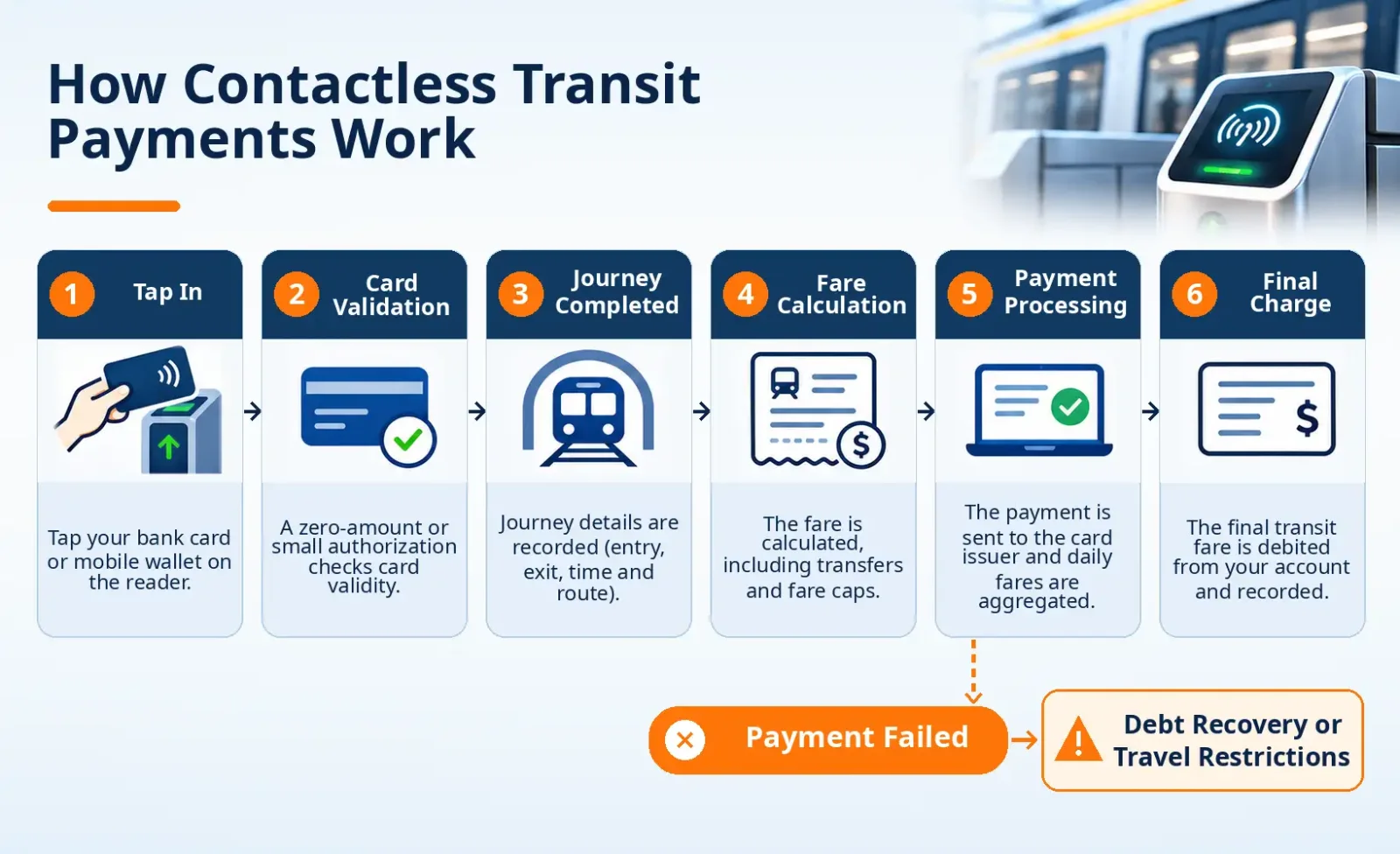
Visa Acceptance's technical documentation on mass transit transactions describes several transaction processing methods, including zero-amount validation, small-amount validation authorizations, deferred aggregated authorizations, and subsequent capture requests. Processes vary across payment networks and transit systems.
New York's OMNY is a good example. According to its official guidance, a temporary authorization may appear on a passenger's card statement the first time they use a payment card or mobile device to ride. This amount is not the actual fare. The temporary authorization is reversed once the transit charge is processed.
A temporary authorization reduces the available balance or credit on a crypto card until the hold is released. If both a pending authorization and the actual charge appear on the account, check whether the temporary authorization has been reversed before concluding that the fare was charged twice.
Delayed charging is not the same as offline payment. A transit system can record journeys while connected to the network and simply submit the authorization or capture request for the final amount later. Even after authorization is approved, capture, clearing, and posting to the account still take time.
Why do several subway rides appear as a single charge?
Public transit involves frequent, low-value transactions. To reduce the number of card transactions that need to be processed, some transit systems use fare aggregation, combining fares incurred with the same payment credential over a specified period into a single card transaction.
Singapore's SimplyGo is a representative example.
According to SimplyGo's official guidance on contactless card payments, transit fares are aggregated as follows across different payment networks:
Payment network | Fare aggregation method |
|---|---|
Mastercard | Accumulated for up to 5 days or until total fares reach SGD 15, whichever comes first |
Visa | Aggregated daily |
American Express | Aggregated daily |
NETS | Aggregated daily |
SimplyGo states that aggregated charges are submitted to the respective banks after 3 days. When the charge actually appears on the card account depends on the issuer's processing time.
Using the same crypto card for several consecutive days in Singapore may therefore result in fewer card transactions than actual rides. The merchant descriptor on the statement typically appears as "BUS/MRT." To check the cost of individual rides, consult SimplyGo's journey history rather than relying solely on the card statement to determine whether any fares were missed or overcharged.
Another concept that is easily confused with fare aggregation is fare capping.
Suppose a transit system charges USD 2 per ride and has a daily fare cap of USD 6. A passenger who takes five eligible rides in one day would normally pay USD 10 but owes only USD 6 under the fare cap. If the system also uses fare aggregation, the USD 6 may be collected as a single card transaction.
Fare capping determines how much passengers ultimately pay. Fare aggregation determines how those fares are combined and collected.
London's TfL offers daily and weekly fare caps, while New York's OMNY calculates cumulative fare benefits over a seven-day period beginning with the first tap. For eligibility and calculation rules, see TfL Fare Capping and OMNY Weekly Fare Cap.
Why does a crypto card work in stores but get declined at a subway fare gate?
Crypto card compatibility with transit payments largely depends on two sets of rules: the transit operator's card acceptance policies and the card issuer's transaction authorization policies.
Transit operators may restrict acceptance based on card type, country or region of issuance, or the specific card product. A card can belong to an accepted card network and still fail the operator's acceptance checks.
Card issuers, meanwhile, must be able to handle the authorization and charging processes specific to transit transactions. Systems that use deferred authorization or fare aggregation may not submit the final transaction amount until after the passenger has left the station. Payments can fail if the card program restricts transit merchants, certain transaction types, cross-border transactions, or subsequent charges.
With crypto cards, differences in funding mechanisms also matter:
Some crypto prepaid cards require users to convert funds into fiat currency in advance and deposit them into a separate card balance account.
Some products automatically debit or convert stablecoins at the point of purchase.
Other products fund payments through available credit secured by crypto assets.
These products may offer similar experiences for ordinary retail purchases, but their ability to handle temporary authorizations, deferred authorizations, and subsequent transit charges can differ.
For example, with a product that uses a separate card balance, a subsequent transit transaction may be declined if that balance is insufficient, even when the user's crypto wallet holds a substantial amount of USDT. Similarly, users of crypto-backed credit cards need to pay attention to their actual available credit rather than the book value of their collateral.
This does not mean crypto prepaid cards are unsuitable for public transit. New York's OMNY official guidance explicitly includes eligible reloadable contactless prepaid cards among accepted payment methods.
Product categories such as prepaid, debit, or virtual cards are not sufficient on their own to determine transit payment compatibility. What matters is the specific card program's rules, its support for transit transactions, and how the card performs in practice.
If the card provider has not published relevant guidance and there is no reliable evidence from actual use, the card's compatibility with transit payments remains unconfirmed.
What happens if your balance is insufficient after a successful ride?
Suppose a passenger uses a crypto card to ride the subway in the morning, enters and exits normally, and transfers out all the funds needed for payment that afternoon. In the evening, the transit operator submits an aggregated authorization, which the issuer declines because the available balance is insufficient.
The passenger has completed the journey, but the fare remains unpaid.
The transit operator may record an outstanding fare, attempt to collect the payment again, or restrict further use of that payment credential for transit.
Visa Acceptance's debt recovery mechanisms for mass transit include operator-initiated follow-up transactions and debt recovery triggered when a passenger taps the card again.
New York's OMNY also explains that when a payment method is restricted because of a transaction issue, passengers must first contact their card issuer to resolve the problem, then settle the outstanding fares through OMNY to restore their ability to ride.
A transit operator restricting a payment credential from further use does not mean the issuer has frozen the associated card account. The card may still work normally at other merchants.
If you normally top up your card as needed and transfer out the remaining balance immediately after spending, that habit needs to change when using a crypto card for public transit. Until transit charges have been collected, keep enough funds available to cover journeys that have not yet been posted. Avoid unnecessarily locking or closing the card, or emptying its balance.
In the event of unauthorized transactions, a lost card, or other security issues, protecting the account should take priority. Any outstanding transit fares can then be settled through official channels.
Why shouldn't you switch between your phone and smartwatch when using the same card?
When riding the London Underground, if you tap in using Apple Pay on your iPhone but tap out with the underlying physical card, the transit system may be unable to match your entry and exit records.
This is because mobile wallets use payment tokenization, replacing the original card number with a device-associated payment credential. A physical card, iPhone, and Apple Watch may all be linked to the same card account, yet the transit system may recognize them as different payment methods.
If entry and exit records cannot be matched, the system may treat the journey as incomplete and charge the maximum applicable fare or impose additional charges. Switching between devices across separate journeys can also prevent transfer discounts and cumulative fare benefits from being calculated correctly.
Transit system | Payment credential requirements |
|---|---|
London TfL | On services requiring passengers to tap in and out, use the same card or device throughout the journey. The same payment method is also required for cumulative fare benefits. |
New York OMNY | Continue using the same card or device to receive eligible transfer discounts and seven-day cumulative fare benefits. |
Singapore SimplyGo | Use the same payment card or mobile device when entering and exiting stations or boarding and alighting from buses. Otherwise, separate transactions and additional charges may result. |
For further details, see TfL's contactless payment guide, OMNY's fare cap FAQs, and SimplyGo's contactless card payment guidance.
If you choose to travel using your phone, use the same card on the same phone throughout the journey and the applicable cumulative fare benefit period. Do not switch to a physical card or smartwatch when exiting a station or transferring between services.
Keep an eye on your device's battery level as well, so you can tap out when required.
What additional costs should you consider when paying for public transit abroad?
Under SimplyGo's terms and conditions, Mastercard or Visa cards issued outside Singapore incur a foreign bank card administrative fee of SGD 0.60 for each day they are actually used to pay transit fares. This fee is separate from any charges imposed by the card issuer.
Using a foreign-issued card for transit every day for 30 consecutive days would result in SGD 18 in administrative fees alone. For daily commuters, that is a cost worth considering.
Crypto cards may also involve currency conversion fees, cross-border transaction fees, crypto conversion costs, and per-transaction fees. For products that charge a fixed fee on each transaction, whether the transit system uses fare aggregation can also affect the actual cost of payment.
Passengers who regularly use public transit abroad should factor these costs into their travel expenses and compare them with local stored-value transit cards, transit passes, and conventional payment cards rather than focusing solely on advertised cashback rates.
How can you tell whether your crypto card is suitable for daily transit use?
Before using a crypto card for public transit for the first time, make the following checks:
Visit the local transit operator's official website to confirm whether your intended routes support direct card payments and accept cards issued abroad.
Check the card's contactless payment capability, international transaction permissions, transaction restrictions, and actual available balance. If necessary, ask the issuer whether the card supports deferred authorization, aggregated transit transactions, and subsequent charges.
Choose a journey with an alternative way to purchase a ticket, and verify that entry, exit, fare calculation, and final charging all work correctly. For transit systems that use fare aggregation, wait until the applicable billing period has ended before checking your statement.
If something goes wrong, compare your journey history with your card transaction records first. Contact the transit operator about incomplete entry or exit records and incorrect fares. For declined authorizations, balance discrepancies, or card account restrictions, contact the issuer.
For occasional international travelers, a crypto card can be a convenient way to pay for public transit. For people who rely on buses and subways every day, however, transaction reliability, access to funds, and predictable payment costs matter more than the number of supported crypto assets or the size of advertised cashback rewards.
Until you have verified the entire journey and payment process, avoid relying on a crypto card as your only means of paying for public transit. Carrying a local transit card or a conventional payment card that you know works can prevent a single failed payment from disrupting your travel plans.