
When applying for a crypto payment card, should you start with a virtual card or pay extra for a physical one?
If you primarily use your card for subscriptions such as ChatGPT and Netflix or for cross-border shopping, a virtual card is usually sufficient. Virtual cards that support Apple Pay or Google Wallet can also cover many in-store purchases. A physical card becomes more useful if you travel internationally, need to withdraw cash from ATMs, or want to keep paying when your phone is unavailable.
A physical card, however, is not an upgrade in every respect. Even one bearing the Visa or Mastercard logo may not support ATM withdrawals, hotel deposits, or car rental preauthorizations.
The decision comes down to whether a physical card adds payment capabilities you actually need, and how much extra you would pay for them.
1. How do virtual and physical cards differ?
A virtual crypto payment card provides a card number, expiration date, and security code (CVV/CVC) digitally. Once approved, users can view their card details in an app and use them for online shopping, software subscriptions, and other internet payments.
A physical card provides a tangible payment instrument. Depending on the product, it can be used at in-store payment terminals through an EMV chip, contactless technology, or other supported payment methods.
The main distinction is the form of the payment credential and how it can be used, not the source of funds or the financial classification of the product.
Feature | Virtual card | Physical card |
|---|---|---|
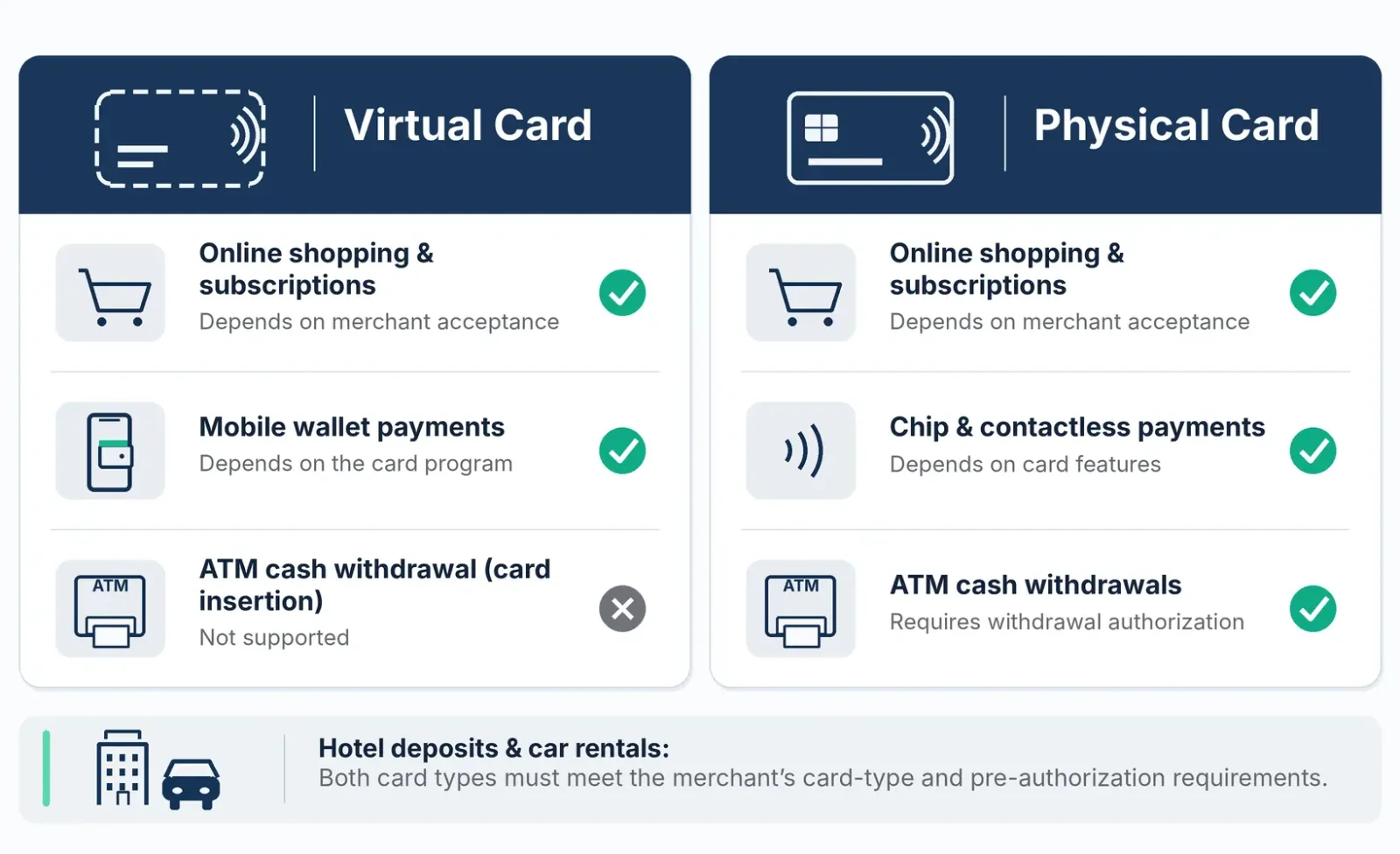
Online shopping and subscriptions | Supports eligible online transactions | Can support them as well |
In-store purchases | May work through a compatible mobile wallet | Supports eligible physical-card payment methods |
Apple Pay / Google Wallet | Depends on the card program | Also depends on the card program |
ATM withdrawals | Conventional card-insertion withdrawals are unavailable; specialized cardless withdrawals are a separate matter | Requires withdrawal access, a PIN, and a compatible ATM |
Acquisition costs | Usually no card production or shipping fees | May involve issuance, delivery, and membership fees |
Loss or theft | No risk of losing a physical card | Risk of losing the card or having it stolen |
Geographic restrictions | Subject to eligibility and issuing-region restrictions | Physical card delivery coverage is an additional consideration |
An important distinction is often overlooked: virtual and physical describe the form of the card, while debit, prepaid, and credit describe the type of financial product.
A virtual card may be a digital payment credential associated with a debit, prepaid, or credit card product. The same classifications apply to physical cards. Even when a card is funded with cryptoassets such as USDT or USDC, obtaining a physical version does not change the underlying financial classification.
A crypto card program may allow both versions to share a balance and transaction limits, or it may issue different card numbers or operate separate card programs.
Consider the Crypto.com prepaid card. Eligible users can receive a virtual card before applying for a physical one. According to Crypto.com's official virtual card documentation, activating the physical card also updates the virtual card's expiration date and CVV. Merchants that have the previous card details on file may require those payment details to be updated.
2. Comparing costs: What makes a physical card more expensive?
Virtual cards do not require a physical card to be manufactured or shipped, so their initial costs are generally lower. Physical cards may carry additional issuance, delivery, or replacement fees. Some products also require a higher membership tier or a commitment to lock up a certain amount of assets.
A one-time issuance fee, however, may not be the largest expense over the life of the card.
The costs that can have a greater long-term impact include funding the card with digital assets, asset conversion, foreign-currency spending, account maintenance, and cash withdrawals. If the virtual and physical cards share the same account and fee schedule, these charges are often identical.
Example: Crypto.com's U.S. prepaid card
Crypto.com's official U.S. Prepaid Visa Card fee schedule, updated September 1, 2026, specifies:
A $4.99 physical card issuance fee for the Midnight tier.
A 1% fee for top-ups made with a debit card.
A 3% foreign transaction fee on non-USD purchases and ATM withdrawals for the Midnight, Ruby, Jade, and Indigo tiers.
A 2% withdrawal fee on amounts exceeding the applicable monthly free ATM allowance. ATM operators may charge additional fees.
Suppose a user spends the equivalent of $1,000 per month in currencies other than USD, and every transaction incurs the 3% foreign transaction fee. The annual total would be $360. By comparison, the $4.99 physical card issuance fee has little effect on overall costs.
That $360 is an illustration of ongoing foreign-currency spending costs, not an additional fee caused by obtaining a physical card. A virtual card on the same fee schedule would incur the same expense.
When funding a card with cryptoassets, users should also consider the difference between the platform's conversion quote and the market price. Even if no separate top-up fee is listed, the conversion spread can still represent a real cost.
A useful comparison separates expenses into two categories:
Shared operating costs: Funding, asset conversion, foreign-currency transactions, and account maintenance, which may apply to both cards.
Incremental physical-card costs: Card production, shipping, physical-card-specific membership requirements, replacements, and costs associated with additional uses such as ATM withdrawals.
To compare virtual and physical cards meaningfully, first calculate the costs they share. Then assess what the physical card adds to the bill and which capabilities those extra charges actually provide.
3. Online subscriptions and mobile wallets: What can a virtual card handle?
For users who primarily pay for AI services, software subscriptions, and international online purchases, the chip and physical payment features of a plastic card offer little benefit. What matters more is whether a virtual card is accepted by the intended merchants and can reliably handle subsequent charges.
Does a successful one-time payment mean recurring subscriptions will work?
A virtual card that completes a one-time e-commerce purchase will not necessarily work for recurring subscriptions to services such as ChatGPT, cloud servers, or streaming platforms.
Merchants may evaluate the issuing country, card type, BIN (Bank Identification Number), billing address, and transaction risk when deciding whether to accept a payment. Some prepaid cards are also subject to restrictions on recurring billing.
In its official Canadian FAQ, Mastercard explains that some prepaid cards can make one-time purchases but cannot be registered for recurring bill payments. This is a limitation affecting certain prepaid cards, not evidence that virtual cards generally cannot be used for subscriptions.
Another factor in online payment acceptance is 3D Secure (3DS).
3DS is a cardholder authentication mechanism used in online card transactions. When additional verification is required, the issuer may ask the customer to authenticate using an SMS code, an in-app confirmation, or another supported method.
Successful authentication and payment authorization are not the same thing.
As explained in Visa's technical overview of 3DS, authentication helps verify the cardholder's identity, while the issuer decides whether to authorize the transaction based on factors such as available funds, account status, and risk rules. A payment can still be declined after successful 3DS authentication.
For cardholders, 3DS support primarily depends on the issuer, card program, and authentication infrastructure. It is not directly determined by whether a physical card has been issued.
If your main goal is paying for ongoing online subscriptions, prioritize a card that supports your intended merchants, recurring charges, and any required authentication. Adding a physical card alone will not resolve these payment compatibility issues.
Mobile wallets have narrowed the gap between virtual and physical cards
Traditionally, one of the clearest differences between virtual and physical cards was their ability to make in-store payments.
The widespread adoption of mobile wallets such as Apple Pay and Google Wallet has changed that. Customers can now pay with smartphones or smartwatches at merchants that accept the relevant contactless payments.
As a result, a card without a physical form may still cover everyday spending at supermarkets, restaurants, convenience stores, and other retail locations.
Mobile wallet support, however, is not a standard feature of every crypto payment card.
According to Apple's official guidance, a card must be issued by a participating Apple Pay issuer, and the merchant's terminal must accept the relevant payment network and contactless transactions. Google likewise requires explicit support for Google Wallet from the issuer, along with compliance with device and regional requirements.
Availability can even differ between card programs operated by the same brand in different issuing regions. For example, Crypto.com's virtual card documentation states that the relevant U.S.-issued virtual cards support Apple Pay, Samsung Pay, and Google Pay, while the corresponding Singapore-issued cards list Google Pay support. Cards issued in Australia, the European Union, and Canada have their own compatibility provisions.
A product's claim that it supports Apple Pay or Google Pay is therefore not enough. Users should check whether the feature is available for the specific issuing region and card program they are applying to.
For people living in markets where contactless card payments are widespread and who already use mobile wallets regularly, a virtual card may cover most everyday purchases.
Physical cards still have an advantage when a merchant requires an inserted chip card, a PIN, or a payment terminal that does not support the relevant mobile wallet.
4. Travel payments: ATMs, hotel deposits, and physical-card backups
Travel is one setting where physical cards can provide a more tangible benefit. But ATM withdrawals, hotel guarantees, and everyday card purchases each have different requirements.
ATM withdrawals: Physical cards have an advantage, but cash access must be enabled
Traditional ATMs generally rely on a physical card and authentication methods such as a PIN to dispense cash. Some machines support cardless or contactless withdrawals, but not every virtual card added to a mobile wallet can use those features.
A Visa or Mastercard logo on a physical card does not automatically mean it can be used to withdraw cash.
Cash access depends on whether the card program enables ATM withdrawals.
Before applying, verify withdrawal eligibility, daily and monthly limits, fees for exceeding those limits, and ATM compatibility at your destination.
ATM operator surcharges and currency conversion costs also matter. An issuer's free withdrawal allowance does not necessarily make every withdrawal entirely free.
Hotel deposits and car rental guarantees: A physical prepaid card is not a substitute for a credit card
A common travel misconception is that any physical Visa or Mastercard crypto card can be used without difficulty for hotel deposits or car rental guarantees.
The reality is more complicated.
At check-in or vehicle pickup, a merchant may place a preauthorization hold on funds to cover room charges, rental costs, deposits, or potential additional expenses. The amount held is then adjusted or released after final settlement.
Whether a merchant accepts a card for this purpose depends not only on its physical form but also on the type of financial product behind it.
Mastercard Canada's official prepaid card guidance notes that hotels and car rental companies may require a credit card for reservations. A prepaid card might be accepted for the final payment without satisfying the merchant's deposit requirements.
This distinction is particularly important for crypto payment cards. Many use a prepaid funding model, requiring customers to maintain sufficient available funds in advance.
Crypto.com's preauthorization guidance explains that hotels, car rental agencies, and some gas stations may authorize an amount greater than the final purchase. Funds held under that authorization cannot be used for other payments until the transaction is settled.
For example, a hotel bill might ultimately come to $500, but the hotel could require a $700 hold at check-in. A card with only $550 available would not have enough funds for the preauthorization, even though the balance would cover the room charge.
Before relying on a crypto payment card for a hotel booking or rental car, confirm whether the merchant accepts that card category, whether a physical card must be presented, and how much may be held and when it will be released.
How valuable is a physical card as a travel backup?
A physical card has another straightforward benefit: if a phone is lost, its battery dies, the device breaks, or the mobile wallet stops working, the customer may still be able to pay with the physical card.
That backup, however, only addresses problems with access to a payment device or credential.
If the virtual and physical cards belong to the same issuing program and share a funding account and risk controls, both may stop working when the account is frozen, funds are insufficient, or the platform suspends service.
5. Security and safeguarding funds: Are two cards really safer?
A virtual card has no physical form, eliminating the risk of losing or directly having a plastic card stolen. Some products also let users freeze, delete, or replace virtual card details within an app, making card management more convenient.
Virtual cards can still be exposed to unauthorized transactions through merchant data breaches, phishing websites, compromised devices, or stolen account credentials.
Physical cards can benefit from safeguards such as EMV chip technology in compatible payment environments, but they remain vulnerable to loss, theft, and exposure of card information.
For crypto payment cards, though, payment credential security is only part of the risk picture.
If users deposit cryptoassets such as USDT into a platform-managed custodial account, the safety of those assets also depends on how the platform manages them, whether customer funds are segregated, its ability to meet withdrawal and redemption obligations, account-freezing policies, and the continued availability of services from partner issuers.
Holders of virtual and physical cards may face the same platform-level operational risks. A physical plastic card does not, by itself, provide additional protection for the funds behind it.
Users should pay particular attention to what happens when something goes wrong: Can a card be frozen immediately? Can its number be replaced? How are refunds returned? Who handles disputed transactions? Will replacing a card or payment credential disrupt existing subscriptions?
These procedures often have a greater effect on actual losses and resolution costs after a suspicious transaction than the likelihood of physically losing the card.
6. Which card fits your needs, and what should you check before applying?
Most users do not need both types of card. Identifying your actual payment needs and then comparing the features and fees of specific products is generally more effective than choosing based on card format alone.
Mainly AI services, software subscriptions, and cross-border shopping: Prioritize a virtual card.
Focus on acceptance by your intended merchants, recurring billing support, 3DS authentication, and long-term costs. If a virtual card reliably handles these transactions, a physical card offers limited additional value.
Mainly everyday in-store purchases: Check mobile wallet compatibility first.
If your virtual card can be added to Apple Pay or Google Wallet in your region and the merchants you frequent widely accept contactless payments, there is little reason to rush into ordering a physical card. Its advantage becomes clearer only when you regularly need a separate physical-card payment method.
Frequent international travel or cash withdrawals: A physical card deserves more consideration.
Check ATM access, PIN support, withdrawal limits, foreign-currency fees, and acceptance at your destination. If you also need hotel deposits or car rental guarantees, it is wise to carry another bank card that meets the merchant's requirements, particularly a credit card.
Want both types of card: Make sure they genuinely complement each other.
Using a virtual card for online subscriptions and mobile wallet payments, while reserving a physical card for ATM withdrawals and in-store spending when your phone is unavailable, is a sensible division of functions. If their payment capabilities largely overlap but holding both requires additional membership fees or locked assets, the benefit may be minimal.
Before submitting an application, check these five points:
Eligibility: Do your country of residence, identity documents, and KYC status meet the requirements of the specific issuing program? Can a physical card be delivered to your location?
Payment compatibility: Does the card support your usual online merchants, recurring billing, 3DS, and Apple Pay or Google Wallet in your region?
Physical-card features: Are ATM withdrawals, chip transactions, and PIN functionality enabled? What transaction limits and geographic restrictions apply?
Total costs: How much will you pay for funding, cryptoasset conversions, foreign-currency transactions, ATM withdrawals, membership, physical card issuance, delivery, and replacements? Are there inactivity fees or asset lockup requirements?
Account and risk management: Do the two cards share a balance, limits, and freeze status? What happens in cases involving refunds, disputes, card replacements, or account restrictions?
You can use the UCardRadar crypto payment card database to compare relevant products, then verify the details against the issuer's official fee schedule and terms of service.
A physical card is worth obtaining when it addresses payment needs that a virtual card cannot meet and that you are likely to encounter. For users who mainly spend online, choosing a reliable virtual card with suitable acceptance and transparent fees is usually the more practical decision.