
A crypto payment card running on the Visa or Mastercard network may look similar at checkout, but the money behind the transaction can come from a preloaded card balance, digital assets already held on the platform, a line of credit, or a crypto-backed loan. The cardholder’s payment experience may be similar, while the underlying funding arrangement and legal relationship can be entirely different.
The market commonly uses terms such as Crypto Prepaid Card, Crypto Debit Card, Crypto Credit Card, and Crypto-Backed Card. In practice, however, these are not four perfectly parallel financial products. Prepaid, debit, and credit primarily describe differences in funding source and account relationship; crypto backing, by contrast, is a form of credit support that can be combined with different lending structures.
A product’s marketing name is not the same as its legal classification. A card marketed as a Crypto Credit Card may in fact be linked to a standalone collateralized loan rather than a traditional revolving credit account. The same card may also allow users to switch between debit and credit spending modes.
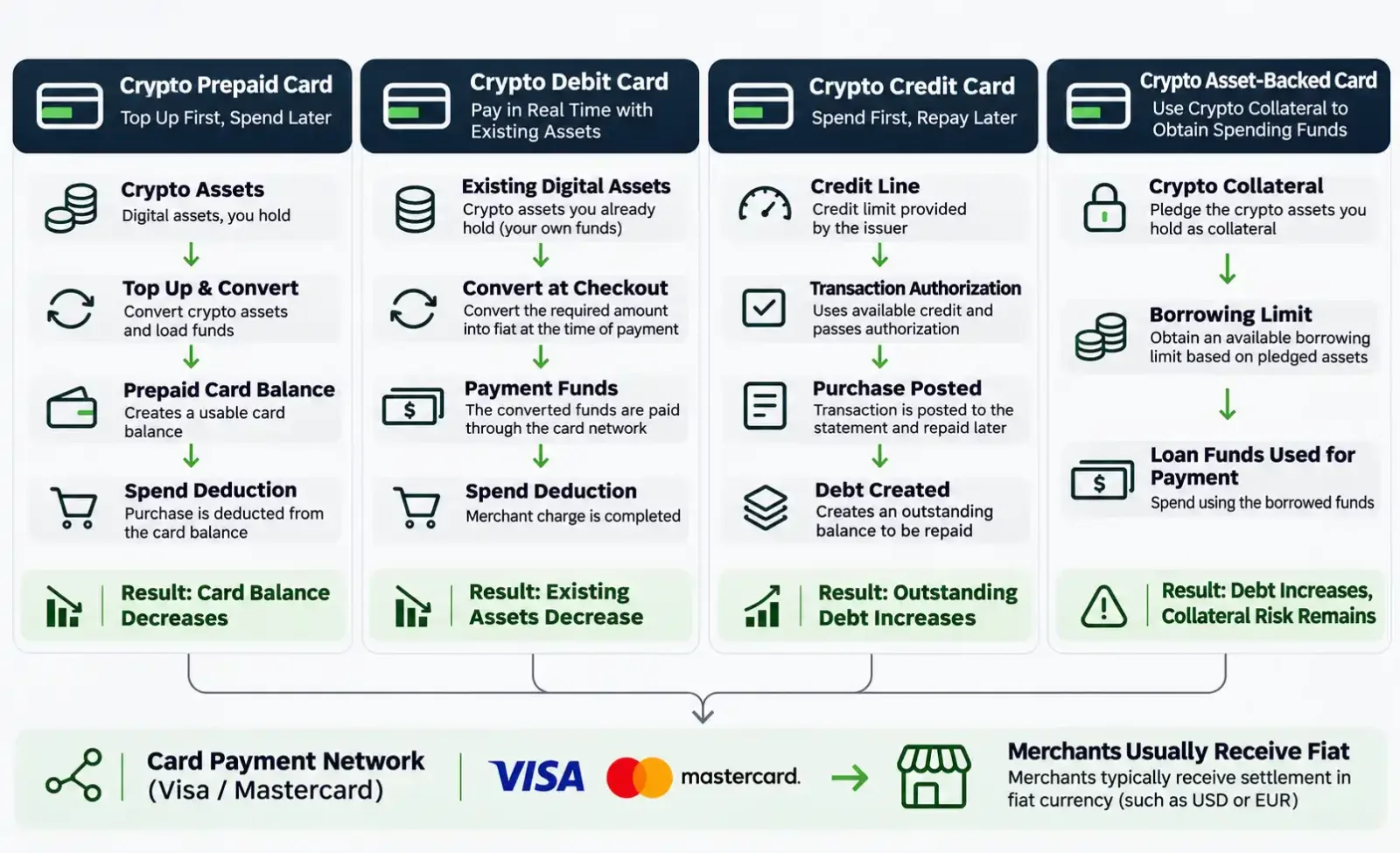
What is the core difference between crypto prepaid, debit, credit, and collateralized cards?
The most direct way to distinguish them is to ask whether spending uses existing funds or borrowed funds, and whether assets must first be moved into a dedicated card account.
:---: | :---: | :---: | :---: | :---: |
|---|---|---|---|---|
Comparison Item | Crypto Prepaid Card | Crypto Debit Card | Crypto Credit Card | Crypto Collateralized Card |
Primary funding source | Preloaded card account balance | Existing funds or asset account | Credit line | Loan capacity backed by digital assets |
Must the card account be funded before spending? | Usually yes | Not necessarily | Usually no | Usually no, but collateral conditions must be met |
Does spending create debt afterward? | Usually no | Usually no | Yes | Yes |
Does it involve borrowing interest? | Usually no borrowing interest | Usually no borrowing interest | Depends on the credit agreement | Depends on the loan agreement |
Does the user bear crypto price risk? | Depends on when top-up and conversion occur | Depends on how assets are held and converted | Depends on the product structure | Usually involves collateral price risk |
Can collateral liquidation be triggered? | Usually no | Usually no | Depends on the structure | Yes, potentially |
Main points to watch | Top-ups, balances, and refunds | Asset control and conversion costs | Credit terms, statements, and repayment | LTV, interest, repayment, and collateral liquidation risk |
The “crypto collateralized card” in the table refers to a credit arrangement backed by digital assets. It is not a standalone legal category of bank card outside prepaid, debit, or credit classifications. Real products may use hybrid structures.
In How are prepaid cards, debit cards, and credit cards different?, the U.S. Consumer Financial Protection Bureau (CFPB) distinguishes these products based on whether a user spends preloaded funds, existing account balances, or borrowed money. Crypto payment cards build on those payment arrangements by adding digital-asset conversion, custody, and collateralized financing.
Crypto prepaid cards: fund first, spend later
A crypto prepaid card uses a fund-first, spend-later model. The cardholder transfers money into a designated card account and can spend only after an available balance has been created. Without an overdraft feature, spending cannot exceed the account balance.
Unlike an ordinary bank debit card, a prepaid card typically does not link directly to the cardholder’s checking account. Even when the top-up originates from a crypto wallet, the funds may already have been converted into fiat currency by the time they reach the card account.
Take the Crypto.com U.S. Prepaid Visa Card as an example. Users can top up through a bank card, a Cash Account, or eligible crypto assets. When using digital assets such as BTC, the system presents a conversion quote and completes the top-up after user confirmation. In this U.S. card program, the card account’s base currency is U.S. dollars. Subsequent card spending uses the available balance in the card account rather than transferring BTC directly to the merchant.
Crypto.com states clearly that once funds are loaded onto the prepaid card, they cannot be transferred back directly to the original Cash Account. Top-ups, spending, and fund returns are not freely reversible actions.
If a user sells BTC to load the card and later changes spending plans, the original BTC position may not be restored. Conversion fees or spreads are already incurred at the time of top-up, and later refunds generally remain subject to card-network and card-service-provider rules.
The advantage of a prepaid card is budget control. Users can load only the amount they intend to spend and do not need to take on debt for everyday purchases. But once funds are transferred into the card account, the withdrawal method, refund path, and applicable protection regime depend on the specific terms governing that account.
Crypto debit cards: spend directly from existing balances
A traditional debit card links directly to an existing funds account held by the cardholder. At the authorization stage, the issuer decides whether to approve the transaction based on the available balance, payment limits, and other conditions, and then reduces the available balance or places a hold on funds.
A crypto debit card, or a debit mode with similar functionality, extends the funding source to digital-asset accounts.
Some products allow users to pay with assets such as USDT, USDC, or BTC without manually converting and loading funds into a separate prepaid card account before each purchase. The system handles asset deduction, conversion, and the necessary payment arrangement during the transaction process.
Nexo Card’s Debit Mode provides one example.
According to Nexo’s official product page, eligible users can spend in Debit Mode using stablecoins, crypto assets, and designated FiatX assets, and can set the spending priority across different assets. The platform handles the conversions required to complete payment.
This arrangement reduces the need for manual top-ups. The digital asset balance shown in the app does not necessarily mean the user is holding funds in a traditional bank deposit account. It may instead represent assets held in custody by the platform or other contractual claims, and the legal nature of those balances must be determined by reviewing the account agreement.
Converting assets at the time of spending can also create costs. For example, if a user holds BTC while the purchase is priced in euros, the payment service still needs to perform the relevant conversion, which may involve transaction fees, exchange spreads, or foreign-exchange charges.
Crypto credit cards: spending creates debt
The biggest difference between a crypto credit card and a prepaid or debit card is that spending uses credit rather than directly consuming an existing account balance.
A traditional credit card typically comes with a credit line provided by the issuer. When the cardholder spends against that line, the transaction creates debt that must be repaid under the contract. Billing cycles, grace periods, minimum payments, and interest calculations depend on the specific product.
A crypto credit card can follow the same structure while adding crypto-related features, such as BTC rewards or the option to repay the bill with digital assets.
But the form of rewards is not the same as the source of payment funds.
A conventional credit card that offers BTC rewards still uses a credit line at the point of purchase. Receiving rewards in bitcoin does not turn the transaction into a crypto debit payment.
There are also products in the market that support spending through a standalone loan agreement. These products may not have the grace period or minimum-payment structure commonly associated with traditional revolving credit cards. Instead, interest accrues and repayment is handled according to the loan balance, borrowing rate, and contract terms.
The commercial label “Crypto Credit Card” is not itself a legal product category, and it should not be assumed to carry the same credit-card consumer protections in every jurisdiction.
Crypto collateralized cards: spend without selling coins, but take on collateral risk
A crypto collateralized card usually allows users to pledge BTC, ETH, or other eligible digital assets as collateral in order to obtain a borrowing limit that can be used for card spending.
The cardholder does not have to sell the pledged assets at the moment of spending, but does assume borrowing costs and exposure to collateral price volatility.
This differs from an ordinary credit card, where credit is extended primarily based on the user’s personal credit profile. In a collateralized structure, the lender must assess the value of the pledged assets and set borrowing capacity and risk controls under the loan agreement.
How does LTV affect borrowing capacity and collateral risk?
Loan-to-Value (LTV) measures the relationship between the outstanding loan balance and the value of the collateral:
[\text{LTV}=\frac{\text{Outstanding Loan Balance}}{\text{Collateral Value}}\times100%]
Assume a user pledges BTC worth $2,000 and the lender sets an initial maximum LTV of 25%. The initial borrowing capacity would then be $500.
If the user draws only $200 and ignores interest and other charges for simplicity:
Amount borrowed: $200
Remaining borrowing capacity: $300
Outstanding principal: $200
Current LTV: 10%
If the user later draws the remaining $300, bringing total outstanding principal to $500, LTV rises to 25%.
Now assume the BTC price falls by 50%, reducing the collateral value from $2,000 to $1,000, while the loan principal remains $500:
[\text{LTV}=\frac{500}{1,000}\times100%=50%]
The user has not borrowed any additional funds, yet LTV has risen from 25% to 50%. A decline in collateral value directly changes the risk profile of the loan.
The 25% figure above is only a calculation example and does not represent any platform’s current lending threshold or risk-management trigger.
A drop in collateral value may lead the lender to require additional collateral, partial repayment, or automatic repayment and sale of collateral assets under the contract.
Nexo’s loan repayment and automatic repayment rules explain that when collateral values fall and LTV reaches relevant risk conditions, the platform may sell part of the collateral to repay the loan. The trigger depends on the specific collateral mix and loan arrangement.
The risk does not end when the card transaction is completed. The user may have already received the goods, but the outstanding loan remains, and the pledged assets remain exposed to market fluctuations. Even if no BTC is sold at the time of purchase, forced sale may occur later if the collateral becomes insufficient.
How is a collateralized card different from a traditional secured credit card?
Crypto collateralization describes a funding support mechanism. It does not by itself determine the legal category of the card. Products in this area may use a credit-card structure, a standalone loan, or another lending arrangement.
It is also different from a traditional secured credit card.
A traditional secured credit card is typically backed by a cash security deposit that satisfies the issuer’s contractual requirements. A crypto-backed loan, by contrast, may be secured by digital assets whose market value fluctuates continuously, causing borrowing capacity and risk levels to change with the asset price.
Why can the Nexo Card switch between debit mode and credit mode?
The Nexo Card combines two spending structures within one product. Users in eligible regions who meet the qualification requirements can switch between Debit Mode and Credit Mode.
Debit Mode uses eligible available assets in the account, and spending reduces existing asset balances.
Credit Mode uses a borrowing limit backed by digital assets. The user keeps exposure to the pledged assets while taking on a corresponding loan obligation.
According to Nexo’s official explanation of Credit Mode, when a purchase is initiated in Credit Mode, the transaction amount first reduces Available to Borrow. Only after the merchant completes processing is the amount formally added to the Outstanding Loan balance.
There is a time gap between card authorization and completion. Nexo also states that while a transaction is pending, the relevant amount has not yet been added to the repayable loan balance, but borrowing interest already starts to accrue. Once the transaction is completed, the interest accumulated during the pending period is added to the outstanding loan balance. If the merchant does not complete capture within the specified 45-day period, the transaction is automatically canceled and no loan interest is charged for that transaction.
Reduction of available borrowing capacity at authorization, posting to the loan balance upon completion, and the start of interest accrual do not necessarily occur at the same moment.
Assume a user holds $100 in stablecoins and also has BTC-backed borrowing capacity:
If the user spends $100 in Debit Mode, the product rules reduce existing assets. If the user switches to Credit Mode and spends the same amount, the transaction consumes borrowing capacity and creates debt under the platform’s lending rules, while the BTC remains pledged as collateral.
The payment outcome for the merchant may be similar, but the effect on the cardholder’s assets and liabilities is different.
Debit Mode mainly concerns asset priority, conversion costs, and available balance. Credit Mode also requires the user to manage borrowing rates, LTV, collateral control, and repayment arrangements.
According to Nexo’s eligibility guidance, the Nexo Card is available to eligible users in certain European countries and markets including Argentina. Supported regions, eligibility requirements, and product terms may vary. The official rules in the user’s jurisdiction should control. The label “Credit Mode” alone is not enough to classify the product as a traditional revolving credit card in the legal sense across all markets.
Does the merchant receive fiat or crypto?
For most crypto payment cards operating through the traditional Visa or Mastercard payment networks, merchants still receive fiat funds through standard card-acceptance mechanisms rather than directly receiving the cardholder’s BTC, USDT, or USDC.
In its research on crypto-linked cards, Visa explains that digital assets can be converted through the relevant card program into funds that work within the card-payment system, allowing merchants to continue using existing payment infrastructure without separately integrating crypto payment acceptance.
The main difference between a crypto payment card and a conventional bank card lies on the cardholder side of the transaction, not in requiring merchants to change how they get paid.
For example, a prepaid card may convert digital assets at the time of top-up; a debit-mode product may convert assets during the purchase; and a collateralized credit product may fund the transaction with borrowed money.
It is also important to distinguish among three separate stages of the transaction:
Authorization: The issuer or relevant processing system determines whether the transaction is approved and may place a hold on funds or reduce available credit.
Posting: After the merchant captures the transaction, it enters the formal accounting process and the account debit or loan balance is recognized under the applicable rules.
Clearing and settlement: Relevant institutions in the card-payment system complete clearing calculations and fund transfers.
Successful authorization does not mean all funds have reached final settlement. In credit mode, using up credit capacity also does not mean the amount has already been formally added to loan principal.
Asset conversion by the cardholder, payment funding by the issuer, and settlement among card networks and financial institutions are separate layers of activity.
Does the card type determine whether funds are protected?
A card’s payment network, the custody arrangement for funds, and deposit insurance are three different things.
If a traditional bank debit card is linked to a qualifying insured deposit account, the deposits may be protected under the applicable local regime. But the balances displayed by a crypto payment platform may not have the same legal nature.
The U.S. Federal Deposit Insurance Corporation (FDIC) explains in its guidance on deposit insurance for prepaid cards that funds loaded onto prepaid cards may receive pass-through deposit insurance if specific conditions are met. That requires the funds to be held at a qualifying insured bank and also requires compliance with rules on beneficial ownership, account records, and customer identification.
FDIC insurance covers qualifying bank deposits and functions according to law when an insured bank fails. The insolvency of a non-bank prepaid card provider does not automatically trigger a bank deposit insurance payout.
The FDIC also makes clear that crypto assets such as BTC and USDT are not themselves covered by FDIC deposit insurance. The scope of protection can be reviewed in the FDIC’s overview of deposit insurance coverage.
Connection to the Visa or Mastercard network, or a partnership with a licensed bank, does not prove that all digital assets held by the platform are protected by bank deposit insurance.
There is a second layer of difference in consumer protection as well. Prepaid funds, bank deposits, credit-card debt, and digital-asset custody are governed by different contracts and regulatory regimes. Refund rules, dispute rights, or lending protections associated with a traditional credit card in one country cannot simply be assumed to apply to every crypto payment card.
Where collateralized lending is involved, fund safety also depends on who controls the collateral, whether it can be rehypothecated, and how collateral is released if the platform stops service or the loan is repaid.
For users, it is more meaningful to identify the card issuer, the custodian of funds, the lender, and the contractual responsibilities of each party than to look only at the payment-network logo printed on the card.
What should you confirm before applying?
Before choosing a crypto payment card, the first step is to identify your actual spending needs.
If you mainly want to convert small amounts of stablecoins into everyday spending funds on a regular basis, a prepaid card can help control spending through top-up amounts, but you must accept the transfer restrictions that may apply once funds have been loaded.
If you want to spend directly from assets already held in an account, focus on comparing the conversion mechanism in debit mode, the custody arrangement for assets, and the rules governing available balance.
If you need spending based on credit, review the interest methodology, repayment obligations, and related fees. If the credit is backed by digital assets, you must also consider the possibility that a market decline could trigger additional collateral requirements, automatic repayment, or collateral sales.
Regardless of the product type, you should confirm the following six points before applying:
What is the card’s legal and contractual classification? Distinguish among Prepaid, Debit, Credit, and hybrid products linked to standalone loan agreements. Do not substitute marketing terminology for contract definitions.
Where do spending funds come from? Verify whether funds are taken from a prepaid card account, a bank account, a platform asset account, or a borrowing line.
At what stage are digital assets converted? Determine how asset conversion, fees, and exchange rates are handled during top-up, transaction authorization, and later settlement.
Does the product create borrowing and collateral obligations? Confirm the interest rate, repayment terms, LTV requirements, collateral control rights, and automatic liquidation conditions.
Which institutions bear the actual legal responsibility? Distinguish among the card brand, the issuer, the digital-asset custodian, and the lending provider, and identify the legal relationship tied to the funds.
How can funds be recovered if the service is interrupted or discontinued? Review the rules covering remaining balances, pending refunds, loan repayment, and collateral release.
These questions should have clear answers in the cardholder agreement, fee schedule, loan contract, and product help center. If a platform cannot explain where funds are actually held, who controls them, and how they will be handled if service stops, then lower advertised fees or higher spending rewards are not enough to offset that information gap.