
Imagine a crypto payment card that you can sign up for with just an email address, without uploading identification, and fund with USDT or USDC. For users who would rather not repeatedly submit passports, selfies, and proof of address, the appeal is easy to understand.
But a more important question arises after funding the card: If the provider subsequently requires KYC, restricts transactions, or the user decides to close the card, can the remaining funds be recovered?
Crypto payment cards typically involve several activities: receiving digital assets, converting funds, issuing cards, and processing card transactions. Different entities may perform these functions, and separate contracts and rules may govern identity checks, account restrictions, and the return of funds.
The relevant question is not how many registration steps a No-KYC crypto card eliminates. It is which functions are available without identity verification, and whether users know who is responsible for their funds after a deposit.
1. What Does No-KYC Actually Exempt You From?
Know Your Customer (KYC) generally refers to the procedures financial service providers use to identify and verify their customers. In practice, related requirements also include customer due diligence (CDD), risk assessments, and ongoing transaction monitoring.
“No KYC Required” is not a legally standardized product category.
Some platforms let users create basic virtual cards with only an email address but require identification documents when users seek higher limits or access to withdrawals. Others apply simplified checks at signup, with certain identity details already verified through partners or other arrangements. Still others merely defer verification until transaction activity meets specified conditions.
Some cards marketed as anonymous crypto cards are essentially fixed-value prepaid cards or gift cards purchased with digital assets. They may not support repeated funding, balance withdrawals, or general-purpose card transactions. They should not be treated as equivalent to reloadable debit cards.
“No Credit Check” and “No Bank Account Required” also appear frequently in promotional materials. Neither means that identity verification is eliminated altogether.
These distinctions directly affect the rights users receive.
For example, the ability to activate a virtual card with only an email address does not establish that the platform refrains from collecting names, device information, or transaction records. Likewise, allowing an unverified account to make small purchases does not mean it has the same withdrawal and refund rights as a verified account.
Users need to establish which functions do not require identification documents, which actions can trigger additional checks, and what happens to their balances if verification fails.
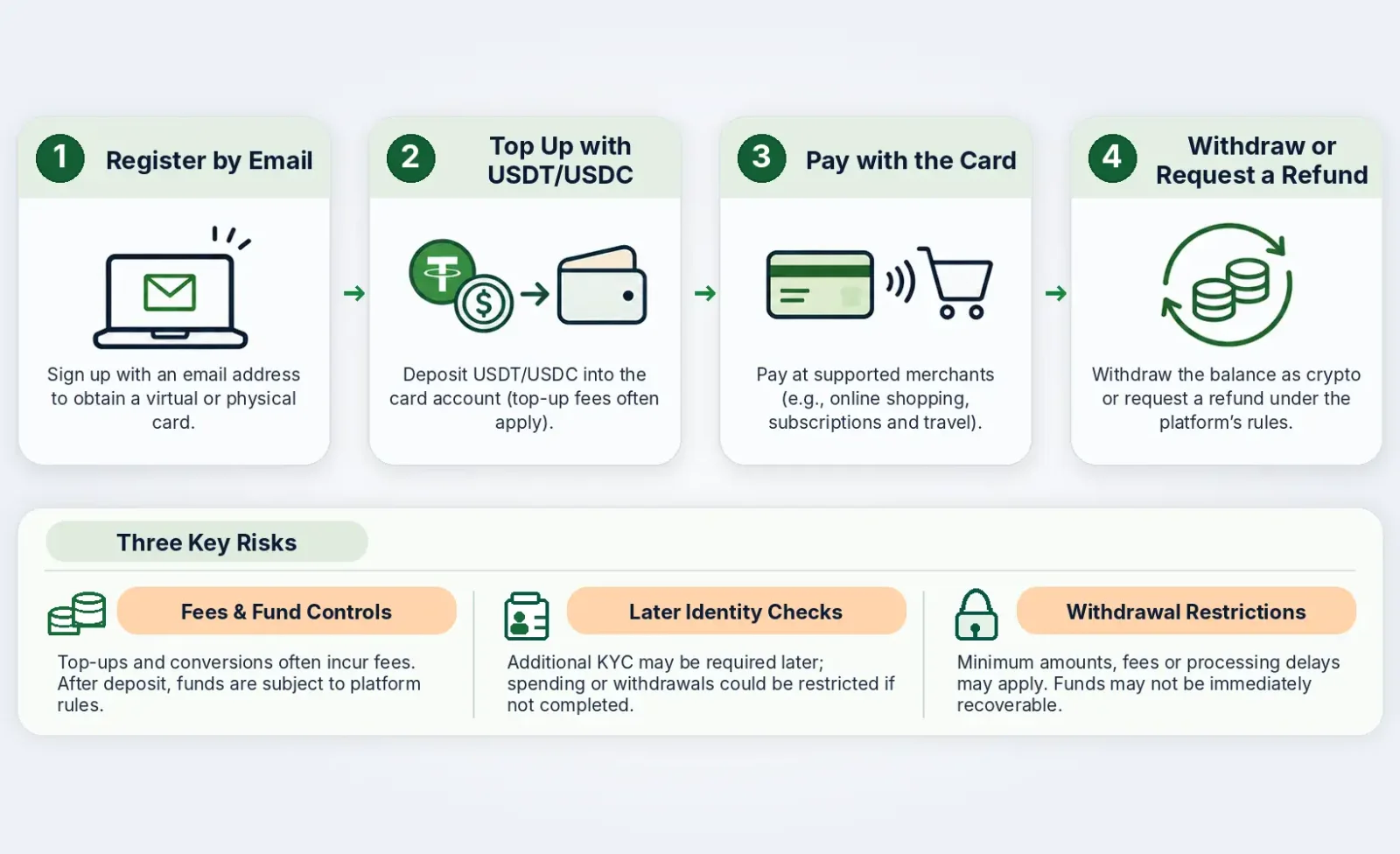
2. SolCard: The Fees and Restrictions Behind ID-Free Card Signup
SolCard offers a concrete example of how these products can be structured.
According to its official fee schedule, SolCard offers its Virtual and Platinum cards under different tiers. The Virtual card uses an email-based signup process without routine identity verification. The Platinum card requires KYC and comes with different fees and usage privileges.
Its published fee schedule, stated to apply from August 15, 2026, shows the following:
Item | Virtual | Platinum |
|---|---|---|
Identity verification | Email-based signup; no routine KYC | KYC required |
Funding fee | 5% | 0% |
New card issuance fee | $10 per card | As displayed at the time of application |
Foreign exchange fee | 1%–2% | 0%–1.5% |
Monthly account maintenance fee | No monthly fee for standard active accounts | No monthly fee for standard active accounts |
For a Virtual card funded with the equivalent of $500, a 5% funding fee would amount to approximately $25. The initial card issuance adds another $10, before accounting for on-chain transfer costs or any exchange-rate spread.
Avoiding routine identity verification therefore comes with product terms that differ from those of Platinum. Users should compare ongoing costs, not just how quickly they can obtain a card.
3. Why Might Identity Verification Be Required After Signup?
International anti-money laundering standards do not require every financial product to use identity checks of identical intensity.
In February 2025, the Financial Action Task Force (FATF) amended its standards to place greater emphasis on proportionality to risk, requiring jurisdictions to permit and encourage simplified measures in lower-risk situations.
This provides a regulatory basis for certain financial services to use simplified due diligence (SDD). It does not authorize unrestricted transactions through anonymous accounts.
The applicable conditions still depend on local law, the obligations of the financial institutions involved, and the customer's risk assessment. There is no globally standardized “KYC-free limit” for crypto payment cards.
See the FATF's February 2025 update to its standards.
In practice, subsequent reviews tend to arise in several circumstances.
Changes in account functionality or transaction volume. An entry-level account may permit only limited funding and online purchases. A provider may require further identity verification when a user requests higher limits, applies for a physical card, uses certain withdrawal features, or changes funding channels.
Financial activity triggers compliance review. On platforms that accept USDT, USDC, and similar assets, the risk profile of blockchain addresses, transaction patterns, source of funds, and sanctions-screening results may all prompt additional checks. The platform may ask users for transaction records, explanations of asset provenance, or proof of control over a wallet.
An on-chain risk flag is not, by itself, proof of illegal activity. False positives, indirect links between addresses, and third-party transactions can affect automated assessments. For legitimate users whose accounts are restricted as a result, clear documentation and appeal procedures matter.
The account does not meet geographic eligibility requirements. A card's ability to make purchases at overseas merchants is not the same as a resident of a particular country being eligible to apply for it.
SolCard's operator, SC PAYMENTS LIMITED, is registered in Hong Kong. However, its Terms of Service expressly exclude Hong Kong residents and individuals or entities located in Hong Kong. The terms also allow the use of IP addresses and other information to enforce geographic restrictions.
A company's place of registration, the jurisdiction where a card is issued, and the countries whose residents may apply are distinct matters. Using a VPN or supplying inaccurate location details does not change a user's actual eligibility.
Basic verification requirements also differ substantially between platforms.
For example, in its identity verification guidance, updated September 14, 2026, Crypto.com requires standard account applicants to provide their legal name, a photograph of a government-issued identity document, and a selfie. The guidance concerns account registration; it is not a separate application agreement for every Crypto.com card program.
SolCard and Crypto.com have different signup requirements, but that difference alone cannot establish which is safer or more compliant. The specific product, applicable jurisdictions, actual card issuer, and customer due diligence arrangements all need to be examined.
Fewer Documents Do Not Mean Anonymous Transactions
No-KYC products may reduce the identity documents required at signup, but they do not eliminate other information generated across the payment chain.
Email addresses, device identifiers, IP addresses, on-chain funding records, and card authorization data—including amounts, merchants, and transaction times—are still processed by the relevant entities.
Self-custody wallets do not guarantee anonymous payments either. Users may control their own private keys, but once an on-chain address is linked to a platform account, exchange records, or card transactions, the associated fund flows can still be traced.
Closing an account also does not mean its records are immediately deleted.
In its data-handling explanation for an earlier version of its service, Gnosis Pay states that certain identity verification and transaction records must continue to be retained after account closure in accordance with applicable requirements.
The example illustrates why submitting identification at signup is only one aspect of privacy. Data protection also depends on what information is collected, how long it is retained, who can access it, and how it is shared with third parties.
4. Getting Funds Out: Contract Terms Matter More Than Easy Signup
Successfully making a first purchase with a No-KYC virtual card says little about whether the card is suitable for holding funds over an extended period.
Suppose a user funds a card with 500 USDT, makes several purchases, and then decides to close the account.
By that point, the funds may have passed through an on-chain transfer, asset conversion, and a credit to the card account. The balance displayed on the card may no longer represent USDT that the user directly controls.
If the product uses a prefunded fiat-denominated card account, the user holds an account balance and associated rights defined by the relevant contracts—not the original digital assets in a personal wallet.
Whether that balance can be withdrawn depends on the account terms.
Can the Remaining Balance Be Returned?
SolCard's Terms of Service allow users to request withdrawal of unused card balances, subject to minimum amounts, supported assets, identity verification, and processing conditions published in the app.
The terms state that when a user confirms card cancellation, any remaining balance below the minimum refundable amount shown in the app will not be returned.
That is a different question from whether the platform offers withdrawals at all.
A product can support withdrawals while still imposing restrictions on minimum withdrawal amounts, supported currencies, review requirements, or the treatment of balances when an account is closed.
Minimum refund thresholds are especially relevant to users making small purchases. Even if the individual amounts are modest, changing cards, canceling subscriptions, or clearing small residual balances over time can leave funds that cannot be withdrawn through the normal process.
The Platform Operator Is Not Necessarily the Card Issuer
SolCard's terms disclose another important business distinction.
SC PAYMENTS LIMITED operates the SolCard platform and manages its card program. Under the terms, however, it is not itself a bank, electronic money institution, or actual card issuer.
The cards are issued by a third-party issuer. The public terms refer to that institution as the “Issuer” without directly identifying it by name.
This distinction matters for users' contractual rights.
A platform may handle registration, funding access, and customer support without being solely responsible for safeguarding funds, processing transactions, or paying out remaining balances.
If a card is suspended, an account is frozen, or a card program ends, users need to know:
Which institution holds unused card-account balances or is responsible for paying them out;
Whether the platform or the issuer handles withdrawals and account closures;
Where users should submit verification materials and formal appeals after an account is restricted;
Whether arrangements exist to return remaining balances if the card issuance program is terminated.
A Visa or Mastercard logo on a card indicates only that the product claims to use the relevant card network. It does not mean user funds are covered by deposit insurance or directly guaranteed by the card network.
Similarly, BIN data may help identify certain issuing details, but it cannot, on its own, establish the full contractual relationship between a platform and its card issuer.
For No-KYC products that require users to fund an account in advance, easier signup is not a sufficient reason to use the product if the actual issuer, the party responsible for the funds, and the balance withdrawal process cannot be verified.
5. When Does Using a No-KYC Crypto Card Make Sense?
No-KYC is not a measure of safety in itself.
If a product clearly discloses its operator, issuing arrangements, geographic eligibility, fees, limits, and balance refund conditions—and provides reasonable procedures for subsequent verification and appeals—a simplified onboarding process can be a legitimate product design choice.
For users who occasionally make small online purchases, do not need a physical card, and do not intend to keep a balance for long, these virtual cards can be convenient. They still need to confirm that their intended merchants accept the card type and that merchant refunds can be returned to the original card account.
Recurring subscriptions, higher-value spending, ATM withdrawals, and international travel create different demands. These activities rely more heavily on long-term card-program stability, the ability to process refunds, transaction dispute procedures, and continued eligibility to use the service. Faster signup cannot compensate for serious weaknesses in those areas.
Before depositing funds, users should have clear answers to at least three questions.
First, what can the account actually do? Does the verification exemption apply to opening the account, funding it, or spending? Are the conditions that trigger later KYC clear? Are funding limits, spending limits, maximum balances, and withdrawal limits stated separately?
Second, how can funds be recovered? Can unused balances be withdrawn? What is the minimum refundable amount? What happens if an account is frozen or verification fails? Are there dormancy fees or additional account-closure conditions?
Third, who is responsible for the funds and card issuance? Can the platform operator, actual issuer, and relevant financial service providers be identified? Is a formal cardholder agreement available, rather than just a marketing page?
If these details cannot be confirmed—particularly when fee schedules, limits, or refund policies contradict one another—it is unwise to deposit a substantial amount first and rely on customer support to resolve the uncertainty afterward.