
What is Rain? The card-issuing infrastructure behind stablecoin cards and the U Card programs it supports
Most consumers rarely interact directly with Rain, but many crypto cards, USD account cards, and corporate spending cards rely on its issuing infrastructure.
Rain does not operate a consumer-facing U Card brand, nor is it a bank or crypto exchange. It primarily serves wallets, exchanges, fintech platforms, and Web3 companies, helping them issue their own branded cards and handle card creation, transaction authorization, stablecoin debits, and settlement through card networks.
Consumers may see products such as ether.fi Cash, Avalanche Card, or KAST Card. The infrastructure provider behind those cards may be Rain.
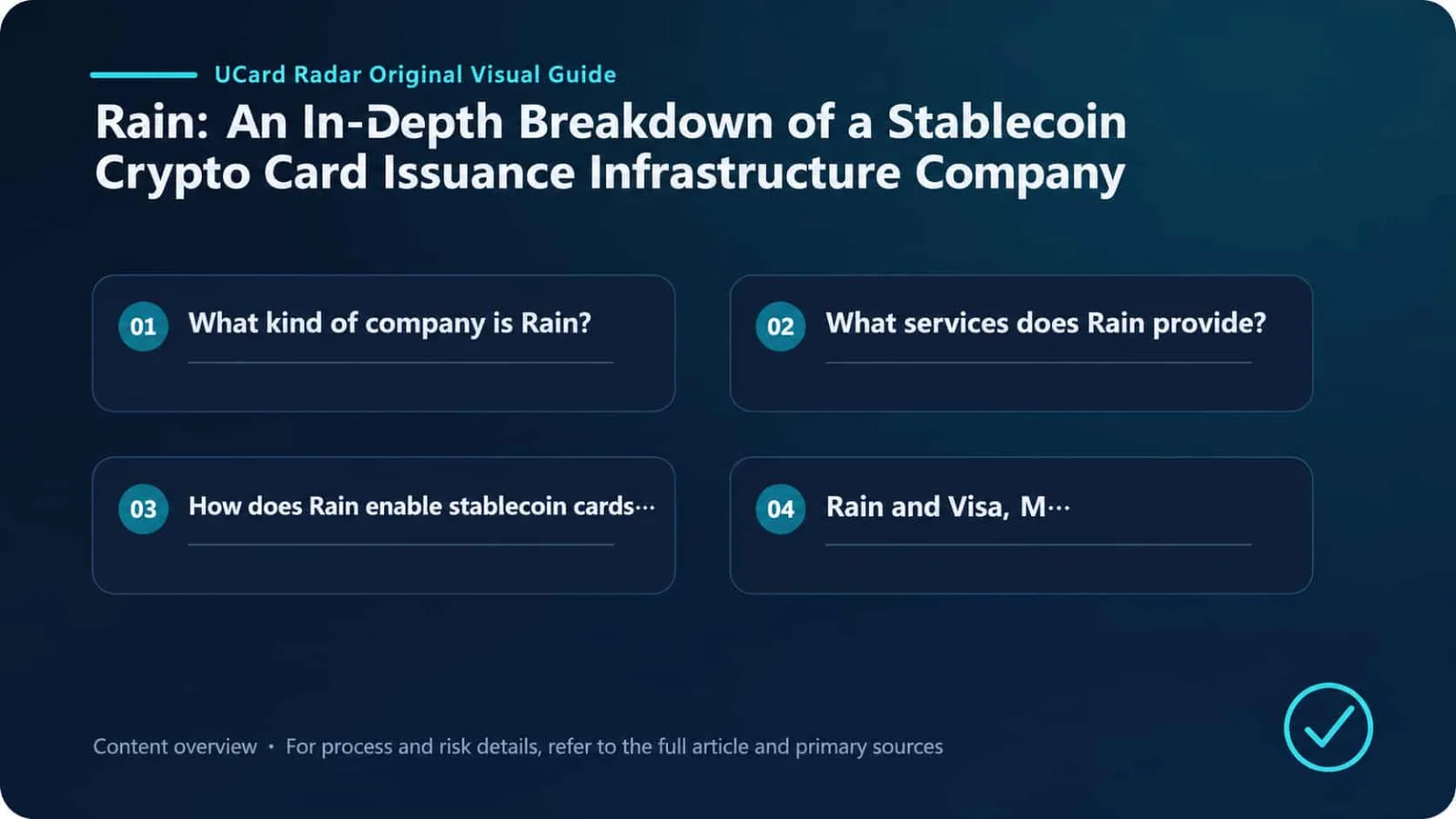
Sources and limits of the conclusions
Primary-source verification: Rain and Visa partner to accelerate onchain credit cards; What it looks like to launch a card program with Rain; Rain expands Visa Membership into Asia-Pacific.
Rain’s official materials describe the company as stablecoin payments and card-issuing infrastructure and disclose a USDC settlement pilot with Visa as well as card-program expansion in Asia-Pacific. These are public company statements. The actual availability, pricing, issuing entity, and safeguards of any specific program remain subject to that program’s contracts and the terms of its licensed partners.
Assessments in this article concerning cost efficiency, project delivery timelines, or the coverage of specific partner cards are analytical. Fees, availability, or revenue that are not explicitly stated in official terms should not be treated as confirmed commitments.
1. What kind of company is Rain?
Rain was founded in 2021 and is headquartered in New York, with offices in Washington, D.C. and Puerto Rico.
The company is led by two co-founders:
Farooq Malik, Chief Executive Officer
Charles Yoo-Naut, Chief Technology Officer
Rain describes itself as an “enterprise-grade stablecoin payments infrastructure provider.” Its customers are primarily fintech companies, digital banks, crypto platforms, and institutions rather than individual cardholders.
From a business-model perspective, Rain can be understood as “Card-as-a-Service + stablecoin settlement infrastructure.” Partner companies can use Rain’s APIs to issue Visa or Mastercard virtual and physical cards while connecting stablecoin wallets, custodial accounts, or fiat accounts to traditional card acceptance networks.
It addresses a practical problem: users may hold stablecoins such as USDC or USDT, but spending still takes place inside the Visa, Mastercard, and banking ecosystem. Rain connects those two financial rails.
2. What services does Rain provide?
Rain combines card issuing, accounts, and movement of funds within a single system. Partner platforms do not need to integrate separately with card processors, wallet providers, and multiple settlement channels.
1. Card issuing
Rain supports prepaid, debit, and credit cards, including both virtual and physical cards.
Partner companies can use these capabilities to:
issue consumer spending cards
create employee and team cards
generate single-use virtual cards
set per-transaction or recurring spending limits
restrict specific merchants or merchant categories
manage card expiration
assign different permissions to employees or AI Agents
freeze, unfreeze, or terminate cards
Card funding can come from stablecoin wallets, custodial accounts, or traditional fiat accounts.
According to information published by Rain, its cards can connect to more than 150 million Visa or Mastercard acceptance locations worldwide. This refers to the theoretical reach of the card networks and does not mean that every card supported by Rain will work at every merchant or in every country. Actual availability still depends on the issuing country, card type, BIN, merchant risk controls, and local regulation.
2. Accounts and wallets
Rain can provide partner platforms with digital dollar accounts, stablecoin wallets, and virtual accounts.
Platforms can choose custodial, non-custodial, or hybrid architectures according to their business needs and use APIs to manage balances, sweep funds, and control account permissions.
The system can also support corporate expense management and AI Agent payments. For example, a company could create a virtual card for a specific Agent with a $100 limit, permission to pay only designated merchants, and an expiration time of 24 hours.
3. Movement of funds
Rain also provides rails between stablecoins and fiat currencies, including:
fiat-to-stablecoin conversion
stablecoin-to-local-fiat conversion
cross-border B2B payments
remittances
merchant settlement
multi-chain routing
Rain has publicly disclosed integrations with blockchain networks including Solana, Tron, and Stellar.
3. How does Rain settle stablecoin card transactions?
Traditional card programs usually need to pre-fund fiat and maintain a certain level of reserves or collateral within banking or card-network systems. Funding and settlement can take several business days.
Rain connects stablecoin rails to Visa and Mastercard networks in an effort to shorten that process.
A transaction roughly follows this path:
Cardholder
↓
U Card brand / wallet / exchange
↓
Rain issuing and payments system
↓
Partner bank or licensed issuer
↓
Visa / Mastercard
↓
Acquirer
↓
Merchant
After the cardholder pays, the merchant still sees a conventional card transaction. The merchant does not need a crypto wallet and does not need to accept USDC directly. Stablecoin debiting, conversion, and settlement take place between the card platform, Rain, partner financial institutions, and the card network.
Rain has worked with Visa on stablecoin settlement, allowing assets such as USDC to be used in routine settlement. Compared with models that rely entirely on banking business days, stablecoin rails can shorten some funding delays and may reduce the amount of fiat collateral that a card program needs to keep locked up for long periods.
This does not mean that every time a consumer swipes a card, Rain sends stablecoins directly to the merchant. The merchant still receives funds processed through the conventional card network.
4. What is the relationship between Rain, Visa, and Mastercard?
Rain has obtained Visa Principal Membership and announced in 2026 that it had become a Mastercard Principal Member.
Principal membership gives Rain more direct access to card-network infrastructure and allows it to participate in card-program design, issuance management, and transaction processing. For partner companies, access to both Visa and Mastercard also increases the range of choices across card networks, issuing regions, and product types.
However, principal membership is not a universal “license to issue cards anywhere in the world.”
Whether a card program can launch still depends on:
the issuing country and the user’s location
local partner banks or licensed institutions
Visa or Mastercard program approval
KYC, KYB, AML, and sanctions-screening requirements
whether the card is prepaid, debit, or credit
how user funds are custodied and converted
local regulation of stablecoins, credit, and card activity
As a result, two cards that both say “Powered by Rain” may use different issuers, BINs, user agreements, and funding structures.
5. Rain is not a bank
Rain is a fintech and payments infrastructure company. It is not a bank or crypto exchange, and it is not necessarily the final custodian of user funds.
Actual card and banking services must be provided by partner banks or other licensed institutions. For some U.S. programs, Rain states that cards are issued by Third National pursuant to Visa licensing. Other markets may use different licensed entities.
Seeing “Rain-issued” or “Powered by Rain” confirms that Rain participates in the program, but it does not mean that Rain is necessarily the legal issuing bank named in the cardholder agreement.
Rain’s role also varies by program and may include:
card creation and lifecycle management
BIN or card-network access
transaction authorization and routing
stablecoin balance debiting
Visa and Mastercard settlement
KYC, KYB, or transaction-monitoring interfaces
wallet and account systems
corporate spending controls
To understand the legal relationship behind a card platform, users still need to review the user agreement, cardholder agreement, and issuing terms.
6. Rain’s growth and funding history
Time | Event |
|---|---|
2021 | Rain founded |
2022 | Raised approximately $6 million in a seed round led by Lightspeed |
2024 | Partnered with companies including Nuvei to expand stablecoin payments in Latin America |
March 2025 | Raised approximately $24.5 million in a Series A led by Norwest; became a Visa Principal Member and launched a stablecoin settlement pilot |
August 2025 | Raised $58 million in a Series B led by Sapphire Ventures |
November 2025 | Acquired onchain rewards platform Uptop |
Late 2025 | Acquired Fern, adding multi-chain routing, compliance, and fiat on/off-ramp capabilities |
January 2026 | Raised $250 million in a Series C led by ICONIQ, reaching a valuation of $1.95 billion |
Around May 2026 | Announced that it had become a Mastercard Principal Member |
Based on publicly disclosed financing data, Rain has raised more than $338 million in total. Disclosed investors include:
ICONIQ Capital
Sapphire Ventures
Lightspeed Venture Partners
Norwest Venture Partners
Dragonfly
Galaxy Ventures
Bessemer Venture Partners
FirstMark
Coinbase Ventures
Circle Ventures
Khosla Ventures
7. Which crypto cards use Rain?
According to Rain’s website, the company now serves more than 200 partners. However, most white-label programs do not publicly disclose their underlying issuing infrastructure provider.
The list below includes only programs that can be confirmed through Rain, the card brand, or related official announcements.
1. Consumer crypto cards
Card | Rain’s role | Product characteristics |
|---|---|---|
ether.fi Cash | Credit-card issuing and stablecoin settlement infrastructure | Non-custodial crypto-collateralized credit card with spending rewards |
Card issuing and Visa payment infrastructure | Supports USDC, USDT, WAVAX, and sAVAX; primarily targeted at Latin America and the Caribbean | |
KAST Cards | Global card issuing and stablecoin settlement infrastructure | Includes Standard, Premium, and Private card tiers |
Spritz Card | Credit-card issuing infrastructure | Visa Signature crypto-collateralized credit card that can be funded from onchain wallets |
Exa App Card | Virtual Visa issuing and settlement infrastructure | Users collateralize ETH, borrow USDC, and then spend through the card in installments |
NAKA+ Visa Platinum Card | Issuing engine and compliance infrastructure | Self-custodial virtual Visa Platinum card for Latin American markets |
Lydian Card | Visa issuing and stablecoin payments infrastructure | Offers virtual and physical cards and supports stablecoins and other digital assets |
Rizon Card | Card issuing, transaction routing, and onchain settlement | Uses USDC balances for cross-border Visa spending |
Offramp Card | Card-issuing infrastructure | Targets Latin America and other emerging markets and supports spending from stablecoin balances |
Qash Visa Credit Card | Issuing infrastructure provided together with Visa | Blockchain-based Visa credit card for Colombia and the Andean region |
Meru Visa Card | Visa issuing infrastructure | Aimed at freelancers, creators, and remote workers in Latin America |
TakeCard | Card issuing and payments infrastructure | Launched by Takenos; supports crypto funding and international subscription payments |
Zar Card | Visa issuing infrastructure | Allows users to spend stablecoins received in their wallet through a Visa card |
FRNT Card | Visa card platform | Designed to work with Wyoming’s Frontier Stable Token and supports physical cards, Apple Pay, and Google Pay |
2. USD account and remote-worker cards
Card | Rain’s role | Product characteristics |
|---|---|---|
Wallbit Visa Platinum Card | Visa issuing infrastructure | Designed for remote workers in markets including Argentina, Colombia, and Mexico |
Cadana Virtual USD Card | Virtual-card issuing and management | Serves remote employees, freelancers, and companies in emerging markets |
Slash GlobalUSD Card | International USD account-card infrastructure | Non-U.S. companies can spend GlobalUSD balances globally |
Whop Cards | Global card issuing and stablecoin settlement | Whop merchants can spend platform earnings directly without first withdrawing to an external bank |
3. Corporate and institutional cards
Card | Rain’s role | Product characteristics |
|---|---|---|
Dakota Corporate Cards | B2B issuing, fund movement, and settlement infrastructure | Companies can issue physical and virtual team cards; transaction infrastructure is built on Base |
MPCVault Card | Corporate Visa card infrastructure | Companies can spend USDC through non-custodial MPC wallets, with multi-user support and separate limits |
Klutch Credit Card | Issuing, authorization, and stablecoin settlement infrastructure | Supports merchant locking, single-use card numbers, spending rules, and automated Mini Apps |
4. AI Agent payment cards
Card | Rain’s role | Product characteristics |
|---|---|---|
Sponge Agent Cards | Restricted-use virtual-card infrastructure | Uses user stablecoin balances while setting limits by amount, merchant, and expiration for AI Agents |
Confirmed programs currently include at least:
ether.fi Cash, Avalanche Card, KAST Cards, Spritz Card, Exa Card, NAKA+, Lydian Card, Rizon Card, Offramp Card, Qash Card, Meru Card, TakeCard, Zar Card, FRNT Card, Wallbit Card, Cadana Card, Slash GlobalUSD Card, Whop Cards, Dakota Corporate Cards, MPCVault Card, Klutch Card, and Sponge Agent Cards.
This is not a complete customer list for Rain. White-label relationships, commercial confidentiality, and regional licensing all affect how much of the partnership structure becomes public.
8. How much does Rain charge for card issuing?
Rain does not publish a single standard price for a complete Card Program. Companies that want to issue branded cards to external users must submit business information to Rain and obtain a customized quote.
Before evaluating costs, it is important to distinguish between two types of Rain products.
Product | Use case | Pricing model |
|---|---|---|
Corporate Cards / Rain Spend | Issue cards to a company’s own employees or teams | Public plans available |
Full Card Program | Issue branded cards to external customers | Custom enterprise pricing |
These two products should not be treated as the same thing.
Corporate Cards are an internal expense-management tool. A full Card Program is the infrastructure that an exchange, wallet, or U Card platform would use to issue cards to its own customers.
1. Public pricing for Corporate Cards
Rain’s published corporate-card plans include:
Plan | Price | Card limits and scope |
|---|---|---|
Starter Plan | $0/month | Up to 10 physical cards and 20 virtual cards; U.S. teams only |
Unlimited Plan | $7,500/year | No fixed card limit, lower rates, and support for global teams |
These plans are designed for managing employee spending and should not be used directly to estimate the cost of launching a customer-facing card program.
2. How is a full Card Program priced?
Issuing a branded card to external users normally requires a customized contract. Commercial terms are typically based on:
platform and program-management fees
contract term
minimum card volume or minimum transaction volume
transaction-processing fees
physical-card manufacturing and delivery costs
compliance scope
Interchange revenue sharing
Differences between quotes are often not limited to “how much you pay per month.” They also include how much Interchange revenue the partner is allowed to retain.
Lower-entry-cost plans may require less upfront investment but provide the partner with a smaller share of transaction revenue. Accepting higher minimum transaction commitments or signing a longer-term contract may make it possible to negotiate better revenue-sharing terms.
Specific terms remain subject to the formal quote and contract provided by Rain.
3. What costs can a full card program involve?
The items below are common cost categories in enterprise card-issuing programs. They are not an official unified Rain price list.
Fee | Billing method | Purpose |
|---|---|---|
Program setup fee | One-time | Program design, compliance assessment, API integration, card configuration, and testing |
Platform fee | Monthly or annual | Access to issuing, account, transaction-control, and settlement systems |
Virtual-card issuance fee | Per card | Create and maintain virtual cards |
Physical-card fee | Per card | Manufacturing, personalization, packaging, and delivery |
Transaction-processing fee | Fixed, percentage-based, or blended | Authorization, clearing, settlement, and cross-border processing |
Chargeback and refund fee | Per case | Handle disputes, refunds, and chargebacks |
Compliance fee | Per user, region, or program | KYC, KYB, sanctions screening, and transaction monitoring |
Wallet and on/off-ramp fees | Usage-based | Stablecoin wallets, fiat on-ramp, and fiat off-ramp |
Minimum volume commitment | Contractual | Additional charges may apply if agreed transaction volume is not reached |
Physical-card programs are generally more expensive than purely virtual-card programs. Custom card artwork, premium materials, independent packaging, and cross-border delivery can all increase both cost and preparation time.
9. How much budget is needed to launch a Rain card program?
Rain does not publish a standard launch price for a full program. The ranges below are only early-stage budgeting references and should not be interpreted as a Rain quote.
Program stage | Reference budget | Typical use |
|---|---|---|
Small-scale test or MVP | $30,000–$80,000 | Validate the system and fund flows while initially issuing hundreds to a few thousand cards |
Full commercial launch | $100,000–$250,000+ | Includes program integration and basic operating costs for the first 6–12 months |
Large-scale operation | Negotiated based on transaction volume and contract | Cost depends on transaction scale, market coverage, and revenue-sharing terms |
These figures are industry cost estimates derived from comparable Card-as-a-Service programs and are not official prices published by Rain.
Program budgets are influenced by factors such as:
expected monthly and annual transaction volume
number of users and cards issued
ratio of virtual to physical cards
whether custom card artwork and packaging are required
target markets and issuing countries
KYC, KYB, and transaction-monitoring scope
whether the product uses prepaid, debit, or credit cards
whether funds are managed by Rain, a partner institution, or the platform itself
whether wallet, fiat on-ramp, and fiat off-ramp services are needed
whether multi-chain support is required
contract duration and minimum transaction commitments
Transaction volume is usually one of the most important variables in commercial negotiations. The greater the volume, the more likely a platform is to negotiate lower processing fees and a higher share of Interchange.
10. What is Interchange?
Interchange Fee is the portion of card-acceptance economics commonly referred to as the interchange fee.
After a user pays by card, the merchant’s payment fee is distributed among the acquirer, card network, and issuer. The portion that flows to the issuer is Interchange. It is one of the main revenue sources in card issuing.
Using a $100 purchase as an example:
The user pays $100 at the merchant.
The merchant does not necessarily receive the full $100.
Fees are deducted across the acquiring, card-network, and issuing layers.
Part of the issuer’s revenue comes from Interchange.
If the card is issued through a partnership between the platform and Rain, the resulting revenue is distributed according to the contract.
If the merchant’s total payment cost is 1.5%–2.5%, that amount does not all go to the issuer. The acquirer, payment processor, Visa or Mastercard, and issuing institution all participate in the economics. How much the card platform ultimately receives depends on the issuing region, card type, merchant category, and commercial agreement.
Therefore, platform revenue cannot be calculated simply as “purchase amount × merchant total fee rate.”
Why do card platforms care about Interchange?
For many issuing programs, Interchange is one of the principal sources of revenue.
Platform revenue broadly depends on two variables:
how many eligible transactions users generate
how much of the Interchange share the platform is allowed to retain
This also explains why issuing platforms care about active users, monthly transaction volume, and spending use cases. A card that has been opened but remains inactive for long periods produces no ongoing Interchange revenue while still potentially generating account, compliance, and system-maintenance costs.
Rain’s commercial contracts therefore need to balance two sets of terms: program fees, platform fees, and minimum transaction commitments on one side, and the partner’s share of Interchange on the other.
11. What should you confirm with sales before integrating Rain?
Simply asking “How much does it cost to issue one card?” usually does not produce a useful answer. A complete quote needs to be broken down and checked item by item. Companies should confirm the following with Rain:
Program eligibility
whether companies incorporated in the current jurisdiction are accepted
whether cards can be issued to users in the target countries
which Visa or Mastercard card types are supported
minimum expected user count or transaction-volume requirements
whether crypto platforms, wallets, or stablecoin businesses are accepted
Legal and compliance
who the legal card issuer is
which BIN and issuing country are used
who performs KYC and KYB
who custodies user funds
who converts stablecoins into fiat
whether the platform itself requires a local license
how responsibility for sanctions screening and transaction monitoring is divided
Fees
one-time setup fee
monthly or annual platform fee
minimum monthly spend or transaction volume
fee per virtual and physical card
transaction authorization, cross-border, and FX fees
refund, chargeback, and dispute-handling fees
wallet, deposit, and withdrawal fees
make-up fees if minimum transaction volume is not met
Revenue sharing
how Interchange is calculated
which transactions do not generate revenue share
whether revenue share varies by merchant category
how Rain, the issuer, and the card platform divide revenue
revenue-share settlement cycle
how refunds and chargebacks reduce revenue
Technology and delivery
API integration timeline
whether the sandbox or test environment is charged
earliest possible launch date for virtual cards
design, production, and delivery timeline for physical cards
whether Apple Pay and Google Pay are supported
whether Webhooks, transaction controls, and real-time authorization APIs are provided
how user balances and existing cards are handled after the partnership ends
12. How should “Powered by Rain” be interpreted?
“Powered by Rain” confirms that Rain participates in the program, but the phrase by itself does not explain the full issuing relationship.
For ordinary users, the points that are really worth verifying are:
the legal card issuer
the Visa or Mastercard BIN
the custodian of user funds
the entity converting stablecoins
applicable countries and regions
responsibility for freezes, chargebacks, and settlement
how balances are handled if the platform stops operating
Rain addresses the infrastructure problem of moving stablecoins into traditional card-payment networks. Whether an individual card is safe and stable still depends on the brand operator, licensed issuer, fund-custody structure, user agreement, and local regulation.
So Rain is an important participant in the issuing chain, but it is not the entire chain. Seeing the Rain, Visa, or Mastercard logo can provide one clue about a program’s structure, but it cannot replace reviewing issuing terms and fund-safety arrangements.
What is Rain? The card-issuing infrastructure behind stablecoin cards and the U Card programs it supports
Most consumers rarely interact directly with Rain, but many crypto cards, USD account cards, and corporate spending cards rely on its issuing infrastructure.
Rain does not operate a consumer-facing U Card brand, nor is it a bank or crypto exchange. It primarily serves wallets, exchanges, fintech platforms, and Web3 companies, helping them issue their own branded cards and handle card creation, transaction authorization, stablecoin debits, and settlement through card networks.
Consumers may see products such as ether.fi Cash, Avalanche Card, or KAST Card. The infrastructure provider behind those cards may be Rain.